
Jun 11
Leveraging Knowledge Graphs for Disrupting Criminal Networks
This presentation proposes a three-step process that utilises knowledge graphs to empower law enforcement agencies in criminal intelligence gathering and criminal network analysis. The approach tackles the challenge of siloed data hindering effective crime investigation.
Step 1: Transitioning to Holistic Intelligence Data
The paper acknowledges the data analysis hurdle faced by law enforcement due to disparate data sources. It proposes transitioning to a knowledge graph to unify these sources and create a holistic view of criminal intelligence data. The knowledge graph collates structured and unstructured data - internal to police forces and from open source data (ex. OSINT) - and resolve entities. This step also leverages LLMs to properly convert text in organised knowledge.
Step 2: From Search to Exploration in Criminal Intelligence
The second step advocates for leveraging the knowledge graph's ability to explore data connections. This enables analysts to navigate connections among people and events, fostering deeper investigative insights compared to traditional search methods. Graphs facilitate this task in terms of speed and understandability.
Step 3: From Analytics to Predictive Policing
Finally, the presentation explores how knowledge graphs can be used for predictive policing. By analysing patterns within the graph, the approach helps identify potential criminal activity and key network players. Also, it allows to reveal hidden connections and to relate crimes to potential offenders empowering modern suspect nomination and risk assessment functions. The predictions provided are fully explainable to guarantee transparency in police operations.
Overall Benefit
The presentation positions knowledge graphs as a transformative tool for criminal intelligence, aiding disruption of criminal networks regardless their size and structure, improved decision-making, and ultimately, enhanced public safety.
youtube.com/watch?v=QcWsGQeI…
--
Alessandro Negro. Chief Scientist, GraphAware
Alessandro Negro is a Chief Scientist at GraphAware. He holds a Ph.D. in Computer Science and has authored several publications on graph-based machine learning.
--
Welcome to Connected Data London's #ThrowbackThursday
Every Thursday at 3pm GMT, we are releasing gems from our vault on #YouTube
Tune in and learn from leaders and innovators; subscribe to our channel and watch premieres as they are released!
#knowledgegraph #graphdatabase #graph #AI #datascience #analytics #semtech #ontology
6
224

Jun 11
Raw on-chain data provides an "anonymous skeleton"—we see connections, but we lack context. 🤔 BlockSec uses #NebulaGraph labeling to turn it into a living "Risk Network." 🕸️
👉 Learn how BlockSec built their #RiskControl system:
na2.hubs.ly/H060ZKw0
#GraphDatabase #Crypto
37
Jun 9
Siloed data = High MTTR. 🚧 BOSS Zhipin built a unified dependency graph using #NebulaGraph and transformed their O&M from reactive firefighting to proactive, intelligent analysis. 🚀
👉 Build your intelligent O&M system: na2.hubs.ly/H05XmGv0
#GraphDatabase #AIOps #DevOps
31
Jun 8
When your business runs on relationships, traditional queries simply can’t see the forest for the trees.🔍 #GraphAlgorithms analyze the shape and flow of your data network, uncovering patterns invisible to standard databases. 🔗na2.hubs.ly/H05Xs9n0
#GraphDatabase #NebulaGraph
10
1,023
The Ultimate Guide to Semantic Reasoning: How to enrich your data for practical applications including use with RAG & LLMs
Semantic reasoning is fast becoming a must-have for anyone running a knowledge graph application as a route to better data, faster queries, and ultimately greater insights. With ever-improving technology, these benefits are no longer for an exclusive few and are instead widely accessible, and yet, many in the industry still lack the knowledge and understanding to fully capture the power of reasoning.
Join this Ultimate Guide to Semantic Reasoning to learn the best practices of rule writing and how to use it to supercharge applications. Use the W3C standard, OWL, for ontological reasoning, and the widely used Datalog for more advanced functionality such as aggregation, negation, and filtering to build a working solution live in the workshop.
Discover how this enriched data, coupled with the advanced automation feature of incremental reasoning, is enabling real-world applications, including how to enhance RAG and LLM-based solutions.
Key Topics
Semantic Reasoning & Rules-based AI
Knowledge Graphs
Querying Graph Databases
Writing Rules
Writing Ontologies
Target Audience
Knowledge Engineers
Data Scientists
Data Engineering
Data Analysts
Managers of the above
Aimed at a spectrum of users, from the non-technical to technically minded but unfamiliar. We cover the basics so that everyone has the tools to follow along with the rest of the tutorial but move quickly onto the more advanced sections. Experts in the field will not find this useful.
Goals
Get hands-on experience using Semantic Reasoning and Knowledge Graphs in order to understand the extent to which it can be used to empower real-world use cases.
Session outline:
In this Masterclass, attendees will learn what reasoning is, what it can to do transform data, and crucially, how to do that themselves and how it supports real-world applications.
After a brief theoretical introduction to the subject, attendees will be expected to get hands-on with a reasoning engine in order to learn how to setup a reasoning-ready datastore, and how to reason over it using OWL and Datalog rules.
No prior experience is required as we will run through the process step-by-step, from start to finish. Over the course of the tutorial attendees will learn:
How to write and run a SPARQL query
The importance of reasoning and its application
How to write a Datalog rule
How to apply and verify the rules they write
The extended opportunities with reasoning
How to create a solution that relies on reasoning
How to achieve RAG (Retrieval-Augmented Generation) with enriched data, KGs and LLMs
Format
This class is very hands-on. Each topic will first be demonstrated to the students so they can copy an ideal example and see the intended results in an informal teacher-student format.
Then they will be given the opportunity to apply their new learned skills without immediate direction, writing rules and queries by themselves.
If at any point a participant requires some assistance, the lecturers will be on hand to help, whether that requires a minor hint, a refresh of the material, or gentle guidance.
Anyone of any skill level should leave this class knowing what reasoning is and how to implement it, so individual support is flexible depending on the needs of the group.
Level
Beginner - Intermediate
Prerequisite Knowledge
None
youtube.com/watch?v=s7iAsR1Z…
--
Peter Crocker. Co-founder, CEO, Oxford Semantic Technologies
Peter Crocker is the co-founder and CEO of Oxford Semantic Technologies (OST), developers of the industry-leading knowledge graph and reasoner RDFox.
Tom Vout. Knowledge Engineer, Oxford Semantic Technologies
Tom help OST transform data into actionable insights using semantic reasoning and knowledge representation technologies
--
Welcome to Connected Data London's #ThrowbackThursday
Every Thursday at 3pm GMT, we are releasing gems from our vault on #YouTube
Tune in and learn from leaders and innovators; subscribe to our channel and watch premieres as they are released!
#knowledgegraph #graphdatabase #graph #AI #datascience #analytics #semtech #ontology
1
2
10
657
May 29
#NebulaGraph emerged as the victor by offering a perfect balance of high-speed data import and low-latency query performance.🚀
With NebulaGraph powering the core, Akulaku deployed a sophisticated real-time anti-fraud platform: na2.hubs.ly/H05Kmg00
#GraphDatabase #RiskControl
88
111
May 28
High concurrency, low latency, zero compromise.🚀
By leveraging #NebulaGraph Enterprise’s distributed architecture, EasyCash achieved sub-8 millisecond query latency even under 300 concurrent requests: na2.hubs.ly/H05JR_00
#GraphDatabase #FraudDetection #RiskControl #Fintech
82
144
May 28
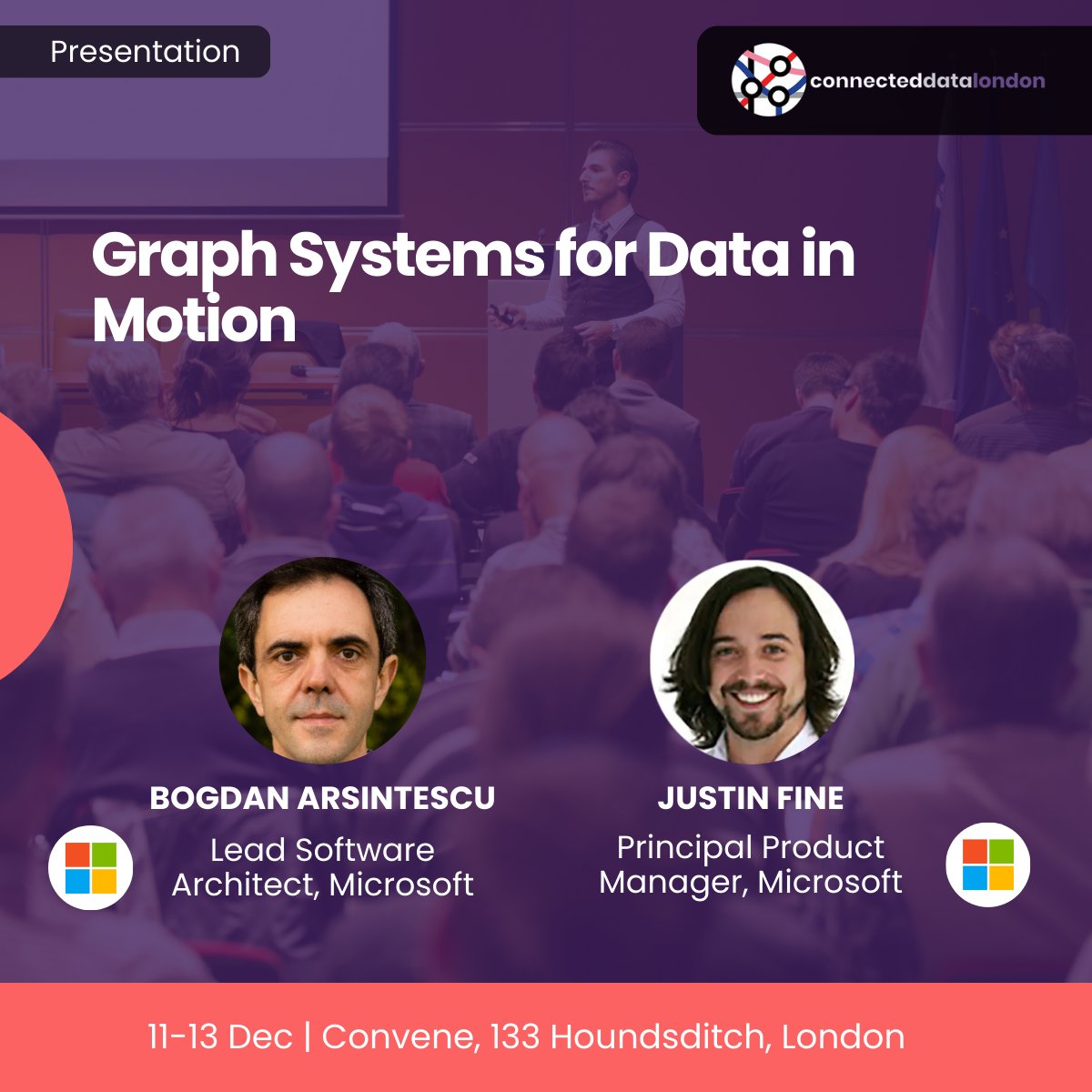
Graph Systems for Data in Motion
Enterprises employ Graphs systems (as property graphs, Knowledge Graphs, etc) to model business logic semantic and gather insights from their entire estate. Sources of truth are generally silos and business insight requires traversal though multiple of these silos to gather insight for scenarios like Customer 360, logistics, security, etc. Graph systems are the emerging technologies to achieve that.
Data is continuously evolving in multiple ways: schema is changing and new columns or details are augmented to existing sources of truth; entire new datasets are enhancing the business logic; data itself is continuously augmented and is streaming in continuously. Analytics systems deal, in general with data at rest while in real world enterprise have data in motion.
Graph system achieve their latency and richness through indexing and/or de-normalization for fast traversal. In order to minimize the cost of such techniques, the tradeoffs is to silo the analysis most of the time but still bring the “whole” graph together when needed.
We are proposing a framework to handle the realities of data in motion using graph systems. These are generic techniques anyone can employ and model over their existing systems; our product blueprint will incorporate this framework into its roadmap. The framework is built on the following principles:
The graph model is defining the graph schema and semantic, but the indexing should be lazily built to optimize the cost. We strongly believe that graphs are valuable and accepted as indices, an overlay that is not requiring changes to sources of truth in the enterprise
Models should be hierarchical to be able to compose semantic from multiple sources, allowing either localized use of smaller graphs or global views that span over multiple graphs. Users could further project or extend these models as they need. Enterprises will be able to deploy stable semantics and users can still experiment and avoid rigid schemas.
Systems that allow accretive schema and data changes allow real-time updates to these graphs.
We provide examples through a fictional graph scenario that the audience could relate to; we show these techniques can be used to handle exabyte size streaming data estates in a cost effective manner.
youtube.com/watch?v=9FJ6xk4N…
--
Bogdan Arsintescu. Lead Software Architect, Microsoft
Justin Fine. Principal Product Manager, Microsoft
--
Welcome to Connected Data London's #ThrowbackThursday
Every Thursday at 3pm GMT, we are releasing gems from our vault on #YouTube
Tune in and learn from leaders and innovators; subscribe to our channel and watch premieres as they are released!
#knowledgegraph #graphdatabase #graph #AI #datascience #analytics #semtech #ontology
1
3
172
May 28
By allowing multiple tenants to share the same underlying hardware and software, #NebulaGraph drastically cuts down on operational and maintenance costs: na2.hubs.ly/H05JS0H0
#GraphDatabase #NebulaGraph #Architecture
1
69
87
May 25
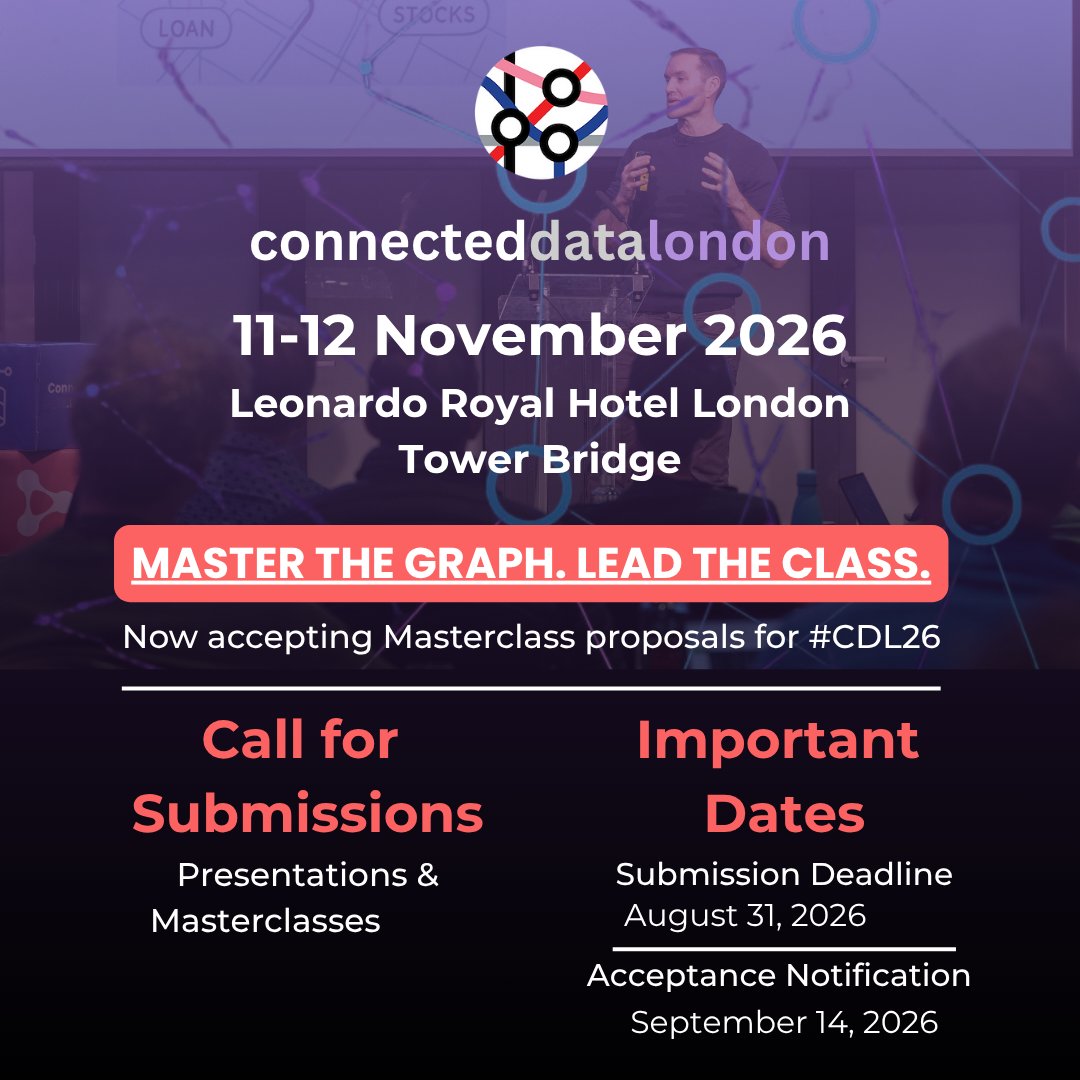
Wanted: Masterclass Instructors for #CDL26. 🛠️
At Connected Data London, we don’t just talk about the future - we build it. Our 2-hour Masterclasses are designed to give attendees practical, hands-on skills they can use in their daily work immediately.
We are looking for experts to lead deep-dive tutorials on:
Graph Engineering: Persistence strategies, triple stores vs LPGs, and scaling.
AI Implementation: Building GraphRAG pipelines, fine-tuning LLMs with KGs, or agentic workflows.
Data Modelling: Advanced ontology design, SHACL validation, and semantic layers.
Why lead a Masterclass?
Beyond the prestige of the CDL stage, you’ll have the opportunity to engage deeply with a technical audience hungry for real-world skills.
📝 Submit your Masterclass proposal: connected-data.london/2026-c…
#CDL26 #ConnectedData #KnowledgeGraphs #DataScience #AI #GraphDB #Masterclass #GraphDatabase #DataEngineering #AIWorkshops
3
205
May 22
By combining the Ontology with the Graph Databases, we move beyond simple chatbots. 🤖 We explore why adding a semantic layer (Ontology) on top of your data is the key to unlocking AI's true potential. 🚀
👉 na2.hubs.ly/H05Dr8h0
#Ontology #AI #GraphDatabase #NebulaGraph #LLM
1
88
100
May 22
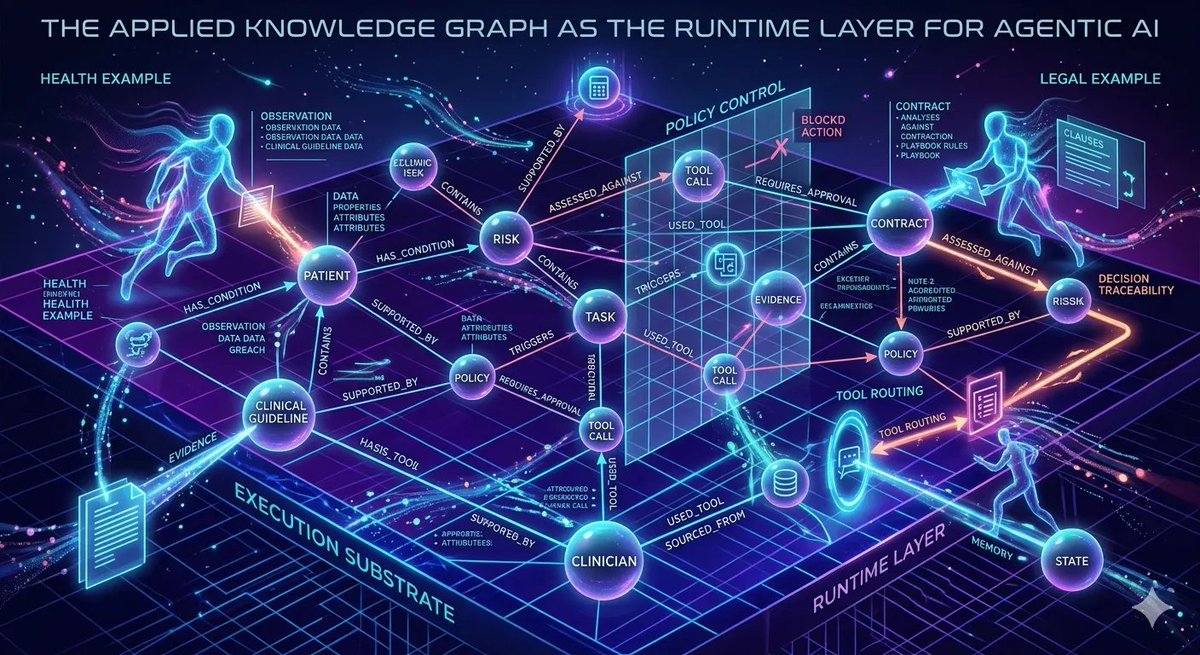
The Applied Knowledge Graph as the Runtime Layer for Agentic AI
Applied Knowledge Graphs transform how agents act in professional workflows. Unlike traditional KGs that describe a domain, an AKG connects knowledge directly to work. It's the operating layer agents need: holding explicit state, structuring memory, grounding decisions in evidence, routing tools intelligently, making policy operational, and recording every decision with full traceability.
The shift matters. An AKG captures not just Patient, Condition, Medication, but also AgentRun, ToolCall, PolicyCheck, and Decision. It's the foundation for health systems where an agent supports clinical pathways with accountability, and legal workflows where contract reviews are connected to playbook rules, deal context, and precedent.
Why Labelled Property Graphs? They're flexible enough for evolving domains, expressive enough for rich relationships with attributes on both nodes and edges, fast enough for operational traversal, and practical enough for agent workflows. LPGs are also schema-optional, which means they grow incrementally as new tasks, entities, and relationships become important. This is critical for applied AI where the model rarely starts perfect.
The practical benefits compound. Agents work with structured context instead of relying only on prompt text. State becomes explicit and queryable, so clinicians can see why a task was created without reading transcripts. Grounding improves because outputs and actions link to evidence, source versions, policy rules, and tool results. Tool use becomes governable instead of invisible. Memory becomes selective and connected rather than a flat summary. Governance and traceability turn from audit challenges into system design.
GraphRAG was a step forward for retrieval. Agentic GraphRAG goes further. The AKG answers deeper questions: What is the task state? What does the agent already know? Which evidence applies? Which tools are allowed? Which policies are required? It helps before generation by selecting context, during action by guiding tools and policies, and after by recording evidence and outcomes.
The stronger next move isn't treating KGs as static knowledge repositories. It's operationalizing them as runtime layers for agents that need context, evidence, control, and accountability. RDF remains important for interoperability and formal reasoning.
But a knowledge graph doesn't have to be RDF-only. LPGs provide a strong foundation for applied systems, and hybrid approaches can combine LPG performance with RDF interoperability where needed.
For health, legal, and professional domains: the challenge isn't fluent output anymore. It's whether agents can act with context, evidence, control, and traceability. That's the AKG.
By Sergey Vasiliev
sergeyvasiliev.substack.com/…
#AppliedKnowledgeGraph #AgenticAI #GraphDatabase #KnowledgeGraph #RuntimeArchitecture
--
Connected Data London 2026 | 11–12 November | Leonardo Royal Hotel London Tower Bridge
🎤 Share your work with the world's most passionate data community. The Call for Submissions is open. connected-data.london/2026-c…
🎟 Tickets on sale now. Early bird discounts up to 30%. 2026.connected-data.london
📺 Sponsorship opportunities available. Contact info@connected-data.london for details.
#KnowledgeGraph #GraphRAG #Ontology #Graph #AI #DataScience #GraphDB #SemTech
4
13
602
May 21
A Polyglot Domain Model Library: narrowing the gap between Semantics Engineers, Domain and Standardization Experts, and Software Developers
Developing and maintaining Domain Models of various kinds – both formal OWL-based ones as well as models based on a proprietary formalism - has become a well-established process in many parts of the manufacturing industry.
However, the uptake of these Domain Models among Software Developers – in the sense of a structured approach to letting these models formally inform software code and interfaces - is slow.
This results in the data which software systems produce, not being readily available for querying or reasoning in Knowledge Graph applications, and thus leads to an extensive need for complicated mappings and – on an organizational level - a continued hesitation towards the adoption of Knowledge Graphs.
Equally, there is regularly a disconnect between Domain Experts developing and maintaining standards and norms about their field of knowledge on the one hand, and the expression of that knowledge in formal ontologies, leading to the fact that industry standards which typically are written in natural language, i.e. in linear text, or proprietary formalisms, need to be translated by a Semantics Engineer into a formal ontology in order to make them available to Knowledge Graph-applications.
These processes are notoriously slow and tedious, as Semantics Engineers typically lack the in depth-knowledge of a given domain that is necessary to cover it correctly and in every detail in an ontology.
Finally, the manufacturing industry is characterized by a large heterogeneity of standards and norms that govern the way data is expressed, exchanged, and reviewed for compliance, further stressing the necessity of turning the process of representing standards and norms as formal Domain Models into a centrally available, streamlined service.
Assuming that each of the involved groups of professionals act as they do out of reasons that make sense in the context of the constraints of their work:
* the need for ready-made code libraries and data contracts that are easy to implement;
* the need to focus on the domain rather on the grammar of formal semantics;
* the need for fully expressive ontologies in order to support the rich potential of Knowledge Graphs –
We are currently developing an approach that intends to narrow these gaps in that it offers the expression of a Domain Model along multiple formalisms, so that one and the same domain can manifest itself as full-length Industry Standard-document or an Open World-based ontology in OWL, but can also be represented as carefully curated templates for semantically enabled data contracts along industry data standards such as OPC-UA, AAS or proprietary JSON-schemas.
We call this a “Polyglot Domain Model Library” in that it “speaks” different formal languages. It revolves around a set of on-demand-translation services in between various data contract formalisms, supporting tools to query and explore Standard documents to ease the work of Semantics Engineers, and LLM-based approaches to support the decision making that is required for going from an Open World-ontology to a Closed World-data contract.
We observe the slow adoption of Knowledge Graphs due to the above-mentioned gaps in many parts of the manufacturing industry and believe that our approach of a Polyglot Domain Model Library will help lowering the adoption threshold, especially in large, heterogeneous organizations.
Target audience: Software Architects, Data Governance Professionals, Ontology Engineers, Standardization Experts
youtu.be/Ff7GJoV814U?utm_sou…
--
Veronika Haderlein-Høgberg. Senior Researcher, Semantics & Reasoning, Siemens Foundational Technologies, Data & AI, Siemens AG, Siemens AG
Dr. Veronika Haderlein-Høgberg is a Senior Researcher in the field of Knowledge Modelling, with many years of experience from various industries (Offshore, Defence, Public Sector, Manufacturing), having given her in-depth insights into how to best bring different communities of practice together.
--
Welcome to Connected Data London's #ThrowbackThursday
Every Thursday at 3pm GMT, we are releasing gems from our vault on #YouTube
Tune in and learn from leaders and innovators; subscribe to our channel and watch premieres as they are released!
#knowledgegraph #graphdatabase #graph #AI #datascience #analytics #semtech #ontology
1
3
647

May 20
1/2 RENAULT and Imerys RNO/NK
This is how at GraphFinancials we feed the GraphDatabase via AI,
- Extension extracting data
- AI back processing / Cleaning (sometimes structuring)
- Creating nodes in the graphDB
- FInding data to link with an elastic search engine
- Linking data
An then....
1
3
744
May 14
Revolutionizing Customer Engagement Through Graph RAG Systems
This presentation provides an overview of the numerous innovative applications of generative AI, which are opened up in particular through the use of Retrieval Augmented Generation (RAG). In particular, the pitfalls and risks that are to be addressed with RAG will be discussed.
At the centre of the presentation is Semantic RAG, which can eliminate numerous disadvantages of conventional RAG architectures. We show how Semantic RAG can be used to implement personalised, user-friendly dialogue systems even in business-critical processes.
In this presentation, we compare Semantic RAG with other GraphRAG approaches and discuss the advantages and the underlying methodology using examples from customer support, knowledge management and ESG (Environmental, Social, Governance).
youtu.be/hwJh0EAGVZ0?utm_sou…
--
Andreas Blumauer. CEO, Co-founder, Semantic Web Company (SWC)
Andreas Blumauer is CEO and co-founder of Semantic Web Company (SWC), the provider and developer of the PoolParty Semantic Platform.
--
Welcome to Connected Data London's #ThrowbackThursday
Every Thursday at 3pm GMT, we are releasing gems from our vault on #YouTube
Tune in and learn from leaders and innovators; subscribe to our channel and watch premieres as they are released!
#knowledgegraph #graphdatabase #graph #AI #datascience #analytics #semtech #ontology
1
3
325

May 14
Thrilled to have @neo4j onboard as a Sponsor & Track Partner for HACKHAZARDS ’26.
Neo4j has been powering modern graph-driven and connected data applications across industries, and we are excited to bring that ecosystem to the HACKHAZARDS community this year.
Participants throughout the hackathon will get an opportunity to experiment, innovate, and build impactful solutions using Neo4j’s technology stack. Can’t wait to see what builders create.
#Neo4j #HACKHAZARDS26 #GraphDatabase
1
2
140
Full Stack Graph Machine Learning
In this course, we take the skills you've developed in working with data tables and DataFrames and extend them to cover graphs, networks, knowledge graphs, property graphs and graph databases.
We work with different types of graphs from multiple domains. This includes natural networks like social networks, collaboration networks or communications networks as well as structural networks like the plan of a Python program or the 3D mesh of a model of a 3-dimensional scene.
Starting from tabular DataFrames and traditional machine learning - we build a theoretical understanding of modern data science and machine learning methods for graph-structured datasets and the practical skills that enable students to implement them.
Students who graduate from the course can add graph analytics and graph machine learning to their daily workflows for small and large datasets using the most popular tools.
We introduce common Python tools for graph analytics and graph machine learning, as well as the popular graph databases Neo4j and KuzuDB. We will focus on property graphs and will compare them with RDF / triple stores using SPARQL. We will cover the core methods from social network analysis and network science that will guide your informed-intuition in doing graph machine learning.
We build a knowledge graph using natural language processing (NLP), combine its duplicate nodes using deep networks for entity resolution and mine the resulting graph for patterns. Finally, we will build a full-stack graph ML application that shows network visualizations of explainable GNNs for chemical engineering.
Key Topics
Students will go from a working knowledge of data science and machine learning with data tables to a working knowledge of data science and machine learning for graphs to build real-world applications. It is not enough to teach students graph neural networks (GNNs) - they need to work their way up from graph theory to GNNs using common Python tools in design patterns based on real-world use cases.
Via a streamlined Docker experience, students will learn to:
* Describe social networks using social network analysis (SNA)
* Describe and analyze any network using network science
* Find significant patterns in real-world networks
* Build predictive systems using traditional graph ML
* Replace manual feature engineering with graph embeddings
* Solve machine learning problems using graph neural networks
* Visualize networks during interactive analysis
Target Audience
Data Scientists
Data Engineers
Machine Learning Engineers
Software Engineers
Data Analysts that know Python
Managers of the above - possibly, might struggle at the code level but would learn a lot
Goals
Students will graduate from the course and be able to work with graphs as they now work with tables and DataFrames. They will understand the fundamentals of network science and graph machine learning and how they relate to modern graph learning methods.
Session Outline
Graph theory - what is a graph? Examples of networks? Heterogeneous networks can model anything!
Social network analysis (SNA) - social science
Network science - techniques that span fields and applications
Graph machine learning tasks - node, link, sub-graph, graph
Graph features and kernels - feature engineering for networks
Graph Neural Networks (GNNs) - neural networks shaped like graphs that learn directly from the properties and structure of the data
Network visualization - data viz for small and large scale networks
Format
This is a hands-on class, where after a lecture in each of 2, 2-hour sessions, we work through one or more Jupyter notebooks. The notebooks are available here:
Network Science Notebook - the fundamentals of network science with networkx and littleballoffur. This is a really neat one to cover.
Graph Machine Learning Notebook - from traditional ML to embeddings to GNNs. I hope to give students the intuition behind modern methods by doing it manually first.
Skill Level
Intermediate
youtube.com/watch?v=jh6mBCWo…
--
Russell Jurney. Graph ML / Viz / LLM Startup CTO, Graphlet AI
Applied AI researcher and startup CTO working at the intersection of large graphs and large language models (LLMs). Consultant at Graphlet AI where he advises companies at the intersection of enterprise knowledge graphs and generative AI.
--
Welcome to Connected Data London's #ThrowbackThursday
Every Thursday at 3pm GMT, we are releasing gems from our vault on #YouTube
Tune in and learn from leaders and innovators; subscribe to our channel and watch premieres as they are released!
#knowledgegraph #graphdatabase #graph #AI #datascience #analytics #semtech #ontology
2
5
715
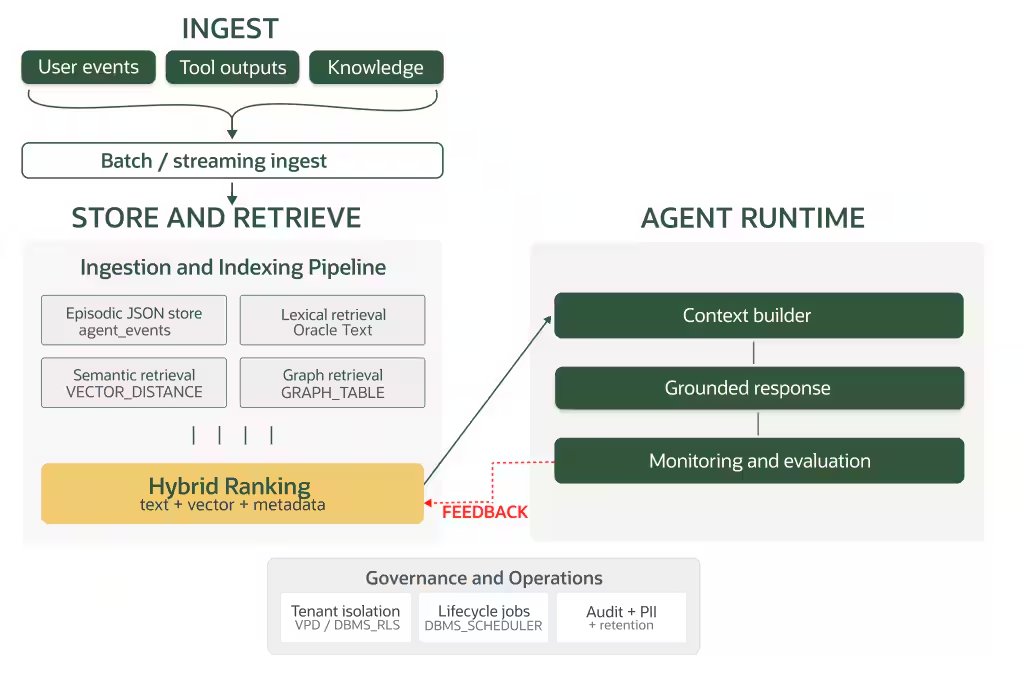
Unified Memory Core for AI Agents
Vector search is not enough. Daniela Pavlenco shows why graph traversal belongs at the heart of agent memory architecture.
Most agent systems reach for vectors first. And vectors are useful. But they return nearest semantic neighbors, not business relationships. When an agent needs to follow context across connected entities, user > ticket > service > document, similarity scores do not help. Graph traversal does.
Daniela's architecture unifies four memory types in Oracle AI Database:
* Episodic: event history stored as JSON, queryable with SQL/JSON
* Lexical: Oracle Text for exact terminology, error codes, policy clauses, things vector search quietly misses
* Semantic: vector indexes for meaning-based retrieval
* Relationship-aware: GRAPH_TABLE for traversing connected business context
The graph piece is what makes this architecture different. Oracle SQL Property Graph sits directly on top of existing relational tables, no data copied, no separate store. The graph definition holds only metadata; queries run against live data. One pattern from the walkthrough:
MATCH (u IS user) -[r IS opened]-> (t IS ticket) -[m IS mentions]-> (d IS document)
That query surfaces what vector search cannot: the organizational and operational relationships around a memory item. Who opened it, what it references, which documents are connected. Context that pure similarity ranking leaves on the floor.
The rest of the architecture handles governance, tenant isolation, and lifecycle controls in the same platform. A companion notebook demonstrates all patterns end to end.
The pattern for building a unified memory layer for AI agents is inspired by Oracle Graph, but it can be applied regardless of the underlying database.
By Daniela Pavlenco. H/T gdotv.
blogs.oracle.com/developers/…
#GraphDatabase #AgentMemory #GraphAI #AIArchitecture #SQLPropertyGraph #KnowledgeGraph
--
Connected Data London 2026 | 11–12 November | Leonardo Royal Hotel London Tower Bridge
🎤 Share your work with the world's most passionate data community. The Call for Submissions is open. connected-data.london/2026-c…
🎟 Tickets on sale now. Early bird discounts up to 30%. 2026.connected-data.london?u…
📺 Sponsorship opportunities available. Contact info@connected-data.london for details.
#KnowledgeGraph #GraphRAG #Ontology #Graph #AI #DataScience #GraphDB #SemTech
2
11
447
Apr 30
Navigating Knowledge Graph Creation: A Practical Approach for Developers
As the significance of graphs continues to grow in the AI space, particularly with technologies like Graph RAG and Text-to-Query exploration, developers face challenges in transitioning from or converting traditional data structures to graph formats.
This session addresses the common hurdles encountered by those unfamiliar with knowledge graphs, simplifying the steep learning curve associated with this process.
In this session, we share an approach to the data modeling process, highlighting its applicability across various contexts while offering practical insights that contribute to a key step in the emerging trends of AI and RAG.
youtube.com/watch?v=y-lhpGxh…
--
Leah Miller. Lead Ontologist, S&P
Leah is a Lead Ontologist at S&P Global, specialising in data strategy and data modelling. With extensive experience gained from her time at Amazon, Google, and Bloomberg, she has developed a deep understanding in knowledge engineering and semantic modelling.
--
Welcome to Connected Data London's #ThrowbackThursday
Every Thursday at 3pm GMT, we are releasing gems from our vault on #YouTube
Tune in and learn from leaders and innovators; subscribe to our channel and watch premieres as they are released!
#knowledgegraph #graphdatabase #graph #AI #datascience #analytics #semtech #ontology
2
6
632

Apr 27
Ultipa GQLDB: A Native Graph Database with a Full Implementation of ISO GQL, new features, and a Community Edition
ISO GQL is to graph databases what SQL became to relational databases:
A common language that means your queries are portable, your skills transfer, and you are not locked into a vendor's proprietary dialect. Standards-based graph is a different proposition altogether.
Ultipa launched GQLDB — v6 of their real-time graph database, touted as the first native graph database to fully implement ISO GQL (ISO/IEC 39075).
What Ultipa built around that foundation:
One engine handles graph, vector, full-text, and RDF/ontology natively — no stitching, no middleware.
Built-in AI capabilities - natural language to GQL, vector embeddings, similarity search, and RAG support.
Real-time graph-native storage with index-free adjacency and full ACID compliance.
The Community Edition is free: a single binary, installs in seconds.
Worth checking if you're working on knowledge graphs for LLMs, fraud detection, real-time recommendations, or tokenizing real-world assets.
ultipa.com/products/gqldb?ut…
#GraphDatabase #ISOGQL #KnowledgeGraph #OpenSource #GraphAI
--
📩 The Year of the Graph Spring 2026 newsletter issue is out!
Beyond Context Graphs: How Ontology, Semantics, and Knowledge Graphs Define Context 👇
yearofthegraph.xyz/newslette…
All things #KnowledgeGraph, #GraphDB, Graph #Analytics / #DataScience / #AI and #SemTech.
Subscribe and follow to be in the know. Reach out if you'd like to be featured
1
6
508