
Why Union-Find fails for entity resolution at scale, and how weighted graph clustering with safeguards and incremental updates works better in production.
#entityresolution #graphalgorithms...Show more
1
1
462

Jun 8
When your business runs on relationships, traditional queries simply can’t see the forest for the trees.🔍 #GraphAlgorithms analyze the shape and flow of your data network, uncovering patterns invisible to standard databases. 🔗na2.hubs.ly/H05Xs9n0
#GraphDatabase #NebulaGraph
10
1,023
Jun 5
From minutes to milliseconds? That's the power of graph-native risk control.⚡️ 3 #GraphAlgorithms to fight fraud:
🔗 Connected Components
🎯 Degree Centrality
🔍 Dense Subgraph Mining
🔗 See how they expose fraud rings:
na2.hubs.ly/H05SX_z0
#NebulaGraph #FraudDetection
33
2,476

Introducing Spanner Graph algorithms
At Google Cloud Next, Google announced the preview of graph algorithms with Spanner Graph, bringing Google Research's state-of-the-art graph mining capabilities natively into an operational database.
Enterprises are increasingly leveraging graph technologies to uncover complex relationships in data for fraud detection, social network analysis, entity resolution, and healthcare research.
Graph algorithms -- such as node centrality and community detection -- are the computational methods used to analyze these structures, quantifying patterns and the strength of connections between entities.
Running graph algorithms at scale has historically been challenging and resource-intensive, often requiring complex ETL pipelines to dedicated analytic solutions or risking the transactional performance of the graph database.
Spanner Graph algorithms are designed to tackle demanding enterprise workloads without compromising operational database performance:
Tight integration with GQL: Directly invoke algorithms using ISO Graph Query Language (GQL) to run structural analytics across your data, minimizing complex data movement to external engines.
Near-zero transactional impact: Algorithm execution happens on dedicated compute resources via Data Boost, without custom ETL pipelines. Pay only for what you use.
Global insights on billion-edge graphs in minutes: The engine can run algorithms on graphs with tens of billions of edges within minutes, using dense topology encoding optimized for random access.
Algorithms available include centrality (betweenness, closeness, PageRank), community detection (label propagation, correlation clustering, modularity clustering, weakly connected components), and similarity/path finding (Jaccard, cosine, set-to-set shortest paths).
Customers including DaVita, Yahoo!, SoundCloud, and WPP are already using Spanner Graph algorithms for patient 360, personalization at scale, music graph analytics, and enterprise intelligence.
By Bei Li and Vahab Mirrokni
cloud.google.com/blog/produc…
#SpannerGraph #GraphAlgorithms #GraphDatabase #FraudDetection #EntityResolution
--
Connected Data London 2026 | 11–12 November | Leonardo Royal Hotel London Tower Bridge
🎤 Share your work with the world's most passionate data community. The Call for Submissions is open. connected-data.london/2026-c…
🎟 Tickets on sale now. Early bird discounts up to 30%. 2026.connected-data.london?u…
📺 Sponsorship opportunities available. Contact info@connected-data.london for details.
#KnowledgeGraph #GraphRAG #Ontology #Graph #AI #DataScience #GraphDB #SemTech
2
14
465

You don’t need 500 random DSA questions.
You need pattern recognition.
Most students stay stuck because every new problem feels like a completely new universe:
Arrays today.
Trees tomorrow.
Graphs next week.
Then suddenly DP. 😵💫
That’s not preparation.
That’s confusion.
At @SevyDevyHQ , we broke DSA into 25 core patterns across 4 learning layers:
1. Core Foundations
2. Core Data Structures
3. Trees, Heaps & Graphs
4. Advanced Patterns
Once you understand patterns like Sliding Window, Two Pointers, Prefix Sum, BFS, DFS, Greedy, and Dynamic Programming - questions stop looking random.
They start looking structured.
We’ve published a detailed visual blog with creative diagrams to help you understand how to identify and use these 25 DSA patterns.
Comment “DSA” and we’ll DM you the blog link.
#SevyDevy
#DSA
#DSAPatterns
#DataStructures
#Algorithms
#CodingInterview
#InterviewPreparation
#SoftwareEngineer
#TechCareers
#ProblemSolving
#DynamicProgramming
#GraphAlgorithms
#SlidingWindow
#BinarySearch
#DeveloperLife
1
1
218
May 20
Traditional databases focus on the "what"—the individual records. But to solve complex business problems, you need to understand the "relationships." 🕸️
🚀 From #SupplyChain to #FraudDetection, #GraphAlgorithms turn connections into cash:
na2.hubs.ly/H05wxyh0
#NebulaGraph
90
73
May 12
Modern fraudsters operate in rings, not isolation. 🕸️ If you're still using rule-based systems, you're missing the network.
Here is how 3 #GraphAlgorithms can stop fraud in #Fintech, E-comm, & Web3: na2.hubs.ly/H05mndq0 💥 Start analyzing networks.
#NebulaGraph #RiskControl
82
46

📊 New #SpecialIssue "Recent Advances and Emerging Applications in Graph Data Mining (GDM)", edited by Dr. Li Sun.
Deadline is: 31 January 2027. Submissions are welcome until deadline!
mdpi.com/journal/information…
#GraphDataMining #GraphMining #GraphAlgorithms
@ComSciMath_Mdpi
35

Want to run GPU jobs without constantly checking nvidia-smi ?
I built gpu-orchestrator — a mini GPU scheduler in C that automatically picks the best GPUs for your Python / PyTorch / DeepSpeed / Hugging Face jobs (via topology matrix and backtracking).
It checks free GPUs (via polling every 5 seconds), VRAM, NVLink/PCIe topology, peer-to-peer communication needs, and then launches the job with the right CUDA_VISIBLE_DEVICES.
Basically: submit your script → scheduler finds the best GPUs → train/infer without manual GPU management.
(no gpu wastage)
Timestamps:
00:00 - 00:30 → Overview
00:30 - 00:57 → About my project
00:58 - 03:55 → What problem it solves & how
03:56 - 09:34 → Quick demo
Repo: github.com/john221wick/gpu-o…
#GPU #GPUScheduler #CUDA #NVIDIA #PyTorch #DeepSpeed #HuggingFace #MachineLearning #AI #ML #MLOps #SystemsProgramming #CPP #Linux #NVLink #PCIe #DistributedTraining #Inference #ModelTraining #CUDA_VISIBLE_DEVICES #NVML #Scheduler #Orchestration #SLURM #AIInfrastructure #GPUComputing #BackendEngineering #InfraEngineering #BuildInPublic #OpenSource #GitHub #DSA #Graphs #Backtracking #GraphAlgorithms #DSAInRealLife #SystemDesign
#AIBoom #nvidia #SLURM #slurm
1
1
875
Apr 24
Graph databases like #NebulaGraph enable three powerful algorithms that detect, dissect, and disable fraud at scale. 🚀 Learn how and what it takes to deploy them in production: na2.hubs.ly/H04YXys0
#GraphDatabase #NebulaGraph #GraphAlgorithms #FraudDetection #RiskControl
1
681
Apr 24
Graph algorithms #NebulaGraph:
→ Find fraud rings with Label Propagation
→ Optimize delivery routes with Shortest Path
→ Boost sales with Personalized PageRank
Real algorithms. Real impact. 💥
na2.hubs.ly/H04YXxw0
#GraphAlgorithms #NebulaGraph #FraudDetection #Logistics
1
679
Apr 23
#NebulaGraph Analytics empowers your teams to move beyond pre-packaged solutions and build algorithms that perfectly mirror your unique business logic. 🚀
Come to Try a Platform for the Era of Billion-Relation Analytics:
na2.hubs.ly/H04Z1BN0
#GraphAnalytics #GraphAlgorithms
851

Apr 21
Finding the Fastest Way Out: How Dijkstra's Algorithm Finds Shortest Paths
Imagine you're an explorer searching an old mine for abandoned treasure with a map showing all chambers and tunnels connecting them. Each chamber is a node in a graph, and each tunnel has a travel time. You want the fastest route. That's exactly what Dijkstra's algorithm solves.
Dijkstra calculates the shortest distance from a starting point to every other node, updating distances over multiple iterations. It shows up everywhere: fastest delivery routes in supply chains, power routing in mapping and ride-sharing apps, moving data efficiently across telecom networks, and understanding dependencies in IT infrastructure.
By Corydon Baylor, Neo4j
neo4j.com/blog/aura-graph-an…
#GraphAlgorithms #GraphDatabase #DataScience #Neo4j #Analytics
--
📩 The Year of the Graph Spring 2026 newsletter issue is out!
Beyond Context Graphs: How Ontology, Semantics, and Knowledge Graphs Define Context 👇
yearofthegraph.xyz/newslette…
All things #KnowledgeGraph, #GraphDB, Graph #Analytics / #DataScience / #AI and #SemTech.
Subscribe and follow to be in the know. Reach out if you'd like to be featured.

2
8
464

Apr 20
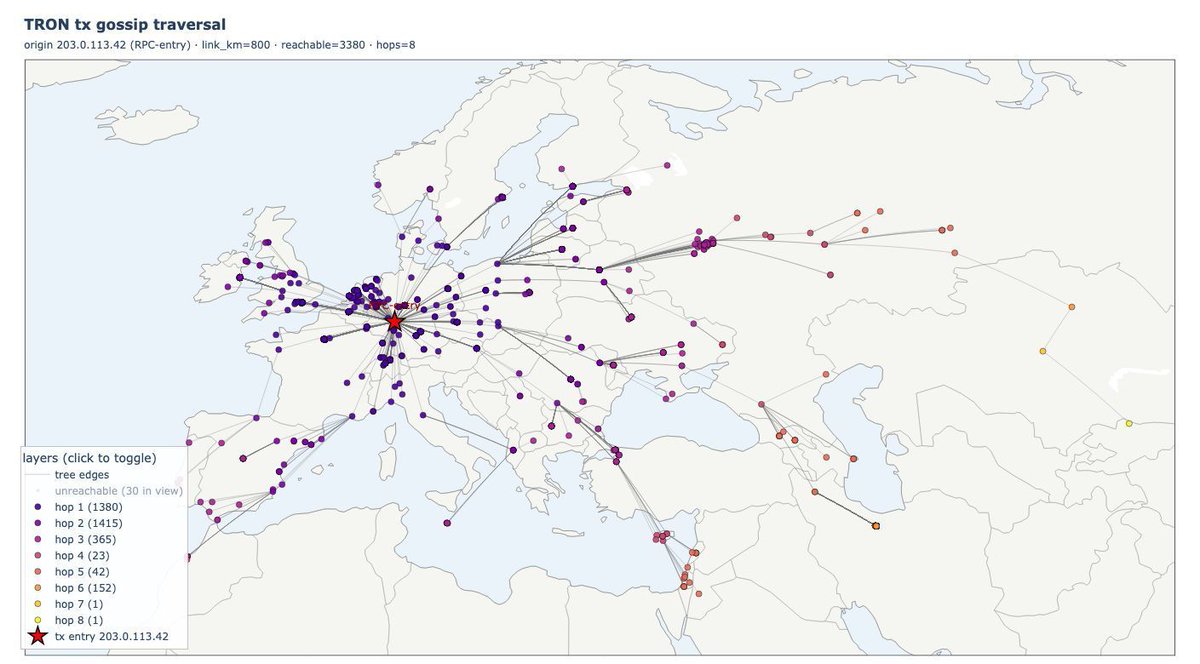
A lot of investigators don't know that TRON listener IPs are available publicly. What if we could simulate how a transaction’s gossip might spread from a starting point using BFS and the Haversine distance between listeners? Read more 👇 cryptogrammar.xyz/research/t…
#GraphTheory #GraphAlgorithms
@TRONSCAN_ORG
2
70
Apr 15
In a world starving for insight, the connections between things often matter more than the things themselves. #GraphAlgorithms help you see those connections. 🔍 #NebulaGraph provides production-ready implementations of key algorithm categories. 🚀
🔗 na2.hubs.ly/H04PlhS0
879
Apr 9
You need relationship intelligence to fight modern fraud. 🔍 And that starts with three proven #GraphAlgorithms:
✔️ Connected Components
✔️ Degree Centrality
✔️ Dense Subgraph Mining (via Louvain or LPA)
🔗 Read More:
na2.hubs.ly/H04LTYj0
#NebulaGraph #Fintech #RiskControl
2
900
Apr 9
#NebulaGraph Analytics lets you:
✅ Write custom graph algos in #GQL
✅ Generate code from natural language (#AI-assisted)
✅ Analyze data in-place (S3, HDFS, etc.)
✅ Get 5-10x speedup & 80% less resource use
🔗 na2.hubs.ly/H04KyV60
#GraphAnalytics #GraphAlgorithms
905

Your data holds hidden connections. Graph #analytics helps you find them.
Stop just collecting #data. Start connecting it. Learn how to uncover the insights that traditional tools miss in our live online #GraphAlgorithms and #MachineLearning course.
Learn more: professionaleducation.mit.ed…
#GraphAnalytics #DataScience #MIT #ProfessionalDevelopment #ML #AI
3
220

Neural Knowledge Graph Reasoning with Relational Digraph #GraphTheory #GraphAnalytics #NetworkScience #GraphModels #GraphAlgorithms #GraphStructures #Combinatorics #DiscreteMathematics #RelationalData #RelationalModeling #RelationshipAnalysis #DataRelationships
6

Mar 20
Day 55✅ Day 56✅
Solve:
-Find eventual safe states
-Alien Dictionary
-Shortest Path Algorithms and Problems
-Shortest path in undirected graph with unit weights
-Shortest path in DAG
Drop a 🔁 if you're on the DSA grind too! #DSA #GraphAlgorithms #LeetCode #100DaysOfCode
1
1
24