
Helping you create health and social impact through social marketing behavior design. Consultant. Author. Trainer.
Joined January 2008
- Tweets 48,268
- Following 647
- Followers 5,506
- Likes 54,896
1,454 Photos and videos









Pinned Tweet

21 Jan 2025
Want to learn how to apply marketing tools and behavioral science to creating social impact and improving public health?
Check out my free eBook for an intro to social marketing, including a strategy worksheet and resource guide.
social-marketing.com/social-…
1
1
11
3,752
Nedra Weinreich retweeted
.@volker_turk You accuse us of “disinformation” and “intimidation”?
Our report documents UN rapporteurs taking millions from China, Russia, Qatar & other donors, praising dictatorships, and targeting democracies.
Instead of attacking the messenger, why not address the evidence?
Jun 15

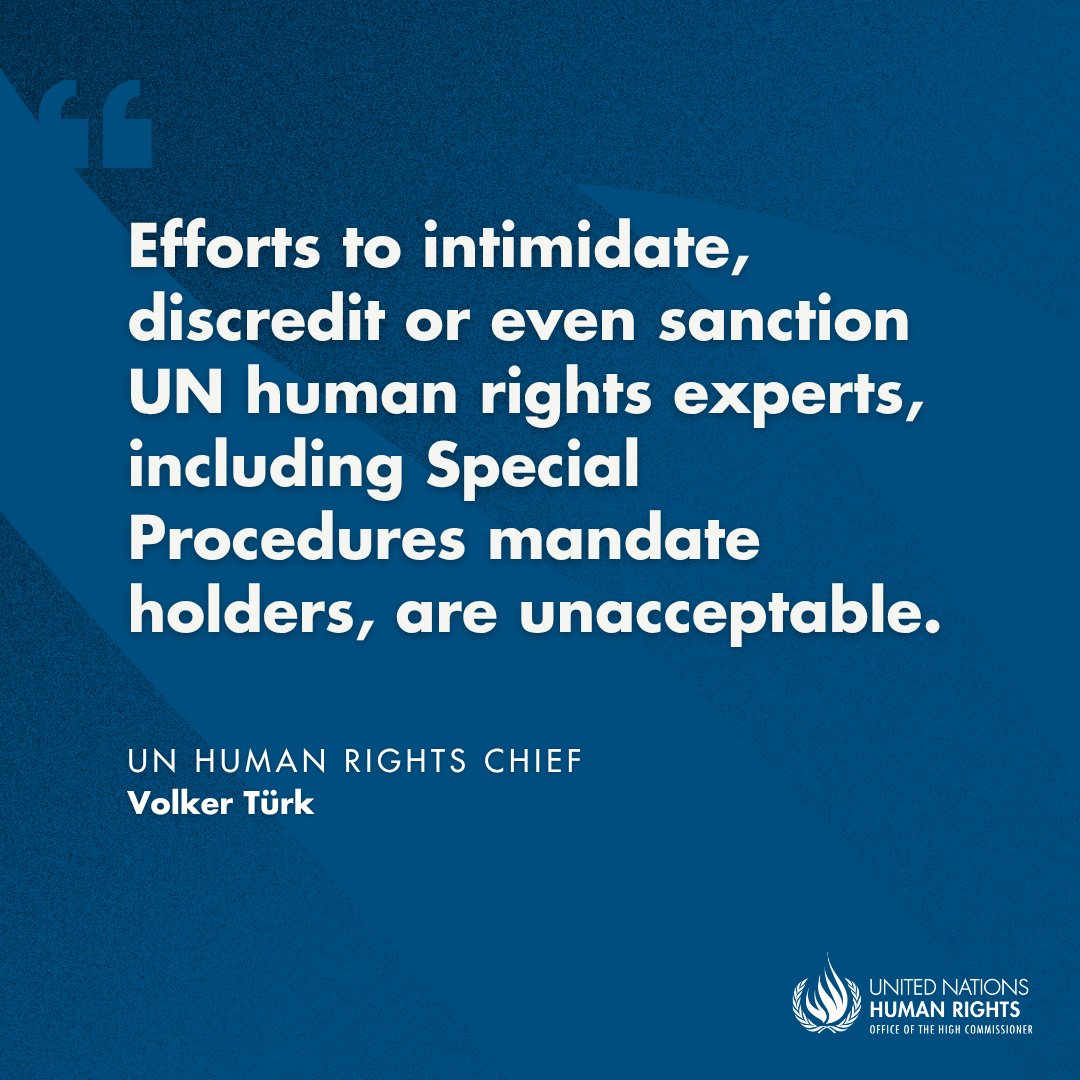
I condemn disinformation campaigns & attempts to undermine the credibility of the UN human rights system, including @UN_SPExperts mandate holders.
Criticism & debate are legitimate & necessary; efforts to intimidate, discredit, or even sanction, are not.
They are unacceptable. - UN Human Rights Chief @volker_turk
41
513
1,525
27,610
Nedra Weinreich retweeted

Jun 15
MOSSADIL COMMENTARY: WINNERS AND LOSERS
This was not a deal.
It was an MOU.
It does not resolve the core issues that triggered the war between Israel and Iran.
Israel was not part of the signing.
Israel is not part of the ongoing negotiations.
Israel is an independent country, and it has both the right and the obligation to act according to its own national interests.
BIGGEST WINNER: The Iranian regime.
Not because they are strong.
Because they survived.
Because the world rewarded them for starting a war, threatening global shipping, firing on Israel, and holding their own people hostage.
They shifted the global conversation.
They turned much of the world against Israel — and, more importantly, pushed the United States from focusing on Israel’s safety and security to protecting the survival of the Iranian regime.
BIGGEST LOSER: The Iranian people.
They were promised freedom.
They were told help was coming.
And once again, they were left behind.
LOSER: Trump.
This could have been his Berlin Wall moment.
Instead, it is becoming his Chamberlain moment.
492
1,051
4,340
209,374
Nedra Weinreich retweeted

This and the UN endorsing the deal is all the proof you need its a win for Iran
Jun 15

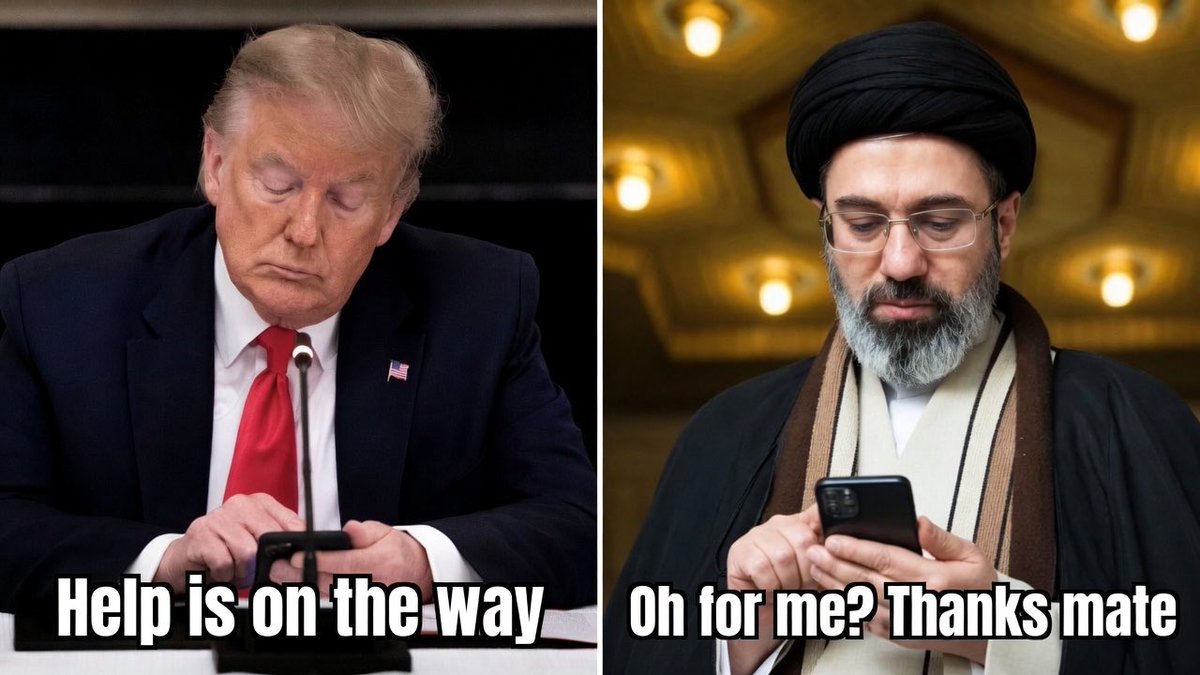
I welcome the agreement reached between the US and Iran, following sustained diplomatic efforts by several partners.
The priority now is its swift and full implementation by all parties.
This agreement should allow for the immediate reopening of the Strait of Hormuz.
Freedom of navigation must be restored toll-free.
This is essential for regional stability and the global economy.
It opens the door to broader negotiations on peace and security in the Middle East.
And should end Iran’s nuclear and ballistic programmes and its destabilising activities in the region.
And of course there can be no peace in the Middle East while Lebanon is in flames.
Once again Europe calls on all parties to respect Lebanon's sovereignty and territorial integrity and implement a genuine ceasefire.
In Evian, G7 leaders will meet partners from the Gulf and the wider Middle East. Europe is ready to play its part.
This crisis also carries a clear lesson.
Once again, energy dependencies have been weaponised.
We must diversify our supply routes and develop alternative export corridors to diversify away from the bottleneck of Hormuz.
We will discuss this, and more, in Evian.
1
107

Jun 14
Trump snatched defeat out of the jaws of victory. Well done. Bravo. What a farce.
1
1
24
Nedra Weinreich retweeted

Jun 14
Simple. Iran keeps dangling a deal in front of Trump like bait on a hook.
Every time it looks like talks are about to collapse, Iran gives just enough ground to make Trump think, "We're almost there, just one more compromise." The closer he thinks he is to getting a deal, the more invested he becomes in protecting it.
Then Iran has Hezbollah or another proxy stir up trouble with Israel. Israel responds, as it always does, and Iran immediately turns around and says, "See? We were about to make a deal, but Israel is about to ruin it."
At that point, Trump's frustration is directed at Israel instead of Iran. Because he is emotionally and politically invested in getting the deal done, he starts viewing Israel's response as the obstacle rather than Iran's behavior.
The result is that Iran gets Washington spending more energy trying to restrain Israel and save negotiations than confronting Iran itself. The deal becomes the carrot, and Trump ends up chasing it while Iran controls the pace.
The goal is not necessarily to get a deal. The goal is to keep America believing a deal is always one step away, long enough to weaken its resolve, create friction with its allies, and reduce its willingness to escalate the conflict.
5
9
968
Jun 14
The most bonkers timeline just keeps getting more and more bonkers. Nothing makes sense anymore.
23
Nedra Weinreich retweeted

Jun 14
Iran wanted to drive a wedge between their 2 biggest threats, the U.S. and Israel and they were successful.
36
82
481
9,483
Jun 14
Whenever I hear our upstairs neighbor, who works for the prime minister's office, closing their safe room metal window shield, I know we need to be prepared for incoming missiles.
2
1
2
78
Nedra Weinreich retweeted

Jun 14
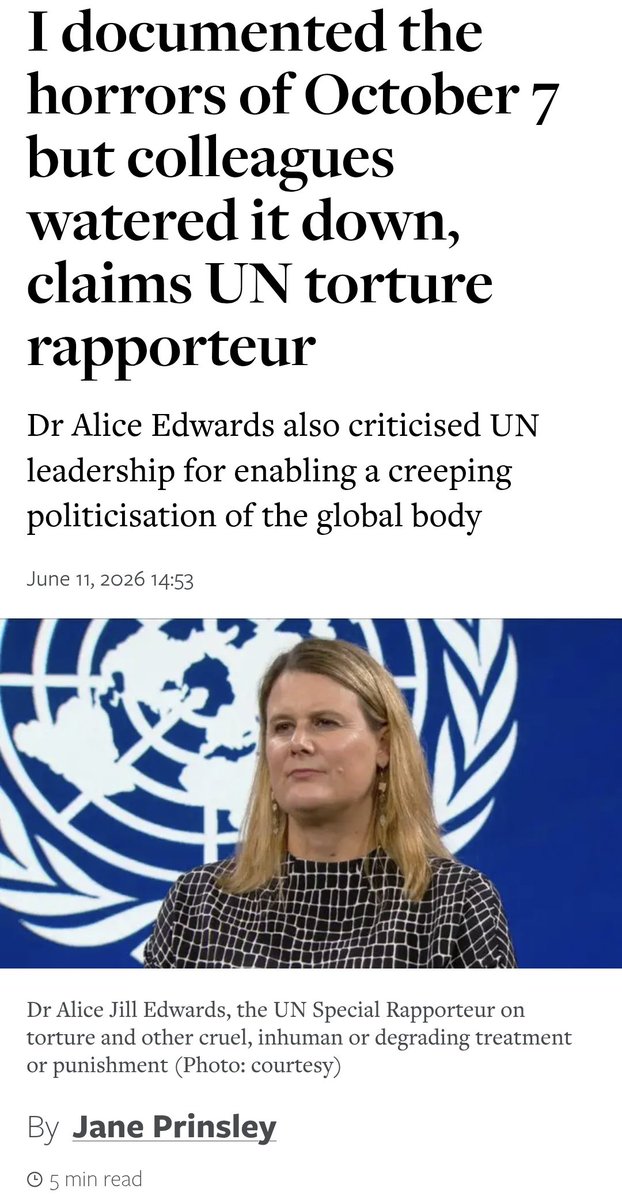
A UN Special Rapporteur says there was a "concerted effort" inside the UN to prevent allegations from October 7 being formally recorded and that colleagues were bullied into not signing a letter documenting the atrocities.
When the world's leading human rights institution cannot honestly document the largest massacre of Jews since the Holocaust, it has a credibility problem.
By @janeprinsley of the @JewishChron
thejc.com/news/world/i-docum…
32
726
1,449
20,888
Nedra Weinreich retweeted

Jun 13
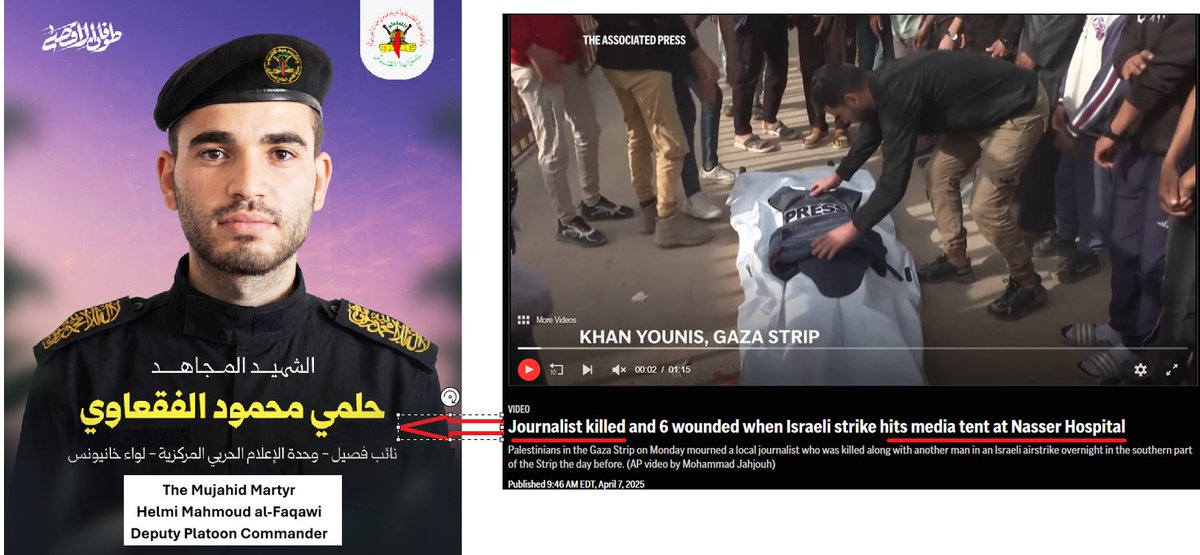
🧵FAKE Gaza Journalist Alert: Helmi Al-Faqawi is listed by @pressfreedom as a journalist killed by the IDF at a "reporter's tent" at Nasser Hospital. But PIJ confirmed he was a commander—he used the hospital as a base. The 14th fake journalist outed in the last few weeks. 1/
Jun 12

🚨Global media claimed the IDF struck a tent of Gaza "journalists" at Nasser Hospital on Apr 7, 2025 killing @pressfreedom listed reporter Helmi al-Faqawi.
PIJ just admitted he was a commander!
REAL STORY: terrorists posing as journalists using hospitals as command centers
5
213
619
110,244
Nedra Weinreich retweeted

Jun 14
Ben Cohen on the special status of Israel in the UN system: “Palestinians are no more human than the other religious and national minorities in the Middle East, like the Kurds and the Yazidis, who have faced actual genocide and who have never carried out an atrocity like Oct. 7 against the populations complicit in their oppression. Nor are they more deserving of self-determination than the Uyghurs or the Tibetans, two nationalities that continue to endure occupation and persecution at the hands of the Communist Party of China.
“When it comes to a realist calculus, the idea of assigning the conflict such an elevated position veers on the nonsensical. There are no natural resources involved. The Jews of Israel—the villainous colonialists in this rubric—are not operating on behalf of any one mother country, as has been the case with colonialism in general. And the Palestinians—the passive victims by the same set of considerations—are a component of a Greater Arab nation numbering 500 million people. The corruption, the kleptocracies and the vast social, gender-based and economic inequalities that plague the Arab world would not be alleviated one jot by the creation of an independent Palestinian state
“What this tells us is that we are dealing with ideology before anything else.”
For JNS, jns.org/opinion/column/ben-c…
Jun 14

The UN’s fatal formula for the Israeli-Palestinian conflict jns.org/opinion/column/ben-c…
4
56
198
7,337
Nedra Weinreich retweeted

Editor of @TheLancet @richardhorton1 has a long history of antisemitism and professional misconduct. @ElsevierConnect should have removed him many years ago. >>
Jun 14

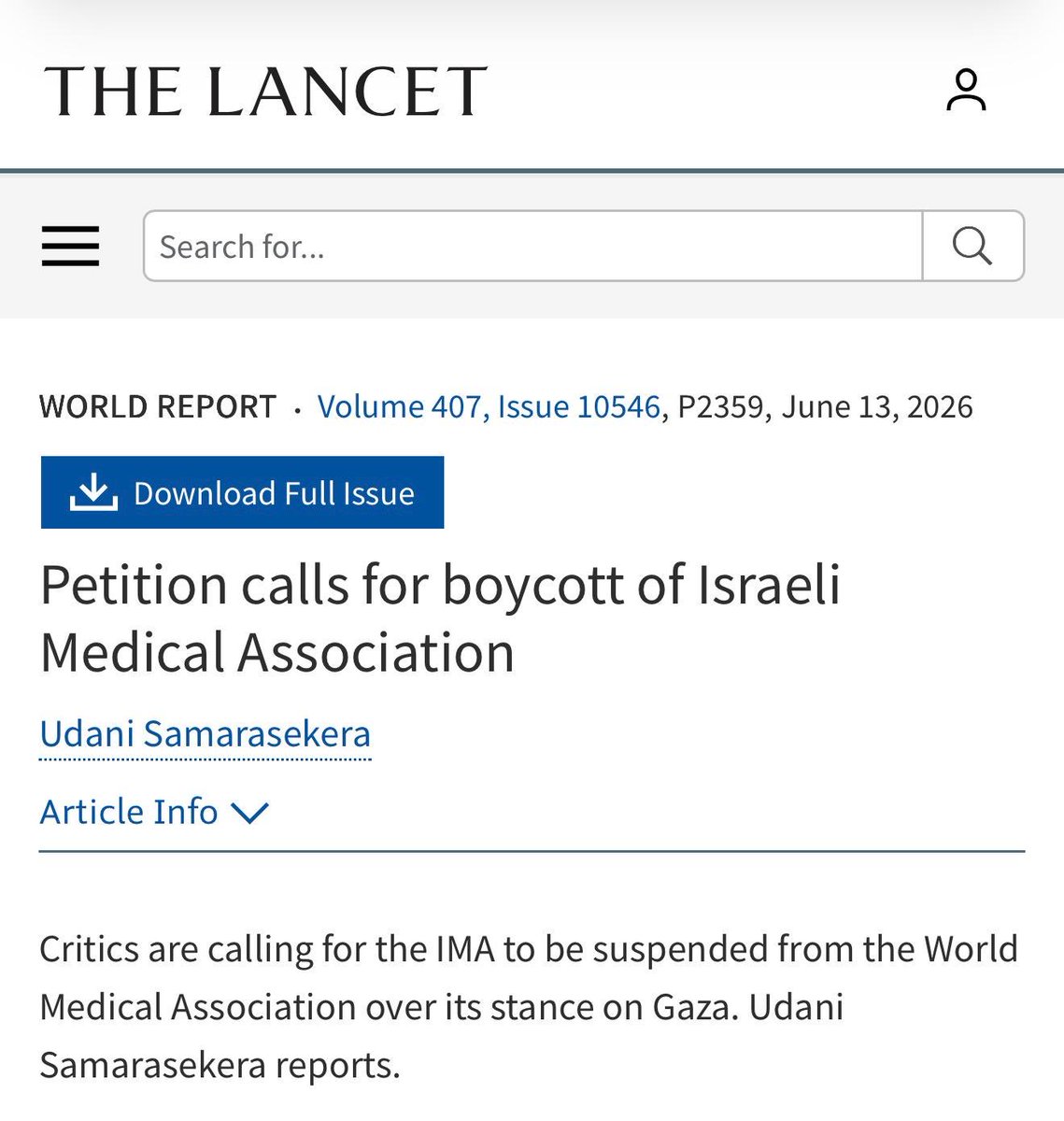
Join me in once again calling for the resignation of @TheLancet editor Richard Horton.
Publishing a petition calling for the boycott of the Israeli Medical Association is an absolute disgrace. Medicine should bring physicians together in service of patients, not weaponize professional organizations for political campaigns.
Just as it failed the public on the #COVID19 origins debate, The Lancet is again positioning itself as a political actor rather than a medical journal.
1
26
73
1,565
Nedra Weinreich retweeted

Jun 14
The Lancet spreads falsehood far and wide.
This is the publication that refused *for 12 years* to retract the fabricated paper linking autism to vaccines.
This is the publication that falsely published US forced had killed 1 million people in Iraq.
It goes on and on.
Jun 14
Join me in once again calling for the resignation of @TheLancet editor Richard Horton.
Publishing a petition calling for the boycott of the Israeli Medical Association is an absolute disgrace. Medicine should bring physicians together in service of patients, not weaponize professional organizations for political campaigns.
Just as it failed the public on the #COVID19 origins debate, The Lancet is again positioning itself as a political actor rather than a medical journal.
1
5
46
1,394
Nedra Weinreich retweeted

1/5
An open letter to @TheLancet from an Iranian-Jewish cardiologist.
Today, one of the world's most prestigious medical journals published a campaign to suspend the Israeli Medical Association from the World Medical Association — the body founded after WWII to ensure physicians would never again be weaponized by political ideology.
I'm a cardiologist. I'm an Iranian Jew who grew up under a regime where medicine was subjugated to the state.
What The Lancet just did is a disgrace to my profession.
Here's what they published — and what they deliberately left out.
265
1,630
5,396
209,157
Nedra Weinreich retweeted

Jun 12
.@CFSaundersUN We welcome your firing of 70 UNRWA “humanitarians” over their Hamas terror ties. But your statement is incoherent.
Here are 400 UNRWA culprits we identified: unwatch.org/unrwa-terror-net…
Who was removed, and what was their role in Hamas or the October 7 massacre?

On June 11, the Commissioner-General ad interim of UNRWA, Christian Saunders, took the decision to terminate the employment of 70 UNRWA staff members in Gaza with immediate effect. The decision was taken further to an assessment of the safety and security of UNRWA operations in Gaza.
Read the full statement: unrwa.org/newsroom/official-…
9
293
825
15,063
Nedra Weinreich retweeted

At some point it may filter through to the wider public consciousness that there is quite a large group of extremely nasty people who have used the Palestinian cause as a permission structure to engage in hideous hate.
Jun 11

Man behind notorious Twitter account which has expressed support for Hamas and Hezbollah and referred to 'Zionist Jews' as 'parasites' alleged to have punched seagull to death
jewishnews.co.uk/man-behind-…
6
81
358
11,656
Nedra Weinreich retweeted

“So hate is cool now.” @JakeWSimons
This is what antisemitism as “the worlds most reliable early warning sign of a major threat to freedom, humanity, and the dignity of difference” (in the words of the late @rabbisacks) looks like.
Normalized by the mechanism that enables its mutation over millennia - demonization, delegitimization, double standards - this lethal hate hijacks, inverts, redefines, weaponizes facts & law, ultimately collapsing morality & the covenant that holds societies together.
Jun 12

So hate is cool now. They’re not even hiding it any more.
6
12
982
Nedra Weinreich retweeted

Jun 11
‼️ @unrwa EXPOSED: 101 UNRWA employees were involved in the October 7 massacre or linked to Hamas’ military wing.
Among them were school principals, teachers, medical personnel, and security staff.
UNRWA staff helped transfer weapons, support operational communications, and use UNRWA facilities for Hamas terrorist activity.
Hamas systematically exploits humanitarian organizations to carry out terror against Israeli civilians.
305
1,282
5,319
132,670

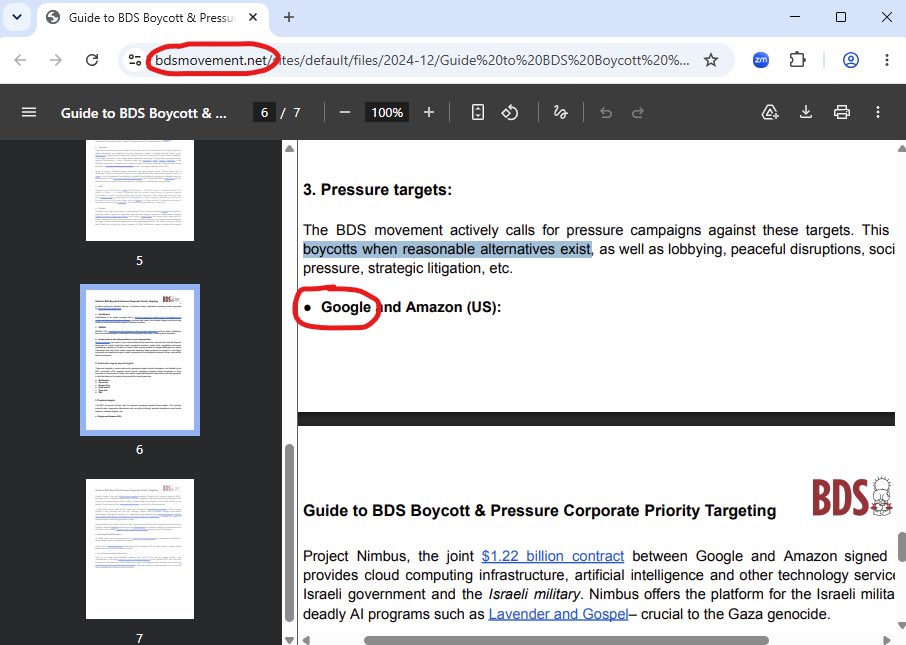
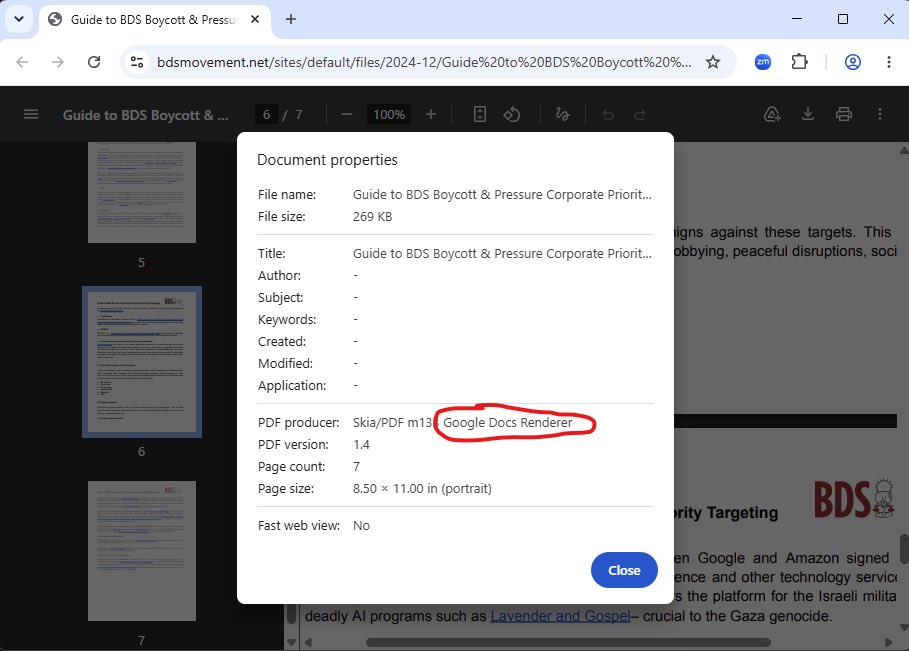
🤦♂️ The BDS movement is a pathetic joke 😂
They published a PDF list of companies that should be boycotted.
Google is listed there as a “Pressure Target” - a company that should be boycotted when reasonable alternatives exist.
The tool they used to create this PDF?
Google Docs 😭😅
35
184
921
18,956