
I was today's years old when I realised that Ansible is to Linux what SCCM is for windows. Unknowingly I have been putting away learning Ansible. 5 minutes into @AbhiVeeramalla's video on Ansible and I am like Bruh.. why was i so hesitant to learn about this.
#Ansible #ConfigurationManagement
9

May 19
Writing Ansible playbooks is only half the battle.
True mastery happens in the terminal —knowing how to safely control, target, and troubleshoot your automation workflows in production environments.
Whether you are pushing a quick hotfix or deploying across a massive cluster, executing playbooks requires precision to avoid configuration drift and accidental downtime.
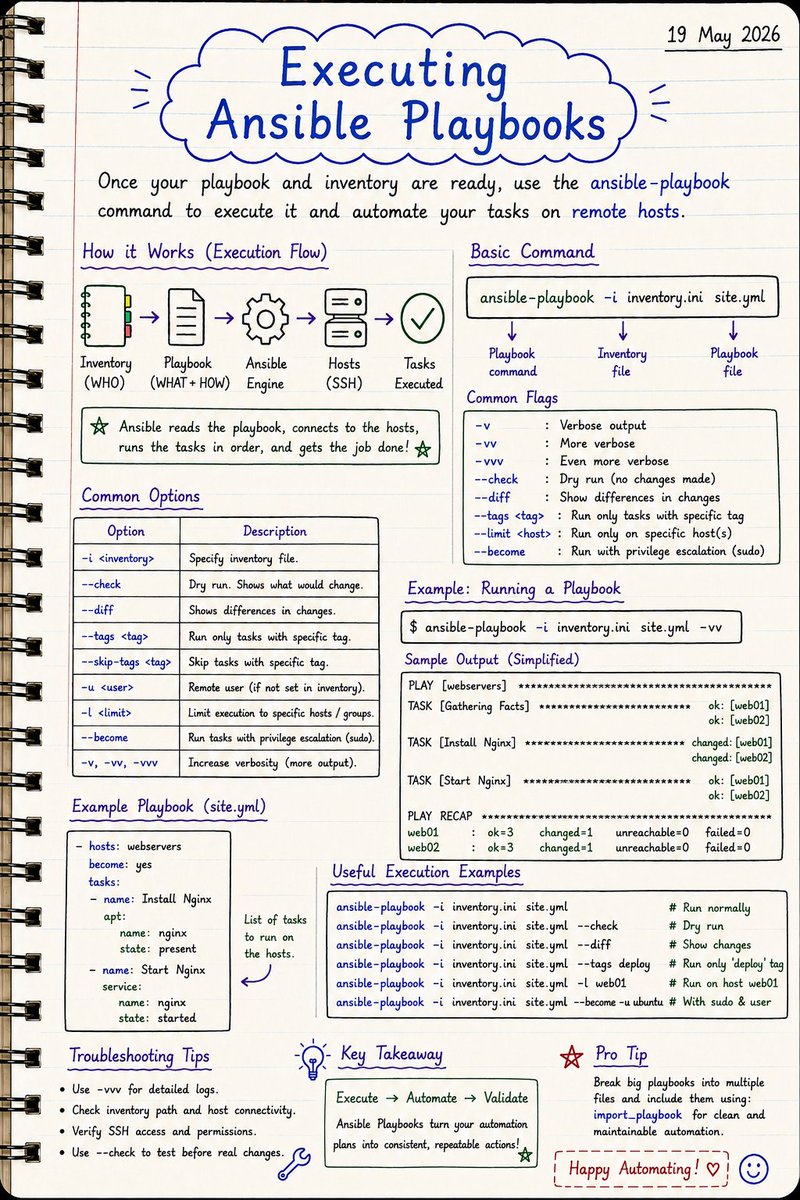
Here is a breakdown of essential execution strategies to level up your workflow:
### 1. The Core Execution Foundation
Every automation run relies on three fundamental pillars. Missing just one will break your execution pipeline:
* The Engine:
ansible-playbook (the CLI binary that parses your automation blueprints).
* The Target (Who):
-i inventory.ini (specifies your managed nodes, groups, and connection variables).
* The Blueprint (What/How):
site.yml (the structured YAML file defining your plays and tasks).
### 2. Safety First:
The Production Guardrails
Never run a complex playbook blindly in production.
Before making live state changes, use these safety flags to predict behavior:
* --check (Dry Run): Simulates the execution. Ansible crawls your managed nodes and reports back what would change, without actually applying any modifications.
* --diff (Visual Code Changes): Shows the exact line-by-line file differences before and after execution.
Pro Tip: Combine them (--check --diff) to review pending infrastructure modifications safely.
### 3. Precision Control & Targeting
Don’t waste time running a massive, 500-line playbook when you only need to fix a single microservice. Isolate your execution:
* --tags <tag_name>: Filters execution to only run tasks explicitly marked with that specific tag (e.g., just updating an Nginx config).
* --limit <host_or_group>: Constraints the playbook to a specific subset of your inventory (e.g., targeting web01 to test a deployment before rolling it out globally).
* --become: Forces privilege escalation. Crucial when your automation requires sudo rights to install packages or manage system services.
### 4. Zeroing In on Failures
When a deployment fails, default output isn't always enough. Increase verbosity to expose the underlying Python execution and SSH connection details:
* -v: Verbose output.
* -vv: More verbose (shows results of modules).
* -vvv: Full connection debugging. Essential for diagnosing SSH authentication, path errors, or permission issues.
### Execution Best Practice
Break monolithic playbooks into modular roles and include them cleanly using import_playbook or include_tasks.
Keep your automation clean, scannable, and maintainable.
Save this visual cheat sheet for your next deployment sprint!👇
#Ansible #ConfigurationManagement
#DevOps #SysOps #SysAdmin
ALT executing playbook
1
3
10
193
May 16
6
1
18
256

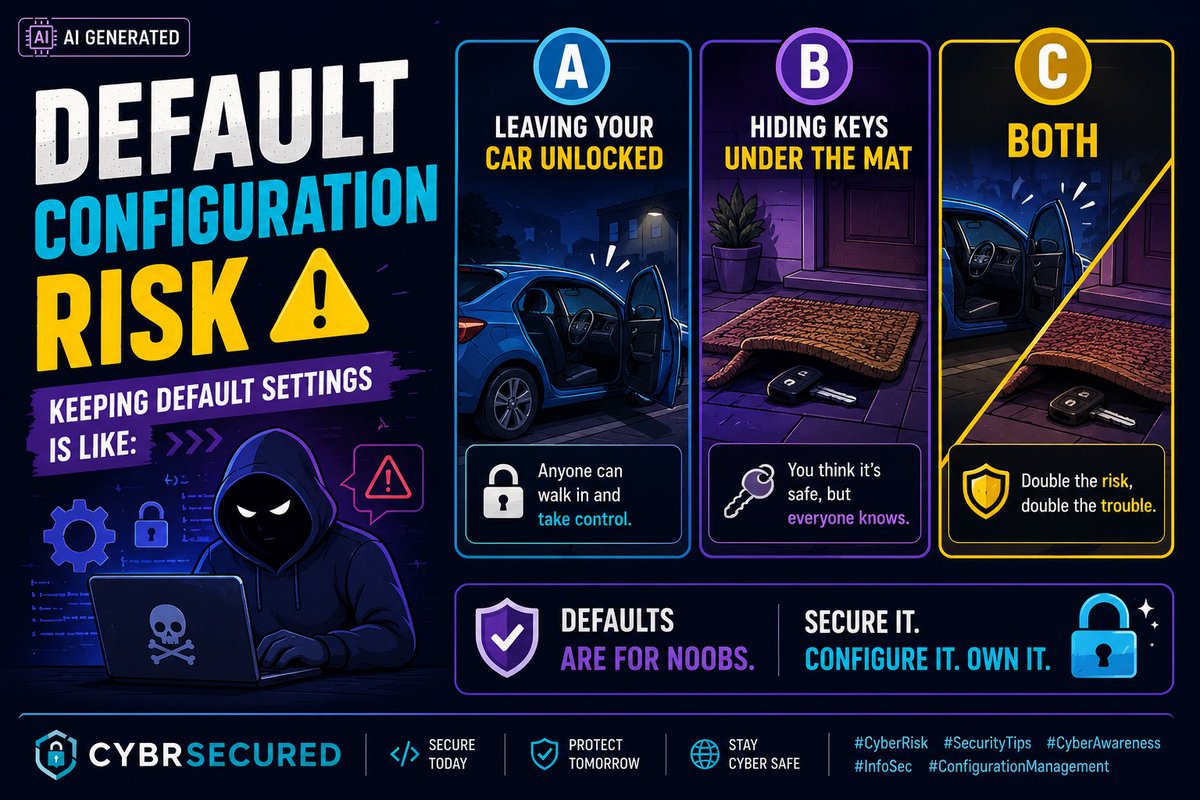
Default Configuration Risk ⚠️
Keeping default settings is like:
A) Leaving your car unlocked
B) Hiding keys under the mat 😭
C) Both
#CyberRisk #SecurityTips #CyberAwareness #InfoSec #ConfigurationManagement
3
1
9
7,049

Spring @PropertySource Guide: How to Load Multiple Custom Property Files | Spring Boot 2026
youtu.be/sufnucGDv80
#SpringFramework #SpringBoot #JavaDevelopment #Java #BackendEngineering #CleanCode #ConfigurationManagement #SoftwareArchitecture #thinkconstructive #JavaTips
4
319

Why Project Leaders Need Configuration Management Now youtu.be/363WkxBiK8A?si=sSvr… via @YouTube #ProjectManager #ProjectManagement #ProjectLeadre #ConfigurationManagement #ConfigurationManager #ChangeManagement #PMP #CAPM #PMPExamPrep
3
3
9

Jan 12
Why Project Leaders Need Configuration Management Now youtu.be/363WkxBiK8A?si=sSvr… via @YouTube #ProjectManagement #ConfigurationManagement #PMP #CAPM #ProjectManager #ProjectLeader #everetech
3
3
23

19 Dec 2025
What I learned today:
🔹 Set up Ansible from scratch on Ubuntu 🐧
🔹 Configured passwordless SSH authentication between servers 🔐
🔹 Ran my first Ansible ad-hoc commands — super easy for quick tasks ⚡
🔹 Created my first Ansible playbook to install & start Nginx 🌐
🔹 Learned inventory management & server grouping 🗂️
🔹 Explored Ansible Roles using ansible-galaxy for complex projects 🧩
Ad-hoc commands for simple tasks
playbooks for multiple tasks 🧠
#DevOps #Ansible #ConfigurationManagement #LearnInPublic 🚀
1
19
180
15 Dec 2025
Day 100 🚀
📌 Learned Configuration Management --> automatically setting up computers and software the same way every time.
Before ❌
🔹We have to Manually setup server everytime
🔹OS & script incompatibility become problem for developers.
🔹Poor scalability in cloud & microservices
🤓 Solution ✅
🛠️ Configuration Management Tools: Puppet, Chef, Salt
🏆 Ansible wins
Why Ansible Wins ?
🔹Push-based model (Admin pushes config instantly)
🔹It is Agentless (SSH / WinRM)
🔹It uses YAML (easy DevOps friendly)
🔹It has Dynamic Inventory (cloud-ready)
🔹Ansible Galaxy & custom modules
⚠️ Cons: Debugging & large-scale performance
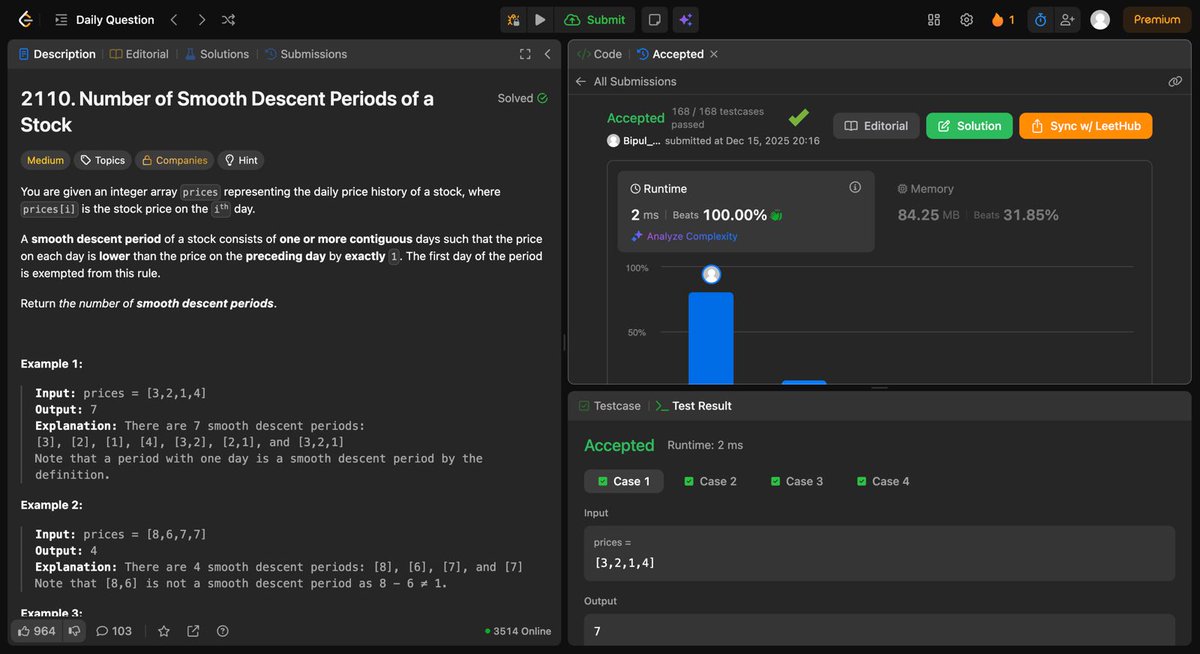
🔹Solve today #Leetcode Potd
#DevOps #Ansible #ConfigurationManagement
5
1
37
318

17 Jul 2025
A single unauthorized configuration change can bring your systems down. Don’t let it happen to you. Learn from our new article by Alex Bykovskyi for #StarWind how configuration management helps maintain stability, security, and agility – plus tools, benefits, and best practices.
Read more here: starwind.com/s/sx
#StarWind_handy #DevOps #ConfigurationManagement #CMTools #GitOps
10
11
739

15 Apr 2025
Struggled with finding the right input properties for command-based and non-command-based DSC resources?
In this short how-to article, you'll learn three methods:
gijsreijn.medium.com/the-thr…
#dsc #dscv3 #configurationmanagement
3
78

12 Mar 2025
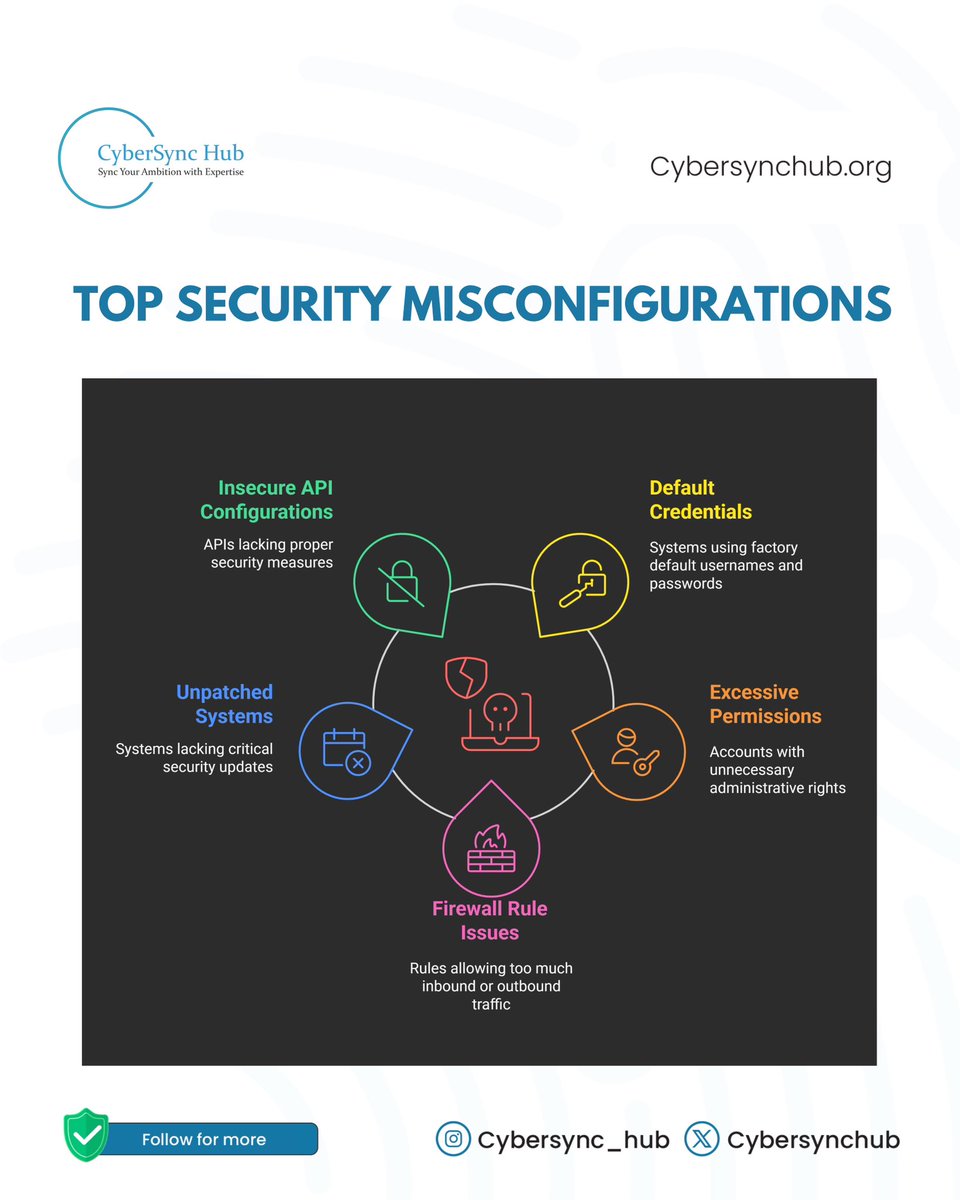
The harsh reality: attackers don't need sophisticated zero-days when these common misconfigurations offer the easiest way in.
Our Wednesday technical spotlight highlights five critical configuration errors that consistently appear in breach post-mortems and security assessments.
Review your environment today. How many of these have you eliminated?
#SecurityHardening #CyberDefense #ConfigurationManagement
3
4
110

12 Feb 2025
☁️ Hiring: Cloud Engineer
📍 #Remote | 🇧🇷 #Brazil
📝 Entry Level
🕗 Full-time
#Kubernetes #Python #Terraform #HighAvailability #CICD
#Hiring #CloudComputing #DevOps #ConfigurationManagement #TechJobs #RemoteWork
hubmub.com/jobs/186978/cloud…
1
2
100

31 Dec 2024
Move Drupal changes seamlessly! 🚀 Oliver Davies @opdavies shares insights on config management, Config Split, and CI pipelines for smooth environment transitions. Read more: bit.ly/3BCRVxi #Drupal #ConfigurationManagement #DevOps

10
65

14 Nov 2024
🚀 Windows Server 2025: Simplified Drift Control and Security Baselines with OSConfig! 🚀
Imagine deploying a full security baseline to Windows Server 2025 in seconds, knowing it’s locked down and stays compliant. No GPO refreshes or manual tweaks required. Windows Server 2025’s new OSConfig feature introduces Declared Configuration for seamless baseline deployment and automatic drift control, putting compliance on autopilot.
Are you curious about how OSConfig can transform your server management strategy? Join me as I explain this powerful new tool, which is set to change the game for configuration management!
lnkd.in/ea48PYUj
#WindowsServer2025 #OSConfig #DeclaredConfiguration #DriftControl #ConfigurationManagement #SecurityBaselines #Security #Intune #MSIntune #Windows #Windows11 #patchmypc

8
38
3,212

27 Oct 2024
Want to use `dsc.exe` on Linux/MacOS? I have just released a new version of my PowerShell module:
powershellgallery.com/packag…
The `Install-DscCli` detects what OS is running and installs the executable on your system.
#dsc #linux #macos #configurationmanagement #powershell
1
4
108

8 Oct 2024
If I configure code coverage in TeamCity at midnight, will I summon the debugging spirits or just a tech support hotline?
Source: devhubby.com/thread/how-to-e…
#codequality #agile #TeamCity #configurationmanagement #codecoverage #coverage
7
24

3 Oct 2024
I just published How to apply Patch Configs in Sitecore Docker environment setup link.medium.com/BEGT8NlVnNb
#Sitecore #Docker #DevOps #ConfigurationManagement #WebDevelopment
2
16

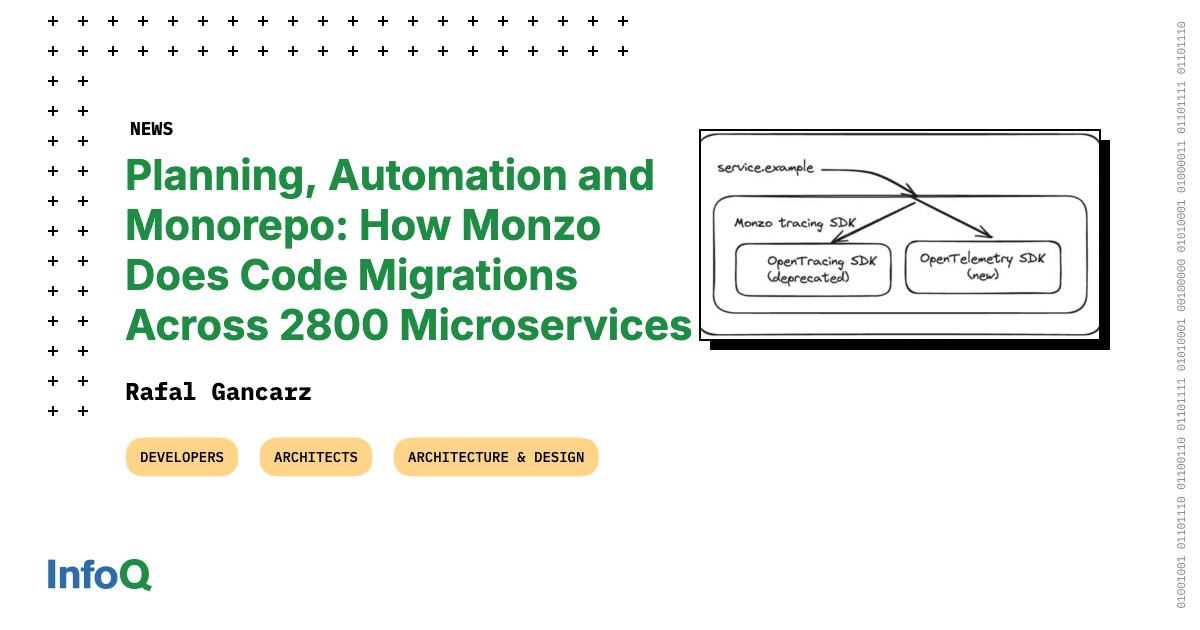
#CodeMigration at scale? Monzo does it with 2800 #microservices!
Careful planning, heavy automation, and config service ensure gradual roll forwards and quick rollbacks in case of issues.
Learn more on #InfoQ 👉 bit.ly/3Bmishz
#Observability #ConfigurationManagement
1
5
1,296