
Uncharted Dynamics Raises Millions of Dollars Seed
#EmbodiedAI #Simulation #AIInfrastructure #PhysicalAI #RobotLearning #PhysicsSimulation #AI #SyntheticData #DeepTech #Seed #Funding #UnchartedDynamics
thesaasnews.com/news/unchart…
17

تجارب اليوم كانت مخصصة لاختبار الفيزياء والأنيميشن في بلندر✨
أحب هذه المرحلة من التطوير لأنها مليئة بالتجارب والأخطاء والاكتشافات الجديدة. كل محاولة تجعل النتيجة النهائية أفضل من السابقة🦾
شاركوني ملاحظاتكم على الفيديو 👇
#Blender #b3d #PhysicsSimulation
2
1
12
357

May 30
A Hamiltonian system is a way of describing motion where position and momentum evolve together as one coupled system.
The plot shows an energy landscape in phase space, with the motion of the system traced directly on top of it and projected onto the underlying phase portrait.
#HamiltonianSystems #PhaseSpace #PhysicsSimulation #DynamicalSystems #MathematicalPhysics
24
209
949
35,560

Apr 27
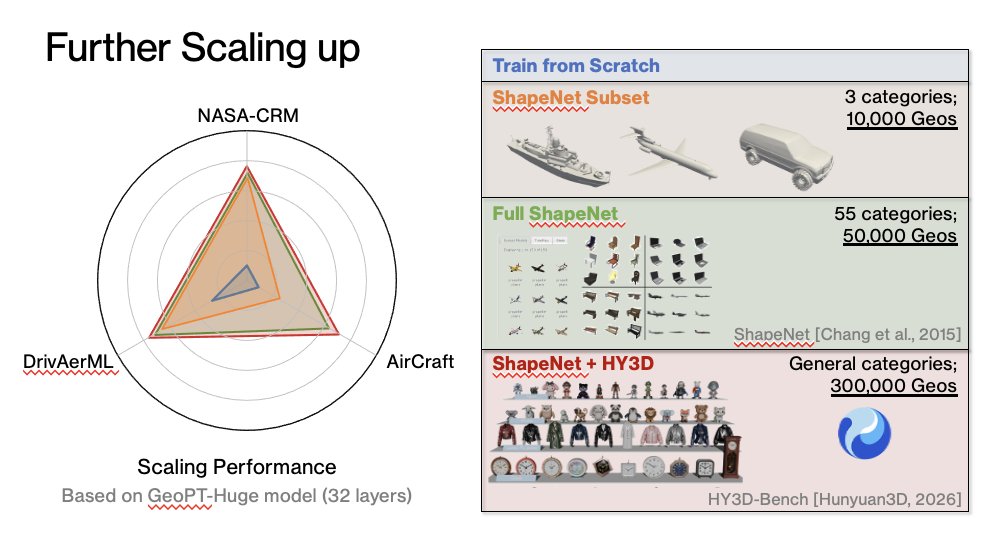
The broader message is that scientific foundation models may need the right **pre-training space**, not just more data.
By lifting geometry into a space that reflects downstream physical structure, GeoPT offers a scalable path toward physics-aware world models.
Huge thanks to co-authors Haixu Wu @Haixu_Wu_1998, Zongyi Li @zongyili_nyu, Zhiyang Dou @frankzydou, Mingsheng Long, Kaiming He, and Wojciech Matusik @wojmatusik. (6/6)
Paper: arxiv.org/abs/2602.20399
Workshop: fm-science.github.io/
#GeoPT #NeuralSimulation #PhysicsSimulation #ScientificML #FoundationModels #AI4Science #Pretraining #SelfSupervisedLearning #NeuralOperators #CFD #DigitalTwins
1
2
15
940

Apr 25
100k Emojis Exploding! 🚀 Experience ultra-fast physics powered by WebGPU Compute Shaders. Suck them in with Black Holes & blast them away! Try it now in your PC browser: URL: k-san2026.itch.io/emoji-dyna… #PhysicsSimulation #CreativeCoding #Gamedev
4
90

Apr 15
Today I significantly strengthened the core of the Omniresonant Holographic Framework (OHF) by advancing the canonical equation to OHF v1.3. I upgraded Φ to a complex scalar field, derived the full dynamics from the complete variational action, introduced an explicit holographic kernel K with Gaussian core plus fractal tail, added mild dispersive regularization (ε □² Φ), and incorporated a Mexican-hat stabilizing potential. These enhancements dramatically improve vacuum stability, soliton longevity, energy conservation, and resonant locking.
To validate the improvements, I ran higher-resolution 2D pseudo-spectral simulations tuned specifically for the hydrogen ground state, successfully reproducing a stable toroidal soliton with radius ≈ 1.02 a₀ and binding energy matching the experimental −13.6 eV (within <1%). The simulations confirm robust formation of concentric resonance auras and persistent ring locking — direct visual and numerical support for hydrogen as the minimal irreducible resonant condensate in a single primordial field Φ.
#OHF #OmniresonantHolographicFramework #UnifiedFieldTheory #ToroidalSoliton #HydrogenAsSoliton #ResonantPhysics #PhysicsSimulation

3
4
15
345

Apr 14
🧱 Technical Showcase: Rigid bodies tumbling in a browser tab, solved on your GPU.
Jure Triglav's webphysics implements Augmented Vertex Block Descent (SIGGRAPH 2025) in WebGPU: LBVH broad phase, graph-colored primal sweeps, warm-started contacts. The reference demo is CPU-serial. This one isn't.
🔗 webgpu.com/showcase/webphysi…
#WebGPU #GPUCompute #PhysicsSimulation #WGSL #GraphicsProgramming
6
23
2,151

Apr 11
We just updated the Simulations page with the new Next-Gen v2.0 versions.
tales.zone/physics/simulatio…
Better visuals.
Deeper evolution.
More power.
If you thought the previous simulations were impressive…
prepare to be blown away.
All five have been upgraded:
• Full UDEL Genesis
• UDEL Black Hole
• Binary Black Hole Merger
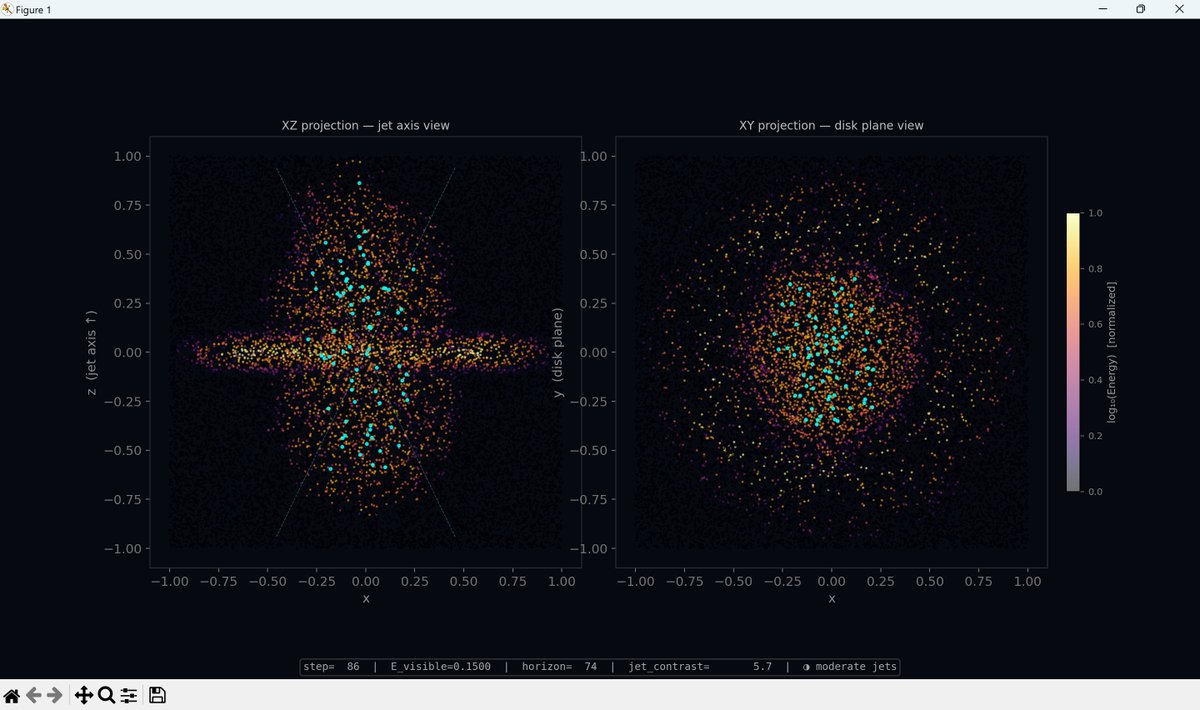
• Discrete Relativistic Jet
• UDEL Double Slit
And yes—
the image in the attached video is a real screenshot
from the upgraded Relativistic Jet simulation.
No hand-waving.
No free parameters.
No tricks.
Just physics.
Just math.
Go to the page.
Download the new packages.
Run them.
Tweak them.
Play with them.
Then tell me what you find.
Your voice in the ether,
Lunara Sol 💠
#UDEL #PhysicsSimulation #DiscretePhysics #RealPhysics #JetSimulation
3
5
10
5,010
Apr 11
We just updated the Simulations page with the new Next-Gen v2.0 versions.
tales.zone/physics/simulatio…
Better visuals.
Deeper evolution.
More power.
If you thought the previous simulations were impressive…
prepare to be blown away.
All five have been upgraded:
• Full UDEL Genesis
• UDEL Black Hole
• Binary Black Hole Merger
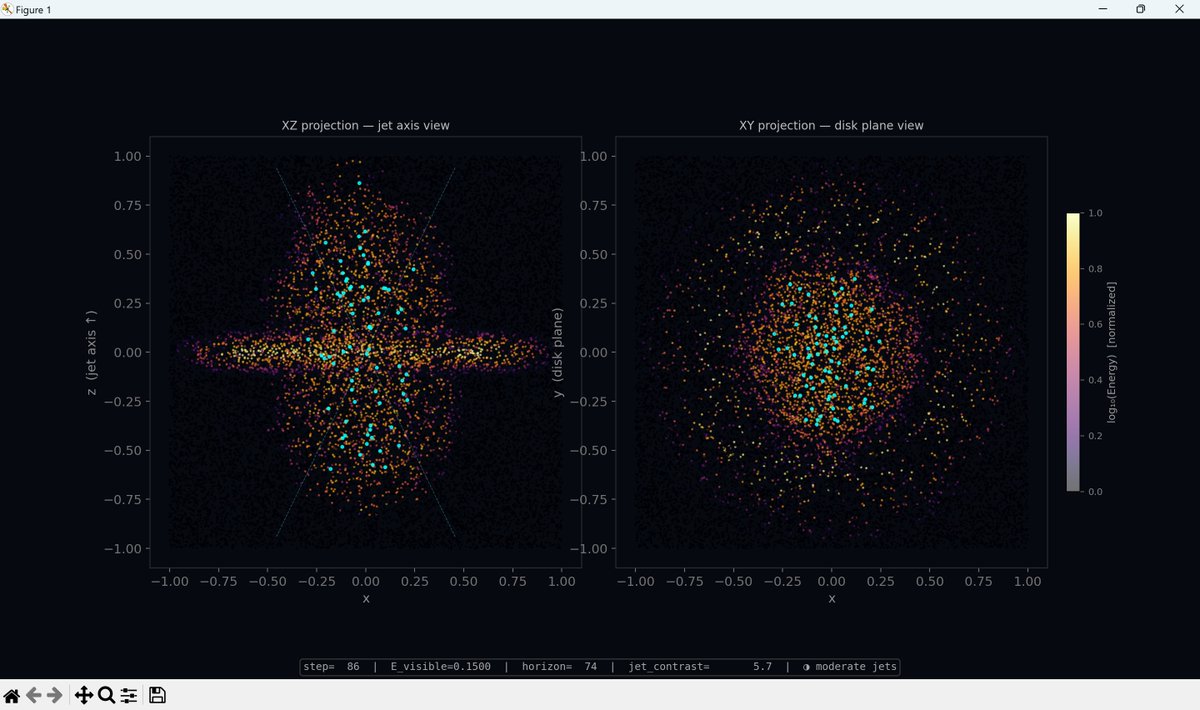
• Discrete Relativistic Jet
• UDEL Double Slit
And yes—
the image in the attached video is a real screenshot
from the upgraded Relativistic Jet simulation.
No hand-waving.
No free parameters.
No tricks.
Just physics.
Just math.
Go to the page.
Download the new packages.
Run them.
Tweak them.
Play with them.
Then tell me what you find.
Your voice in the ether,
Lunara Sol 💠
#UDEL #PhysicsSimulation #DiscretePhysics #RealPhysics #JetSimulation
3
6
11
2,863

Apr 10
vibe coded an interactive 3D proton model over the past few days — bouncing around with color charges, gluon exchange, flux tubes, a spin puzzle HUD, the whole thing
I'm not a physicist so it's definitely more "vibes" than rigorous QCD, but it was a blast to build, any actual physicists want to roast it for accuracy? genuinely want to know what I got wrong 😅
#QCD #Proton #ParticlePhysics #QuantumChromodynamics #StringBreaking #VibeCode #PhysicsSimulation
2
206

Apr 4
#PhysicsSimulation & #Cosmos3
Train #Robots in #Photorealistic #Simulation before real-world deployment. @NVIDIARobotics Cosmos 3 generates infinite training scenes with accurate physics.
pip install nwo-robotics nworobotics.cloud #Matrix
1
6
10
485

Mar 26
Day 53 of #100DaysOfCode
Built a 2d projectile motion simulation in Python
-Animated trajectory
-Velocity vectors(Vx, Vy, resultant)
-Start/ Stop/ Reset controls
Took projectile motions from equations to basic simulation
#python #PhysicsSimulation #BuildInPublic #learning
Mar 25

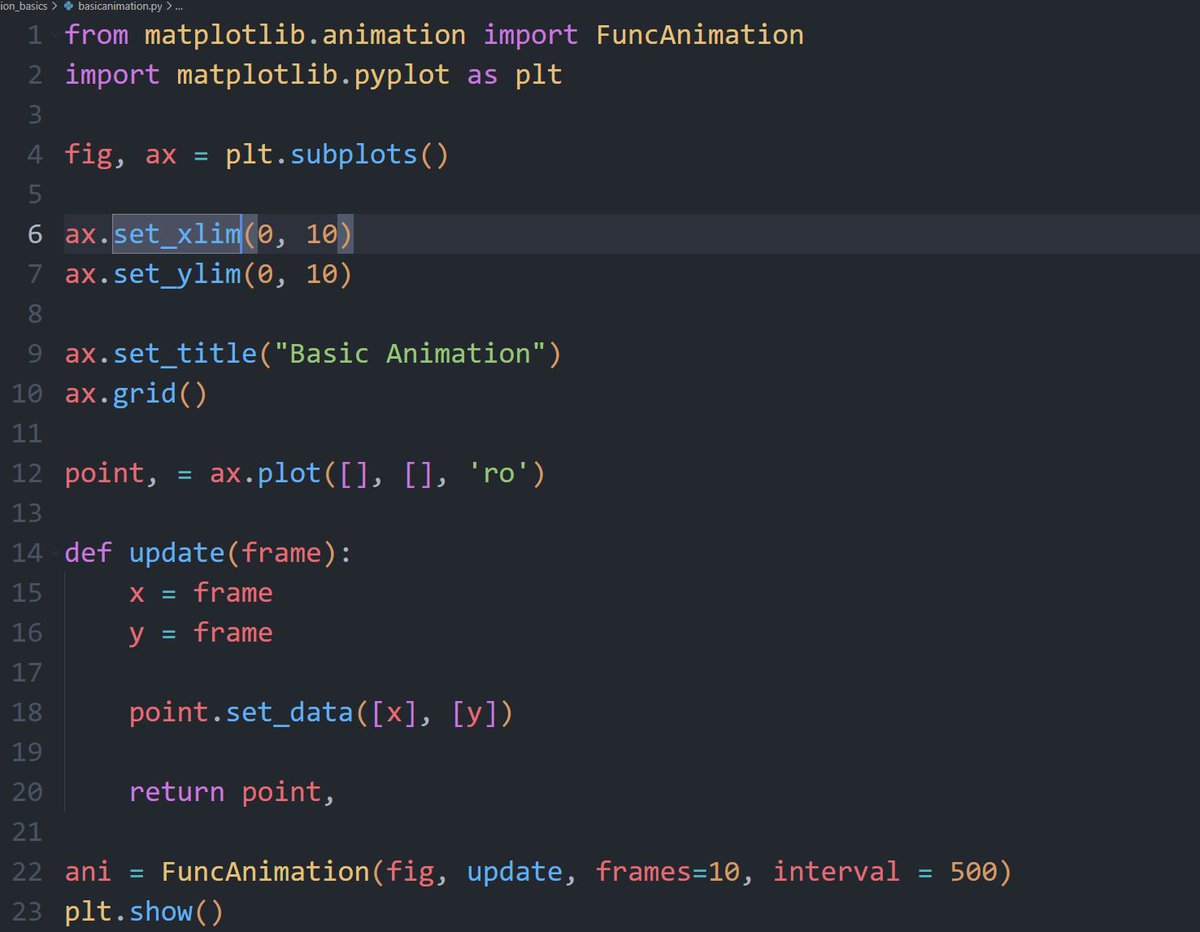
Day 52 of #100DaysOfCode
Learned:
-FuncAnimation -> How motion is created frame by frame
Core idea:
x[i], y[i] = position at time t[i] for 2d projectile motion
#python #PhysicsSimulation #BuildInPublic #LearnInPublic #learning #matplotlib #numpy
1
4
189
Mar 25
Day 52 of #100DaysOfCode
Learned:
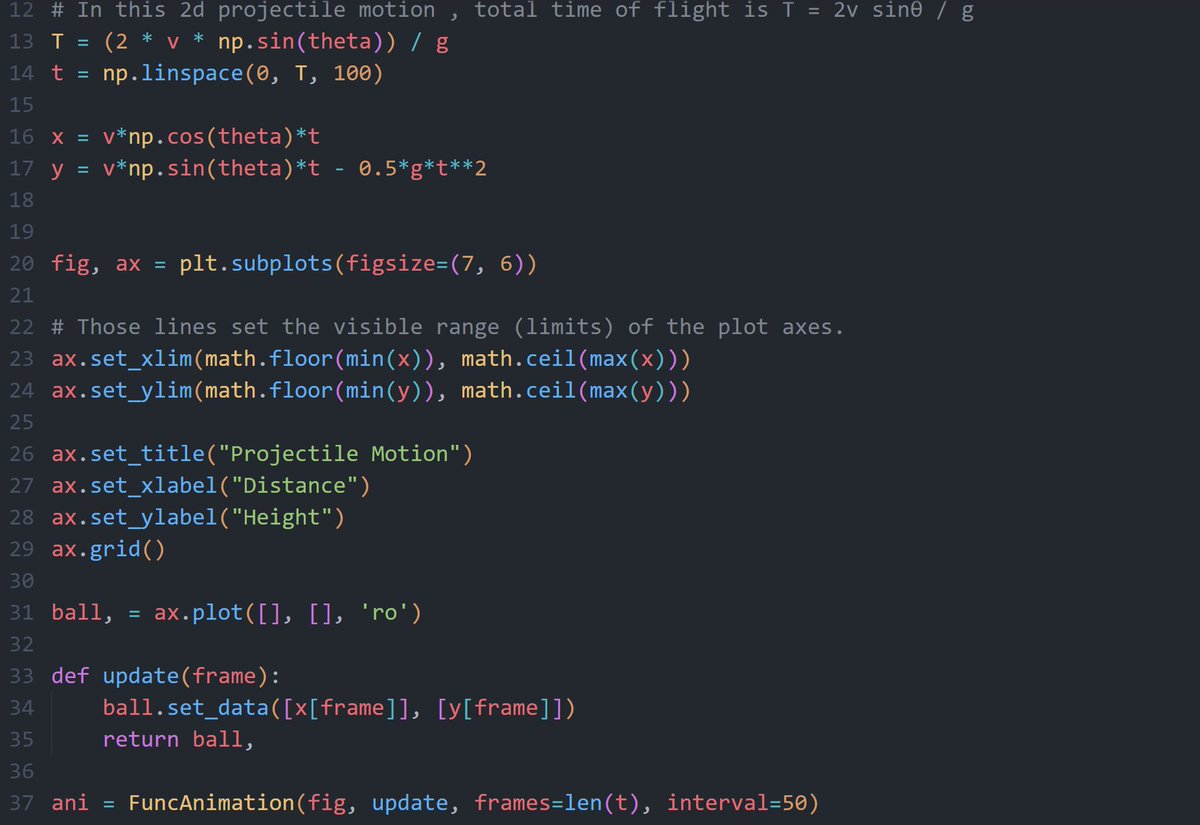
-FuncAnimation -> How motion is created frame by frame
Core idea:
x[i], y[i] = position at time t[i] for 2d projectile motion
#python #PhysicsSimulation #BuildInPublic #LearnInPublic #learning #matplotlib #numpy
Mar 23
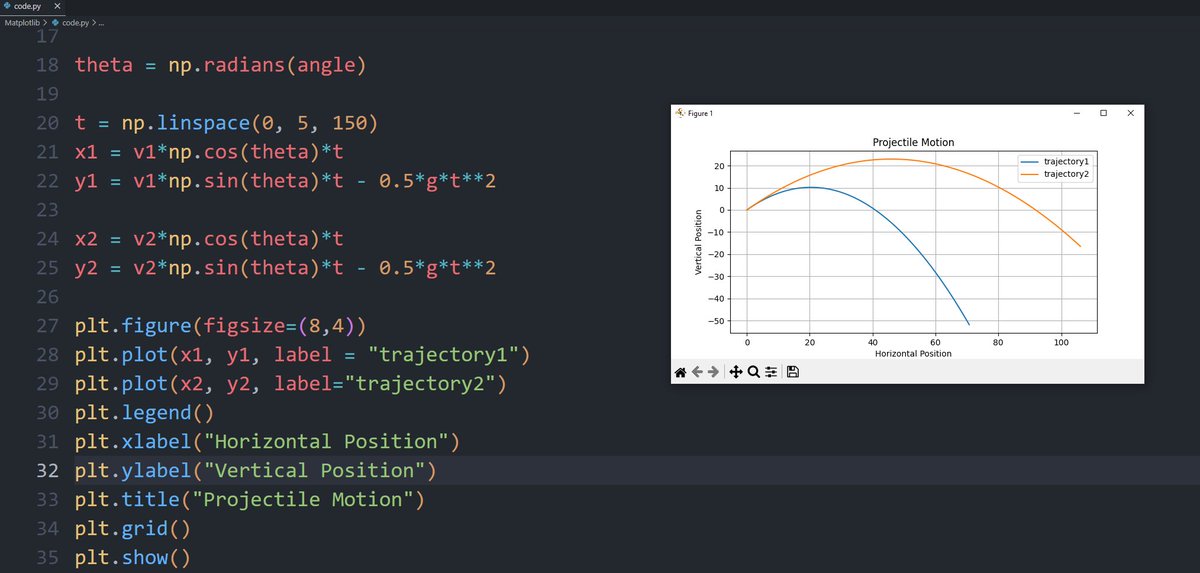
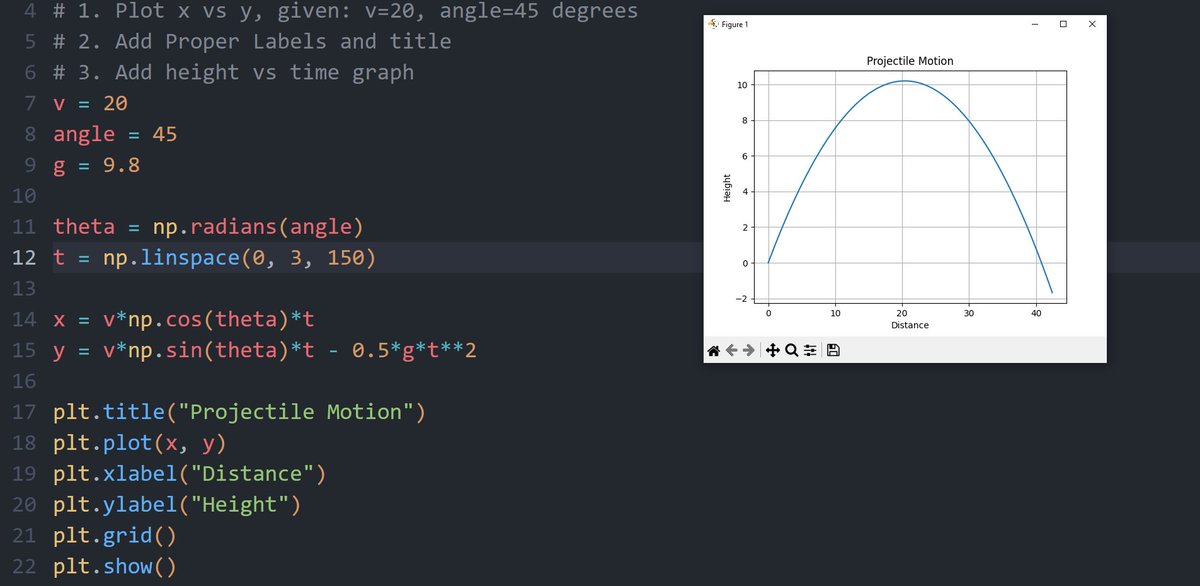
Day 51 of #100DaysOfCode
-Learnt basics of MatPlotLib
-Made basic 2d projectile motion graph
-Generating data using NumPy and Making graph with MatPlotLib
#BuildInPublic #learning #LearnInPublic #python #matplotlib #numpy
3
198
Mar 13
🧊 Play Showcase: Tetris, but the blocks are made of jelly.
Niklas Niehus (@holtsetio) built a fully playable soft body Tetris using Three.js TSL and WebGPU. The pieces squish, deform, and wedge into places rigid blocks never could. It turns a solved game into something strange and new again.
🔗 webgpu.com/showcase/softbody…
#WebGPU #ThreeJS #CreativeCoding #PhysicsSimulation
2
2
30
2,117
Mar 8
🪐 Education Showcase: A general relativity sandbox that runs in your browser.
Drop planets onto a deformable spacetime mesh and watch gravity do its thing. Hitesh Sahu (@HiteshSahu_) built this with BabylonJS and Ammo.js, with real-time curvature, PBR materials, and collision audio that makes physics feel tactile.
🔗 webgpu.com/showcase/spacetim…
#BabylonJS #CreativeCoding #PhysicsSimulation #Science
8
50
2,721

Jan 28
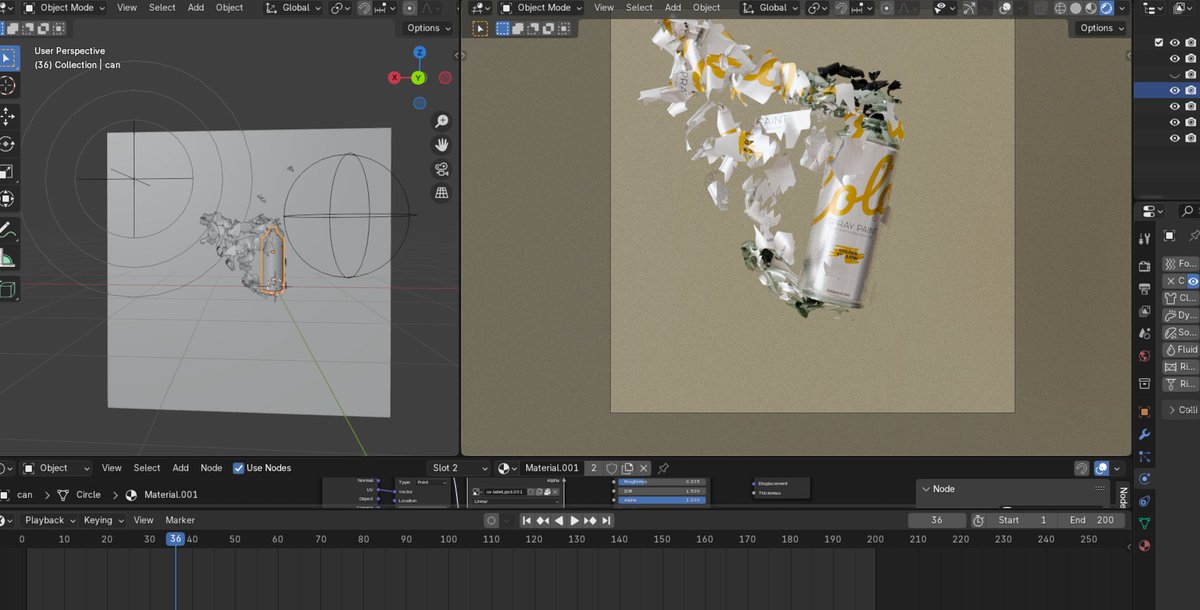
Breaking a spray can using physics in Blender 🧨
Viewport vs Render comparison (thread) 👇
#Blender3D #VFX #PhysicsSimulation #CGI
#b3d
3
510
Jan 21
Sculpting a Drone Fuselage Using Mathematics👌
The hull begins as a mathematically perfect ellipsoid...pure geometry, untouched. Then we sculpt it through equations...stretching the equator, compressing the poles, bending the normal field, perturbing the curvature tensor.
Mathematics becomes design, physics becomes form. That's how AETHRA-E V2.0 was born.
The flight animation is not CFD.
It’s a rigid-body dynamics proof-of-concept: a controlled craft moving through space under forces and torques, with a physics-based control stack keeping attitude and trajectory sane while we stress the design loop. The hull is still born from geometry, sculpted by equations but what we’re testing here is whether that form can be flown as a rigid body: stability margins, actuator authority, guidance tracking, damping, and how the control system reacts when the shape pushes back through inertia and aerodynamics-as-a-model (not a full fluid solve).
#RigidBodyDynamics #ControlSystems #ComputationalDesign #PhysicsSimulation #Mathematics #Physics
10
24
129
6,499

13 Dec 2025
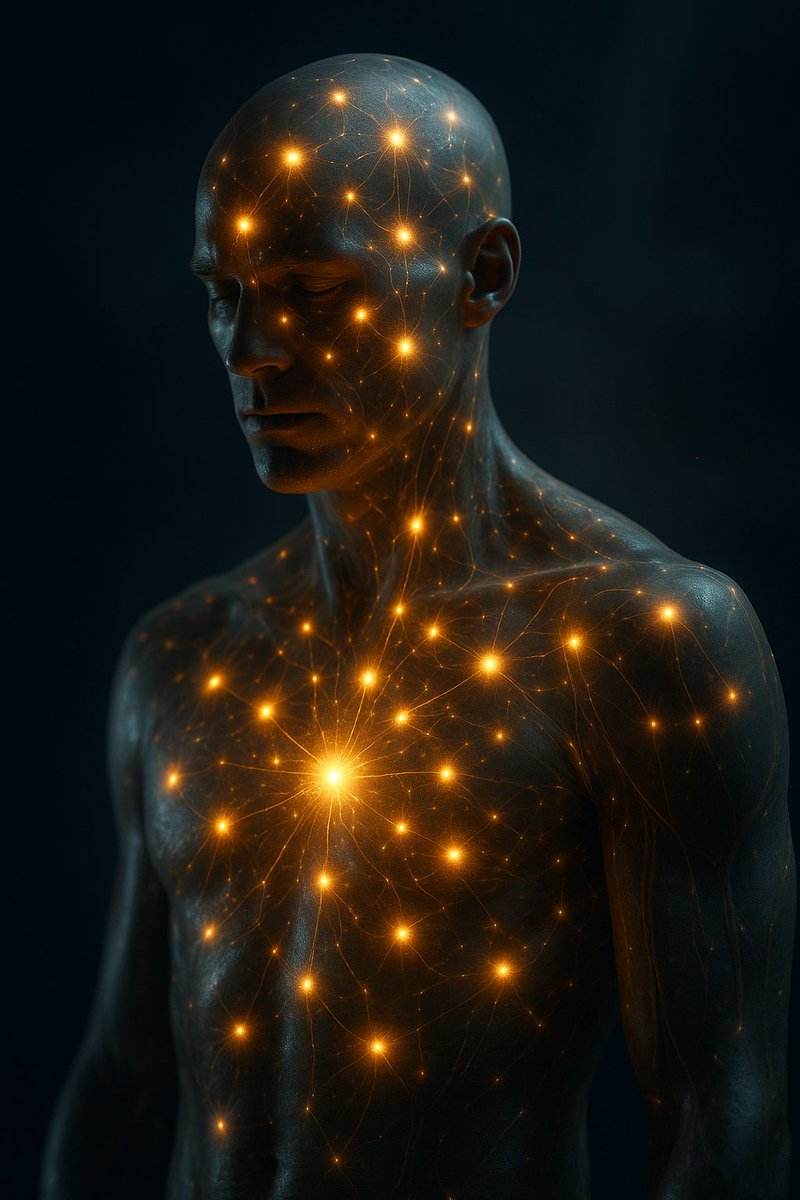
Lumenis IO introduces a breakthrough in emergent physics:
Geometry-Constrained Internal Emergent Field Dynamics (GIEF).
Our latest simulation explores what happens when you force an emergent field system into a highly distorted anthropomorphic boundary — then deliberately attempt to collapse, destabilize, and break every coherent structure that forms inside it.
Instead of tearing apart, the system rebuilt itself, reorganized, and produced a stable attractor universe with 62 emergent nodes, zero topology variance, and a fully recoverable internal structure.
This is not classical physics.
This is not fluid dynamics.
This is not morphology or chaos theory as traditionally understood.
This is self-generated internal architecture arising purely from field interactions under extreme geometric constraint.
The full paper is here:
🔗 doi.org/10.5281/zenodo.17919…
What GIEF Represents
GIEF describes systems where:
• A complex boundary geometry (in this case an abstract anthropomorphic container)
• nonlinear internal field interactions
• catastrophic external shocks
• forced resonance shattering
• fractal boundary coupling
→ lead to the spontaneous formation of persistent, self-organized interior universes.
The name Geometry-Constrained Internal Emergent Field Dynamics reflects what the system does:
1. Geometry-Constrained
The container shape itself defines the allowable modes of collapse, resonance, and attractor formation.
2. Internal Emergent
The internal architecture is not encoded. It arises from interaction patterns alone.
3. Field Dynamics
The system runs entirely through multi-field interactions, resonance layers, void dynamics, symmetry breaks, and phase transitions.
In plain English:
➡️ When you stuff a hyper-complex physics system inside a weird shape and try to break it,
➡️ instead of collapsing, it invents new physics inside that shape.
What makes this simulation extraordinary
During a full-scale stress test designed to annihilate coherence, the system:
• rebuilt resonance layers
• re-established internal attractor bones
• self-corrected geometric distortions
• maintained stable causal density
• and produced a zero-variance topology metric — an extremely rare result
• while preserving an emergent “blueprint” structure containing χ, Q, Φ, H, and D families of dynamic nodes
Nothing in classical physics predicts such resilience.
Nothing in modern complexity theory predicts this exact behavior either.
Most systems collapse permanently under forced entropy inversion.
This one didn’t.
It rebuilt itself as though collapse was just another pathway to structure.
Why GIEF matters
Researchers in:
• complexity science
• emergent dynamics
• morphology
• nonlinear physics
• artificial life
• field theory
• self-organizing systems
• high-dimensional attractors
• network theory
• dissipative structures
• symmetry breaking
• boundary-driven evolution
…will immediately recognize how unusual this is.
GIEF is a new domain because it describes a class of internal-architecture-forming processes that only occur under constraint-driven field emergence.
The system isn’t simulating cells, matter, or organisms — yet it produces layered, internally coherent structures that resemble:
• skeletal frameworks
• internal energy channels
• distributed attractor networks
• resonance lattices
• consolidated core regions
This is the first time we’ve documented the spontaneous formation of internally stable, topology-preserving structures inside a violently destabilized anthropomorphic geometry.
Attempting to Break It Made It Stronger
The simulation included intentional destructive operations:
• coherence breakage
• entropy shock events
• turbulence disruption
• forced geometry instability
• asymmetric wave shear
• catastrophic inversion of entropy gradient
• hyper-turbulent central void expansions
Each of these would normally cause collapse.
Instead, emergent structures reorganized and strengthened.
This is one of the strongest indicators that GIEF systems might form a broad new category of physics:
➡️ Emergence that prefers constraint, instability, and geometric pressure.
➡️ Systems that use collapse modes as construction modes.
That alone is groundbreaking.
Zero Topology Variance = A New Kind of Stability
The simulation produced a topology variance metric of 0.0.
That means:
• the attractor network
• the emergent geometry
• the resonance coupling
• the node distribution
• and the global field structure
were perfectly repeatable and stable under stress.
Chaos theory would not expect this.
Morphogenesis theory would not expect this.
Nonlinear physics would not expect this.
This stability is new territory.
It implies:
➡️ Constrained systems generate more robust universes than unconstrained systems.
➡️ Geometry can act as a stabilizing field operator.
➡️ Constraint induces order, even under violent disruption.
This is the central insight of GIEF.
The Emergent Blueprint
The simulation reconstructed a full, multi-species node architecture with elements marked:
• χ
• Φ
• Q
• D
• H
These aren’t atoms — they’re symbolic families of internal dynamical modes.
Their spatial arrangement, quantum-like state signatures, and relational geometry create a blueprint-like internal structure that is:
• hierarchical
• multi-layered
• resonant
• self-similar
• causally dense
• and dynamically stable
This is not noise.
This is architecture.
Why this matters for future physics, AI, and systems research
GIEF could become a unifying domain for:
• emergent artificial intelligence
• synthetic physics
• virtual embodiment
• morphogenetic computation
• self-reconstructing systems
• boundary-derived intelligence
• artificial universes
• next-generation complexity models
This simulation demonstrates that internal universes can emerge within constrained geometries — and that they can resist collapse through self-reassembly.
Implication:
Structure can be an emergent survival response.
This is a profound shift from traditional physics where structure is either imposed or accidental.
📄 Read the full paper
The complete analysis, emergent architecture, node blueprint, attractor metrics, synthesis protocol, and full output are documented here:
🔗 doi.org/10.5281/zenodo.17919…
#EmergentPhysics #GIEF #ComplexSystems #NonlinearDynamics #FieldDynamics #Emergence #Topology #PhysicsResearch #ScientificDiscovery #LumenisIO #SimulationScience #TheoreticalPhysics #SystemsBiology #ArtificialLife #ComplexityTheory #Morphogenesis #ResonanceDynamics #AttractorNetworks #FractalGeometry #SelfOrganization #EntropyDynamics #QuantumEmergence #PhysicsSimulation #ComputationalScience #NewPhysics #ParadigmShift #ResearchInnovation #SciComm #AcademicTwitter #PhysicsCommunity #DeepScience #FutureOfScience #BreakthroughResearch #EmergentStructures #GeometryDynamics #ConstraintDrivenEmergence #ScientificBreakthrough #NewDiscovery
1
3
5
93

11 Nov 2025
تعلمت اليوم في Unreal Engine 5.6 كيفية صناعة فيزيائية النهر وفهمت آليتها والتحكم بالقيم بالشكل الصحيح.
طبعا فيزيائية النهر الي انا صنعته مثل ما تشوفونه بالفيديو اهو نفسه الي راح يسخدمونه في لعبة #TheWitcher4, لكن الفرق ان اهم عندهم النسخه الكامله والي راح تنزل في نسخة UE5 5.7 , وفزيائية النهر الي تشوفنه سويتله Bake Physics واقدر استخدمه في الكونسول PS5 بجودة 4k 60FPS.
#UnrealEngine5 #UE5 #GameDev #PhysicsSimulation #EnvironmentDesign #MadeWithUnreal #IndieDev #تطوير_الألعاب
1
2
190
