
⚔️📜 The Sword and the Ledger: A 1944 Herzog Seizure and a Possible Museum Match
In 1944, during the systematic seizure of Jewish-owned property in Budapest, officials inventoried objects removed from the Herzog Palace at Andrássy út 93 — home to one of Hungary’s most important Jewish collections.
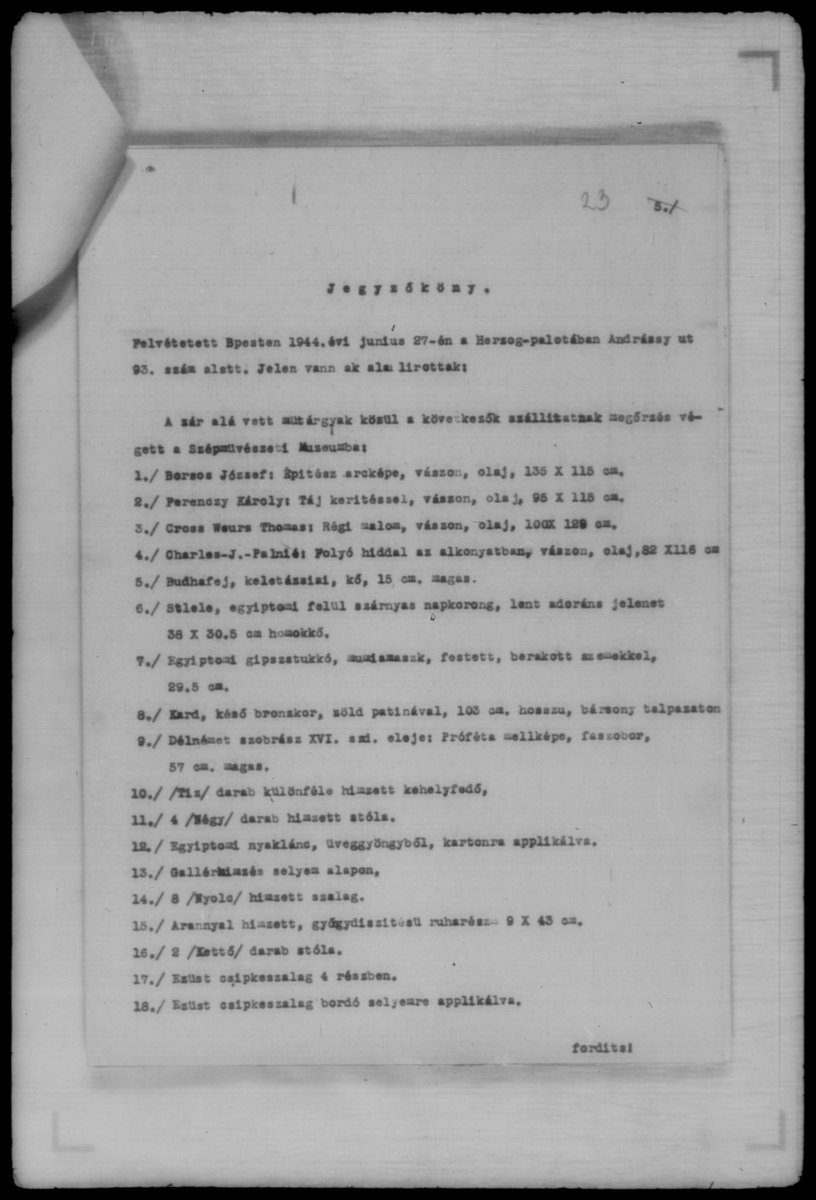
Among the entries appears #8 with, a specific description:
“Kard, késő bronzkor, zöld patinával, 103 cm hosszú, bársony talpasaton.”
Late Bronze Age sword, with green patina, 103 cm long, on a velvet stand.
🏛️ The Herzog Collection
The object belonged to the collection assembled by Baron Mór Lipót Herzog (1869–1934), one of Central Europe’s most significant art collectors.
Following the German occupation of Hungary in March 1944, artworks and antiquities from the Herzog collection were systematically inventoried and seized under anti-Jewish measures. Many objects were transferred into Hungarian state custody through museums and other public institutions.
This sword was among them.
⚔️ A Possible Modern Candidate
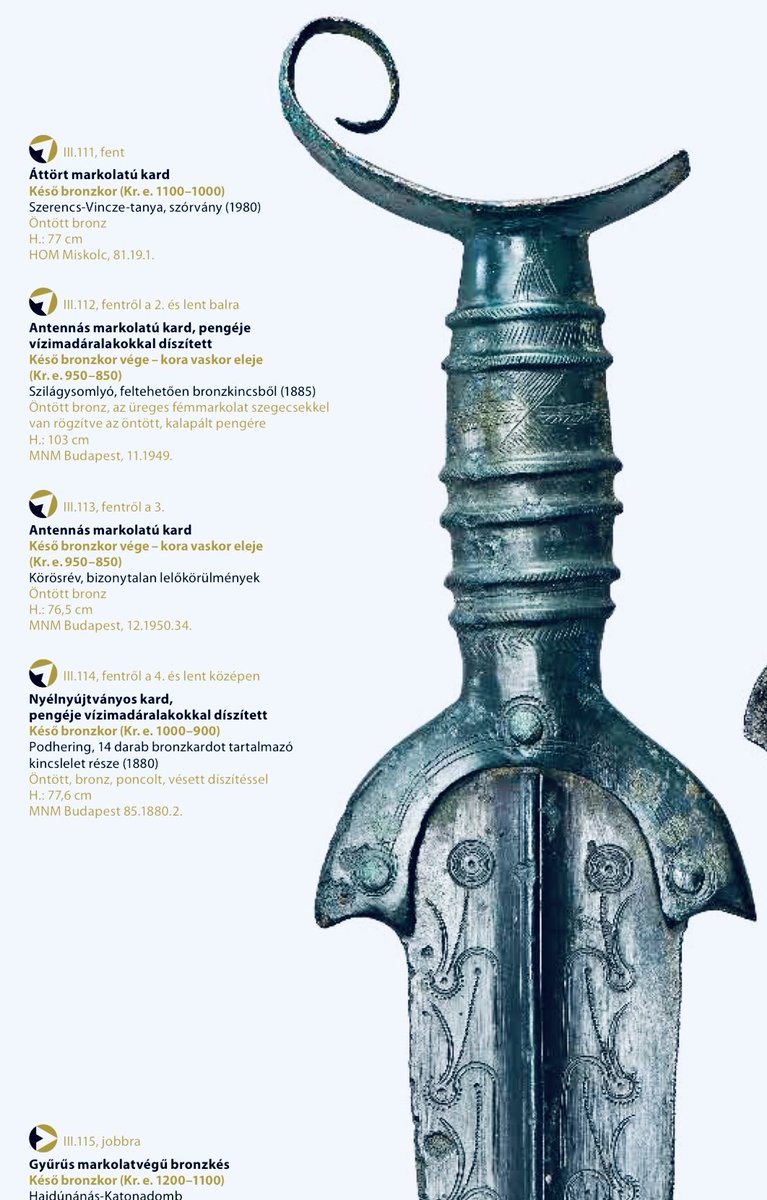
A compelling candidate exists today in the collections of the Hungarian National Museum:
Late Bronze Age antenna-hilted sword
Length: 103 cm
Date: c. 950–850 BCE
MNM 11.1949
The sword is catalogued in Hungarian archaeological literature and belongs to the class of high-status prestige weapons produced during the final centuries of the Bronze Age in the Carpathian Basin.
Most strikingly, its documented length is exactly 103 cm — the same measurement recorded in the 1944 Herzog inventory.
🔍 Why This Matters
Several factors make this an important provenance lead:
• Exact length match: 103 cm
• Correct period: Late Bronze Age
• Consistent condition: ancient bronze with green patina
• Display context: the 1944 inventory notes a velvet stand, suggesting a curated collector’s object rather than a recently excavated find
Taken together, these details warrant further investigation.
❓ The Provenance Gap
The surviving 1944 inventory establishes that a 103 cm Late Bronze Age sword was present in the Herzog Palace and entered state custody during the Holocaust era.
What remains unclear is whether the sword now catalogued in Hungarian museum collections is the same object.
Publicly available records do not currently identify the Herzog collection as part of its ownership history, nor do they reference the 1944 seizure.
📜 A Call for Transparency
@ArtRecoveryInit calls upon the Hungarian National Museum and the Museum of Fine Arts, Budapest to review and publish any records relating to:
• 1944 transfers from the Herzog collection
• Subsequent museum deposits and movements
• Accession files connected to 103 cm Late Bronze Age swords in state custody
⚖️ Restoring the Broken Line
The striking overlap between the 1944 ledger and the 103 cm sword cataloged as MNM 11.1949 presents an uncontradicted mandate for clarity. Because the archival trail confirms this curated weapon was plundered from the Herzog Palace, the burden now rests on the holding institutions to open their internal accession books and wartime deposit records. Tracing this definitive chain of custody is the only way to close the provenance gap and restore the true history of this artifact.
#HolocaustArtRecovery #HerzogCollection #ProvenanceResearch #LootedArt #BronzeAgeSword #HungarianNationalMuseum #MuseumOfFineArtsBudapest #WashingtonPrinciples #HEARAct
@WJRORestitution @nytimesarts @USAmbHungary @Telexhu @bbcarts @cnni @ArannReichhardt @neil_burridge @swordposting @ancientorigins @archaeologyart @archeohistories @smithsonian @LootBuster @ChasingAphrodit @artnet @wolfblitzer @elonmusk
1
1
2
236
🔎 1944 Seizure Entry vs. 2021 Market Appearance: Csók István's Balaton Masterpiece
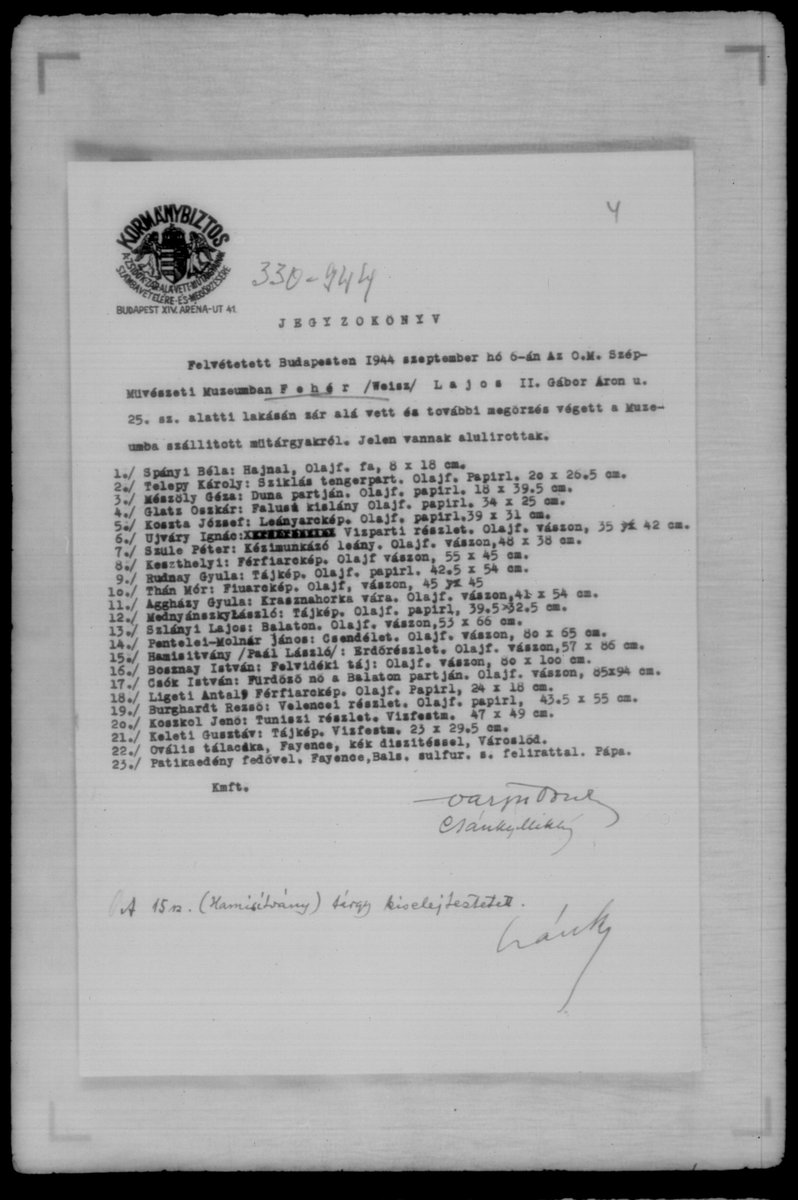
A 1944 Hungarian Government Commissioner inventory records the wartime seizure and museum transfer of artworks from the sealed Budapest home of Fehér/Weisz Lajos, at Budapest II., Gábor Áron u. 25.
Among the listed works on Reel 144, slide 787 is Item 17:
“Csók István: Fürdőző nő a Balaton partján. Olajf. vászon, 85 × 94 cm.”
Translation: István Csók — “Bathing Woman on the Shore of Lake Balaton.” Oil on canvas, 85 × 94 cm.
🖼️ A compelling 2021 market candidate
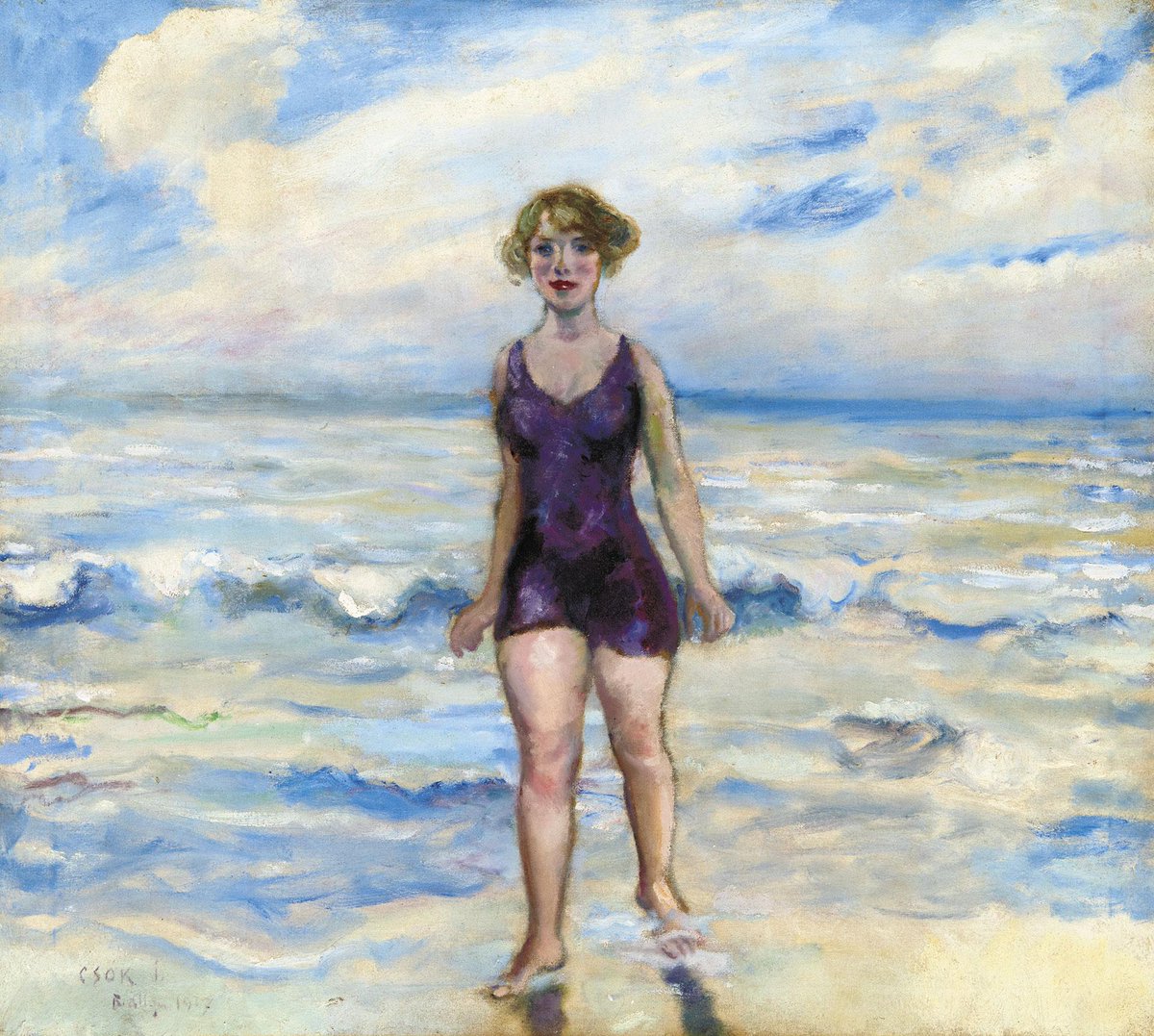
A work that closely corresponds to this seizure entry appeared at Virág Judit Gallery, 67th Autumn Sale, Lot 96:
Csók István, Lake Balaton, 1917
Oil on canvas, 83 × 95 cm
Signed bottom left: “Csók I. B. aliga 1917”
Auction record and image:
viragjuditgaleria.com/en/lot…
🧩 Why this candidate matters
The convergence is significant:
• Artist: exact match — Csók István.
• Subject: the 1944 title describes a bathing woman on the shore of Lake Balaton. The 2021 auction title is generalized to Lake Balaton, but the image shows a woman in bathing attire standing at the water’s edge.
• Dimensions: 85 × 94 cm in the 1944 record versus 83 × 95 cm in the auction record — effectively the same format, allowing for normal cataloguing, framing, or measurement variance.
• Medium: both records identify the work as oil on canvas.
• Location inscription: the signature includes “B. aliga 1917,” indicating Balatonaliga, which fits the Balaton-shore subject directly.
This should be treated as a high-confidence match candidate requiring full provenance review, not as a closed identification until the ownership history is publicly clarified.
⚠️ The provenance gap
The public 2021 auction record does not account for the painting’s ownership history between the 1944 seizure inventory and its recent market appearance. For a work with this level of archival and visual correspondence, that gap should be addressed transparently and responsibly.
💎 The Rarity Factor
Csók’s Balaton pictures occupy an important place in his mature work, and a large, signed 1917 Balatonaliga canvas is not an ordinary market appearance. When a distinctive, large-format Csók Balaton painting appears publicly without a disclosed wartime ownership history, and a 1944 seizure inventory records a near-identical Csók Balaton-shore bathing subject from a sealed Jewish-owned Budapest collection, the responsible next step is full disclosure of the painting’s ownership path, verso evidence, and any wartime or postwar museum-transfer records.
📢 Request for disclosure and review
@ArtRecoveryInit calls on the relevant parties — including Virág Judit Gallery, any current holder, and the appropriate Hungarian museum and archival authorities — to assist in clarifying the painting’s chain of custody by disclosing or making available:
📜 Full pre-2021 provenance and ownership history
📸 Verso photographs, including labels, stamps, inscriptions, and inventory numbers
🏛️ Any wartime or postwar museum deposit, transfer, return, or deaccession records
🛡️ Consignor-side due diligence information, where legally shareable
📁 Archival records connected to Fehér/Weisz Lajos, Budapest II., Gábor Áron u. 25
This is exactly the kind of case that Holocaust-era provenance research is meant to clarify: a documented wartime seizure entry, a closely matching later-market appearance, and a public record that does not yet explain the intervening chain of custody.
Transparency here would serve the historical record, the art market, the museum field, and the families whose collections were seized in 1944. 🕯️
#HolocaustArtRecovery #CsókIstván #IstvanCsok #ProvenanceResearch #NaziLootedArt #Hungary1944 #ArtRestitution #WashingtonPrinciples #HungarianArt #Restitution
@WJRORestitution @nytimesarts @Telexhu @schuhmacher @artbreakhotel @guardian @cnni
1
1
162
🕯️ #9 on the Weiser Inventory: Tracing a Lost Vida Géza Sculpture
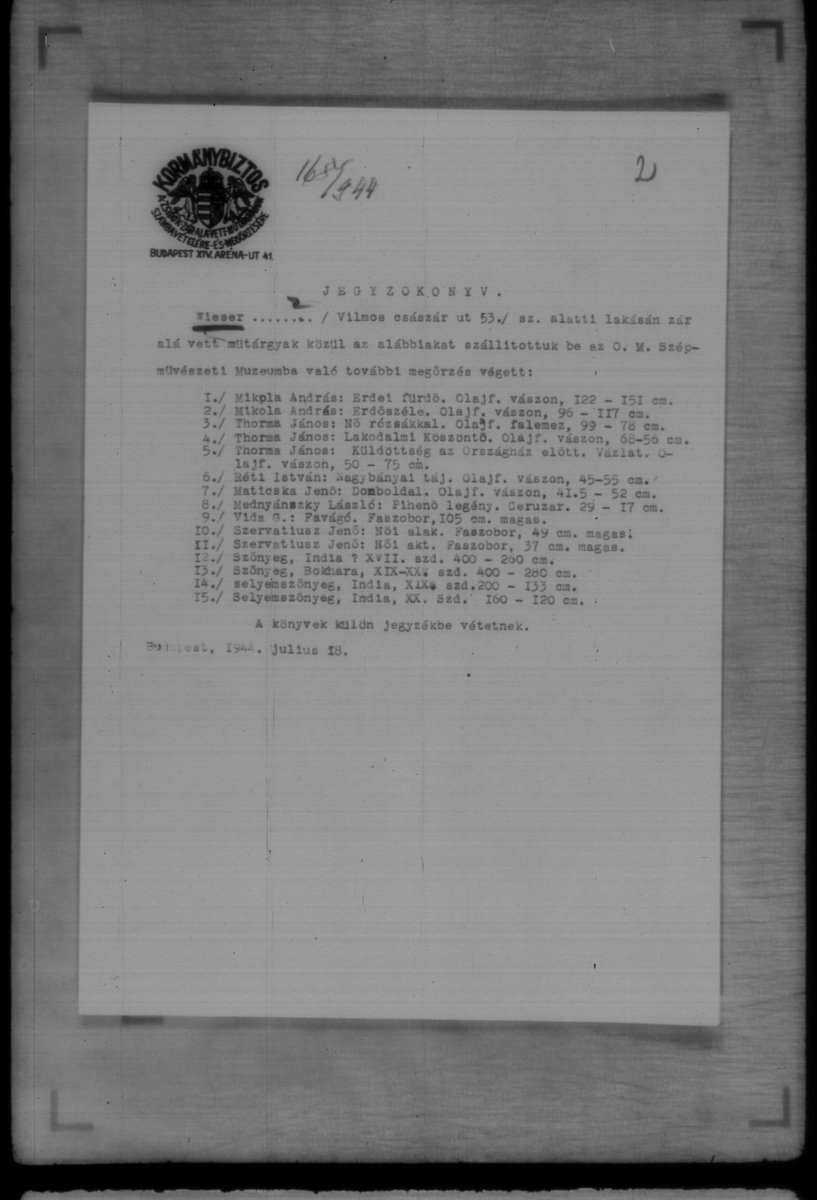
Continuing the review of Case 168/1944 — the 18 July 1944 seizure from the Budapest apartment of Jewish collector Miklós Weiser at VI., Vilmos Császár út 53.
The inventory records:
“9./ Vida G.: Favágó. Faszobor, 105 cm. magas.”
(“Vida G.: Woodcutter. Wood sculpture. Height 105 cm.”)
🌲 The Strongest Candidate
One work stands out as an exceptionally strong match candidate:
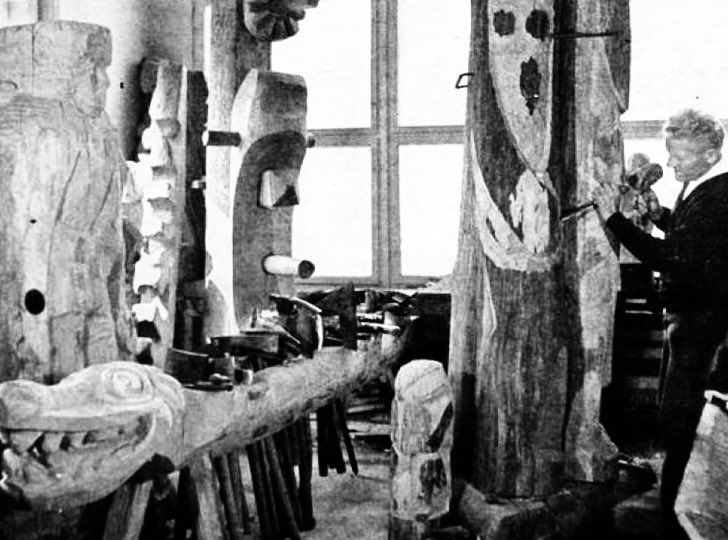
Vida Géza, A favágó (The Woodcutter), 1937
Wood sculpture
Height: 105 cm
The sculpture appears in an official 2018 public document concerning the Bay Collection at the Thorma János Museum in Kiskunhalas, where it is listed as:
“Vida Géza: A favágó, 1937 (fa, 105 cm)”
The alignment is striking:
• Artist: Vida G. / Vida Géza
• Title: Favágó / A favágó
• Medium: Wood sculpture
• Height: 105 cm
• Subject: Woodcutter
📚 About the Artist
Vida Géza (1913–1980) was one of the most significant sculptors associated with the Nagybánya (Baia Mare) artistic tradition. Known for expressive wood carvings depicting workers, peasants, and everyday life, he frequently explored labor-oriented themes that reflected the social realities of the era.
A sculpture titled A favágó fits squarely within his documented artistic practice.
🔍 Why This Matters
Provenance research often depends on assembling multiple pieces of evidence rather than finding a single document that answers every question.
Here, the combination of:
• Artist match
• Subject/title match
• Medium match
• Exact height match (105 cm)
creates a compelling connection between the 1944 Weiser inventory and the museum-listed sculpture.
At present, no publicly available provenance records explain how a sculpture matching the inventory description may have traveled from a Holocaust-era seizure record to its later museum listing.
📜 A Call for Transparency
The historical record would benefit from the publication of any available acquisition files, provenance research, transfer records, or wartime documentation relating to this sculpture.
Under the spirit of the Washington Principles and ongoing Holocaust-era provenance initiatives, transparency helps institutions, researchers, descendants, and the public better understand the history of cultural property affected by persecution and war.
Every recovered document adds another piece to the story.
🕯️ Remembering Miklós Weiser means remembering not only the people who were targeted, but also the artworks and cultural objects caught up in that history.
#HolocaustArtRecovery #ProvenanceResearch #VidaGeza #WashingtonPrinciples #HEARAct #ArtHistory #CulturalHeritage #MuseumTransparency #Nagybanya #LostArt
@WJRORestitution @nytimesarts @USAmbHungary @SecRubio @HolocaustUK @HolocaustMI @CathyHickley @AmbHerzog @TheLeoTerrell @CarolineGlick
3
4
187
🕯 The Greeting Man and the Weiser Inventory: A 1944 Seizure Record Points to the Thorma János Museum
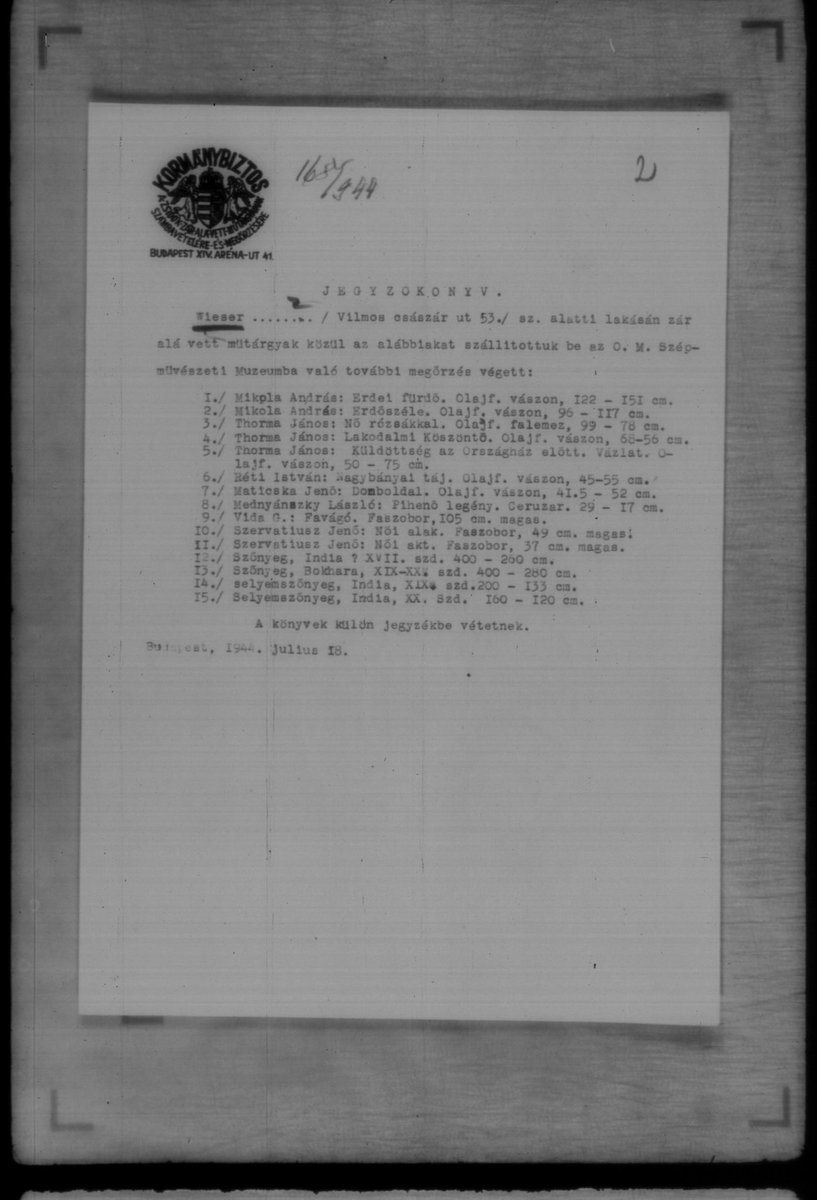
Case 168/1944, bearing the stamp of the Government Commissioner for Jewish Affairs, records the forced seizure of fifteen artworks from the Budapest apartment of Weiser Miklós at VI., Vilmos Császár út 53 on 18 July 1944. The fourth entry reads:
“4./ Thorma János: Lakodalmi Köszöntő. Olajf. vászon, 68–56 cm.”
Lakodalmi Köszöntő — Wedding Toast. Oil on canvas. 68 × 56 cm.
🔍 The Match Candidate
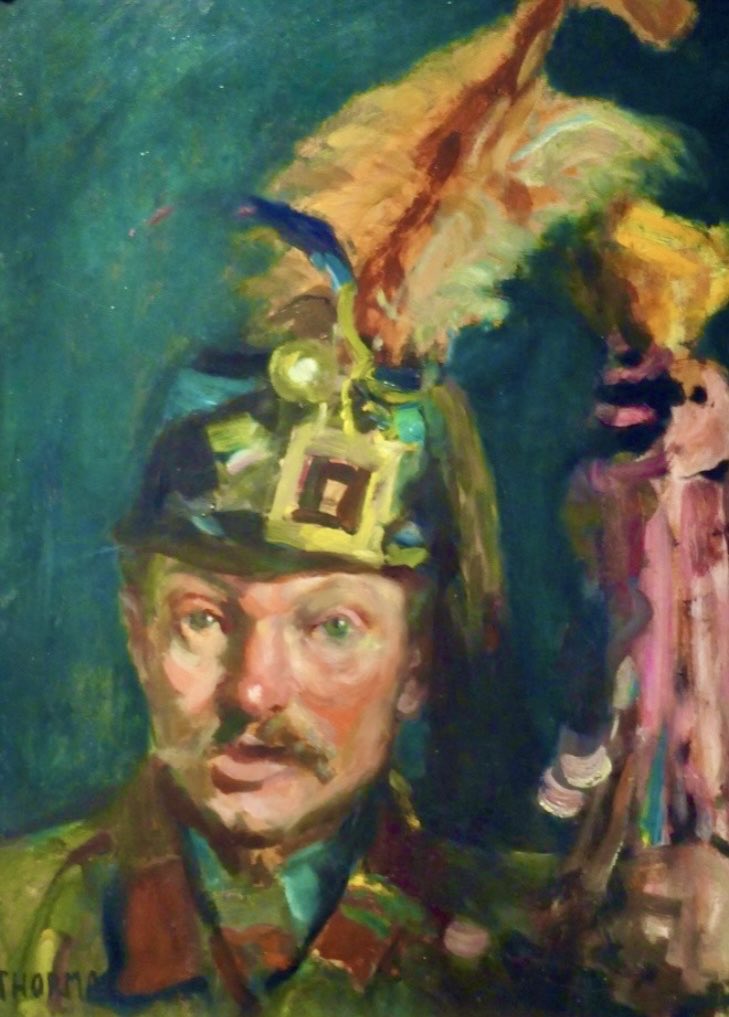
The Thorma János Museum in Kiskunhalas holds a work catalogued as A nagybányai köszöntő ember (The Nagybánya Greeting Man), 1928, oil on canvas, 68 × 56.5 cm, signed lower right, inventory no. 2005.19.1.
gallery.hungaricana.hu/hu/Ki…
Artist, medium, subject, and dimensions correspond precisely — half a centimeter within normal cataloguing tolerance. The museum’s own description confirms this was a subject Thorma returned to repeatedly, making title drift between Lakodalmi Köszöntő and A nagybányai köszöntő ember entirely consistent with postwar cataloguing practice. No other known Thorma work of this subject at these dimensions has been identified.
🎨 The Artist
János Thorma (1870–1937) was a founding figure of the Nagybánya artists’ colony, working across naturalism, historical subjects, and romantic realism. The feathered, ornamented greeting figure — a man in ceremonial dress with glass raised — was one of his most characteristic subjects, rooted in the communal life of Nagybánya that he documented across decades.
⚠️ An Important Note
No publicly available documentation directly links inventory no. 2005.19.1. to the 1944 Weiser seizure. The accession number dated 2005 raises an unanswered question about how this work entered the collection. The postwar provenance window — from the Szépművészeti Múzeum’s 1944 intake to the Thorma János Museum’s 2005 accession — has not been accounted for in any public record.
🧾 The Pattern
This is the second Thorma work match candidate documented from the 18 July 1944 Weiser inventory identified at this specific museum. Küldöttség az Országház előtt was documented here in an earlier post. That two works from the same wartime seizure appear to have entered the Thorma János Museum without disclosed Holocaust-era provenance is not coincidence. It is a pattern — and it demands an institutional answer.
📢 A Call for Transparency
We ask the Thorma János Museum to publish full acquisition documentation for inventory no. 2005.19.1. — including the complete chain of custody and any records connecting or ruling out a link to the Weiser collection seizure of 18 July 1944.
Under the Washington Principles on Nazi-Confiscated Art and the HEAR Act, institutions holding such material bear a responsibility to identify, disclose, and facilitate just and fair resolution.
A painting seized from a Jewish collector’s apartment in 1944 and a painting catalogued at a Hungarian museum in 2005 share overlapping match factors that cannot be dismissed. Whether they share the same history is a question only the Thorma János Museum and the Museum of Fine Arts, Budapest can answer.
#HEARAct #WashingtonPrinciples
@WJRORestitution @nytimesarts @marcorubio @WorldJewishCong
171
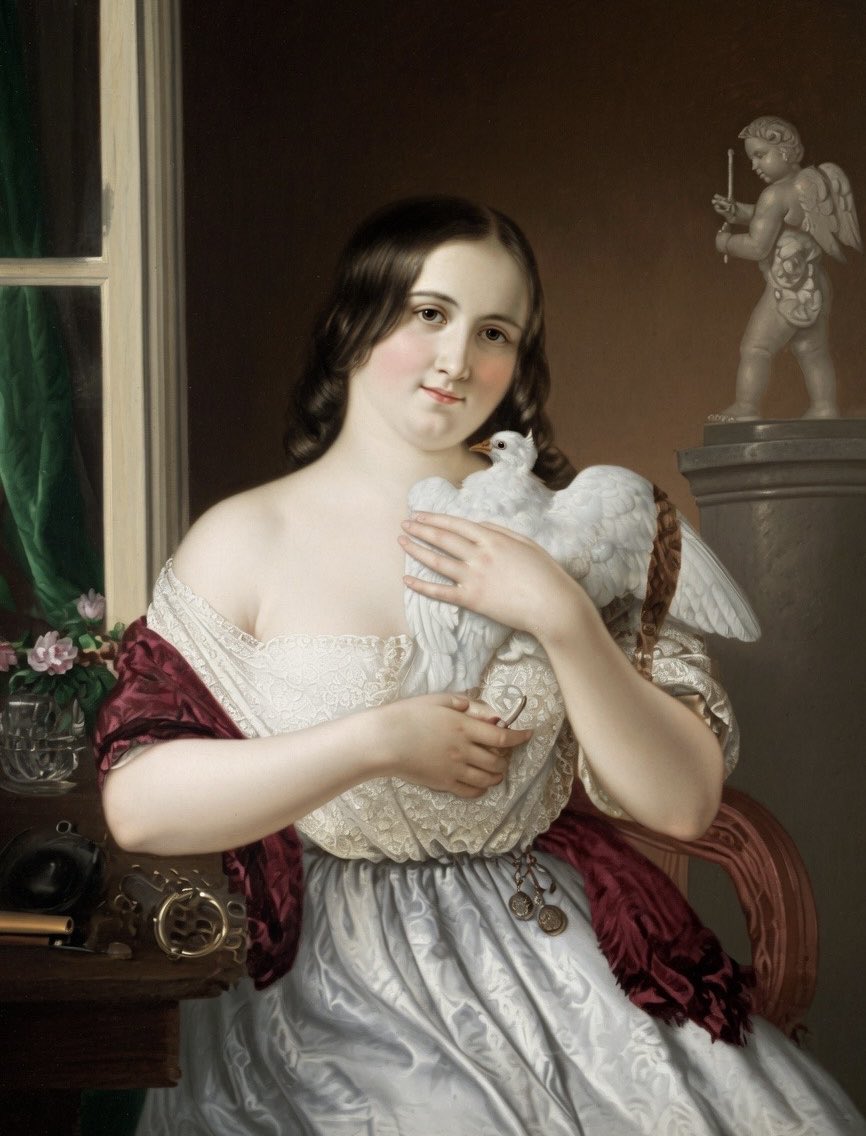
🕯 The Label Survived: Béla Freud’s Galambposta and the 1944 Transfer Inventory
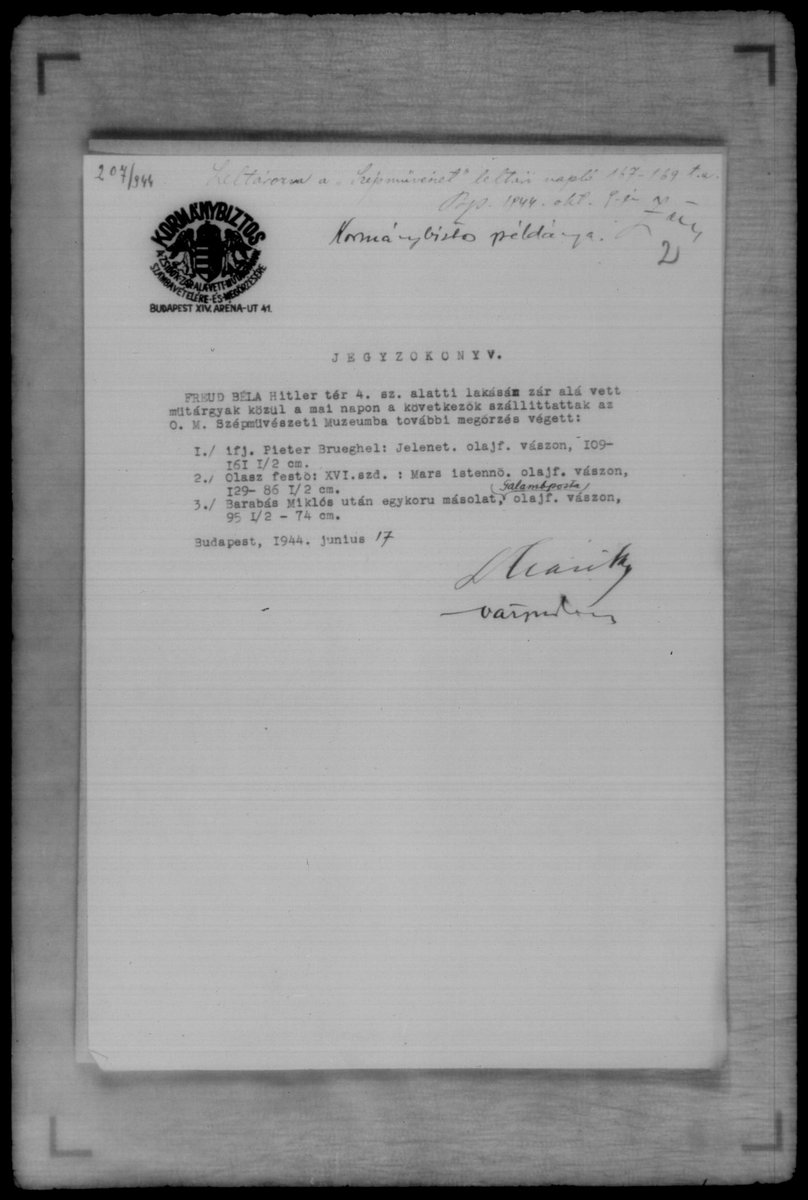
A Kormánybiztos inventory — Case 207/1944, bearing the official stamp of the Government Commissioner for Jewish Affairs and signed by Csánky Dénes — records the forced transfer of artworks from the Budapest apartment of Béla Freud at Hitler tér 4 to the Szépművészeti Múzeum on 17 June 1944. The third entry reads:
“3./ Barabás Miklós után egykoru másolat, (Galambposta) olajf. vászon, 95 1/2 – 74 cm.”
Contemporary copy after Miklós Barabás, Galambposta (Pigeon Post). Oil on canvas. 95.5 × 74 cm.
🎨 The Painting and the Label
At the 82nd Polgár Christmas Art Auction on 1 December 2009, Lot 107, a painting titled Galambposta (after Miklós Barabás) was offered — oil on canvas, 95 × 73 cm. The dimensions correspond within half a centimeter on both measurements.
axioart.com/tetel/freud-bela…
What distinguishes this case is the physical evidence on the painting itself. The verso carries a handwritten label reading: “Barabás M. után egyk. másolat: Galambposta — Freud Béla, Hitler tér 7” — alongside an Ernst Múzeum exhibition label, placing this painting in Budapest’s pre-war art world before it disappeared into state custody.
The name on the verso is the name in the seizure record. Whoever labelled this painting wrote the same name that appears at the top of the 1944 government document — Freud Béla — and that name survived on the back of the canvas for sixty-five years before the painting surfaced at auction.
⚠️ A Discrepancy to Note
The 1944 inventory records Freud’s address as Hitler tér 4. The verso label reads Hitler tér 7. These are different addresses on the same square. Whether this reflects a transcription error in the inventory, separate premises used by the same owner, or another explanation is not established in any public record — and is part of what a full provenance review should address.
🎨 The Subject and the Artist
Miklós Barabás (1810–1898) was one of Hungary’s most significant painters — a founder of Hungarian genre painting whose work met with great success in Vienna and Pest. His Galambposta of 1843, depicting a young woman receiving a message carried by a pigeon, became one of the most beloved images of Hungarian Biedermeier art and was widely copied by later artists. The copy in Béla Freud’s collection was documented and labelled during his lifetime — and transferred to state custody in a single afternoon in June 1944, alongside a Brueghel and a 16th century Italian painting.
📢 A Call for Transparency
This painting surfaced at public auction in Budapest in 2009 — sixty-five years after the seizure — without any disclosed connection to the 1944 inventory. It is now in private hands. We ask the current holder to review the painting’s full provenance history, and we ask the Szépművészeti Múzeum to disclose what records exist for the transfer of this work under Case 207/1944.
Under the Washington Principles on Nazi-Confiscated Art and the HEAR Act, works with documented wartime seizure records and unresolved postwar provenance chains warrant full transparency and just and fair resolution.
The government took the painting. It could not take the label. And the label remembered exactly whose it was.
#HEARAct #WashingtonPrinciples
@WJRORestitution @nytimesarts @USAmbHungary @lauder_ronald
180
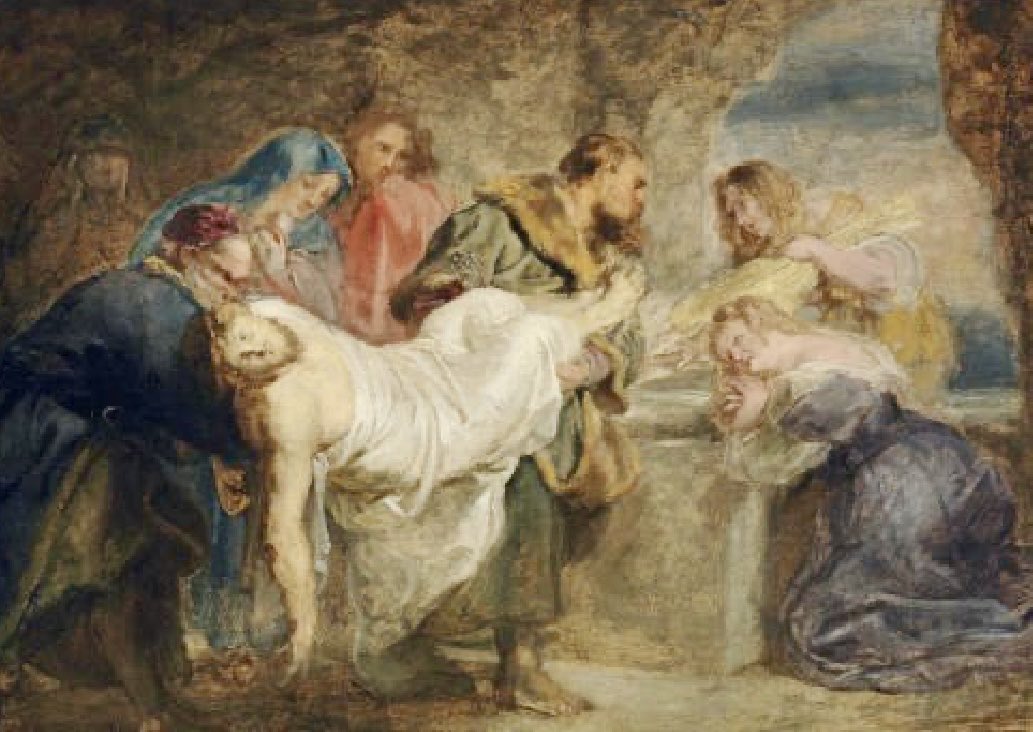
🖼️ Tracing a Herzog Rubens: From the 1944 Budafok Inventory to Christie’s London
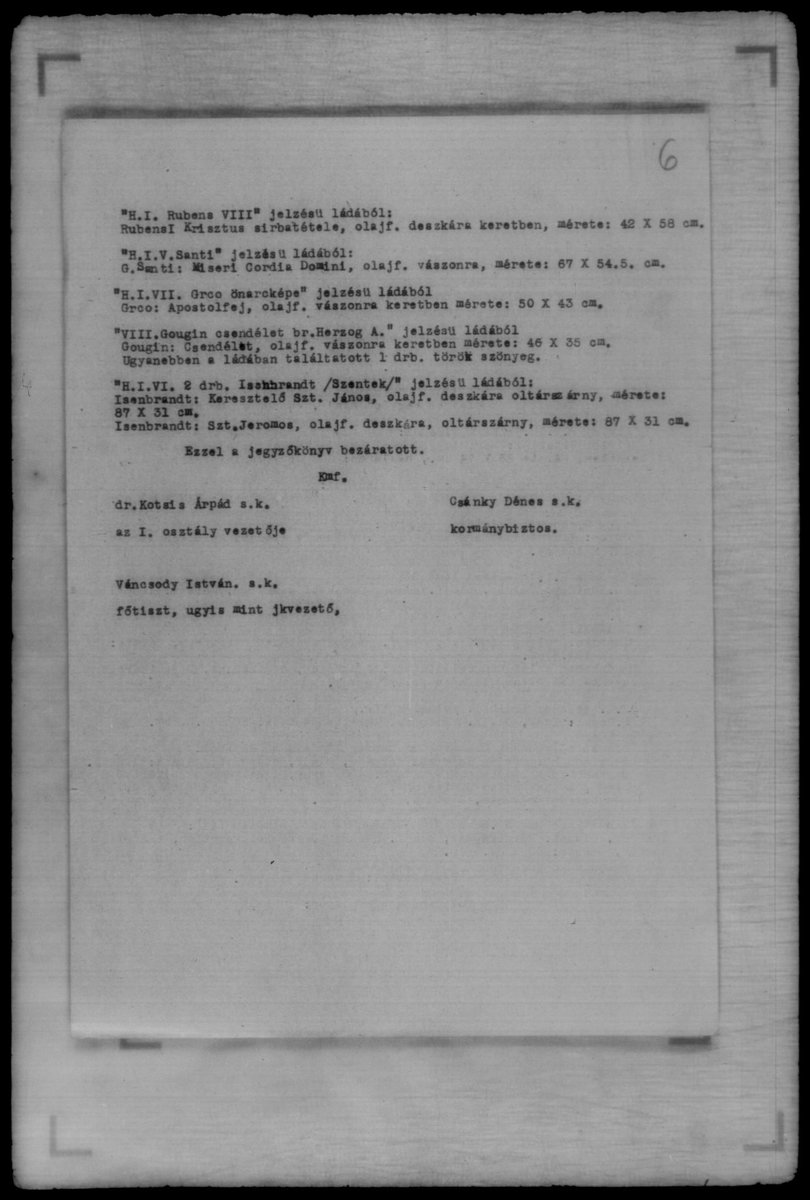
In June 1944, Hungarian authorities inventorying Jewish-owned property discovered a hidden cache of artworks in the cellars of the Herzog family’s Budafok factory.
Among the entries in crate H.I. Rubens VIII. was a small panel attributed to Peter Paul Rubens:
“Rubens: Krisztus sírbatétele (Krisztus siratása), fa, olaj, mérete: 42 × 58 cm.”
Translation:
Rubens. Christ Carried to the Tomb. Oil on panel. 42 × 58 cm.
More than two decades later, a remarkably similar work appeared at Christie’s London (Lot 19, November 27, 1970):
• Peter Paul Rubens
• Christ Carried to the Tomb
• Oil on panel
• 41.6 × 57.5 cm
The match is striking.
Unlike canvas, wooden panels remain dimensionally stable over centuries. For provenance researchers, measurements can function almost like fingerprints. Here, the artist, subject, medium, and dimensions all align with the 1944 inventory.
🎨 The Artist
Peter Paul Rubens (1577–1640) was one of the greatest painters of the Baroque era. His dramatic religious compositions transformed European art and made him one of the most sought-after artists of his age.
This composition depicts Christ being carried to the tomb following the Crucifixion. Christie’s noted that the image is documented through an engraving by Han Witdoeck, a close collaborator of Rubens, and the work has been discussed by leading Rubens scholars including Julius Held and Carl Depauw Judson.
🧾 The Herzog Connection
The painting formed part of the celebrated collection of Baron Mór Lipót Herzog, one of the most important Jewish collectors in prewar Europe.
After Herzog’s death, portions of the collection passed to his son, Baron András Herzog. In 1944, as Jewish property was systematically targeted across Hungary, the family attempted to protect artworks by hiding them in the Budafok factory cellars.
The surviving inventories document what happened next.
Many works listed in those ledgers ultimately entered state custody and remain subjects of restitution efforts today.
This Rubens appears to have followed a different path.
When Christie’s offered the painting in 1970, the catalogue traced ownership through Jules Porgès, Marcell Nemes, Baron Andreas Herzog, and by descent to his daughter, Erzsébet Herzog (Madame Dimitri Angelopoulo).
What remains unclear is the painting’s precise journey between the 1944 inventory and the 1970 sale.
That gap is exactly why provenance research matters.
The Budafok inventory documents the painting’s wartime seizure. The Christie’s catalogue documents its later reappearance through a surviving branch of the Herzog family. Together, they help reconstruct another chapter in the history of one of Europe’s greatest Jewish art collections.
🔗 Christie’s London, Lot 19 (27 November 1970):
christies.com/en/lot/lot-502…
#HolocaustArtRecovery #HerzogCollection #Rubens #ProvenanceResearch #ArtHistory #WashingtonPrinciples #HEARAct #NaziLootedArt #CulturalHeritage
1
1
3
473
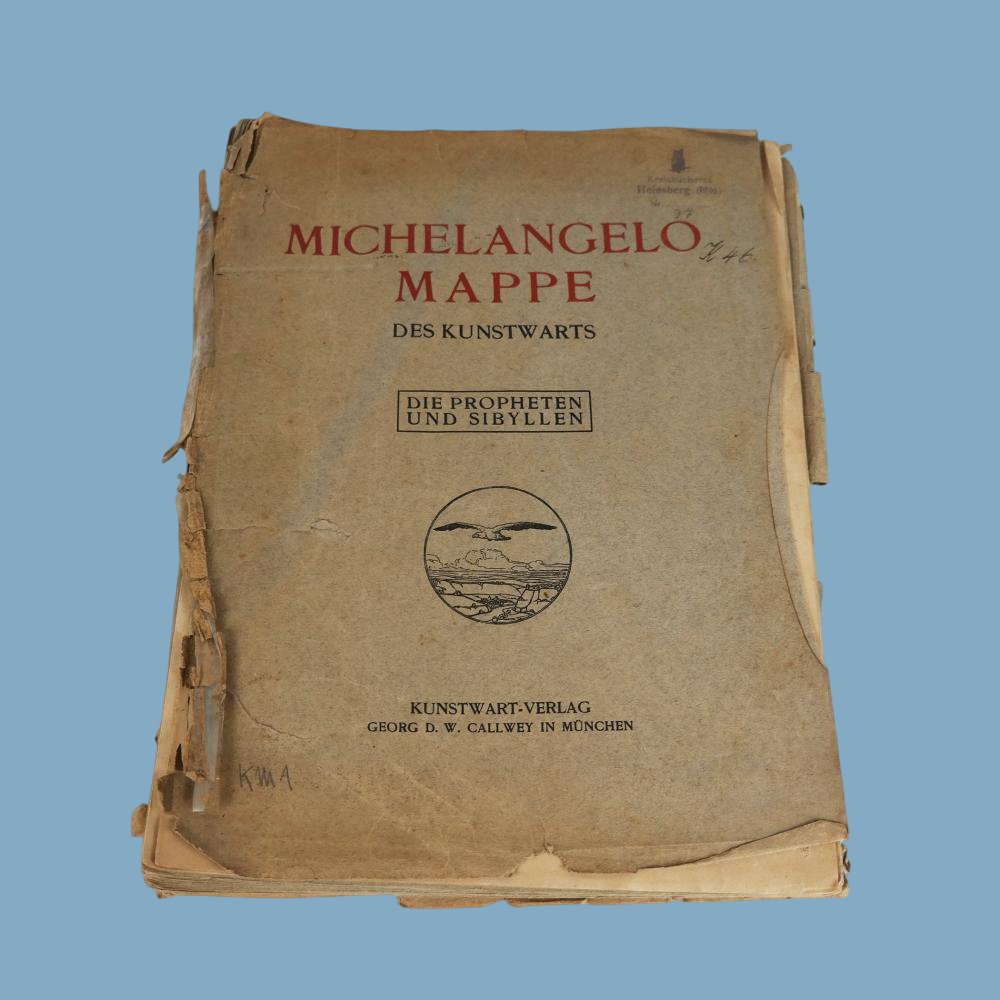
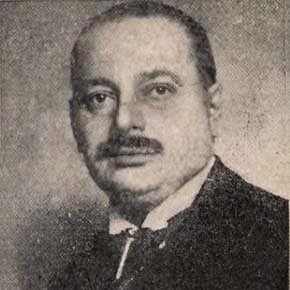
🕯️ PROVENANCE QUESTION: Dr. Ágai Béla’s 1944-Looted Michelangelo Kunstwart Portfolios
📌 The case at a glance: Dr. Ágai Béla, a Budapest physician, writer, and art collector, was deported to Auschwitz in 1944 and murdered there. His apartment at Kmetty utca 31 was sealed by the Hungarian Government Commissioner for Jewish Affairs. Among the cultural property removed from his home was a rare two-part Michelangelo portfolio set connected to Der Kunstwart, the influential German arts and culture publication.
What happened to Ágai’s library was not vague wartime “loss.” It was documented state seizure. Hungarian authorities catalogued his books and portfolios, signed for them, and transferred them into national institutions through official paperwork that survives today.
📜 The 1944 Archival Record
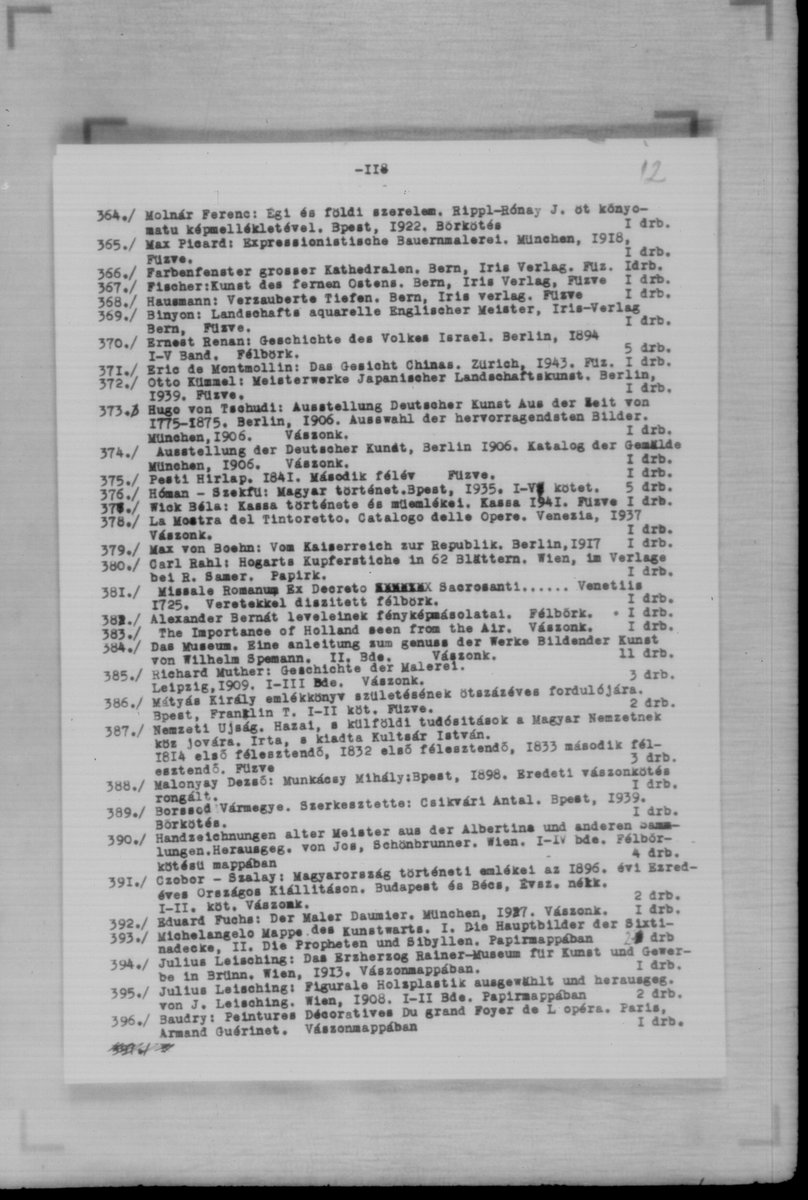
Reel 144, Slide 685, Entry 393 at @HolocaustMI records:
“Michelangelo Mappe des Kunstwarts. I. Die Hauptbilder der Sixtinadecke, II. Die Propheten und Sibyllen. Papirmappában 2 db.”
In English: Michelangelo, Kunstwart portfolios. Vol. I: The principal images of the Sistine ceiling. Vol. II: The Prophets and Sibyls. In paper portfolios/folders. Two items.
The 1944 inventory identifies the object with unusual precision: owner, title, subject, two-part structure, Sistine Chapel contents, and physical format. This is exactly the kind of specificity provenance researchers look for.
🖼️ Where are the Ágai portfolios now?
Independent research has identified only two known Hungarian public-collection copies matching this specific Michelangelo Kunstwart portfolio set, including copies held by:
National Széchényi Library, Budapest (Országos Széchényi Könyvtár) — Hungary’s national library.
Museum of Fine Arts, Budapest Library (Szépművészeti Múzeum Könyvtára) — the library of Hungary’s major state fine-arts museum.
That creates a direct provenance question for both institutions:
Are the Michelangelo Kunstwart portfolios now held in your collections the same portfolios seized from Dr. Ágai Béla’s apartment in 1944?
🔎 The burden is on the holding institutions
The surviving records establish that Dr. Ágai owned this specific two-part Michelangelo Kunstwart portfolio set and that it was removed through the wartime state-seizure process. Under the Washington Principles on Nazi-Confiscated Art, museums and public institutions are expected to identify Nazi-confiscated art, research gaps in provenance, and pursue just and fair solutions. That responsibility cannot depend on heirs or outside researchers doing all the work.
The burden now falls on the holding institutions to publish full acquisition documentation showing that their copies were acquired through legitimate prewar or postwar channels — and are not the Ágai portfolios.
A vague notation of “old collection,” “prewar holdings,” “unknown acquisition,” or “no information available” is not enough. Full transparency requires disclosure of accession records, shelf records, transfer documentation, wartime intake files, institutional correspondence, ownership markings, stamps, ex libris evidence, and post-1944 cataloguing notes connected to these copies.
⚖️ Why this matters
These are not anonymous art books sitting quietly in library stacks. They are potentially documented stolen cultural property from a Holocaust victim whose library was inventoried, removed, and absorbed into the Hungarian state system in 1944.
The pattern is familiar across these reels: named Jewish owners, exact inventories, official signatures, institutional transfers, and cultural property disappearing into state collections. Dr. Ágai Béla’s Michelangelo portfolios give us a precise test case. The archival record names the owner. It names the object. It identifies the two parts and the subject matter. It shows the state seizure process at work.
Now the holding institutions must answer the provenance question plainly:
Are these the Ágai portfolios?
If not, publish the records proving it.
Transparency is not optional in Holocaust-era provenance research. It is the minimum obligation owed to victims whose collections were taken, catalogued, and redistributed under color of law.
The archive has already spoken clearly. It is time for the institutions to do the same.
#HolocaustArtRecovery #ProvenanceResearch #LootedArt #Restitution #Michelangelo #Kunstwart #HungarianMuseums #WashingtonPrinciples #HEARAct
@WJRORestitution @ClaimsCon @yadvashem @HolocaustMuseum @USAmbHungary @nytimesarts @artnet @WorldJewishCong @SenBlumenthal @RepLaurelLee @marcorubio @UNESCO @nytimesbooks @ahistoryinart @brand_arthur @raydowd @mediciproject @JewishCurrents @JewishJournal @AuschwitzMuseum @RepJerryNadler
1
3
448
🔵🏺 Is a 1944 Seizure File the Missing Link to a Painting in a Private Hungarian Collection?
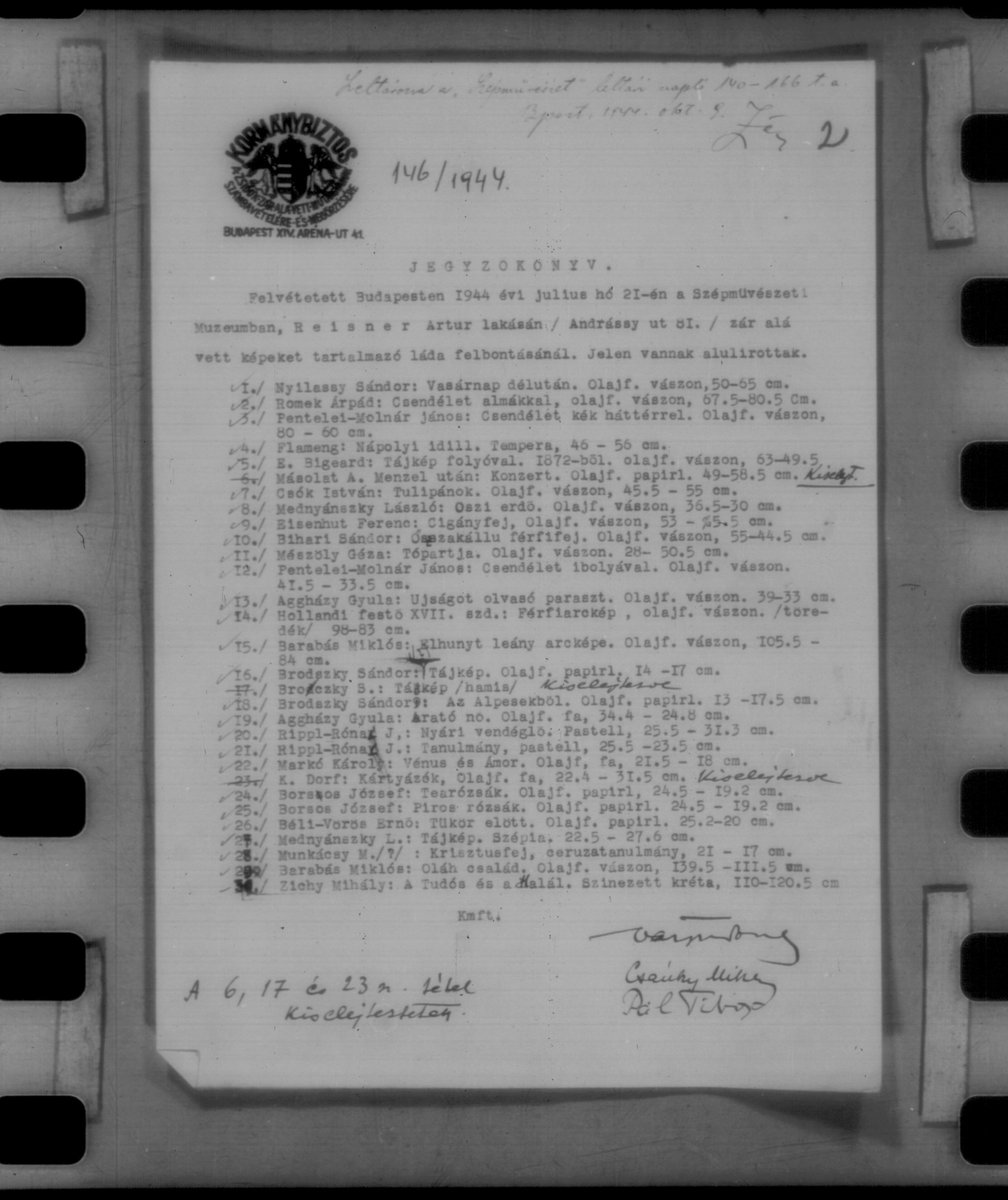
21 July 1944. Andrássy út 81, Budapest.
At the Szépművészeti Múzeum — the Museum of Fine Arts, Budapest — officials opened a sealed crate of paintings taken from the residence of Artur Reisner.
Item #3 in the official Jegyzőkönyv reads:
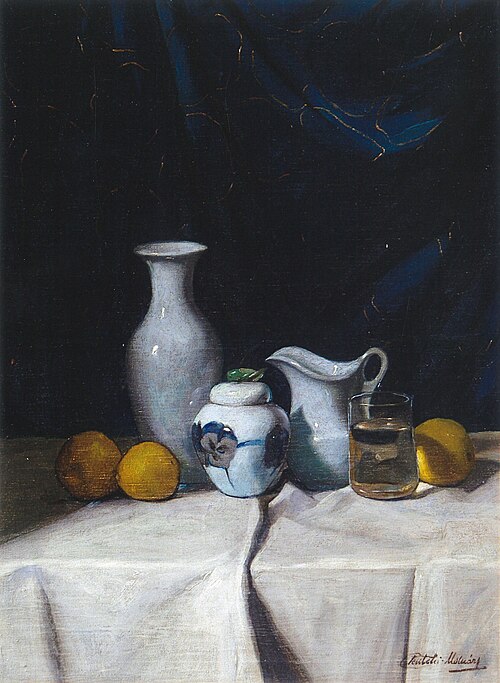
“Pentelei-Molnár János: Csendélet kék háttérrel. Olajf. vászon, 80 × 60 cm.”
Translation:
János Pentelei-Molnár — Still Life with Blue Background. Oil on canvas, 80 × 60 cm.
That is a remarkably specific lead: artist, subject, blue-background description, medium, and exact dimensions.
The strongest public candidate @ArtRecoveryInit has found is:
Pentelei-Molnár János — Fehér porcelánok kék háttérrel
White Porcelains with Blue Background
1910s
Oil on canvas
80 × 60 cm
Listed publicly in the Boda József Collection
The match profile:
Artist: János Pentelei-Molnár — exact match
Dimensions: 80 × 60 cm — exact match
Medium: oil on canvas — exact match
Subject: blue-background still life — direct correlation
The title shift is not a contradiction.
A clerk in 1944 wrote the plain identifying phrase: still life with blue background.
A later title gives the more specific subject: white porcelains with blue background.
That may be ordinary cataloguing refinement. It may also make a 1944 seizure trail harder to see unless the records are placed side by side.
That is why the file matters.
Artur Reisner was not making an ordinary museum deposit. His paintings were taken from his Andrássy út residence, placed under seal, and processed during the 1944 confiscation of Jewish property in Hungary.
And because this crate was opened at the Museum of Fine Arts, the museum is the logical place to begin the custody trail.
If this is the same painting, the public issue is straightforward: how did a work recorded in a sealed wartime crate at the Museum of Fine Arts later appear in a private Hungarian collection? Was it returned, released, sold, transferred, deaccessioned, or otherwise separated from the Reisner seizure file?
We ask the Szépművészeti Múzeum, relevant Hungarian cultural authorities, and any current custodian of the painting to publish the provenance file for Fehér porcelánok kék háttérrel, including:
1️⃣ the 1944–1945 custody trail for Reisner inventory item #3;
2️⃣ any postwar return, release, sale, transfer, or deaccession records;
3️⃣ any documentation showing how the painting entered the Boda József Collection; and
4️⃣ any internal comparison with the 21 July 1944 Reisner protocol.
If there is a separate provenance chain, publish it. If not, the 1944 Reisner inventory remains a serious lead. Either way, the file should answer the question.
#Holocaust #ProvenanceResearch #NaziLootedArt #ArtRestitution #PenteleiMolnár #Hungary1944 #WashingtonPrinciples #HEARAct
@nytimesarts @WJRORestitution @USAmbHungary @raydowd @ahistoryinart @Telexhu @UNESCO
1
5
594
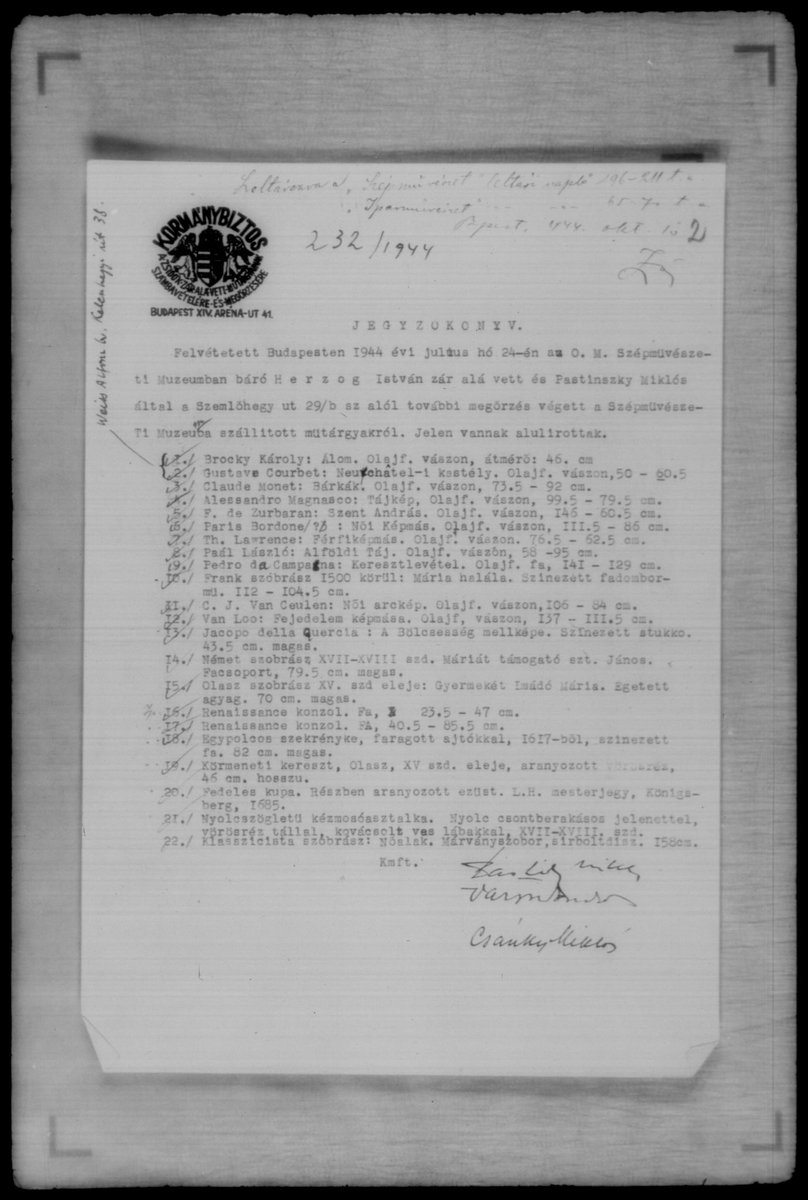
🚨🖼️ PROVENANCE ALERT: Herzog Inventory #9 — the 1944 “Pedro da Campagna” Keresztlevétel may point to the Prado’s Pedro Machuca, The Descent from the Cross (inv. P003017)
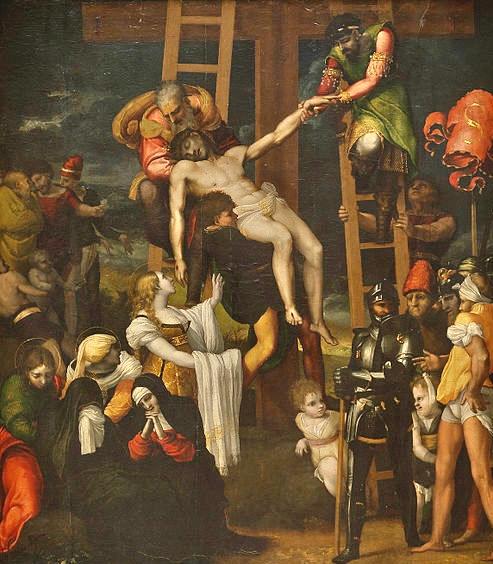
On 24 July 1944, during the Nazi occupation of Hungary, Hungarian authorities entered the residence of Baron István Herzog at Szemlőhegy út 29/b and compiled an official Jegyzőkönyv recording artworks seized and transferred to the Szépművészeti Múzeum (Museum of Fine Arts, Budapest).
📜 Item #9 is recorded as:
“9./ Pedro da Campagna: Keresztlevétel. Olajf. fs, 141–129 cm.”
This is a document-based identification, not a speculative resemblance.
🔎 Why this Match Candidate at the Museo Nacional del Prado (“the Prado”), Madrid deserves scrutiny:
Link🔗: museodelprado.es/en/the-coll…
• Subject:
1944 inventory: Keresztlevétel (“Descent from the Cross”)
Prado today: The Descent from the Cross
• Support:
1944: oil on panel
Prado: oil on panel
• Dimensions:
1944: 141 × 129 cm
Prado: 141 × 128 cm
A 1 cm variance is well within normal archival measurement drift.
• Attribution drift:
The 1944 inventory uses “Pedro da Campagna,” a period attribution associated with Pedro/Pieter Campaña (Kempeneer). The Prado now attributes the painting to Pedro Machuca. For sixteenth-century Spanish/Flemish material, that kind of historical attribution shift is exactly the kind of issue that demands document-level review, not dismissal.
🏛️ The Prado’s current published provenance reads:
“Gourgeois Frères, Paris, 1870; baron M. de Herzog, Budapest; Dimitri Angelupulo; collection of Palermo, early century XX; acquired by the Patronado of the Prado Museum, 1961.”
But if the 24 July 1944 Budapest seizure record refers to this same painting, then the currently published provenance does not explain the work’s documented presence in Budapest in 1944.
What is missing is not a footnote. It is a public explanation for the painting’s documented 1944 custody in Budapest.
We call on the Museo del Prado and the Szépművészeti Múzeum to publish:
1️⃣ All accession, deposit, transfer, and deaccession records tied to Herzog Inventory #9
2️⃣ Any post-1945 documentation showing where this painting was held, moved, sold, or exhibited
3️⃣ The complete provenance file underlying Prado inv. P003017
4️⃣ Any Budapest museum records connecting the July 1944 Herzog seizure to a later transfer abroad
This is not an accusation. It is a document-based request for transparency.
The records exist. The overlap is too close to ignore. The public deserves the full chain.
#HolocaustArtRecovery #HerzogCollection #ProvenanceResearch #NaziLootedArt #WWIIArtRestitution #MuseoDelPrado #WashingtonPrinciples #TerezinDeclaration #PedroMachuca #ArtRecovery
@WJRORestitution @marcorubio @JohnCornyn @RepJerryNadler @UNESCO @tedcruz @nytimesarts @artnet @USAmbHungary @CathyHickley @elpais_cultura @elmundoes @eldiarioCultura @Telexhu @BBCWorld @cnni @fcjecom @BarcelonaJudia @IsraelinSpain @jfederations
4
1,022
📜🖼️ BARON HATVANY’S PAINTING: SEIZED BY THE LUFTWAFFE IN 1944, HIDDEN IN PLAIN SIGHT AT THE HUNGARIAN NATIONAL GALLERY
The Archival Record
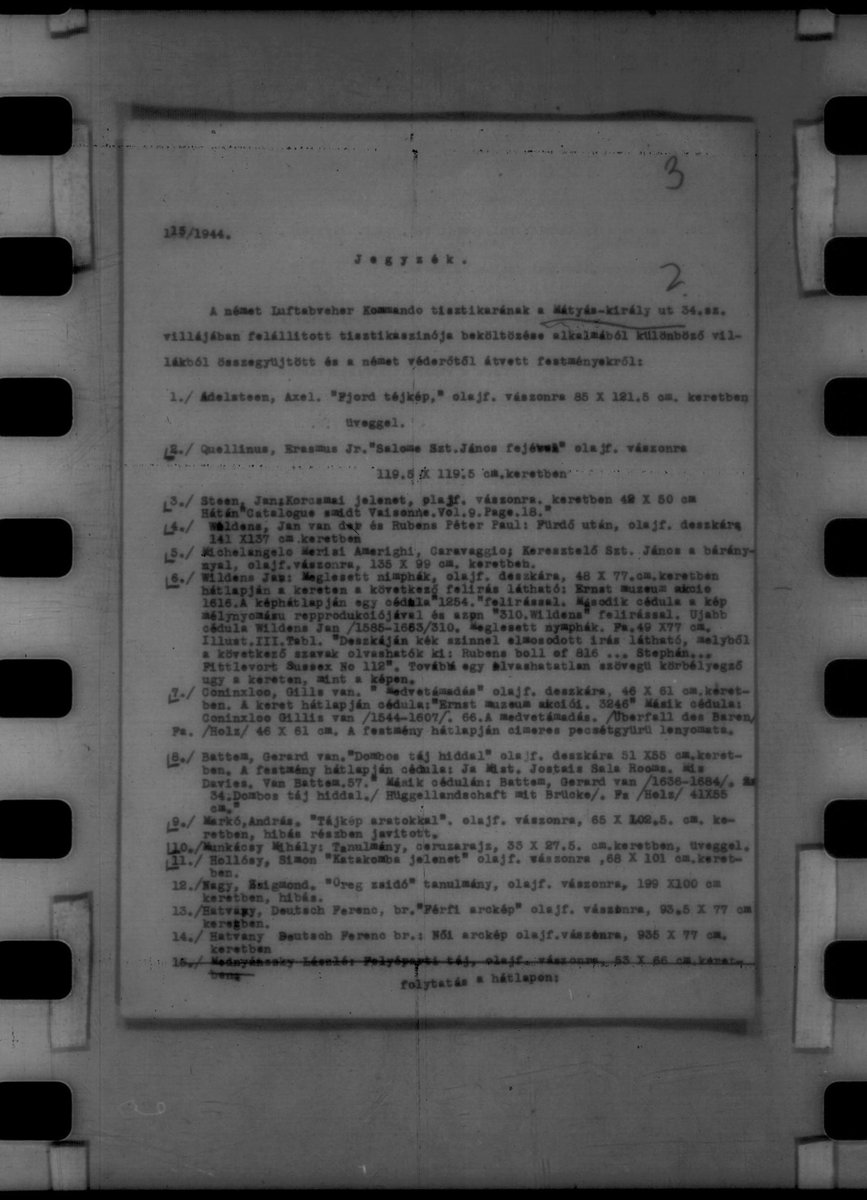
Hungarian government cultural property seizure records at the @HolocaustMI (File 115/1944)
A typed inventory dated 12 May 1944 records paintings collected from Jewish-owned villas in Budapest and transferred under Luftwaffe authority during the German occupation of Hungary. The document lists fifteen works confiscated from multiple residences and deposited at the German officers’ facility at Mátyás király út 34.
Entry #14 records:
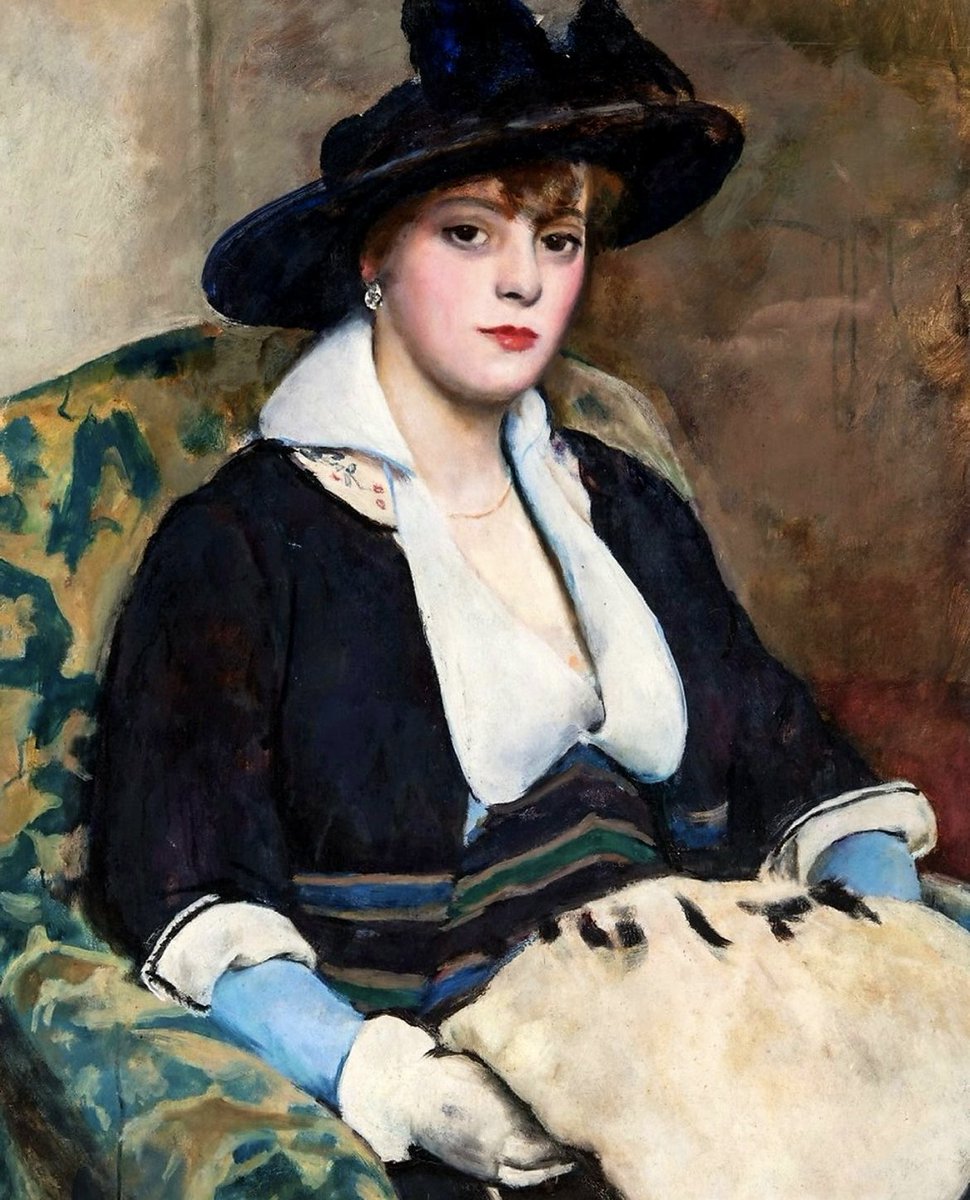
Hatvany Deutsch Ferenc br.: Női arckép
Oil on canvas — framed 90.5 × 77 cm
The Corresponding Object
A closely matching painting is held today by the Magyar Nemzeti Galéria (Hungarian National Gallery):
Női arckép (Portrait of a Woman)
Baron Ferenc Hatvany — Oil on canvas
Canvas: 80 × 65.5 cm — Frame: 88 × 74 × 3 cm
Inventory number: 4878
Hungarian record: mng.hu/mutargyak/47826/
English record: en.mng.hu/artworks/47826/
The 2.5 cm variance between the 1944 framed measurement of 90.5 × 77 cm and the current frame measurement of 88 × 74 cm is consistent with standard 20th-century reframing. Title, artist, medium, and dimensions correspond directly.
The museum’s catalogue entry lists no pre-1945 provenance. The record carries the standard notation that information is subject to revision due to ongoing research.
The Artist and His Looted Collection
Baron Ferenc Hatvany (1881–1958) was both a significant painter and one of the most important art collectors in Central Europe before the war. After the German occupation of Hungary in March 1944, his collection was systematically looted. Recoveries have come from London and Paris.
The Provenance Question
The evidence is clear: a painting recorded in a 1944 Luftwaffe seizure inventory matches the artist, title, and dimensions of a work held by the Hungarian National Gallery today. The museum’s own record flags it as subject to ongoing research. That research needs to be made public.
The Obligation
The Hungarian National Gallery must publish the complete internal object file for inventory 4878 — including all acquisition records and any documentation covering the period between the 1944 confiscation and the painting’s entry into the national collection.
Under the Washington Principles on Nazi-Confiscated Art (1998), documented evidence of Holocaust-era confiscation shifts the burden of disclosure to current holders. The United States has long supported that principle — and the HEAR Act reauthorization currently before Congress is the mechanism that keeps American pressure on foreign institutions meaningful. It must be passed.
A painter’s own work was taken from him by an occupying army. Eighty years later it hangs in his country’s national gallery. His name is on the canvas and on the seizure document. The gallery owes him — and his heirs — an answer.
#HolocaustArtRecovery #ProvenanceResearch #WashingtonPrinciples #HEARAct #HEARAct2025 #OpenTheArchives #HungaryMuseums #HatvanyCollection
@nytimesarts @ClaimsCon @RepLaurelLee @MikeJohnson @RepGoodlander @RepJerryNadler @JohnCornyn @SenBlumenthal @tedcruz @USAmbHungary @MayaKadosh @raydowd @ahistoryinart @IvankaTrump @hyperallergic @artnet @UNESCOEU @UNESCO @AlanDersh @BLaw @CathyHickley @HolocaustMI @AuschwitzMuseum @yadvashem @ArtLawProgram @JewishVLibrary @Jerusalem_Post @nypost @WSJ @WashPost @ForeignAffairs @ForeignPolicy @FT @cnni @bbcarts @BillAckman @elonmusk @grok
1
4
509

5 Mar 2025
80 years after the end of Nazi terror, Germany remains committed to returning Nazi-looted art to their rightful owners. The #WashingtonPrinciples pave the way for just & fair restitutions. Together we return what rightfully belongs to others.
41
28
111
16,549

5 Apr 2024
NS-Raubkunst: Bund veröffentlicht wissenschaftliche Studie zur Beratenden Kommission. Staatsministerin Claudia Roth: „Wertvolle Impulse, um den Reformprozess voranzubringen.“ #WashingtonPrinciples #Restitution
Mehr dazu:
kulturstaatsministerin.de/Sh…
1
7
8
1,115

5 Mar 2024
Restituting Nazi-looted cultural assets is hugely important. German cultural institutions have a job to do: Since the adoption of the #WashingtonPrinciples 25 years ago, over 7,500 cultural assets were returned. But much remains to be done. @StateDept @WJRORestitution @ushmm
2
3
14
2,146

What’s the point of having the #WashingtonPrinciples if museums are simply going to ignore them?
.
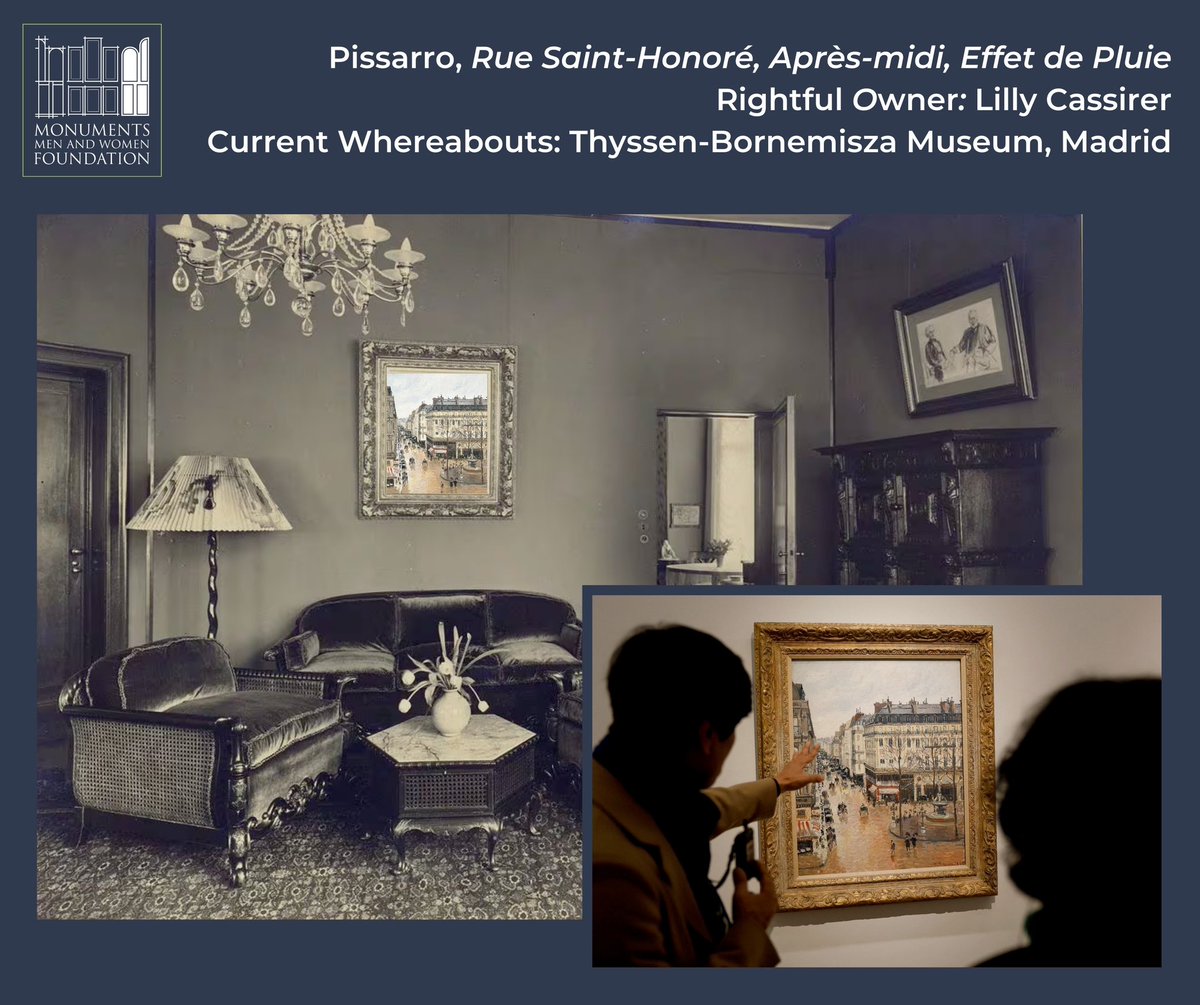
📷 The Pissarro painting hanging in the Berlin apartment of Lilly Cassirer (ca. 1930). Photo courtesy of David Cassirer via @Artnet. And the painting on the walls of the Museum.
1
1
202

2 Oct 2023
Rectify Injustice! Locate Nazi Looted Art Now! #LootedArt #Restitution #Nazi #Holocaust #WashingtonPrinciples
@KathyHochul @MuseumModernArt @metmuseum @whitneymuseum @Guggenheim @brooklynmuseum @MorganLibrary @ronaldlauder @MikeBloomberg @JewishVoice
thejewishvoice.com/2023/09/r…
@Katheri73214366 @klj998866 @club_ed8 @10903 @Kybelle195739 @FirminSheila @FredHonaker8 @kybetra61 @Liberty_Belle04 @DSloan111 @stpstpjr @terryloohoo @SpitfireRoseUSA @NewaiGreen @garyelam23 @plotweaver @Torrid_Zone @JoslinSam @Hamletgarcia17 @dtannie @GrammyC4Zone @Holly2360 @JennyDupuis5 @MichaelDBlush1 @PaulRev90604674 @ChackamoFeena @lotusflower1822 @DHarryMcGee1 @SorinsSomnium @cminyard1 @jhodnot @rebdur @cspanreview @fedmech @Torrid_Zone @RockwaterReport @bmwtonyi @writergary @JackLon09169906 @KatTheWonk
1
4
7
324

28 Sep 2023
Rectifying an Historical Injustice - Global Campaign to Locate Nazi Looted Art Must Be Launched Now - thejewishvoice.com/2023/09/r… #Nazi #lootedart #injustice #Museums2023 #artcollection @GovKathyHochul @ADL @antisemitism @EndJewHatred #restitution #gustavklimt @AJCGlobal @WorldJewishCong #washingtonprinciples @StopAntisemites @AntisemitismOrg @AntisemitismEye
6
14
640
28 Sep 2023
Rectifying an Historical Injustice - Global Campaign to Locate Nazi Looted Art Must Be Launched Now - thejewishvoice.com/2023/09/r… #Nazi #lootedart #restitution #washingtonprinciples #Holocaust @KathyHochul @MuseumModernArt @metmuseum #NYC @whitneymuseum @Guggenheim @brooklynmuseum @MorganLibrary @ronaldlauder @MikeBloomberg
2
38
66
10,197

13 Apr 2023
Will the @NationalGallery , a federal government institution, uphold the commitment made by the United States 25 years ago at the Washington Conference?
#WashingtonPrinciples
theartnewspaper.com/2023/02/…
1
3
272

2 Mar 2023
'New French restitution laws should benefit the market—and maybe force change in Britain too?': theartnewspaper.com/2023/02/… #WashingtonPrinciples #restitution #ParthenonSculptures #culturalheritage
2
3
216
If the #MFAH is the proponent of the #WashingtonPrinciples that they claim to be, why do they continue to cling to technical (yet incorrect) defenses?
.
@HoustonMatters from minute 38: houstonpublicmedia.org/artic…
1
1
4