
Exposing Holocaust-era art theft. Public evidence, provenance research, and restitution documentation.
Joined July 2025
- Tweets 655
- Following 7,501
- Followers 456
- Likes 74
601 Photos and videos
Pinned Tweet

⚔️📜 The Sword and the Ledger: A 1944 Herzog Seizure and a Possible Museum Match
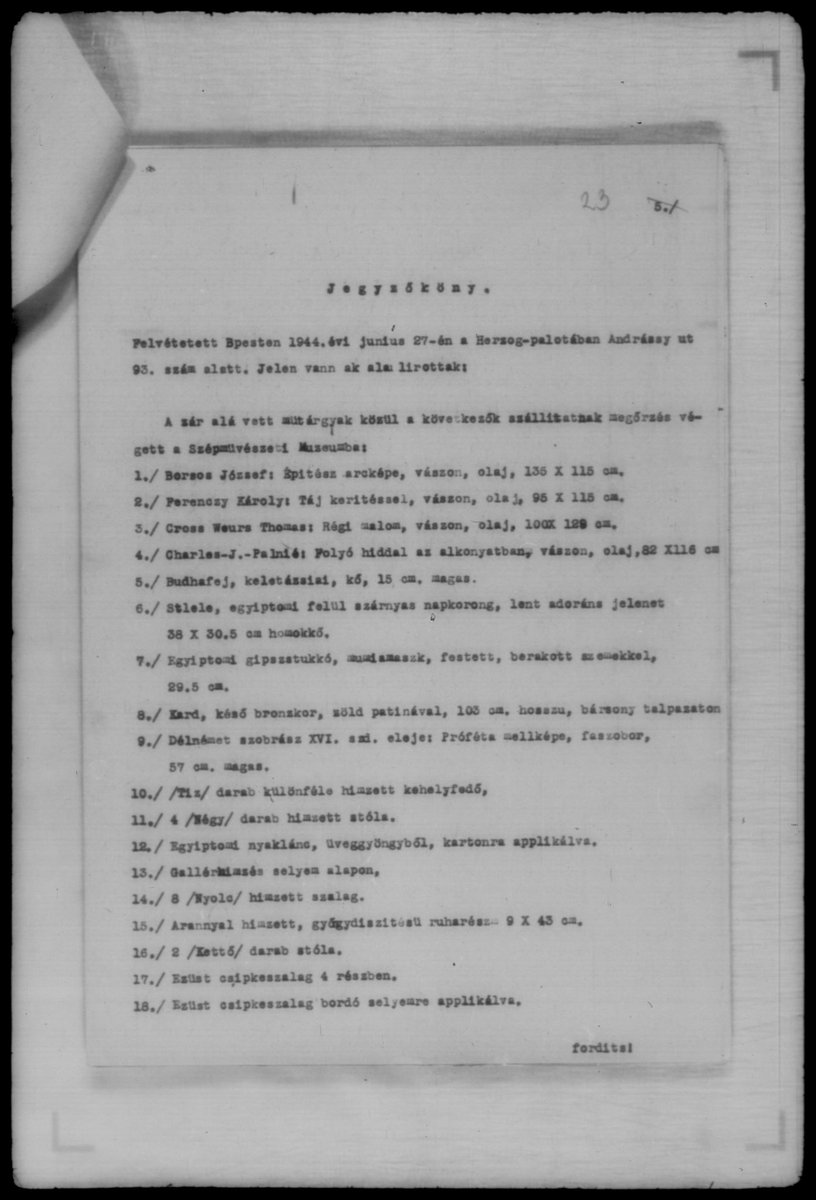
In 1944, during the systematic seizure of Jewish-owned property in Budapest, officials inventoried objects removed from the Herzog Palace at Andrássy út 93 — home to one of Hungary’s most important Jewish collections.
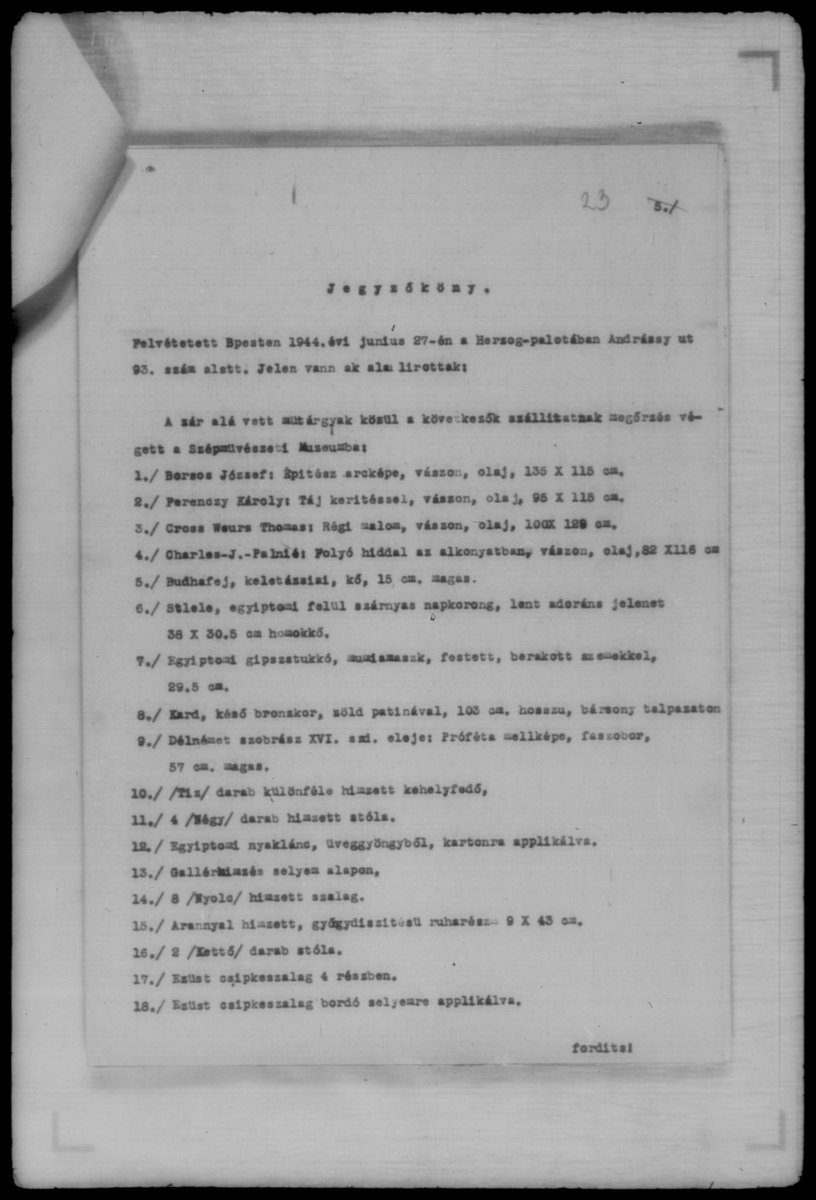
Among the entries appears #8 with, a specific description:
“Kard, késő bronzkor, zöld patinával, 103 cm hosszú, bársony talpasaton.”
Late Bronze Age sword, with green patina, 103 cm long, on a velvet stand.
🏛️ The Herzog Collection
The object belonged to the collection assembled by Baron Mór Lipót Herzog (1869–1934), one of Central Europe’s most significant art collectors.
Following the German occupation of Hungary in March 1944, artworks and antiquities from the Herzog collection were systematically inventoried and seized under anti-Jewish measures. Many objects were transferred into Hungarian state custody through museums and other public institutions.
This sword was among them.
⚔️ A Possible Modern Candidate
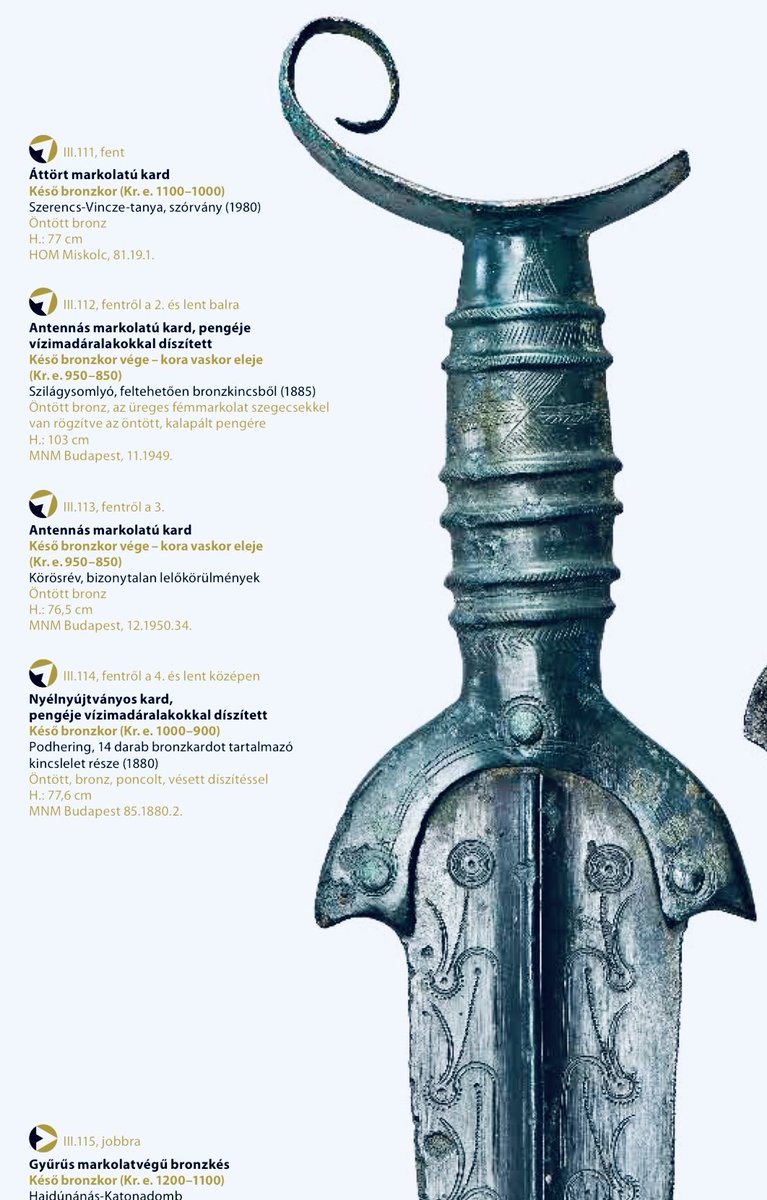
A compelling candidate exists today in the collections of the Hungarian National Museum:
Late Bronze Age antenna-hilted sword
Length: 103 cm
Date: c. 950–850 BCE
MNM 11.1949
The sword is catalogued in Hungarian archaeological literature and belongs to the class of high-status prestige weapons produced during the final centuries of the Bronze Age in the Carpathian Basin.
Most strikingly, its documented length is exactly 103 cm — the same measurement recorded in the 1944 Herzog inventory.
🔍 Why This Matters
Several factors make this an important provenance lead:
• Exact length match: 103 cm
• Correct period: Late Bronze Age
• Consistent condition: ancient bronze with green patina
• Display context: the 1944 inventory notes a velvet stand, suggesting a curated collector’s object rather than a recently excavated find
Taken together, these details warrant further investigation.
❓ The Provenance Gap
The surviving 1944 inventory establishes that a 103 cm Late Bronze Age sword was present in the Herzog Palace and entered state custody during the Holocaust era.
What remains unclear is whether the sword now catalogued in Hungarian museum collections is the same object.
Publicly available records do not currently identify the Herzog collection as part of its ownership history, nor do they reference the 1944 seizure.
📜 A Call for Transparency
@ArtRecoveryInit calls upon the Hungarian National Museum and the Museum of Fine Arts, Budapest to review and publish any records relating to:
• 1944 transfers from the Herzog collection
• Subsequent museum deposits and movements
• Accession files connected to 103 cm Late Bronze Age swords in state custody
⚖️ Restoring the Broken Line
The striking overlap between the 1944 ledger and the 103 cm sword cataloged as MNM 11.1949 presents an uncontradicted mandate for clarity. Because the archival trail confirms this curated weapon was plundered from the Herzog Palace, the burden now rests on the holding institutions to open their internal accession books and wartime deposit records. Tracing this definitive chain of custody is the only way to close the provenance gap and restore the true history of this artifact.
#HolocaustArtRecovery #HerzogCollection #ProvenanceResearch #LootedArt #BronzeAgeSword #HungarianNationalMuseum #MuseumOfFineArtsBudapest #WashingtonPrinciples #HEARAct
@WJRORestitution @nytimesarts @USAmbHungary @Telexhu @bbcarts @cnni @ArannReichhardt @neil_burridge @swordposting @ancientorigins @archaeologyart @archeohistories @smithsonian @LootBuster @ChasingAphrodit @artnet @wolfblitzer @elonmusk
1
1
2
236
🇪🇬📿 The Egyptian Bead Necklace and the 1944 Ledger: Tracking a Herzog Seizure to the Museum of Fine Arts, Budapest
Archival evidence from the 1944 looting of the Herzog Palace (Andrássy út 93, Budapest) details the vast array of art and antiquities stripped from one of Central Europe’s premier private Jewish collections: the renowned holdings of Baron Mór Lipót Herzog and his heirs.
Following the German occupation of Hungary in March 1944, the state systematically inventoried, seized, and took custody of Jewish-owned cultural property. Thousands of objects were caught up in this bureaucratic confiscation, including paintings, sculptures, furniture, and manuscripts.
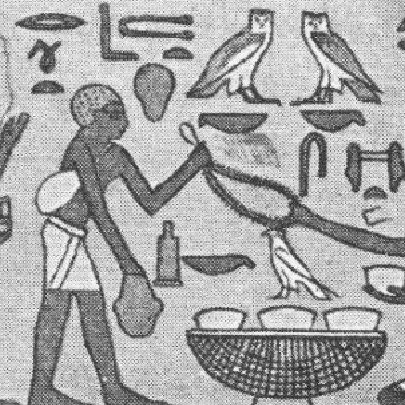
Among these plundered treasures was an ancient Egyptian necklace.
📜 The 1944 Inventory Entry (#12)
“Egyiptomi nyaklánc, üveggyöngyből, kartonra applikálva.”
(Egyptian necklace, made of glass beads, mounted on cardboard.)
The description is brief but unusually specific. It records an Egyptian bead necklace preserved in the practical museum manner of the era — mounted on cardboard to keep the fragile components together and prevent loss.
🏛️ Strongest Identified Candidate
Beads from a Necklace
Museum of Fine Arts, Budapest (Szépművészeti Múzeum)
Egyptian Art Collection
Inventory No. 51.1038
Status: Not on display
mfab.hu/artworks/20818/
The museum’s own record notes:
“This record is subject to revision due to ongoing research.”
🔍 Why This Object Warrants Investigation
• Material Correspondence
The museum catalogs the object as Egyptian faience beads. Wartime inventory clerks may have described faience as “glass” because of its glossy, glass-like surface. The 1944 description is entirely consistent with a faience bead necklace.
• The Mounting Detail
The inventory specifically notes that the necklace was mounted on cardboard (kartonra applikálva). This is not a decorative feature but a preservation detail. Small bead assemblages were commonly mounted in this manner, making the notation unusually useful for provenance research.
• Institutional Continuity
The candidate object remains in the same museum that received confiscated cultural property during 1944. At the time, Dénes Csánky served both as director of the Museum of Fine Arts and as the government official overseeing the custody of seized Jewish-owned cultural assets.
• The Cataloging Date
The inventory prefix “51.” indicates formal cataloging in 1951, during the period when wartime deposits, transfers, and previously uncataloged holdings were being incorporated into permanent state museum inventories.
• Elimination of Alternatives
A review of publicly accessible museum records did not identify a stronger candidate matching the 1944 description. While this does not establish identity, it makes Inv. 51.1038 a significant object for further provenance review.
• The Provenance Gap
The public record contains no reference to the Herzog family, the 1944 seizure, or the object’s path into the collection after the war.
⚖️ An Ancient Object, A Modern Question
The Museum of Fine Arts can identify the necklace’s civilization, material, function, and approximate age. It can place the object within the history of ancient Egypt and explain how it was made thousands of years ago.
What remains unclear is a much shorter span of time.
A surviving 1944 inventory records an Egyptian bead necklace removed from the Herzog Palace and transferred into state custody. Today, a remarkably similar necklace sits in the same museum’s Egyptian collection under Inventory No. 51.1038.
Whether this object ultimately proves to be the Herzog necklace remains an open question.
But the comparison highlights a recurring challenge in Holocaust-era provenance research: sometimes the greatest uncertainty is not the ancient history of an artifact, but the last eighty years of its existence.
The beads survived antiquity.
The ownership history should not be harder to reconstruct.
42
⚔️📜 The Sword and the Ledger: A 1944 Herzog Seizure and a Possible Museum Match
In 1944, during the systematic seizure of Jewish-owned property in Budapest, officials inventoried objects removed from the Herzog Palace at Andrássy út 93 — home to one of Hungary’s most important Jewish collections.
Among the entries appears #8 with, a specific description:
“Kard, késő bronzkor, zöld patinával, 103 cm hosszú, bársony talpasaton.”
Late Bronze Age sword, with green patina, 103 cm long, on a velvet stand.
🏛️ The Herzog Collection
The object belonged to the collection assembled by Baron Mór Lipót Herzog (1869–1934), one of Central Europe’s most significant art collectors.
Following the German occupation of Hungary in March 1944, artworks and antiquities from the Herzog collection were systematically inventoried and seized under anti-Jewish measures. Many objects were transferred into Hungarian state custody through museums and other public institutions.
This sword was among them.
⚔️ A Possible Modern Candidate
A compelling candidate exists today in the collections of the Hungarian National Museum:
Late Bronze Age antenna-hilted sword
Length: 103 cm
Date: c. 950–850 BCE
MNM 11.1949
The sword is catalogued in Hungarian archaeological literature and belongs to the class of high-status prestige weapons produced during the final centuries of the Bronze Age in the Carpathian Basin.
Most strikingly, its documented length is exactly 103 cm — the same measurement recorded in the 1944 Herzog inventory.
🔍 Why This Matters
Several factors make this an important provenance lead:
• Exact length match: 103 cm
• Correct period: Late Bronze Age
• Consistent condition: ancient bronze with green patina
• Display context: the 1944 inventory notes a velvet stand, suggesting a curated collector’s object rather than a recently excavated find
Taken together, these details warrant further investigation.
❓ The Provenance Gap
The surviving 1944 inventory establishes that a 103 cm Late Bronze Age sword was present in the Herzog Palace and entered state custody during the Holocaust era.
What remains unclear is whether the sword now catalogued in Hungarian museum collections is the same object.
Publicly available records do not currently identify the Herzog collection as part of its ownership history, nor do they reference the 1944 seizure.
📜 A Call for Transparency
@ArtRecoveryInit calls upon the Hungarian National Museum and the Museum of Fine Arts, Budapest to review and publish any records relating to:
• 1944 transfers from the Herzog collection
• Subsequent museum deposits and movements
• Accession files connected to 103 cm Late Bronze Age swords in state custody
⚖️ Restoring the Broken Line
The striking overlap between the 1944 ledger and the 103 cm sword cataloged as MNM 11.1949 presents an uncontradicted mandate for clarity. Because the archival trail confirms this curated weapon was plundered from the Herzog Palace, the burden now rests on the holding institutions to open their internal accession books and wartime deposit records. Tracing this definitive chain of custody is the only way to close the provenance gap and restore the true history of this artifact.
#HolocaustArtRecovery #HerzogCollection #ProvenanceResearch #LootedArt #BronzeAgeSword #HungarianNationalMuseum #MuseumOfFineArtsBudapest #WashingtonPrinciples #HEARAct
@WJRORestitution @nytimesarts @USAmbHungary @Telexhu @bbcarts @cnni @ArannReichhardt @neil_burridge @swordposting @ancientorigins @archaeologyart @archeohistories @smithsonian @LootBuster @ChasingAphrodit @artnet @wolfblitzer @elonmusk
1
1
2
236
🌎 From Budapest to Chicago: The Sword’s International Journey
One reason this provenance question matters is that the Hungarian National Museum has treated this particular sword (Inventory No. 11.1949.6) as a flagship artifact of its prehistoric collection.
The museum loaned the weapon for the major international exhibition First Kings of Europe (later presented in Canada as First Royals of Europe), a traveling show exploring the emergence of elite warrior societies during European prehistory.
🏛️ North American Exhibition History
The sword was displayed at:
• The Field Museum (Chicago) — March 31, 2023 to January 28, 2024
• Canadian Museum of History (Gatineau) — 2024–2025
In the official exhibition catalogue, the object was identified as:
Sword. Bronze. Șimleu Silvaniei (Szilágysomlyó), Romania.
900–850 BCE
Length: 102.9 cm
Inventory No. 11.1949.6
The catalogue highlights the weapon as a masterpiece of Late Bronze Age metalworking, decorated with stylized bird motifs and representing the prestige weapons of elite warrior culture.
⚔️ Why This Matters
The surviving 1944 Herzog Palace inventory records:
“Late Bronze Age sword, with green patina, 103 cm long, on a velvet stand.”
The museum sword’s published length of 102.9 cm is remarkably close to the 103 cm recorded in the wartime seizure ledger.
That measurement alone cannot establish identity. Many archaeological objects require additional provenance evidence before a definitive conclusion can be reached.
However, the exact dimensional correspondence, combined with the object’s prominence within the Hungarian National Museum’s collection, makes it an important candidate for further archival review.
📜 The Missing Provenance
The museum’s public catalogue and exhibition materials discuss the sword’s archaeological significance but do not reference:
• The Herzog collection
• The 1944 seizure inventory
• Holocaust-era transfers into state custody
• Any connection to the documented wartime confiscation of Jewish-owned cultural property
Whether this sword, forged more than three millennia ago, is ultimately proven to be the Herzog object remains an open question.
The answer lies not in exhibition catalogues, but in accession files, transfer records, and internal museum documentation.
Those records should be made available so the object’s complete history can be evaluated transparently and in accordance with the Washington Principles and the bi-partisan HEAR Act.
@FBIDirectorKash @TheLeoTerrell @JohnCornyn @SenBlumenthal @RepLaurelLee @RepJerryNadler @JBPritzker @ADL @jfederations @DickDurbin @ChicagoJCRC @chicagotribune @Suntimes @IsraelinChicago @HolocaustMI @jaredkushner @USAmbHungary @UNESCO @SCOTUSblog @USSupremeCourt @neal_katyal @danabrams @JustinTrudeau @globeandmail @slesposito @AndreaMedinaTV @raydowd @CarolineGlick @bariweiss
45
🕯️ Jakab Márton: The Chronicle and Plunder of a Local Artist
📜 A Painting from the Székesfehérvár Ghetto Inventory
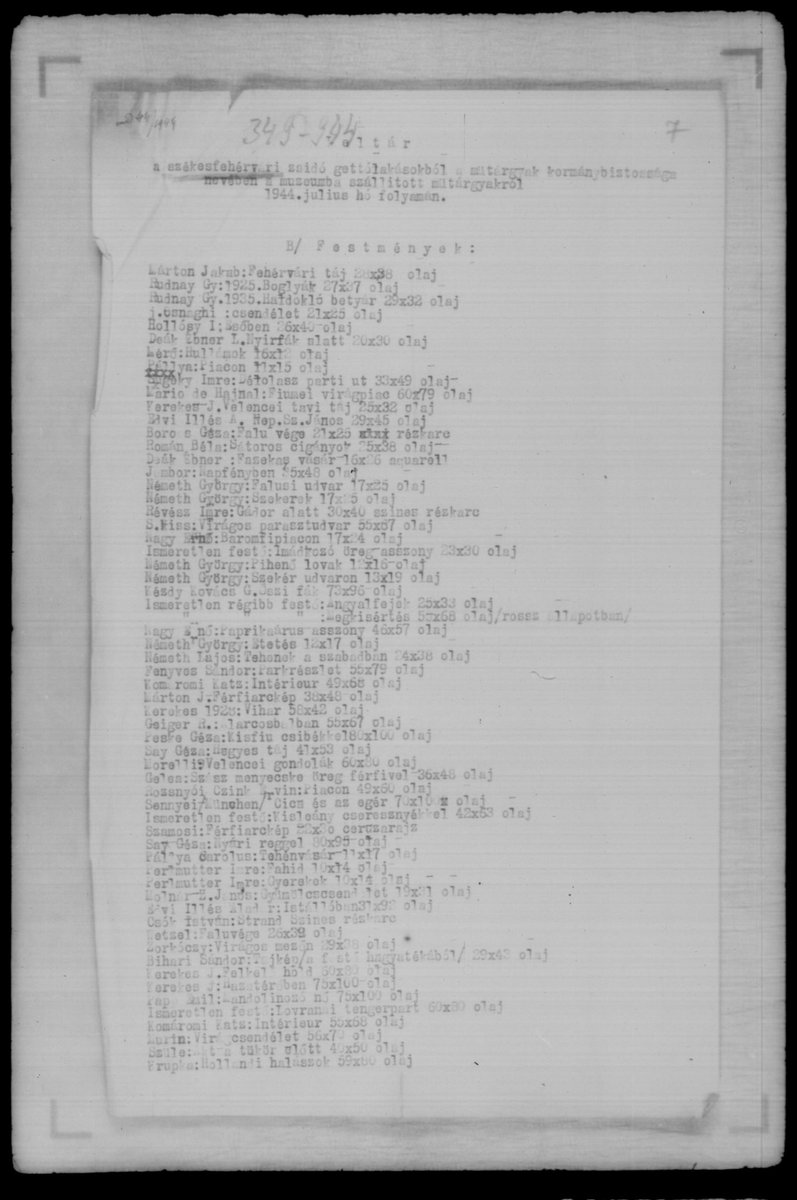
In July 1944, an inventory was compiled in Székesfehérvár documenting paintings removed from Jewish ghetto apartments. Under the authority of the government’s art commissioner, they were delivered straight to a local museum.
The very first painting listed on that ledger is described simply:
Jakab Márton, Fehérvári táj (Landscape of Székesfehérvár), 28 × 38 cm, oil.
🎨 The Artist
Jakab Márton was no outside observer of the city he painted.
Born in Túrócszentmárton in 1870, he trained under Károly Lotz and Bertalan Székely in Budapest, and under Kern in Berlin. In 1911, he continued his studies at the Nagybánya free school—a formative center of Hungarian landscape painting.
After early teaching posts in Kaposvár and Körmöcbánya, he settled in Székesfehérvár in 1903. For the next twenty-seven years, he taught drawing at the Ybl Miklós State Secondary School.
🏛️ The City’s Visual Chronicler
Jakab’s work extended well beyond the classroom. He exhibited regularly at the Műcsarnok and the Nemzeti Szalon in Budapest. He produced watercolor views of Székesfehérvár’s historic monuments, publishing them as a standalone album and a postcard series. He had become one of the city’s principal visual chroniclers.
His portrait commissions reflected his deep integration into local society: he painted mayors Saára Gyula and Havranek József, as well as Dr. Lőwy Károly, president of the Székesfehérvár Israelite community.
He illustrated books, belonged to the Fejér County Museum Association, and chaired the school board of the Goldziher Jewish elementary school. When he retired in 1930, colleagues praised the affection he had earned from “all of Székesfehérvár’s society.”
💔 The City Turns Away
In 1944, that same society’s institutions seized his painting of its own landscape. They logged it in a museum ledger first among more than 150 works stripped from Jewish homes.
Later that year, Jakab was deported to Auschwitz. He reportedly shared a transport wagon with his former colleague, the painter György Oszkár.
Jakab did not survive.
🔍 What Became of Fehérvári táj?
The first painting listed on this inventory has never been located in any public museum collection, auction record, or database.
What remains is the ledger entry itself: a 28 × 38 centimeter view of Székesfehérvár, painted by a man who spent decades teaching its children, documenting its landmarks, and preserving its cultural memory.
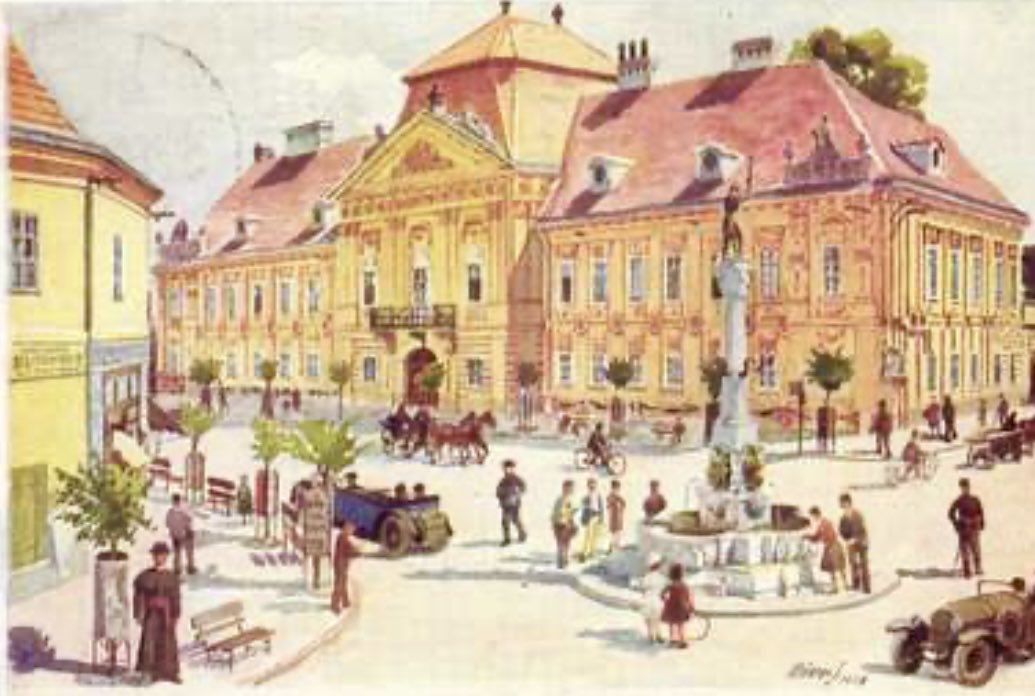
Images: A historic color postcard from the National Széchényi Library Postcard Collection on Hungaricana, reproducing a landscape painting by Jakab Márton. It portrays the timeless architecture and everyday life of Székesfehérvár—the very city that plundered his art collection in July 1944 before his deportation to Auschwitz. Also attached is the 1944 Inventory page referenced in the post.
@WJRORestitution @AuschwitzMuseum
@444hu @CathyHickley @nytimesarts
1
168
🔎 1944 Seizure Entry vs. 2021 Market Appearance: Csók István's Balaton Masterpiece
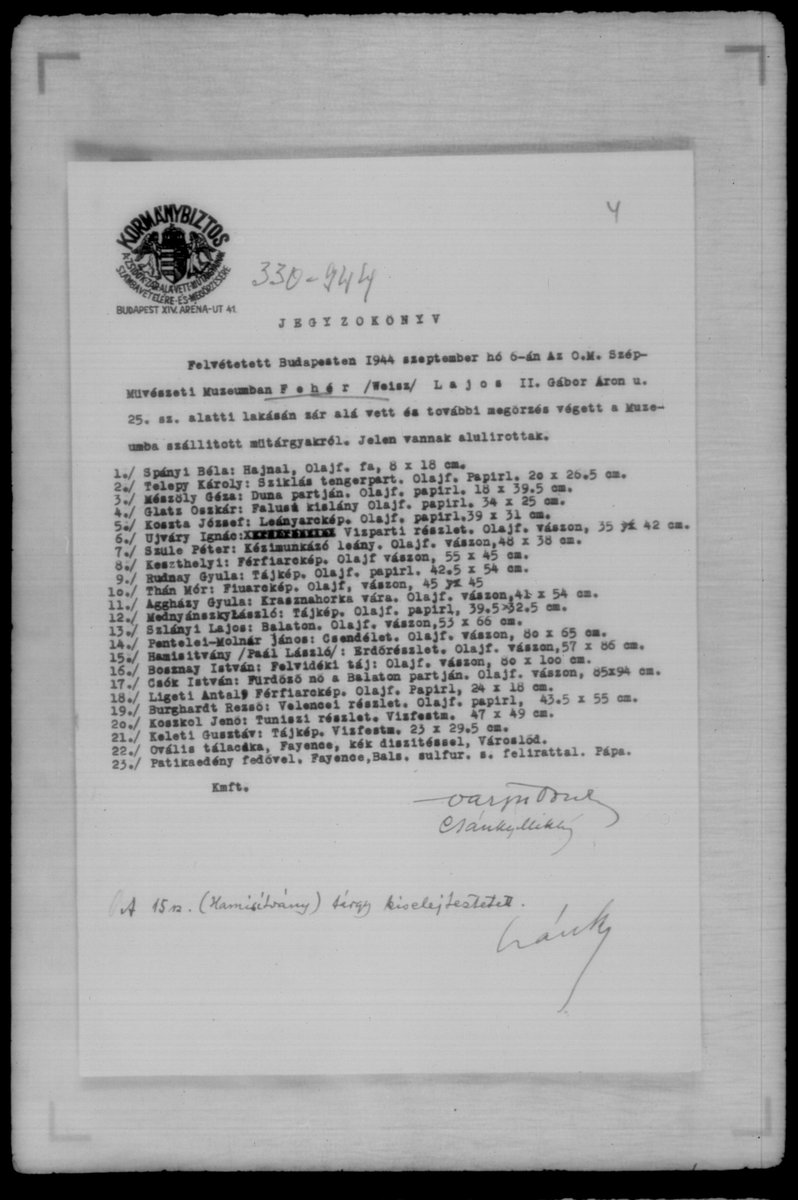
A 1944 Hungarian Government Commissioner inventory records the wartime seizure and museum transfer of artworks from the sealed Budapest home of Fehér/Weisz Lajos, at Budapest II., Gábor Áron u. 25.
Among the listed works on Reel 144, slide 787 is Item 17:
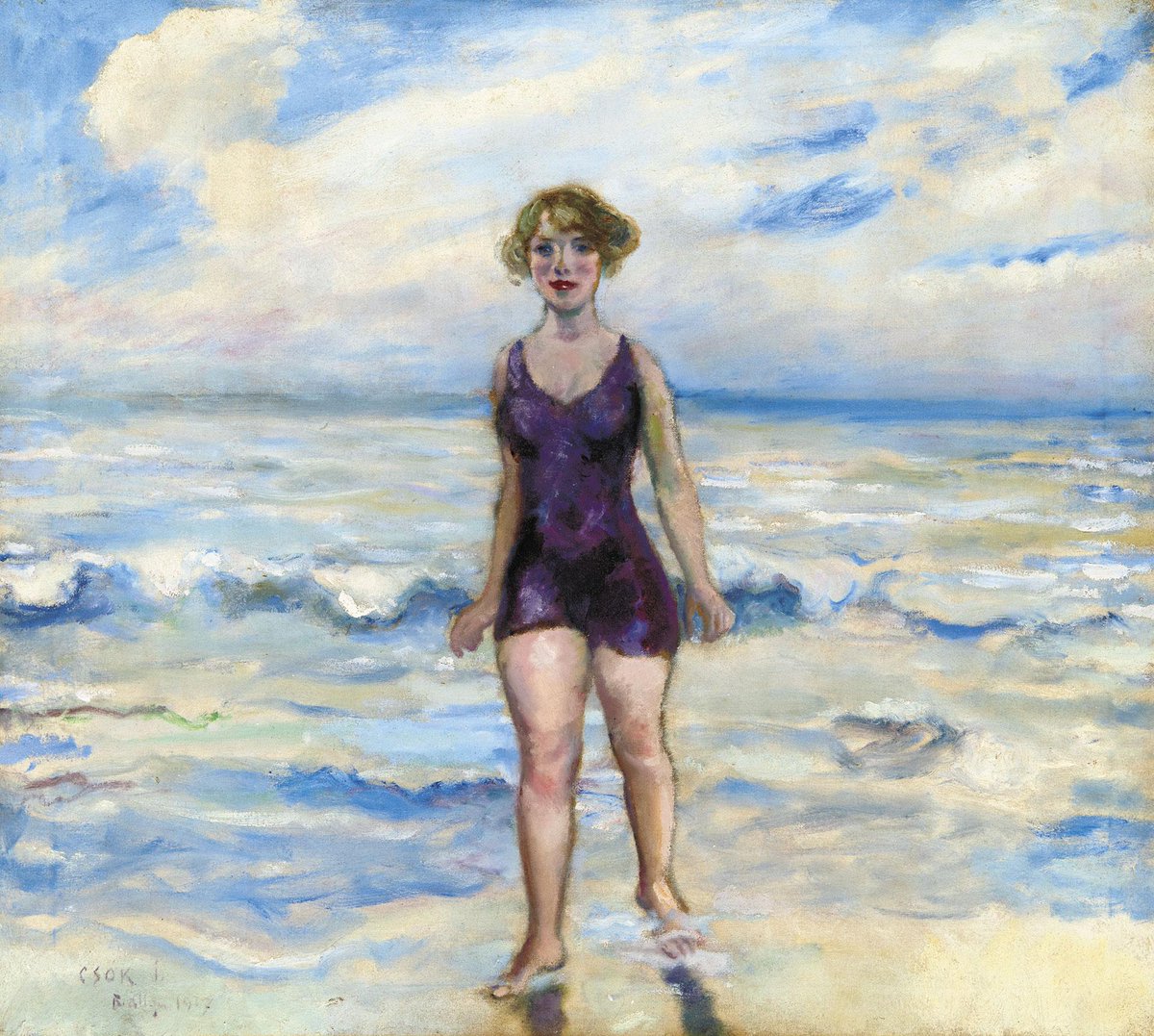
“Csók István: Fürdőző nő a Balaton partján. Olajf. vászon, 85 × 94 cm.”
Translation: István Csók — “Bathing Woman on the Shore of Lake Balaton.” Oil on canvas, 85 × 94 cm.
🖼️ A compelling 2021 market candidate
A work that closely corresponds to this seizure entry appeared at Virág Judit Gallery, 67th Autumn Sale, Lot 96:
Csók István, Lake Balaton, 1917
Oil on canvas, 83 × 95 cm
Signed bottom left: “Csók I. B. aliga 1917”
Auction record and image:
viragjuditgaleria.com/en/lot…
🧩 Why this candidate matters
The convergence is significant:
• Artist: exact match — Csók István.
• Subject: the 1944 title describes a bathing woman on the shore of Lake Balaton. The 2021 auction title is generalized to Lake Balaton, but the image shows a woman in bathing attire standing at the water’s edge.
• Dimensions: 85 × 94 cm in the 1944 record versus 83 × 95 cm in the auction record — effectively the same format, allowing for normal cataloguing, framing, or measurement variance.
• Medium: both records identify the work as oil on canvas.
• Location inscription: the signature includes “B. aliga 1917,” indicating Balatonaliga, which fits the Balaton-shore subject directly.
This should be treated as a high-confidence match candidate requiring full provenance review, not as a closed identification until the ownership history is publicly clarified.
⚠️ The provenance gap
The public 2021 auction record does not account for the painting’s ownership history between the 1944 seizure inventory and its recent market appearance. For a work with this level of archival and visual correspondence, that gap should be addressed transparently and responsibly.
💎 The Rarity Factor
Csók’s Balaton pictures occupy an important place in his mature work, and a large, signed 1917 Balatonaliga canvas is not an ordinary market appearance. When a distinctive, large-format Csók Balaton painting appears publicly without a disclosed wartime ownership history, and a 1944 seizure inventory records a near-identical Csók Balaton-shore bathing subject from a sealed Jewish-owned Budapest collection, the responsible next step is full disclosure of the painting’s ownership path, verso evidence, and any wartime or postwar museum-transfer records.
📢 Request for disclosure and review
@ArtRecoveryInit calls on the relevant parties — including Virág Judit Gallery, any current holder, and the appropriate Hungarian museum and archival authorities — to assist in clarifying the painting’s chain of custody by disclosing or making available:
📜 Full pre-2021 provenance and ownership history
📸 Verso photographs, including labels, stamps, inscriptions, and inventory numbers
🏛️ Any wartime or postwar museum deposit, transfer, return, or deaccession records
🛡️ Consignor-side due diligence information, where legally shareable
📁 Archival records connected to Fehér/Weisz Lajos, Budapest II., Gábor Áron u. 25
This is exactly the kind of case that Holocaust-era provenance research is meant to clarify: a documented wartime seizure entry, a closely matching later-market appearance, and a public record that does not yet explain the intervening chain of custody.
Transparency here would serve the historical record, the art market, the museum field, and the families whose collections were seized in 1944. 🕯️
#HolocaustArtRecovery #CsókIstván #IstvanCsok #ProvenanceResearch #NaziLootedArt #Hungary1944 #ArtRestitution #WashingtonPrinciples #HungarianArt #Restitution
@WJRORestitution @nytimesarts @Telexhu @schuhmacher @artbreakhotel @guardian @cnni
1
1
161
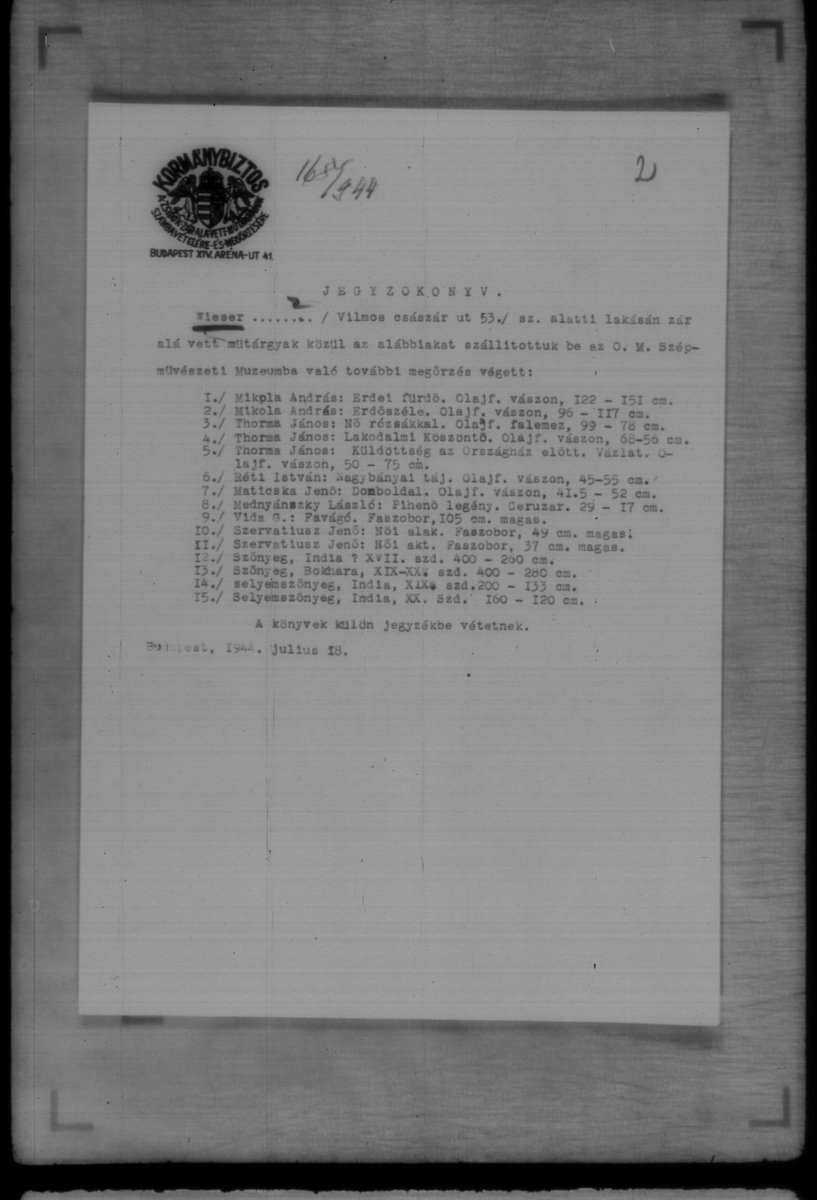
🕯️ #9 on the Weiser Inventory: Tracing a Lost Vida Géza Sculpture
Continuing the review of Case 168/1944 — the 18 July 1944 seizure from the Budapest apartment of Jewish collector Miklós Weiser at VI., Vilmos Császár út 53.
The inventory records:
“9./ Vida G.: Favágó. Faszobor, 105 cm. magas.”
(“Vida G.: Woodcutter. Wood sculpture. Height 105 cm.”)
🌲 The Strongest Candidate
One work stands out as an exceptionally strong match candidate:
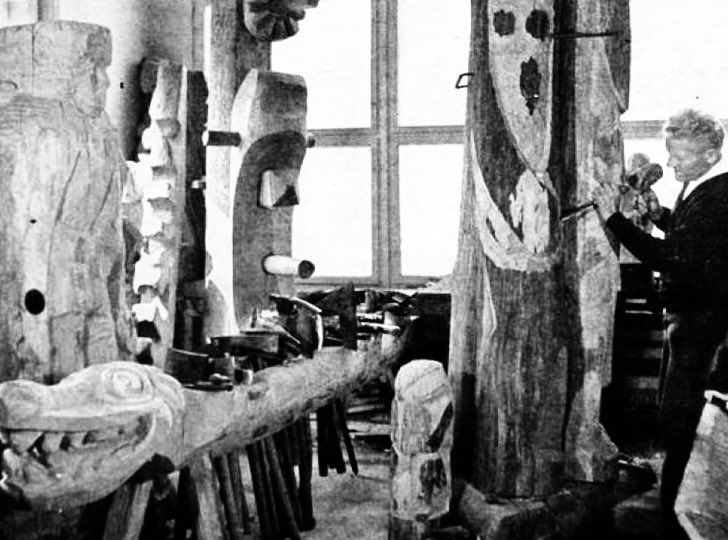
Vida Géza, A favágó (The Woodcutter), 1937
Wood sculpture
Height: 105 cm
The sculpture appears in an official 2018 public document concerning the Bay Collection at the Thorma János Museum in Kiskunhalas, where it is listed as:
“Vida Géza: A favágó, 1937 (fa, 105 cm)”
The alignment is striking:
• Artist: Vida G. / Vida Géza
• Title: Favágó / A favágó
• Medium: Wood sculpture
• Height: 105 cm
• Subject: Woodcutter
📚 About the Artist
Vida Géza (1913–1980) was one of the most significant sculptors associated with the Nagybánya (Baia Mare) artistic tradition. Known for expressive wood carvings depicting workers, peasants, and everyday life, he frequently explored labor-oriented themes that reflected the social realities of the era.
A sculpture titled A favágó fits squarely within his documented artistic practice.
🔍 Why This Matters
Provenance research often depends on assembling multiple pieces of evidence rather than finding a single document that answers every question.
Here, the combination of:
• Artist match
• Subject/title match
• Medium match
• Exact height match (105 cm)
creates a compelling connection between the 1944 Weiser inventory and the museum-listed sculpture.
At present, no publicly available provenance records explain how a sculpture matching the inventory description may have traveled from a Holocaust-era seizure record to its later museum listing.
📜 A Call for Transparency
The historical record would benefit from the publication of any available acquisition files, provenance research, transfer records, or wartime documentation relating to this sculpture.
Under the spirit of the Washington Principles and ongoing Holocaust-era provenance initiatives, transparency helps institutions, researchers, descendants, and the public better understand the history of cultural property affected by persecution and war.
Every recovered document adds another piece to the story.
🕯️ Remembering Miklós Weiser means remembering not only the people who were targeted, but also the artworks and cultural objects caught up in that history.
#HolocaustArtRecovery #ProvenanceResearch #VidaGeza #WashingtonPrinciples #HEARAct #ArtHistory #CulturalHeritage #MuseumTransparency #Nagybanya #LostArt
@WJRORestitution @nytimesarts @USAmbHungary @SecRubio @HolocaustUK @HolocaustMI @CathyHickley @AmbHerzog @TheLeoTerrell @CarolineGlick
3
4
187
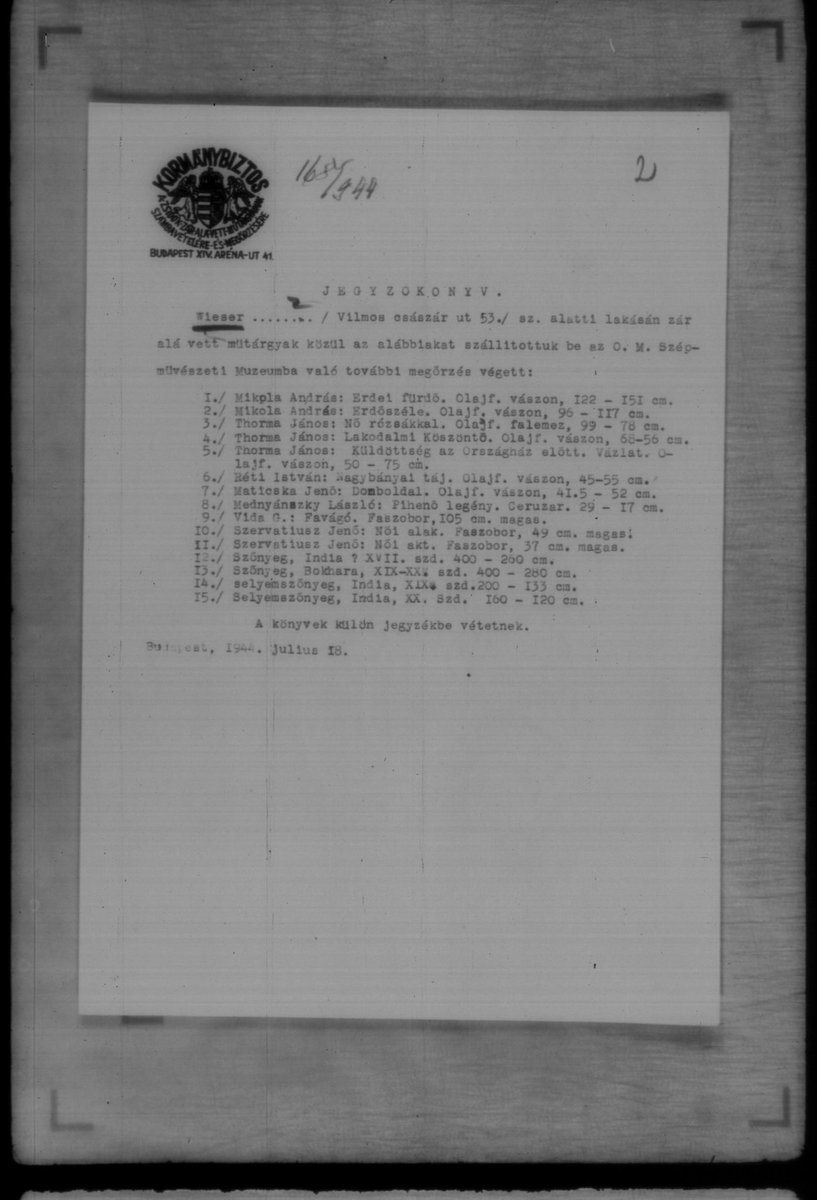
🕯 The Greeting Man and the Weiser Inventory: A 1944 Seizure Record Points to the Thorma János Museum
Case 168/1944, bearing the stamp of the Government Commissioner for Jewish Affairs, records the forced seizure of fifteen artworks from the Budapest apartment of Weiser Miklós at VI., Vilmos Császár út 53 on 18 July 1944. The fourth entry reads:
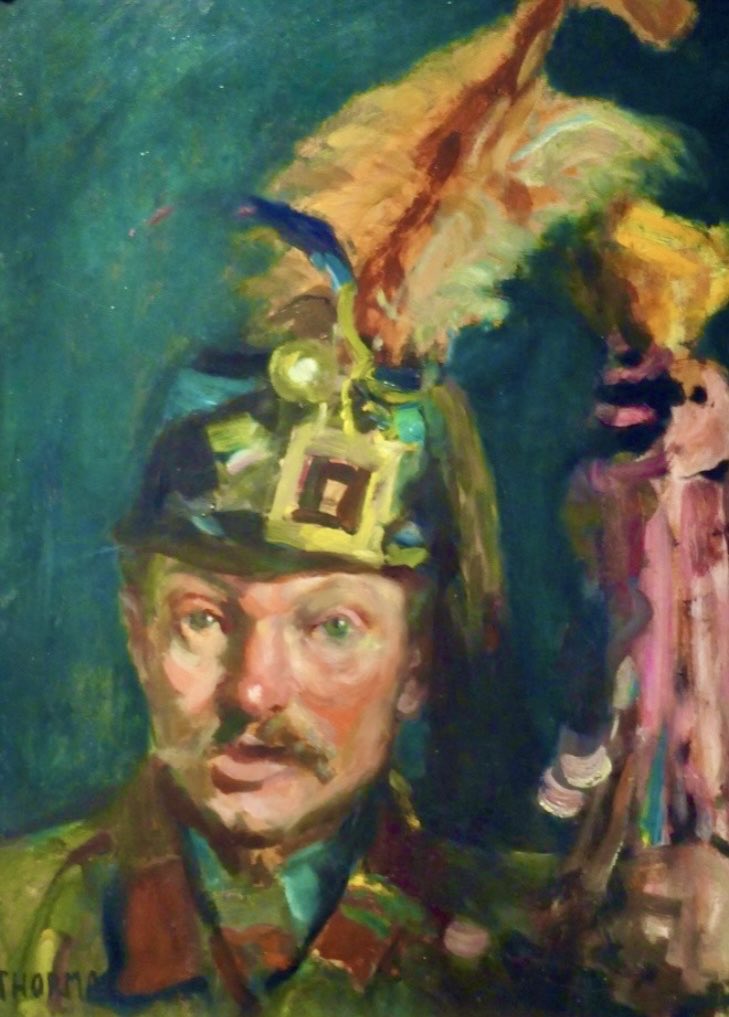
“4./ Thorma János: Lakodalmi Köszöntő. Olajf. vászon, 68–56 cm.”
Lakodalmi Köszöntő — Wedding Toast. Oil on canvas. 68 × 56 cm.
🔍 The Match Candidate
The Thorma János Museum in Kiskunhalas holds a work catalogued as A nagybányai köszöntő ember (The Nagybánya Greeting Man), 1928, oil on canvas, 68 × 56.5 cm, signed lower right, inventory no. 2005.19.1.
gallery.hungaricana.hu/hu/Ki…
Artist, medium, subject, and dimensions correspond precisely — half a centimeter within normal cataloguing tolerance. The museum’s own description confirms this was a subject Thorma returned to repeatedly, making title drift between Lakodalmi Köszöntő and A nagybányai köszöntő ember entirely consistent with postwar cataloguing practice. No other known Thorma work of this subject at these dimensions has been identified.
🎨 The Artist
János Thorma (1870–1937) was a founding figure of the Nagybánya artists’ colony, working across naturalism, historical subjects, and romantic realism. The feathered, ornamented greeting figure — a man in ceremonial dress with glass raised — was one of his most characteristic subjects, rooted in the communal life of Nagybánya that he documented across decades.
⚠️ An Important Note
No publicly available documentation directly links inventory no. 2005.19.1. to the 1944 Weiser seizure. The accession number dated 2005 raises an unanswered question about how this work entered the collection. The postwar provenance window — from the Szépművészeti Múzeum’s 1944 intake to the Thorma János Museum’s 2005 accession — has not been accounted for in any public record.
🧾 The Pattern
This is the second Thorma work match candidate documented from the 18 July 1944 Weiser inventory identified at this specific museum. Küldöttség az Országház előtt was documented here in an earlier post. That two works from the same wartime seizure appear to have entered the Thorma János Museum without disclosed Holocaust-era provenance is not coincidence. It is a pattern — and it demands an institutional answer.
📢 A Call for Transparency
We ask the Thorma János Museum to publish full acquisition documentation for inventory no. 2005.19.1. — including the complete chain of custody and any records connecting or ruling out a link to the Weiser collection seizure of 18 July 1944.
Under the Washington Principles on Nazi-Confiscated Art and the HEAR Act, institutions holding such material bear a responsibility to identify, disclose, and facilitate just and fair resolution.
A painting seized from a Jewish collector’s apartment in 1944 and a painting catalogued at a Hungarian museum in 2005 share overlapping match factors that cannot be dismissed. Whether they share the same history is a question only the Thorma János Museum and the Museum of Fine Arts, Budapest can answer.
#HEARAct #WashingtonPrinciples
@WJRORestitution @nytimesarts @marcorubio @WorldJewishCong
171
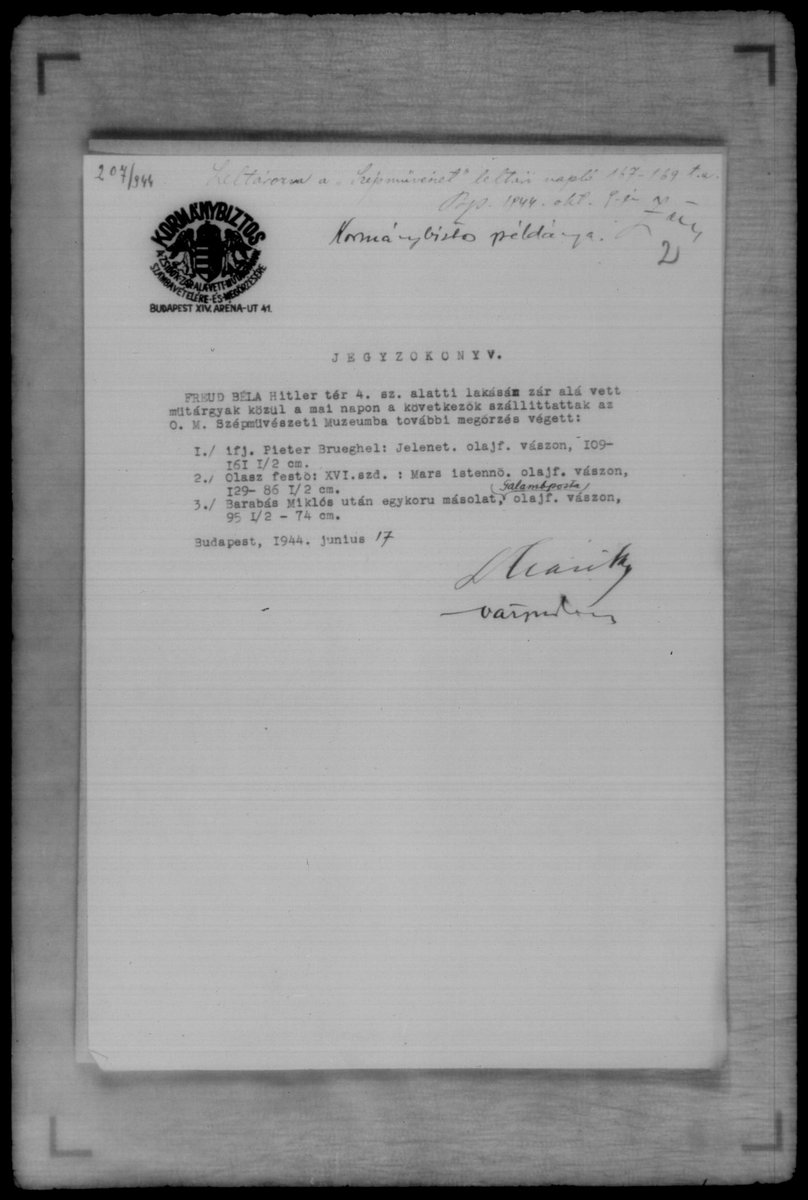
🕯 The Label Survived: Béla Freud’s Galambposta and the 1944 Transfer Inventory
A Kormánybiztos inventory — Case 207/1944, bearing the official stamp of the Government Commissioner for Jewish Affairs and signed by Csánky Dénes — records the forced transfer of artworks from the Budapest apartment of Béla Freud at Hitler tér 4 to the Szépművészeti Múzeum on 17 June 1944. The third entry reads:
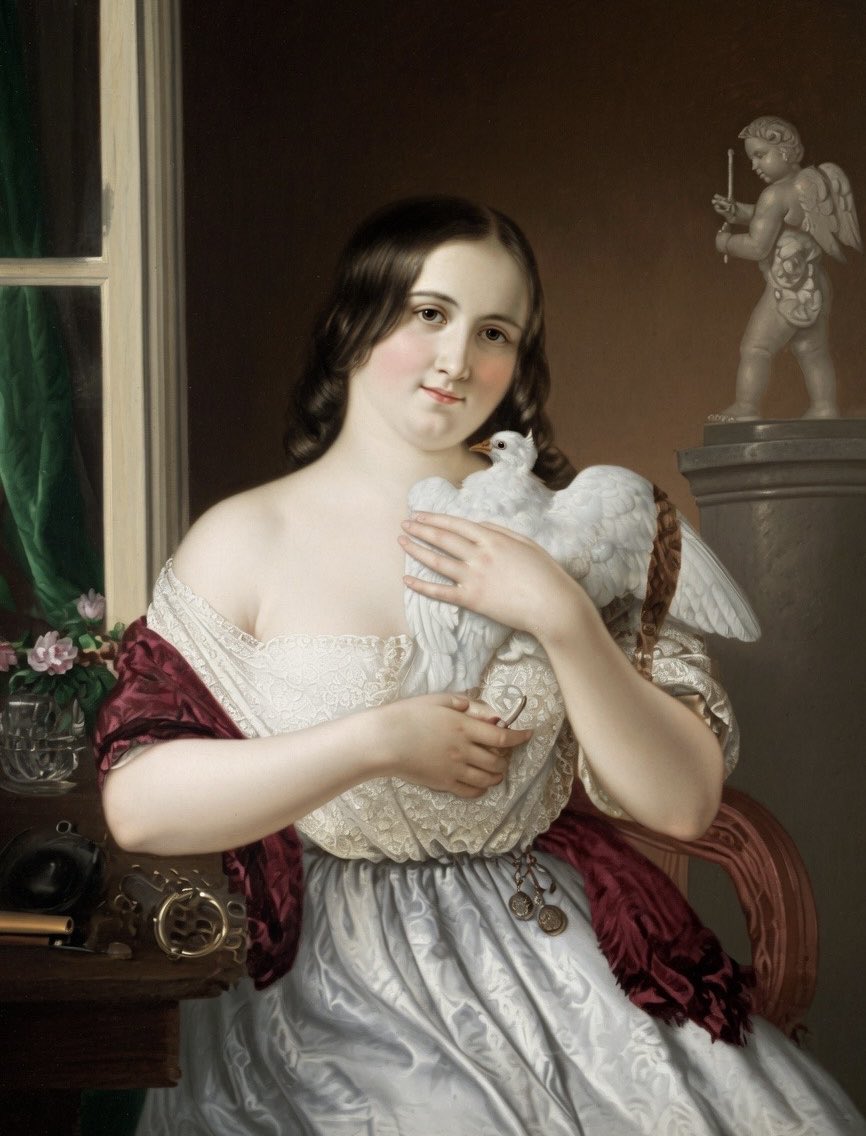
“3./ Barabás Miklós után egykoru másolat, (Galambposta) olajf. vászon, 95 1/2 – 74 cm.”
Contemporary copy after Miklós Barabás, Galambposta (Pigeon Post). Oil on canvas. 95.5 × 74 cm.
🎨 The Painting and the Label
At the 82nd Polgár Christmas Art Auction on 1 December 2009, Lot 107, a painting titled Galambposta (after Miklós Barabás) was offered — oil on canvas, 95 × 73 cm. The dimensions correspond within half a centimeter on both measurements.
axioart.com/tetel/freud-bela…
What distinguishes this case is the physical evidence on the painting itself. The verso carries a handwritten label reading: “Barabás M. után egyk. másolat: Galambposta — Freud Béla, Hitler tér 7” — alongside an Ernst Múzeum exhibition label, placing this painting in Budapest’s pre-war art world before it disappeared into state custody.
The name on the verso is the name in the seizure record. Whoever labelled this painting wrote the same name that appears at the top of the 1944 government document — Freud Béla — and that name survived on the back of the canvas for sixty-five years before the painting surfaced at auction.
⚠️ A Discrepancy to Note
The 1944 inventory records Freud’s address as Hitler tér 4. The verso label reads Hitler tér 7. These are different addresses on the same square. Whether this reflects a transcription error in the inventory, separate premises used by the same owner, or another explanation is not established in any public record — and is part of what a full provenance review should address.
🎨 The Subject and the Artist
Miklós Barabás (1810–1898) was one of Hungary’s most significant painters — a founder of Hungarian genre painting whose work met with great success in Vienna and Pest. His Galambposta of 1843, depicting a young woman receiving a message carried by a pigeon, became one of the most beloved images of Hungarian Biedermeier art and was widely copied by later artists. The copy in Béla Freud’s collection was documented and labelled during his lifetime — and transferred to state custody in a single afternoon in June 1944, alongside a Brueghel and a 16th century Italian painting.
📢 A Call for Transparency
This painting surfaced at public auction in Budapest in 2009 — sixty-five years after the seizure — without any disclosed connection to the 1944 inventory. It is now in private hands. We ask the current holder to review the painting’s full provenance history, and we ask the Szépművészeti Múzeum to disclose what records exist for the transfer of this work under Case 207/1944.
Under the Washington Principles on Nazi-Confiscated Art and the HEAR Act, works with documented wartime seizure records and unresolved postwar provenance chains warrant full transparency and just and fair resolution.
The government took the painting. It could not take the label. And the label remembered exactly whose it was.
#HEARAct #WashingtonPrinciples
@WJRORestitution @nytimesarts @USAmbHungary @lauder_ronald
179
🖼️ Tracing a Herzog Rubens: From the 1944 Budafok Inventory to Christie’s London
In June 1944, Hungarian authorities inventorying Jewish-owned property discovered a hidden cache of artworks in the cellars of the Herzog family’s Budafok factory.
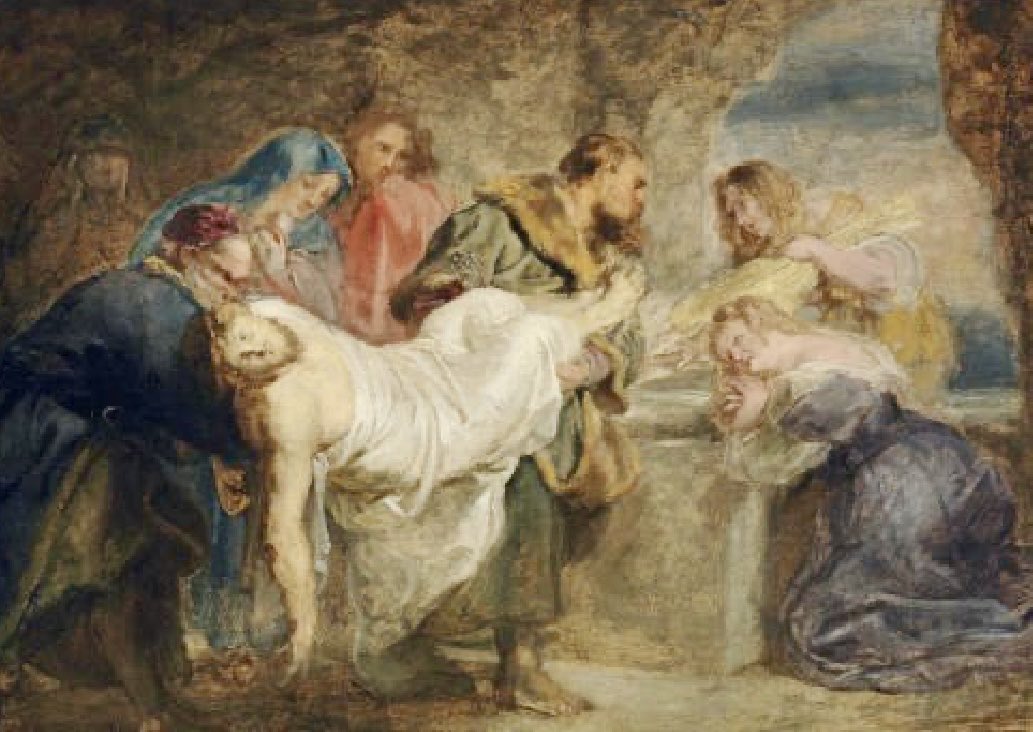
Among the entries in crate H.I. Rubens VIII. was a small panel attributed to Peter Paul Rubens:
“Rubens: Krisztus sírbatétele (Krisztus siratása), fa, olaj, mérete: 42 × 58 cm.”
Translation:
Rubens. Christ Carried to the Tomb. Oil on panel. 42 × 58 cm.
More than two decades later, a remarkably similar work appeared at Christie’s London (Lot 19, November 27, 1970):
• Peter Paul Rubens
• Christ Carried to the Tomb
• Oil on panel
• 41.6 × 57.5 cm
The match is striking.
Unlike canvas, wooden panels remain dimensionally stable over centuries. For provenance researchers, measurements can function almost like fingerprints. Here, the artist, subject, medium, and dimensions all align with the 1944 inventory.
🎨 The Artist
Peter Paul Rubens (1577–1640) was one of the greatest painters of the Baroque era. His dramatic religious compositions transformed European art and made him one of the most sought-after artists of his age.
This composition depicts Christ being carried to the tomb following the Crucifixion. Christie’s noted that the image is documented through an engraving by Han Witdoeck, a close collaborator of Rubens, and the work has been discussed by leading Rubens scholars including Julius Held and Carl Depauw Judson.
🧾 The Herzog Connection
The painting formed part of the celebrated collection of Baron Mór Lipót Herzog, one of the most important Jewish collectors in prewar Europe.
After Herzog’s death, portions of the collection passed to his son, Baron András Herzog. In 1944, as Jewish property was systematically targeted across Hungary, the family attempted to protect artworks by hiding them in the Budafok factory cellars.
The surviving inventories document what happened next.
Many works listed in those ledgers ultimately entered state custody and remain subjects of restitution efforts today.
This Rubens appears to have followed a different path.
When Christie’s offered the painting in 1970, the catalogue traced ownership through Jules Porgès, Marcell Nemes, Baron Andreas Herzog, and by descent to his daughter, Erzsébet Herzog (Madame Dimitri Angelopoulo).
What remains unclear is the painting’s precise journey between the 1944 inventory and the 1970 sale.
That gap is exactly why provenance research matters.
The Budafok inventory documents the painting’s wartime seizure. The Christie’s catalogue documents its later reappearance through a surviving branch of the Herzog family. Together, they help reconstruct another chapter in the history of one of Europe’s greatest Jewish art collections.
🔗 Christie’s London, Lot 19 (27 November 1970):
christies.com/en/lot/lot-502…
#HolocaustArtRecovery #HerzogCollection #Rubens #ProvenanceResearch #ArtHistory #WashingtonPrinciples #HEARAct #NaziLootedArt #CulturalHeritage
1
1
3
473
🖼️ Update: The Herzog Rubens Reappears at Christie’s – December 2007
The small panel matching the 1944 Budafok inventory (crate H.I. Rubens VIII) appeared at Christie’s London (Live Auction 7448, Lot 118):
Attributed to Sir Peter Paul Rubens
Christ Carried to the Tomb
Oil on panel, 41.6 × 57.5 cm
* Estimate: £30,000–£40,000
* Price realized: £192,500 (5× the low estimate!)
🔗 Full lot details: christies.com/en/lot/lot-502…
The 2007 Provenance Link:
The Christie’s catalog explicitly traced the panel back to its pre-war owners:
Jules Porgès ➡️ Marczell von Nemès (1913) ➡️ Baron Andreas Herzog ➡️ Madame Dimitri Angelopoulo (who first auctioned it in 1970).
The Market vs. Scholarship:
While major scholars (Held 1980; Judson 2000) labeled it a period copy, the catalog noted that the central figure of Joseph of Arimathea shows Rubens’s actual handling from circa 1614. The massive £192,500 final hammer price shows the market aggressively bet on the presence of the master's own hand.
Why It Matters:
Publicly documenting these individual auction milestones is vital to connecting wartime records with the modern market. Under the Washington Principles, tracking these reappearances is key to establishing full transparency.
#HolocaustArtRecovery #HerzogCollection #Rubens #ProvenanceResearch #NaziLootedArt #WashingtonPrinciples #HEARAct #ArtRestitution
179
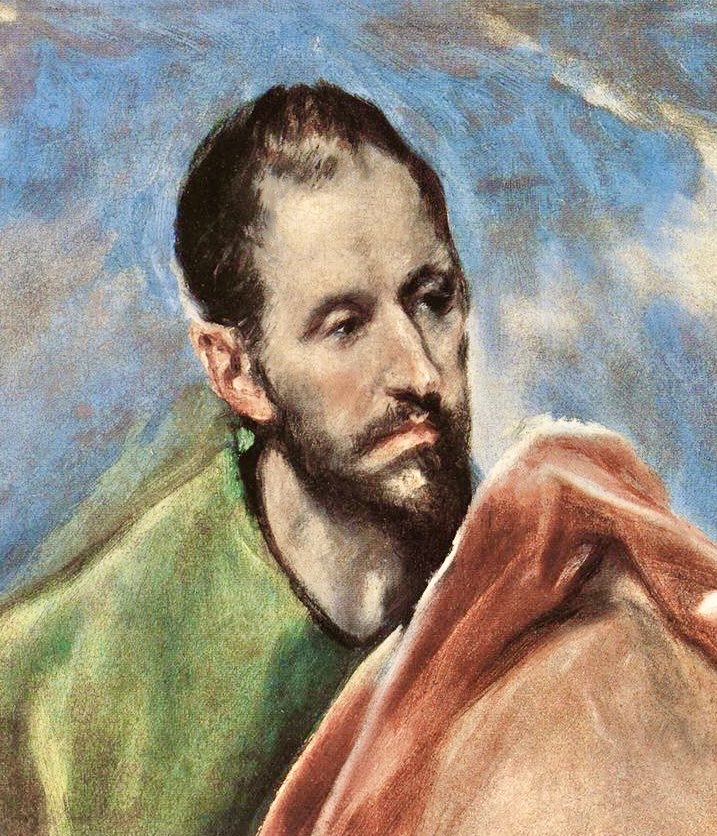
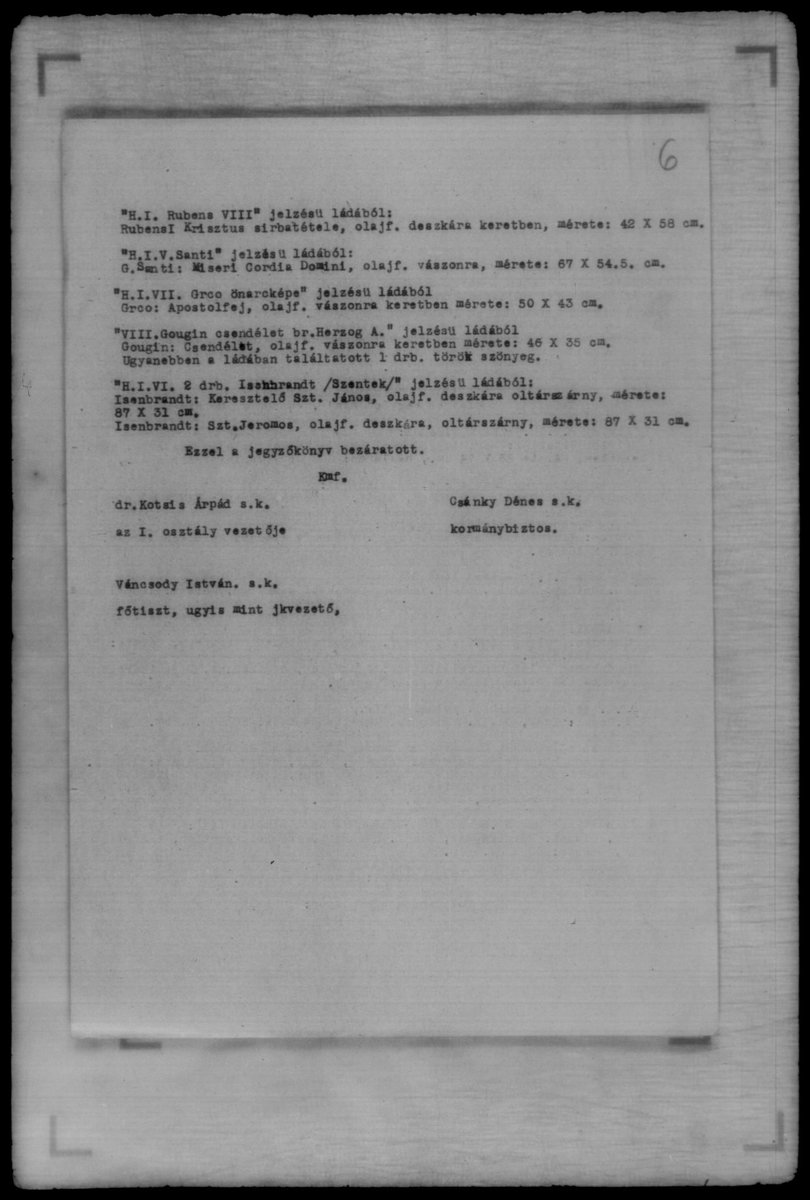
🕯 Hidden in a Factory Cellar, Seized by the State: El Greco’s Apostolfej and the Herzog Collection
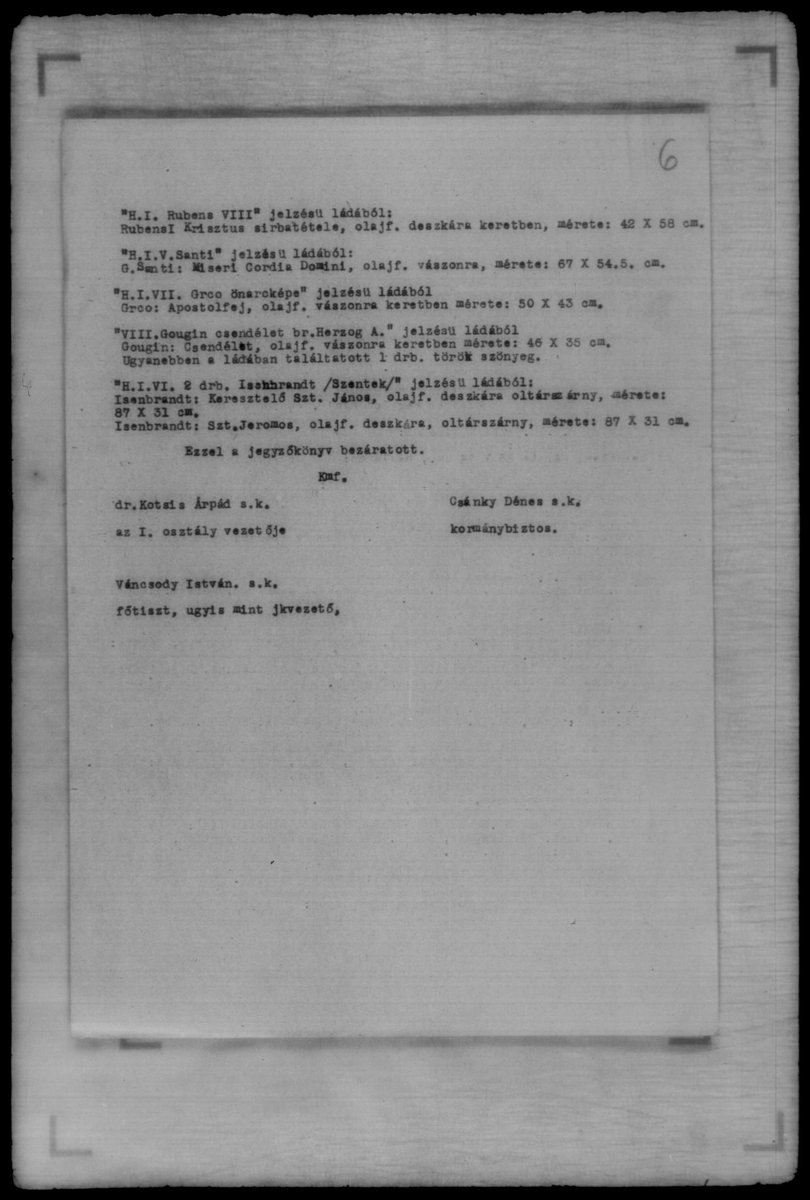
The final page of a 1944 Hungarian government inventory records objects removed from crates hidden in the cellars of the Herzog family’s Budafok factory. From crate H.I.VII., labelled “Grco önarcképe,” one entry reads:
“Grco: Apostolfej, olajf. vászonra keretben mérete: 50 × 43 cm.”
Grco — the inventory’s consistent shorthand for El Greco. Apostolfej — Apostle Head. Oil on canvas, framed. 50 × 43 cm.
🎨 The Painting
The Museum of Fine Arts, Budapest holds a work catalogued as Saint Bartholomew Apostle (fragment), attributed to El Greco (Domenikos Theotokopoulos, Candia 1541 – Toledo 1614), oil on canvas, 49.5 × 42.5 cm. Dated ca. 1585. Inventory no. 9048. Not on public display.
mfab.hu/artworks/8775/
The dimensions correspond within half a centimeter on both measurements. The artist, medium, and subject match exactly. The work is documented in the 2022 Budapest El Greco exhibition catalogue (cat. no. 48) and in Éva Nyerges’s 2021 scholarly study. The museum’s own record states: “This record is subject to revision due to ongoing research.”
🧾 The Collection and the Concealment
Baron Mór Lipót Herzog (1869–1934) assembled one of Central Europe’s greatest private collections — over 2,500 works including at least six El Grecos, many acquired from the legendary collector Marcell Nemes. Historic photographs of his Andrássy Avenue study show multiple El Grecos hanging together. After Herzog’s death in 1934, his heirs inherited the collection. In 1944, as Hungarian authorities under the Zsidó Kormánybiztosság systematically seized Jewish property, the family concealed what they could in the cellars of their Budafok factory. It was not enough.
⚠️ An Important Note
This specific work does not appear among the approximately 40 paintings named in De Csepel v. Republic of Hungary — the landmark Herzog family restitution lawsuit that reached the U.S. Supreme Court. Its absence from formal proceedings makes the absence of provenance disclosure more, not less, significant. Whether any postwar transaction was genuinely voluntary or conducted under duress while the family’s property remained under state control is precisely what the museum’s own records must answer. No public documentation accounts for the chain of custody between the Budafok crate and the museum’s present holding.
📢 A Call for Transparency
We ask the Szépművészeti Múzeum to publish the complete provenance file for inventory no. 9048 — including 1944 Budafok crate intake and transfer records, any postwar acquisition documentation, and the complete chain of custody to the present.
Under the Washington Principles on Nazi-Confiscated Art and the HEAR Act, institutions holding such material bear a responsibility to identify, disclose, and facilitate just and fair resolution.
This inventory page ends with the names of three officials — Csánky Dénes as Government Commissioner, dr. Kotzis Árpád as Division Chief, Váncsody István as secretary — followed by a single typed line: “Ezzel a jegyzőkönyv bezáratott.” The inventory is hereby closed.
Eight years later, their names do not represent a legal title—they represent an unpunished crime. The matter was not settled in 1944, and it will remain an open account until the artwork is returned to its rightful heirs.
#HEARAct #WashingtonPrinciples
@nytimesarts @SenBlumenthal @RepJerryNadler @marcorubio @UNHOP @USAmbHungary @CarolineGlick @WorldJewishCong @SCOTUSblog @neal_katyal @danabrams @raydowd @CathyHickley @elonmusk @grok @SmithsonianMag
1
269
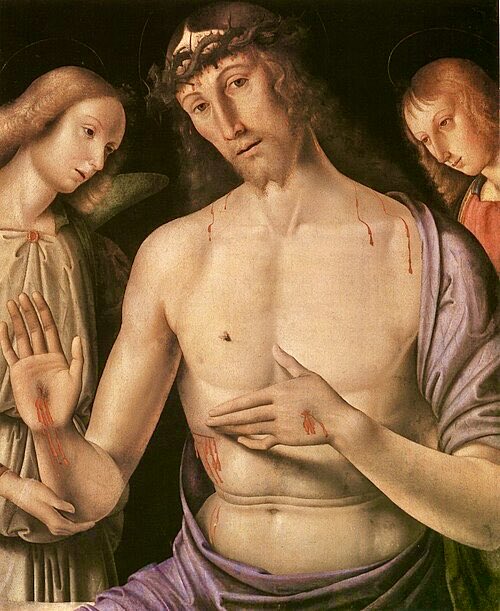
🖼️ FROM THE HERZOG COLLECTION TO A MUSEUM WALL: GIOVANNI SANTI’S MISERICORDIA DOMINI
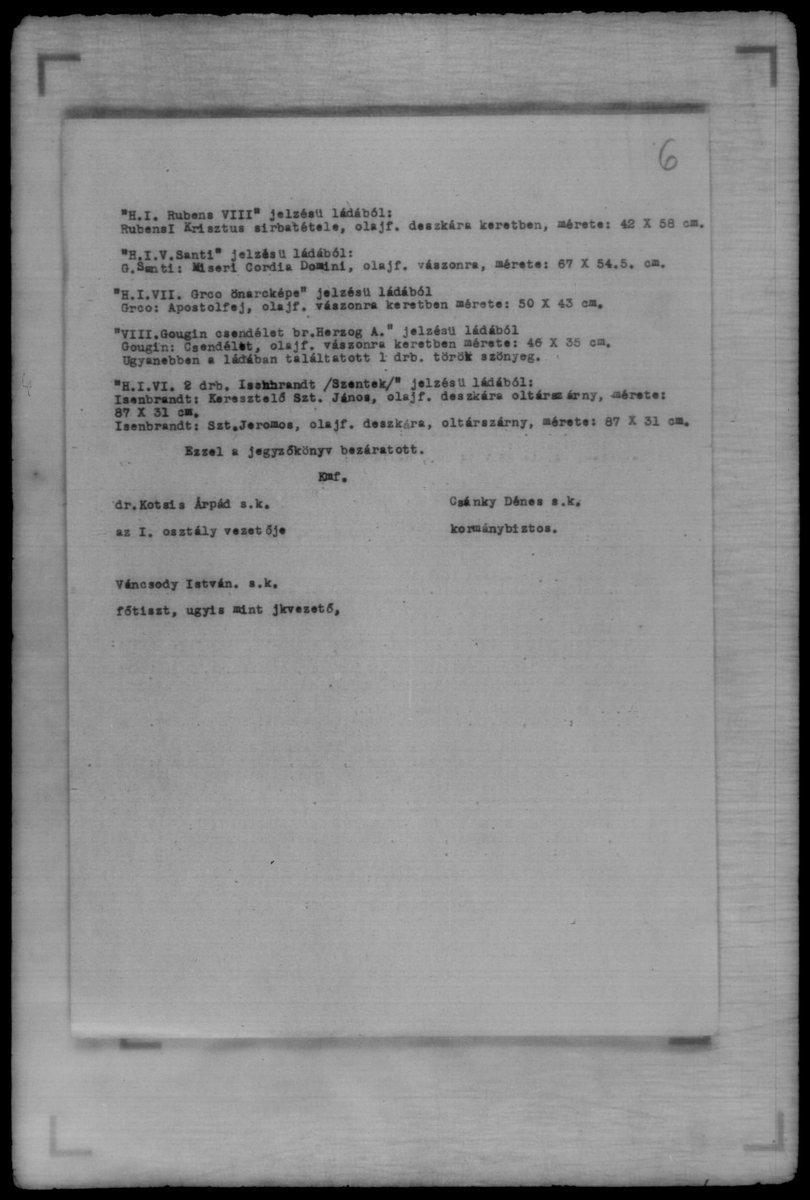
🕯️ In June 1944, Hungarian authorities operating under the Zsidó Kormánybiztosság (Jewish Government Commissioner) inventoried artworks stored by the Herzog family in the cellars of their Budafok factory.
Among the recorded crates was one marked:
“H.I.V. Santi”
Inside appeared the following entry:
“G. Santi: Miseri Cordia Domini, olajf. vászonra, mérete: 67 × 54.5 cm.”
Translated:
“G. Santi: Misericordia Domini (Mercy of the Lord), oil on canvas, 67 × 54.5 cm.”
Eighty years later, a painting matching that description remains on public display in Budapest.
🖼️ The Artwork
Giovanni Santi (c. 1435/1440–1494)
The Man of Sorrows (also known as Dead Christ with Two Angels, Christ the Dolorous, or Christ with a Fly)
• c. 1490
• Tempera on canvas (transferred from wood)
• 66.5 × 54.5 cm
• Inventory No. 51.799
• Museum of Fine Arts, Budapest (Szépművészeti Múzeum)
• Currently on view in the European Art collection
Museum record:
mfab.hu/artworks/9766/
The painting depicts the wounded Christ supported by two angels in the traditional Imago Pietatis (“Man of Sorrows”) format. The inventory’s reference to Misericordia Domini—the Mercy of the Lord—corresponds naturally with this devotional subject.
📜 The Documentary Trail
The convergence is striking:
• Artist: “G. Santi” appears in both records.
• Title: “Miseri Cordia Domini” corresponds to the devotional subject represented by the painting.
• Dimensions: 67 × 54.5 cm in 1944 versus 66.5 × 54.5 cm today.
• Medium: Wartime inventories often simplified technical descriptions; minor differences between “oil” and modern conservation terminology are common.
• Collection history: The painting was part of the Herzog holdings and appears in the documented 1944 Budafok inventory.
🏛️ The Herzog Collection
The Herzog Collection, assembled by Baron Mór Lipót Herzog, was one of the most important private art collections in Central Europe.
After the German occupation of Hungary in 1944, the collection was systematically inventoried, seized, dispersed, and transferred into state custody. The surviving inventories provide an extraordinary documentary record of that process.
This Giovanni Santi painting was:
• Published before World War II in scholarly literature.
• Owned by the Herzog family after its acquisition from the Marcell Nemes collection.
• Listed in the 1944 Budafok inventory.
• Retained in Hungarian museum custody after the war.
• Included in restitution litigation brought by Herzog heirs.
⚖️ Why This Matters
This is not an anonymous painting with an uncertain history.
It is a published Renaissance masterpiece with a documented ownership record, a wartime seizure inventory, an identifiable present location, and an ongoing restitution history.
Cases like this demonstrate why provenance research remains essential. The archival record survives. The object survives. The ownership history can be reconstructed.
📂 Call for Transparency
The Holocaust Art Recovery Initiative encourages the publication of:
• The complete provenance file for Inventory No. 51.799.
• All 1944 intake and transfer records.
• Conservation and accession files.
• Any archival materials documenting postwar custody and ownership.
Transparency is the foundation of ethical stewardship and fair resolution under the Washington Principles on Nazi-Confiscated Art.
🕯️ The inventory survived.
🖼️ The painting survived.
📜 The paper trail survived.
What remains is a full public accounting of its journey.
Sources:
• Museum of Fine Arts, Budapest object record: mfab.hu/artworks/9766/
• 1944 Herzog Budafok inventory
• David L. de Csepel et al. v. Republic of Hungary filings
• O. Fischel (1924) and subsequent scholarly literature
#HolocaustArtRecovery #HerzogCollection #GiovanniSanti #ProvenanceResearch #Restitution #WashingtonPrinciples #NaziLootedArt #MuseumTransparency #HEARAct
1
1
450
🖼️ From Raphael’s Childhood Workshop to a Holocaust Seizure Inventory
From the hands of a father, through the eyes of a young prodigy, to the trauma of the Holocaust: the journey of Giovanni Santi’s Misericordia Domini spans an extraordinary, half-millennium continuum of human history.
Painted around 1490 in the final years of Santi’s life, this Renaissance masterpiece emerged from the Urbino workshop where his seven- or eight-year-old son Raffaello—destined to become Raphael—was growing up. Surrounded by his father’s canvases, the future master likely marveled at the hyper-realistic trompe l’œil fly painted onto Christ’s shroud. When Santi died just four years later, orphaning 11-year-old Raphael, works like this remained a tangible link to his father’s legacy.
Four and a half centuries later, that artistic continuum collided with industrial slaughter. In June 1944, Nazi collaborators cracked open a wooden crate hidden in the Herzog family’s Budafok factory cellar. A bureaucrat’s cold inventory line—“G. Santi: Miseri Cordia Domini…”—instantly reduced a deeply personal Renaissance treasure to looted Jewish property.
Because both the artwork and the archival record survived, we are able to reconstruct this incredible, tragic history. True museum stewardship requires more than displaying beauty—it demands historical justice.
We call on the Museum of Fine Arts, Budapest, to grant full transparency to the Herzog files, confront the trauma beneath the varnish, and ensure a fair resolution under the Washington Principles.
#HolocaustArtRecovery #Raphael #HerzogCollection #GiovanniSanti #ProvenanceResearch #Restitution #MuseumTransparency @nytimesarts @CathyHickley @jerrysaltz @brand_arthur @lauder_ronald @WorldJewishCong @ncph @Adam_FineArt @Telexhu @KatyHessel @JohnCornyn @RepLaurelLee @HolocaustMI
1
235
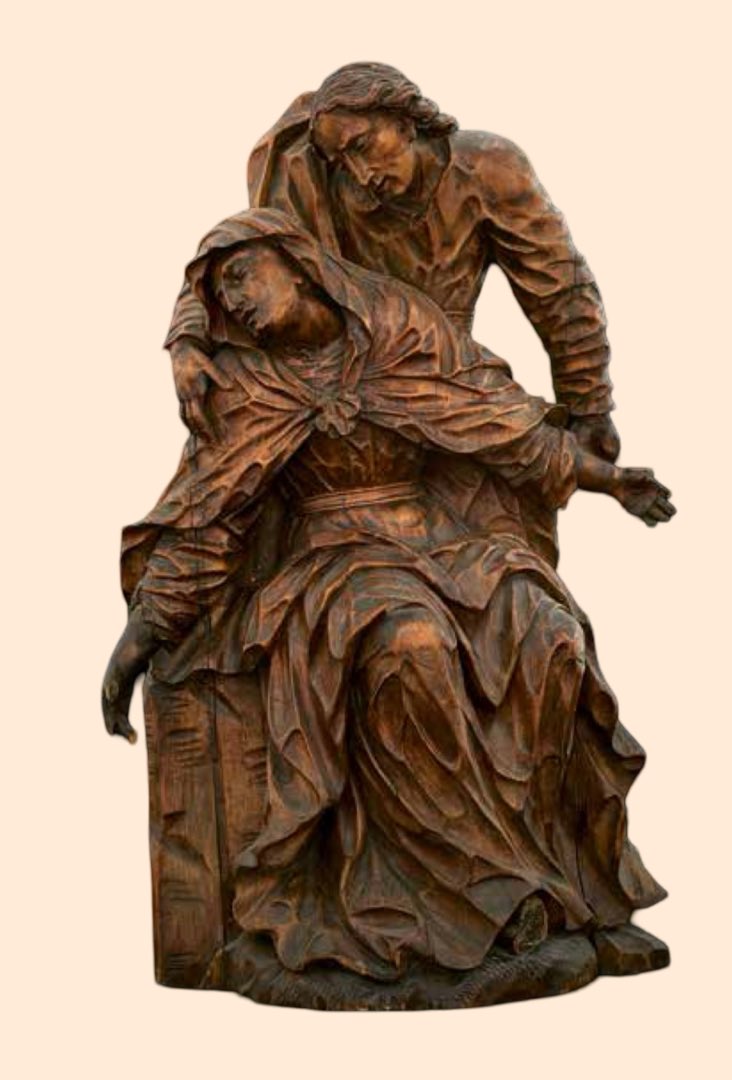
🕯️ A HERZOG SCULPTURE’S JOURNEY: FROM A 1944 SEIZURE INVENTORY TO A PUBLIC AUCTION RECORD
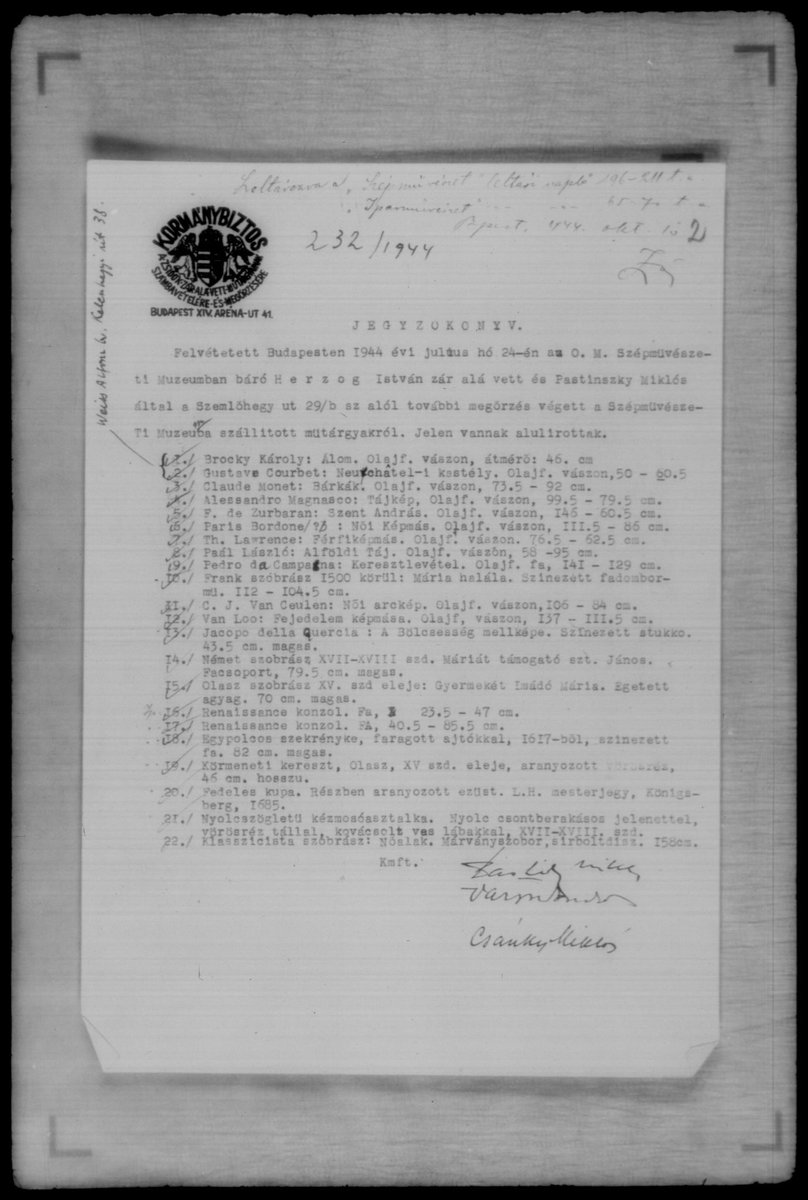
📜 On July 24, 1944, Nazi-aligned Hungarian authorities operating through the Zsidó Kormánybiztosság (Jewish Government Commissioner) recorded the seizure of 22 artworks from the Budapest residence of Baron István Herzog at Szemlőhegy út 29/b.
The official inventory (Jegyzőkönyv), preserved in the Hungarian Holocaust-era microfilm collection, documents the transfer of these objects to the Szépművészeti Múzeum (Museum of Fine Arts, Budapest) for “safekeeping.”
Among the entries appears:
📋 Entry #14
“Német szobrász XVII–XVIII. szd. Máriát támogató szt. János. Faszobor. 79.5 cm magas.”
Translation:
“Unknown German sculptor, 17th–18th century. Saint John supporting the Virgin Mary. Wooden sculpture. Height: 79.5 cm.”
🙏 More than seventy years later, a public auction record appears to identify the same sculpture.
🪵 Identified Artwork
Saint John Supporting the Virgin Mary
• Unknown German sculptor
• Late 17th–early 18th century
• Carved wood sculpture
• Approximately 80 cm high
Auction record:
kieselbach.hu/alkotas/janos-…
The sculpture depicts the Apostle John supporting the fainting Virgin Mary, a classic Baroque devotional scene associated with the Crucifixion. Its emotional composition, expressive drapery, and intimate scale are characteristic of South German and Austrian religious sculpture of the period.
🔍 Why This Identification Is So Compelling
Several independent points of correspondence align:
• Subject: “Saint John supporting Mary” corresponds directly to the sculpture depicted in the auction record.
• Attribution: Both sources identify an anonymous German sculptor from the same period.
• Medium: The 1944 inventory specifies a wooden sculpture (“faszobor”), matching the auctioned object.
• Dimensions: 79.5 cm in the wartime inventory versus approximately 80 cm in the auction record—a negligible variance consistent with historical cataloguing practices.
• Provenance: The auction catalogue explicitly identifies the work as originating from the Herzog collection and acknowledges seizure by the Zsidó Kormánybiztosság.
📚 The Documentary Trail
What makes this case especially significant is the convergence of multiple independent records:
➡️ A 1944 seizure inventory
➡️ A specific object description
➡️ A documented Herzog residence
➡️ State confiscation during the Holocaust
➡️ A later public auction record
➡️ An auction catalogue acknowledging the wartime seizure
Taken together, these records create an unusually strong documentary trail spanning more than seven decades.
👨👩👧👦 The Herzog Family
The sculpture belonged to the Herzog family, one of Hungary’s most important Jewish art collecting dynasties.
The fate of many objects remains unresolved today.
⚖️ Why Transparency Still Matters
Although the auction record acknowledges the wartime seizure and later return, important questions remain:
• What was the complete chain of custody between 1944 and the present?
• What records survive regarding postwar restitution?
• Where is the sculpture today?
• Are all associated archival materials publicly accessible?
The Washington Principles on Nazi-Confiscated Art call for transparency, provenance research, and fair solutions grounded in historical truth.
🏛️ Call for Documentation
We encourage the publication of:
• Complete provenance records
• Archival transfer documents
• Postwar restitution files
• Historic photographs
• Conservation and ownership records relating to this sculpture
Every recovered document helps reconstruct a history disrupted by the Holocaust.
🕯️ The inventory survived. The sculpture survived. The documentary trail survived.
Each piece of evidence brings us closer to a fuller accounting of what was taken, what was returned, and what remains unresolved.
211
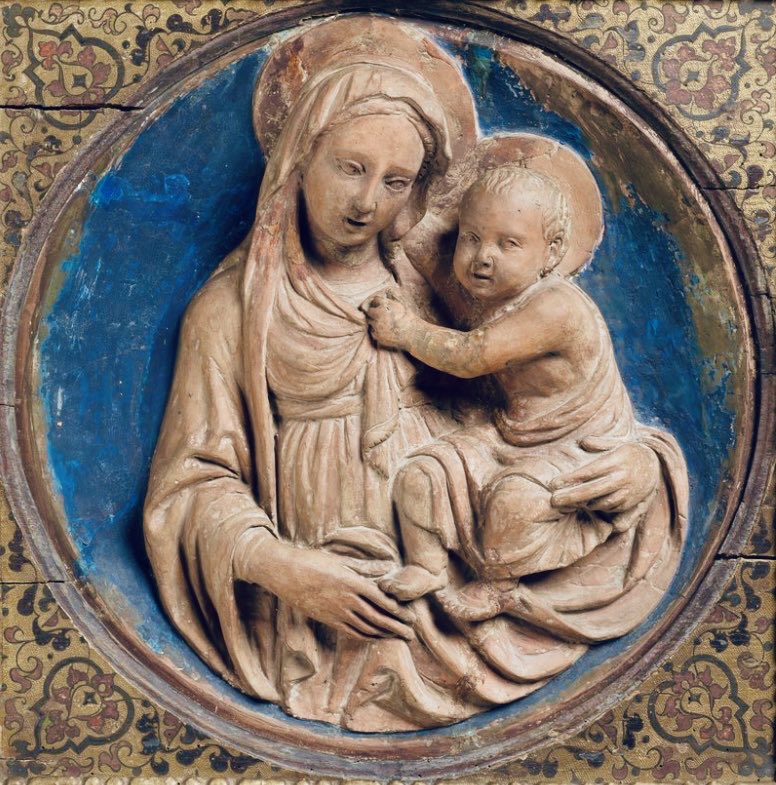
🏛 The Herzog-Sváb Ledger: A Florentine Relief Match Candidate at the Museum of Fine Arts
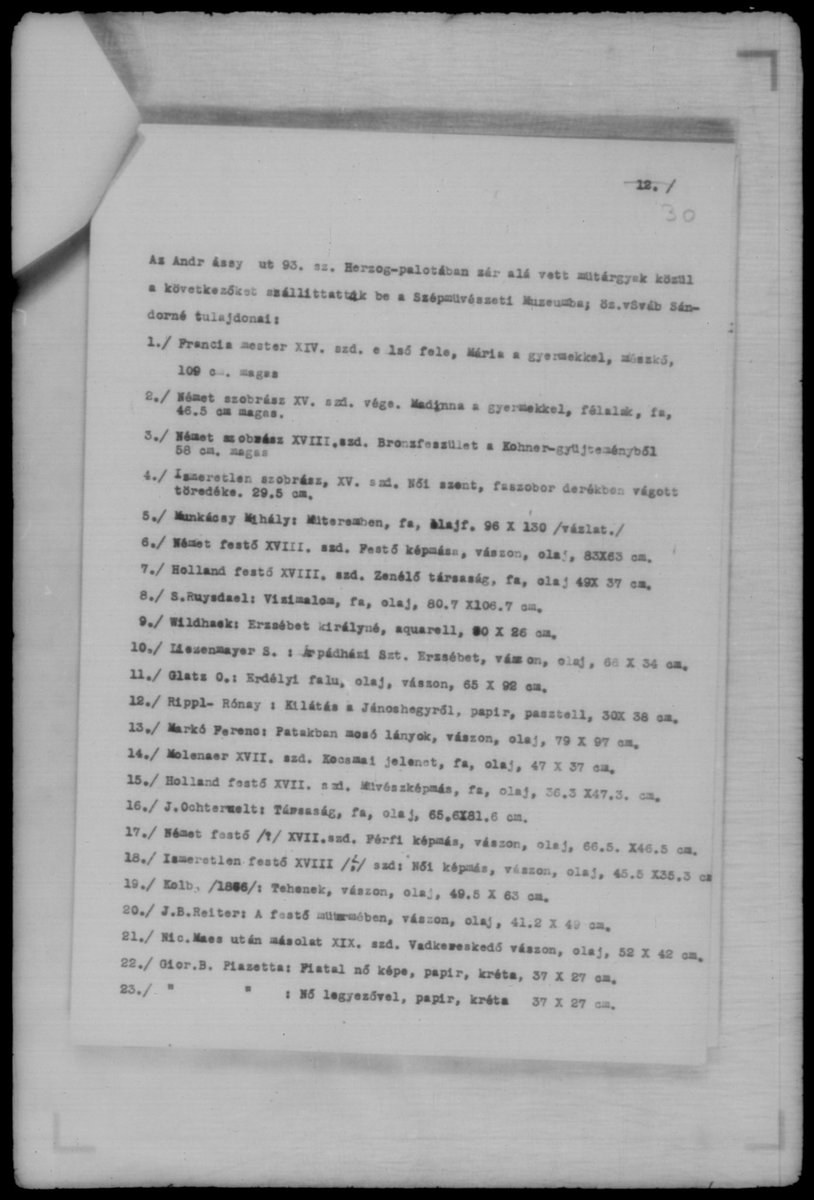
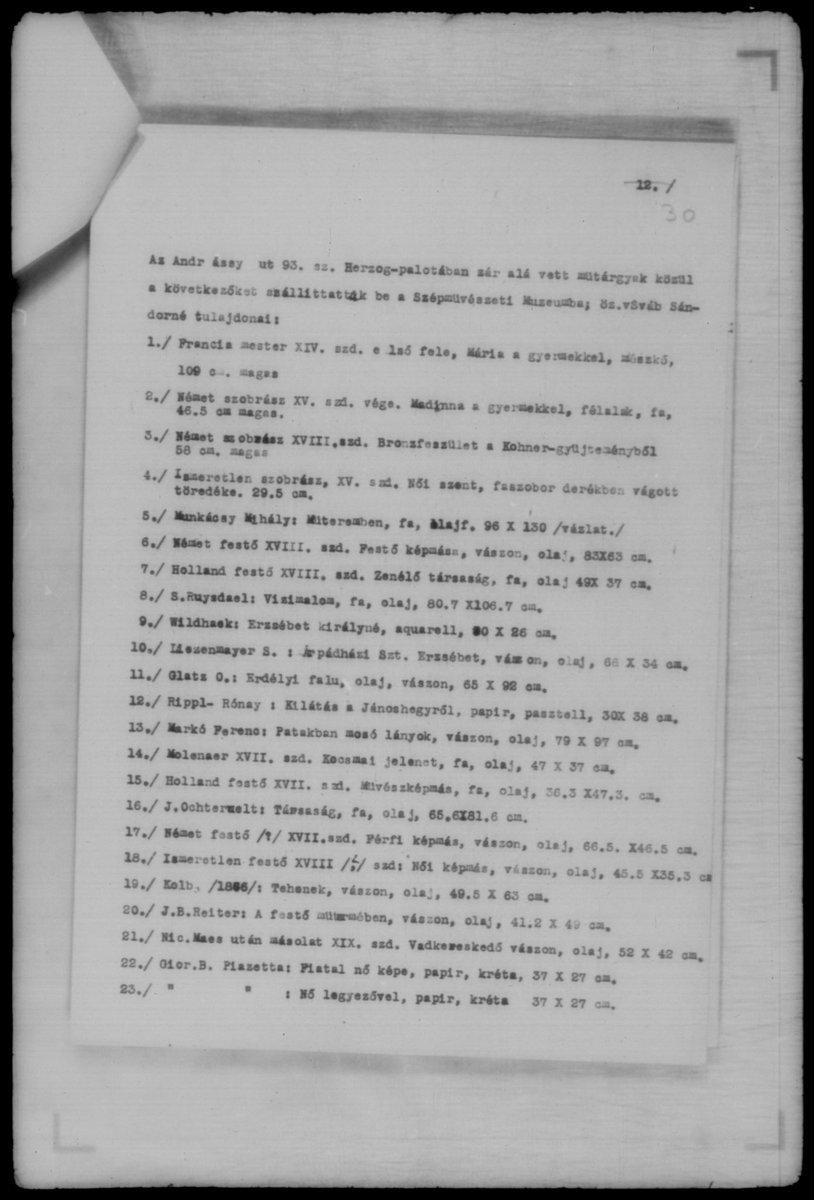
An official 1944 Hungarian archival inventory records the forced transfer of artworks from the Herzog Palace at Andrássy út 93 to the Szépművészeti Múzeum (Museum of Fine Arts, Budapest). The seized items are listed as the property of "widow Sváb Sándorné" — the legal married name of Baroness Irén Herzog.
The second entry reads:
“2./ Német szobrász XV. szd. vége. Madánna a gyermekkel, fálalak, fa, 46.5 cm magas.”
German sculptor, late 15th century. Madonna with Child. Wooden figure. 46.5 cm high.
That is how a wartime clerk described it. Today, a compelling candidate in the museum’s collection mirrors these exact specifications.
🎨 The Object
The Szépművészeti Múzeum/Museum of Fine Arts, Budapest holds a painted terracotta relief — Virgin and Child — attributed to a Florentine sculptor active in the second half of the 15th century, 46.5 × 46.5 × 8 cm, 14 kg. Inventory no. 1183. Not on display.
👉 szepmuveszeti.hu/mutargyak/2…
The dimensions are exact. The subject identical. The medium — painted terracotta — explains the clerk’s “fa” (wood): heavily polychromed Florentine devotional reliefs of this period were routinely misidentified by non-specialist eyes. The attribution shift from “German sculptor” to Florentine school is the kind of postwar scholarly refinement documented across this entire reel.
⚠️ An Important Note
No publicly available documentation directly links inv. 1183 to the 1944 seizure. The postwar provenance window has not been disclosed. This object does not appear among the 40 works named in De Csepel v. Republic of Hungary — the Herzog family lawsuit that reached the U.S. Supreme Court.
📢 A Call for Transparency
We ask the Szépművészeti Múzeum to publish the full provenance file for inventory no. 1183 — including 1944 intake documentation and the complete chain of custody from Andrássy út 93 to the present.
Under the Washington Principles on Nazi-Confiscated Art and the HEAR Act, institutions holding such material bear a responsibility to identify, disclose, and facilitate just and fair resolution.
The 1944 record details an artwork seized from Andrássy út 93. The Museum of Fine Arts holds a piece matching those exact specifications, yet its listing omits this potential origin. This historical gap demands answers.
#HEARAct #WashingtonPrinciples #ArtRestitution #ProvenanceResearch
@WJRORestitution @ClaimsCon @nytimesarts @artnet @SCOTUSblog @cnni @guardian @artdetective @CathyHickley @Pontifex @AndrewRCasper1 @cagliotileg @artlossregister @HolocaustMI
191
🕯 The Verso Didn’t Lie: A 1944 Seizure Record and the Painting That Named Its Owner
An official Hungarian archival inventory records the forced transfer of artworks from the Herzog Palace at Andrássy út 93, Budapest, to the Szépművészeti Múzeum — the property of widow Sváb Sándorné. The eleventh entry reads:
“11./ Glatz O.: Erdélyi falu, olaj, vászon, 65 × 92 cm.”
Erdélyi falu — Transylvanian Village. Oil on canvas. 65 × 92 cm.
🎨 The Artist
Oszkár Glatz (1872–1958) was a leading figure of the Nagybánya artists’ colony — trained under Simon Hollósy, active in the circle that transformed Hungarian painting in the early 20th century. His Transylvanian landscapes and genre scenes, combining Impressionist light with strong compositional structure, were among the most sought-after works of their generation. The Magyar Nemzeti Galéria included this painting in its 1996 centenary exhibition of Nagybánya art.
🔍 The Match — and the Verso
A painting documented at Kieselbach Aukciósház corresponds closely to this inventory entry:
Glatz Oszkár, Hegyi tanya (Erdély határán, Tanya a Törcsvári szorosban), c. 1906
Oil on canvas, 64 × 90 cm
Kieselbach 64th Autumn Auction, Lot 79, 18 September 2020
Starting price: 15,000,000 HUF / Estimated: 20–40 million HUF
kieselbach.hu/alkotas/erdely…
The artist, medium, and subject are exact matches. The dimensions — 65 × 92 cm in the 1944 inventory versus 64 × 90 cm in the auction record — differ by a single centimeter in each direction, within normal variance for wartime handwritten measurements.
What distinguishes this case is the physical evidence on the painting itself. The verso bears a handwritten inscription: “Sváb Sándorné tulajdona Andrássy út 93” — Property of Mrs. Sándor Sváb, Andrássy út 93. The auction catalogue confirms the Herzog/Sváb provenance explicitly. The inventory document records the seizure from that same address. These are not inferences — they are the same address, the same owner, the same painting. The work was sold at auction in September 2020 and is now in private hands.
🧾 The Victim
Irén Herzog — widow Sváb Sándorné — came from one of Hungary’s most prominent Jewish industrial and cultural families. The Herzog collection assembled at Andrássy út 93 was among the most significant private art collections in Hungary. In 1944 it was seized, catalogued, and transferred to state museum custody under Decree 1830/1944.
⚖️ Wider Context
The broader Herzog collection remains one of the largest partially unresolved Holocaust-era restitution cases in Hungary, with formal claims across U.S. and Hungarian courts spanning decades. This painting does not appear among the 40 works named in the Herzog family’s landmark De Csepel v. Republic of Hungary lawsuit — which reached the U.S. Supreme Court. Whether it was recovered by the family, held privately, or has been circulating unrecognized outside formal restitution proceedings is not established in any public record.
📢 A Call for Transparency
We ask the Szépművészeti Múzeum to publish the full 1944 Herzog/Sváb intake ledger for this inventory page, including any internal museum records, depot notations, and chain-of-custody documentation for all items on this reel.
Under the Washington Principles on Nazi-Confiscated Art and the HEAR Act, full disclosure of wartime intake records is not optional — it is the foundation of just and fair resolution.
The painting named its owner eighty years ago. What remains is not a question of evidence — it is a question of will.
#HEARAct #WashingtonPrinciples
@WJRORestitution @ClaimsCon @nytimesarts @CathyHickley @WorldJewishCong @SCOTUSblog @neal_katyal @danabrams @USAmbHungary @brand_arthur @raydowd @NicholasMOD @jerrysaltz @AmbHerzog @AJCGlobal
1
1
182
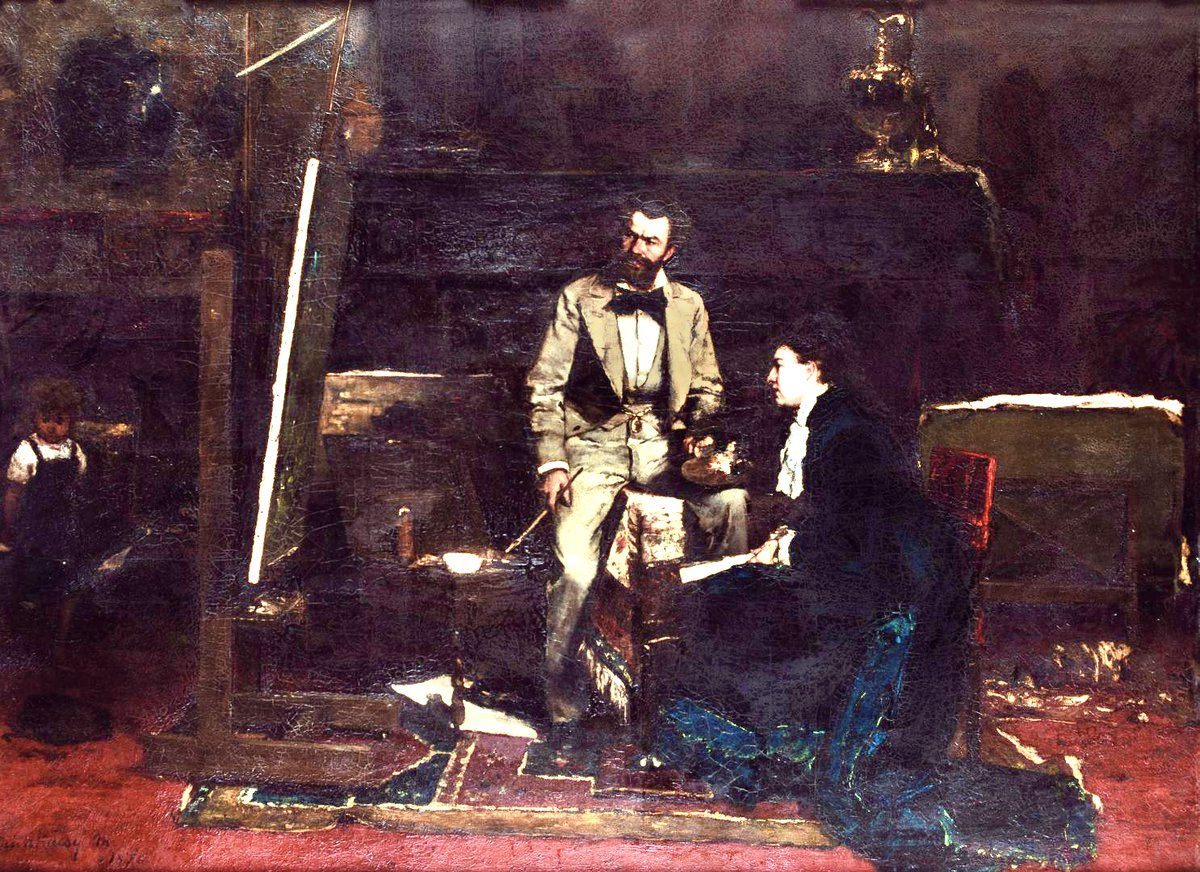
🧾🖼️Munkácsy’s In the Studio: A Herzog Palace Inventory Entry Hiding in Plain Sight?
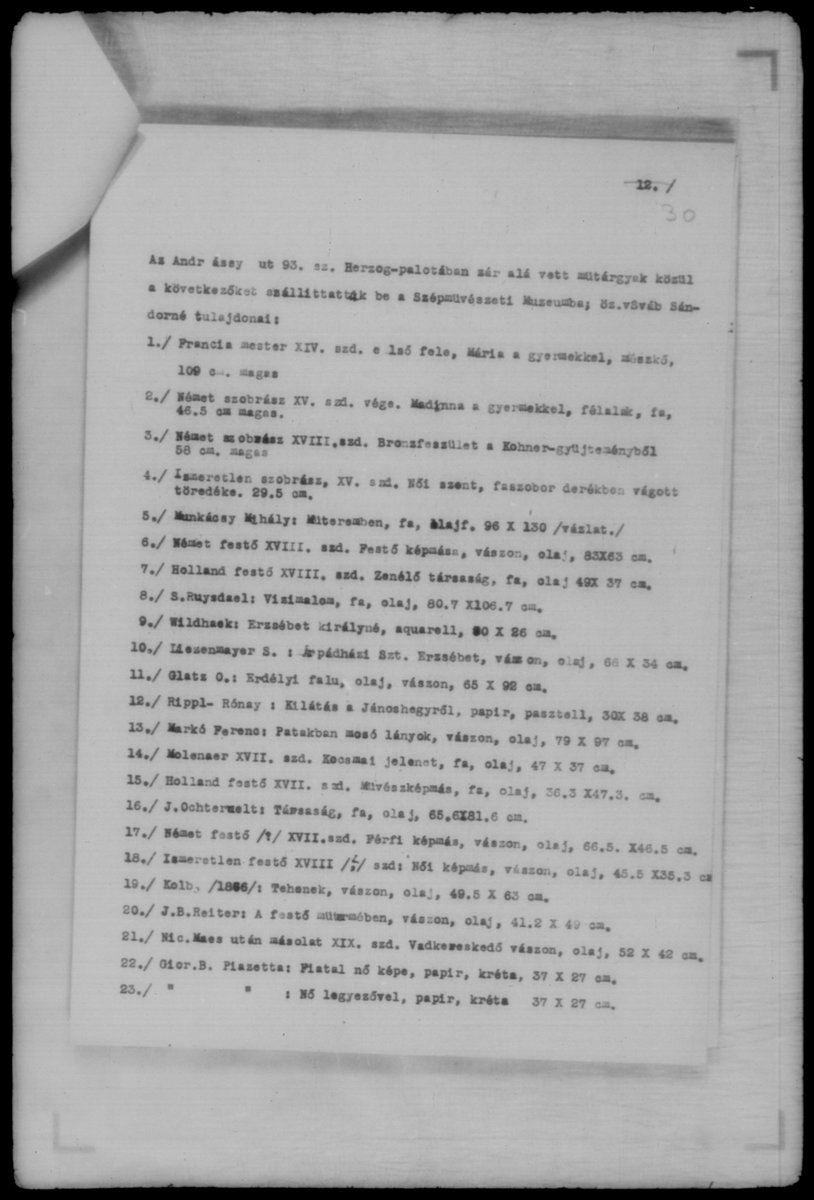
Reel 145, Slide 514 records artworks from the Herzog Palace, Andrássy út 93, delivered to the Szépművészeti Múzeum/Museum of Fine Arts, Budapest during Hungary’s 1944 wartime seizure process.
Among the entries is a major work by Hungary’s most celebrated 19th-century painter:
Entry #5 — Munkácsy Mihály: Műteremben
Medium: oil on wood panel
Dimensions: 96 × 130 cm
Note: marked as “vázlat” — sketch/study
In English: Mihály Munkácsy, In the Studio, oil on panel, 96 × 130 cm, sketch/study.
This is not a vague description. It is a named Munkácsy studio scene, with title, support, dimensions, and object type.
🔎 The public artwork match
A closely corresponding work is publicly known today:
Mihály Munkácsy — Műteremben/In the Studio
Date: 1876
Medium: oil on wood panel
Dimensions: 96 × 131 cm
Collection: Hungarian National Gallery, Budapest
The overlap is striking: same artist, same title, same medium, same support, same subject, near-identical dimensions, and the same wartime museum destination. This is exactly the kind of match provenance researchers take seriously.
📜 Why the Herzog context matters
The Herzog Collection was one of Europe’s great private art collections. After Baron Mór Lipót Herzog died, the collection passed to his heirs, including Erzsébet Herzog. In 1944, as Hungary’s anti-Jewish persecution escalated under Nazi occupation and Hungarian collaboration, Herzog-family artworks were inventoried, sealed, moved, and absorbed into wartime custody systems.
Munkácsy’s In the Studio is not merely a strong research lead. It has been expressly discussed in the Herzog restitution litigation. U.S. court records identify Mihály Munkácsy’s In the Studio as a work that belonged to Erzsébet Herzog and was among the contested Herzog works in de Csepel v. Hungary.
Those records also describe the painting’s complicated postwar status. The 1944 inventory places the work in the wartime museum-custody pipeline. Later records discussed in the litigation indicate that In the Studio remained under Hungarian cultural control as a museum deposit for decades. A 1966 Hungarian government letter asked whether it and other Herzog works were in the museum’s possession; a 1973 Ministry of Culture letter treated the painting as having passed to the Hungarian state; and U.S. courts later analyzed whether claims involving this work could proceed in American court.
In January 2026, the D.C. Circuit affirmed dismissal on jurisdictional grounds. Press reporting later indicated that the Herzog heirs sought rehearing en banc. Whatever the final procedural posture, however, a jurisdictional ruling is not a provenance record.
That is the point. Legal procedure does not erase archival evidence. A court’s jurisdictional ruling does not substitute for full public disclosure of the museum file. The 1944 inventory, the postwar deposit history, and the museum’s current custody all need to be reconciled in public.
🏛️ The provenance question
For a work matching a Herzog Palace inventory entry this closely — and already discussed in major restitution litigation — the public should be able to see the complete chain of custody from 1944 onward.
That means:
• the 1944 intake and delivery documentation;
• the Museum of Fine Arts custody ledger;
• postwar re-inventory or transfer records;
• documentation of movement to the Hungarian National Gallery;
• deposit, restitution, settlement, compensation, or ownership determinations;
• verso photographs showing labels, stamps, and historic inventory marks; and
• all records explaining how the work was treated after seizure, after the war, and after later claims proceedings.
This is not a marginal object. It is a major Munkácsy work, tied to a major Jewish collection, listed in a wartime inventory from the Herzog Palace, and discussed in major restitution litigation.
⚖️ What transparency requires
HARI calls on the Magyar Nemzeti Galéria/Hungarian National Gallery, the Szépművészeti Múzeum/Museum of Fine Arts, Budapest, and the relevant Hungarian authorities to publish the full provenance file for Munkácsy Mihály’s Műteremben/In the Studio.
If the publicly known 1876 painting is the same work listed as Entry #5 on Reel 145, Slide 514, the public record should say so plainly. If Hungary maintains that it is not the same work, the museum should publish the documents proving the distinction.
Either way, the files exist. The public record should match them.
🧾 The question
In 1944, the Herzog Palace inventory listed Munkácsy Mihály: Műteremben, oil on wood panel, 96 × 130 cm, marked as a sketch/study. Today, a Munkácsy In the Studio is publicly known in the Hungarian National Gallery as oil on wood panel, 96 × 131 cm.
That creates a direct, document-answerable question: is this the same painting? If yes, the public provenance record should say so clearly and include the full file. If no, the museum should publish the documentation distinguishing the two works.
The history of the Herzog Collection cannot be resolved through closed files, partial catalogue entries, or jurisdictional rulings. Every object taken in 1944 deserves a transparent chain of custody, especially one tied this closely to a named inventory entry, a major Jewish collection, and decades of restitution litigation.
A legal ruling is not a provenance record. The museum file must be opened.
#HolocaustArtRecovery #HerzogCollection #MunkácsyMihály #Műteremben #HungarianNationalGallery #SzépművészetiMúzeum #ProvenanceResearch #art #Restitution #WashingtonPrinciples #HEARAct @WJRORestitution @nytimesarts @SCOTUSblog @WorldJewishCong @artlaw @brand_arthur @raydowd @Telexhu @HolocaustMuseum @USAmbHungary @marcorubio @CathyHickley @artnet @cnni @guardian @444hu
281
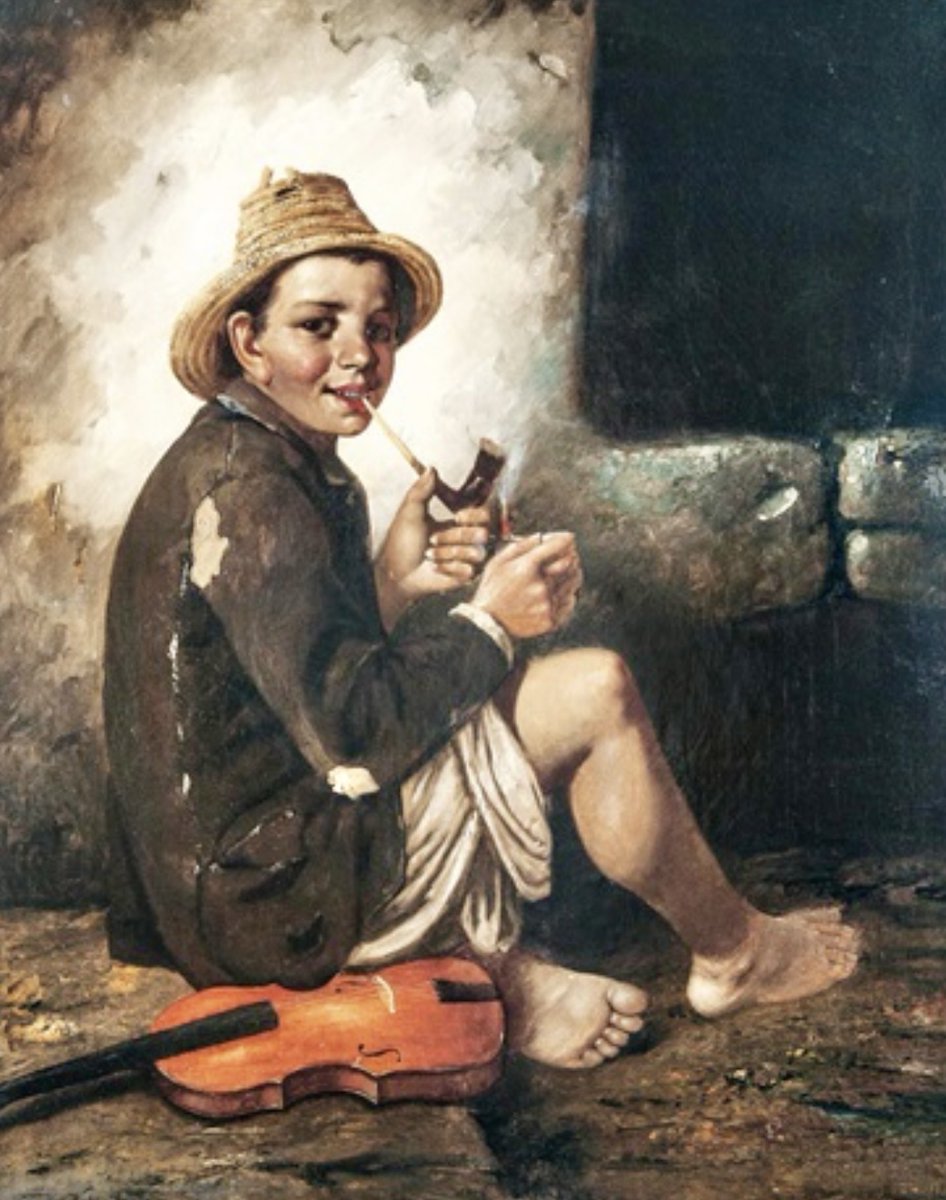
🖼️🔎 Tracing the Boy with a Pipe: From a Jewish Widow’s Home to a Modern-Day Auction Candidate
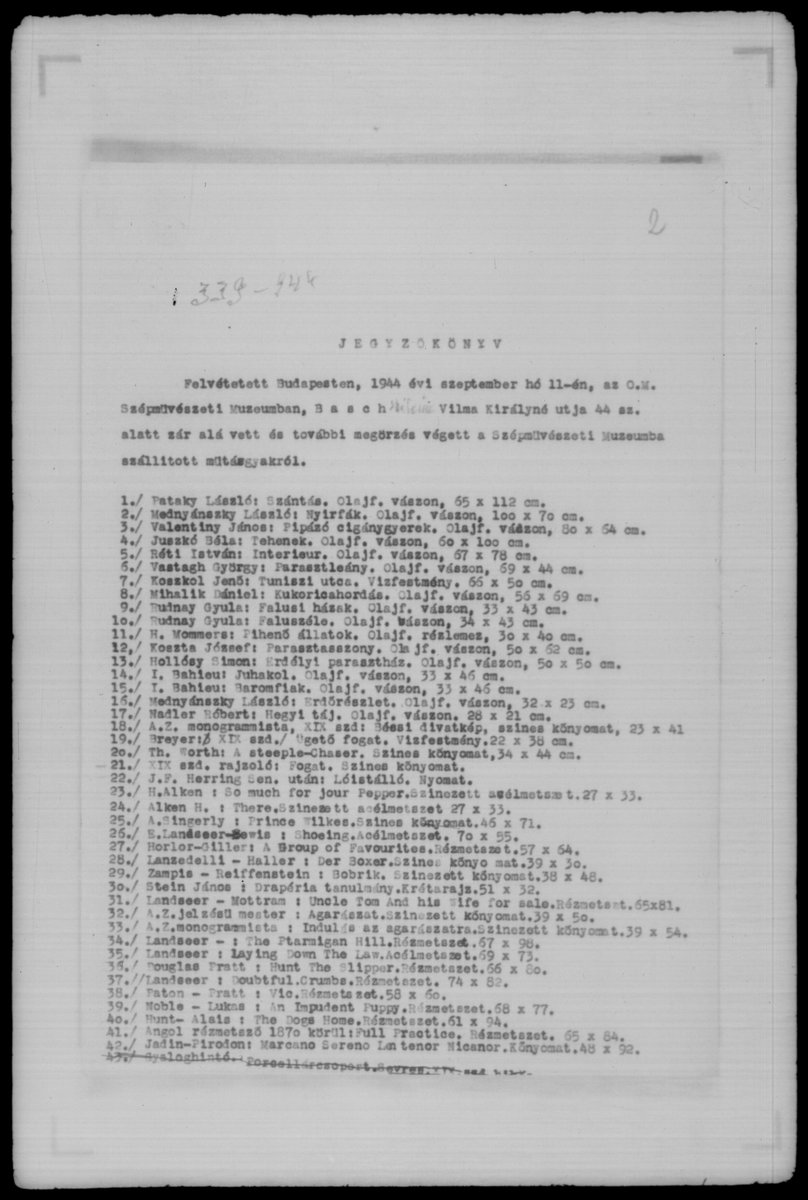
In June 1944, Hungarian authorities inventoried artworks taken from the Budapest apartment of Mrs. Béla Basch at Vilma királynő út 44. The resulting record — Szépművészeti Múzeum File 339/1944 — is part of the wartime paper trail showing how Jewish-owned cultural property was seized, catalogued, and moved into state-controlled custody under the language of “safekeeping.”
Among the works listed is Inventory #3:
Valentiny János: Pipás cigánygyerek
Oil on canvas, 80 × 64 cm
In English, the title means roughly “Romani Boy with a Pipe” or “Gypsy Boy with a Pipe.” The historical title uses a period ethnographic term. The subject — a young Romani figure — fits Valentiny’s "folk realist" genre-painting practice, which often depicted rural and Romani subjects with close attention to expression, costume, and everyday life.
🖼️ The Modern Market Candidate
A public Hungarian auction record shows a strikingly similar work:
Valentiny János — Pipázó fiú / “Boy Smoking a Pipe”
Oil on canvas, 80 × 64 cm
Signed lower left: “Valentiny J.”
The painting was offered by Nagyházi Galéria és Aukciósház in Auction 216 on 31 May – 1 June 2016, with a starting price of 480,000 HUF. Public market databases also preserve later references to a Valentiny Pipázó fiú with the same medium and dimensions.
2016 Nagyházi catalogue:
calameo.com/books/0024163802…
Műtárgy lot page:
mutargy.com/mutargy/festmeny…
MutualArt reference:
mutualart.com/Artwork/Pipazo…
🔎 Why This Candidate Matters
The overlap is unusually strong:
• Artist: Valentiny János — direct match
• Medium: oil on canvas — direct match
• Dimensions: 80 × 64 cm — exact match
• Subject: boy with a pipe — direct subject match
• Title drift: Pipás cigánygyerek → Pipázó fiú is entirely plausible
The wartime title is more specific: “Romani/Gypsy boy with a pipe.” The market title is shorter and more neutral: “Boy Smoking a Pipe.” That kind of title softening is common in later auction catalogues, especially where older descriptive titles used ethnic or socially charged terminology.
This is not yet final proof of identity. But it is a serious, document-based provenance lead. The match factors are too specific to ignore.
📜 The Gravity of File 339/1944
File 339/1944 is not a benign household list. It records the removal of artworks from a Jewish home in Budapest during the same period when Hungarian authorities were inventorying, sealing, and redirecting Jewish-owned cultural property into state-supervised channels.
That matters because restitution research is not limited to famous museum masterpieces. A modest genre scene can carry the history of a destroyed household. A painting does not need to be monumental to be stolen. It only needs to have been taken.
Here, the Basch file provides the wartime starting point. The 2016 auction record provides a possible modern market appearance. What remains missing is the chain between them.
⚖️ The Provenance Questions
@ArtRecoveryInit calls on Nagyházi Galéria és Aukciósház, later market participants, and any current holder of Valentiny János’s Pipázó fiú to disclose the full provenance for the work, including:
• pre-1944 ownership records;
• any reference to Mrs. Béla Basch, Vilma királynő út 44, or File 339/1944;
• postwar custody, transfer, sale, inheritance, export, or restitution documentation;
• auction-house intake records and consignor-provided provenance;
• high-resolution front and verso photographs;
• frame labels, stretcher markings, stamps, inventory numbers, or export notations; and
• any institutional correspondence involving the Szépművészeti Múzeum/Museum of Fine Arts, Budapest.
The public auction record does not appear to provide a complete wartime and postwar provenance. That gap matters because the 1944 Basch inventory identifies a Valentiny painting with the same artist, same subject, same medium, and same dimensions.
🧾 Restoring the Broken Chain
The question is direct:
Is the Pipázó fiú that appeared in the Hungarian market the same canvas listed as Inventory #3 in the 1944 Basch seizure file?
If no, the records showing a separate lawful provenance should be made public.
If yes, the painting’s history must be corrected, and the Basch family’s ownership must no longer be erased.
Every inventory line represents a life interrupted. Every recovered link in the chain brings history one step closer to justice.
#HolocaustArtRecovery #ProvenanceResearch #BaschCollection #ValentinyJános #Hungary #Restitution #WashingtonPrinciples #HEARAct
@WJRORestitution @nytimesarts @News24Arts @WorldJewishCong @hyperallergic @ProvenanceThe @HolocaustMI @schuhmacher @brand_arthur @raydowd @ncph @cnni @bbcarts @guardian @Adam_FineArt @LordFredericLe1 @Jerusalem_Post
326
A 1944 SEIZURE RECORD, A 174 CM PAINTING, AND AN UNANSWERED QUESTION IN BUDAPEST 🕯️
📜 Sometimes the most important evidence is not a painting.
Sometimes it is a single sheet of paper.
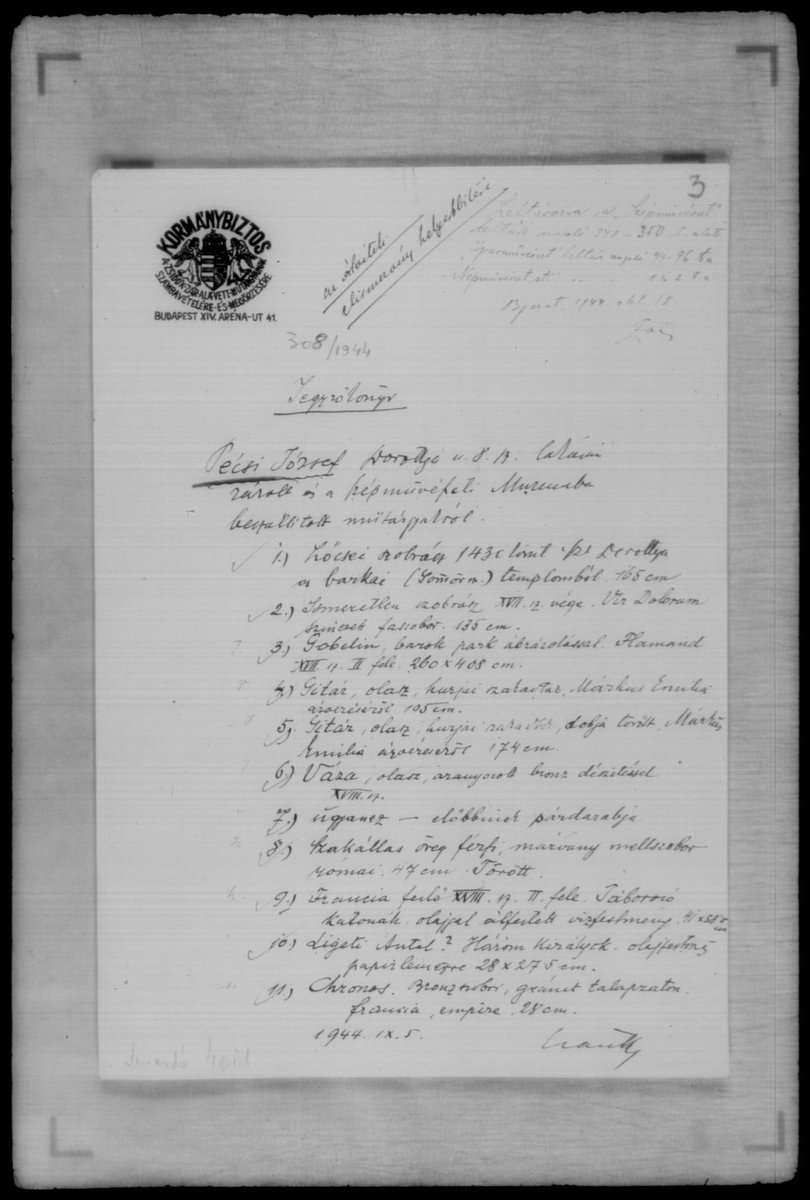
On 5 October 1944, Hungarian authorities created File 308/1944, a record concerning artworks found in the apartment of photographer, educator, and collector József Pécsi and transported to the Museum of Fine Arts in Budapest.
The document’s operative language is significant:
📝 “Record concerning artworks found in the apartment of József Pécsi and transported to the Museum of Fine Arts.”
This is not merely an inventory.
It is documentary evidence linking specific objects to a transfer into the Hungarian museum system during the Holocaust era.
👤 WHO WAS JÓZSEF PÉCSI?
📸 József Pécsi (1889–1956) was one of Hungary’s pioneering photographers, teachers, and visual innovators. His studio on Dorottya Street helped shape generations of artists and photographers, while his collection reflected a deep engagement with European art and culture.
The surviving record provides direct evidence that artworks from his collection were removed and placed into state custody.
🔍 ITEM #5
Among the listed objects is an entry that appears to describe:
🎨 An oil painting
🧍 A composition featuring slender or standing figures (“karcsú alakos”)
📏 A principal measurement of approximately 174 cm
As with many wartime inventories, portions of the handwriting remain difficult to decipher and remain subject to further review.
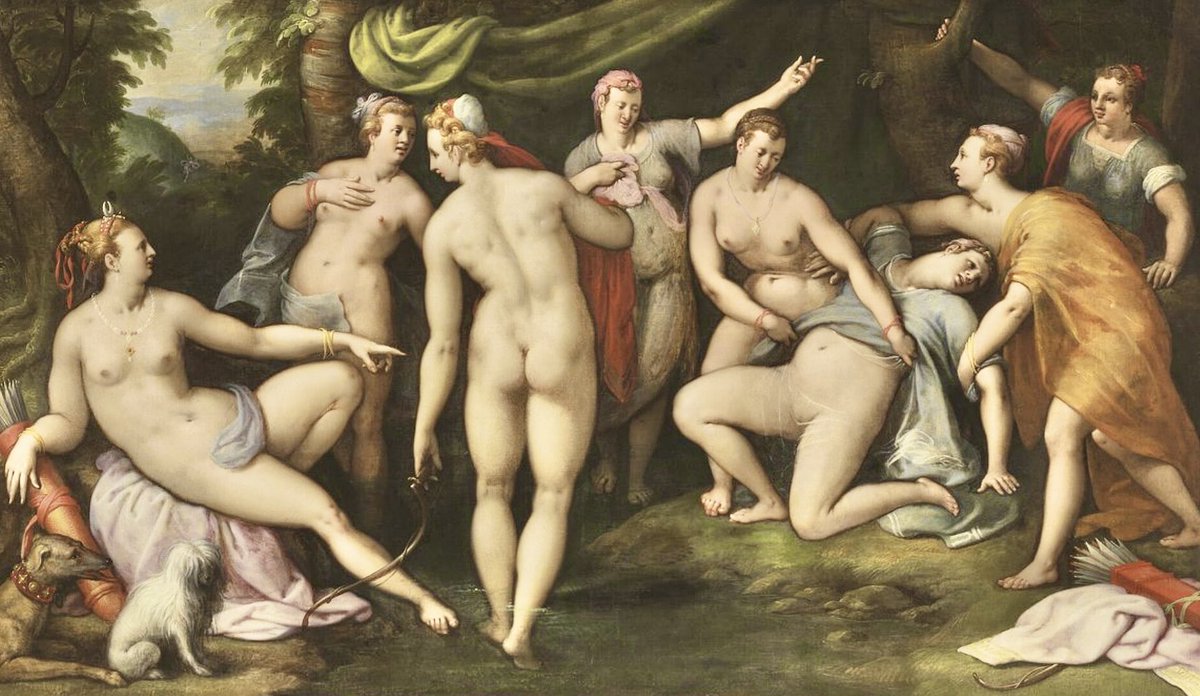
🖼️ A POSSIBLE CANDIDATE
Following a review of publicly accessible museum records, one painting warrants further investigation:
Gillis Coignet (I) / Circle of Anthonie Blocklandt van Montfoort
“Diana Discovering Callisto’s Pregnancy”
Oil on canvas
103 × 174 cm
Museum of Fine Arts, Budapest
Inventory No. 59.2
The painting contains multiple standing and kneeling figures and shares the exact 174 cm dimension recorded in the inventory.
⚖️ IMPORTANT
This is not a confirmed identification.
At present, it is best understood as a research lead requiring further archival investigation.
The crucial question is not whether the dimensions align.
The crucial question is whether surviving museum records can establish where inventory no. 59.2 was located before, during, and immediately after 1944.
📂 THE MISSING PAPER TRAIL
To answer that question, researchers need access to:
• Museum accession files
• Wartime transfer records
• Ministry correspondence
• Internal inventory ledgers
• Conservation and provenance files
🏛️ A CALL FOR TRANSPARENCY
The Museum of Fine Arts, Budapest should review and publish archival materials relating to inventory no. 59.2 and to cross-reference the object against File 308/1944.
The record survived. The museum survived. Closing this gap isn't a matter of luck anymore—it’s a matter of transparency. ⚖️
#HolocaustArtRecovery #PécsiJózsef #ProvenanceResearch #WashingtonPrinciples #Restitution #MuseumTransparency #ArtLaw #CulturalHeritage #HEARAct
@WJRORestitution @nytimesarts
187
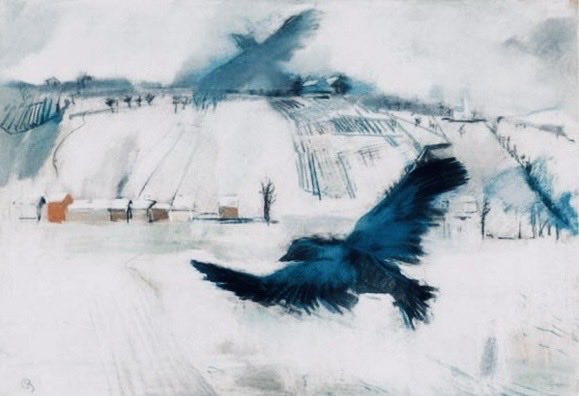
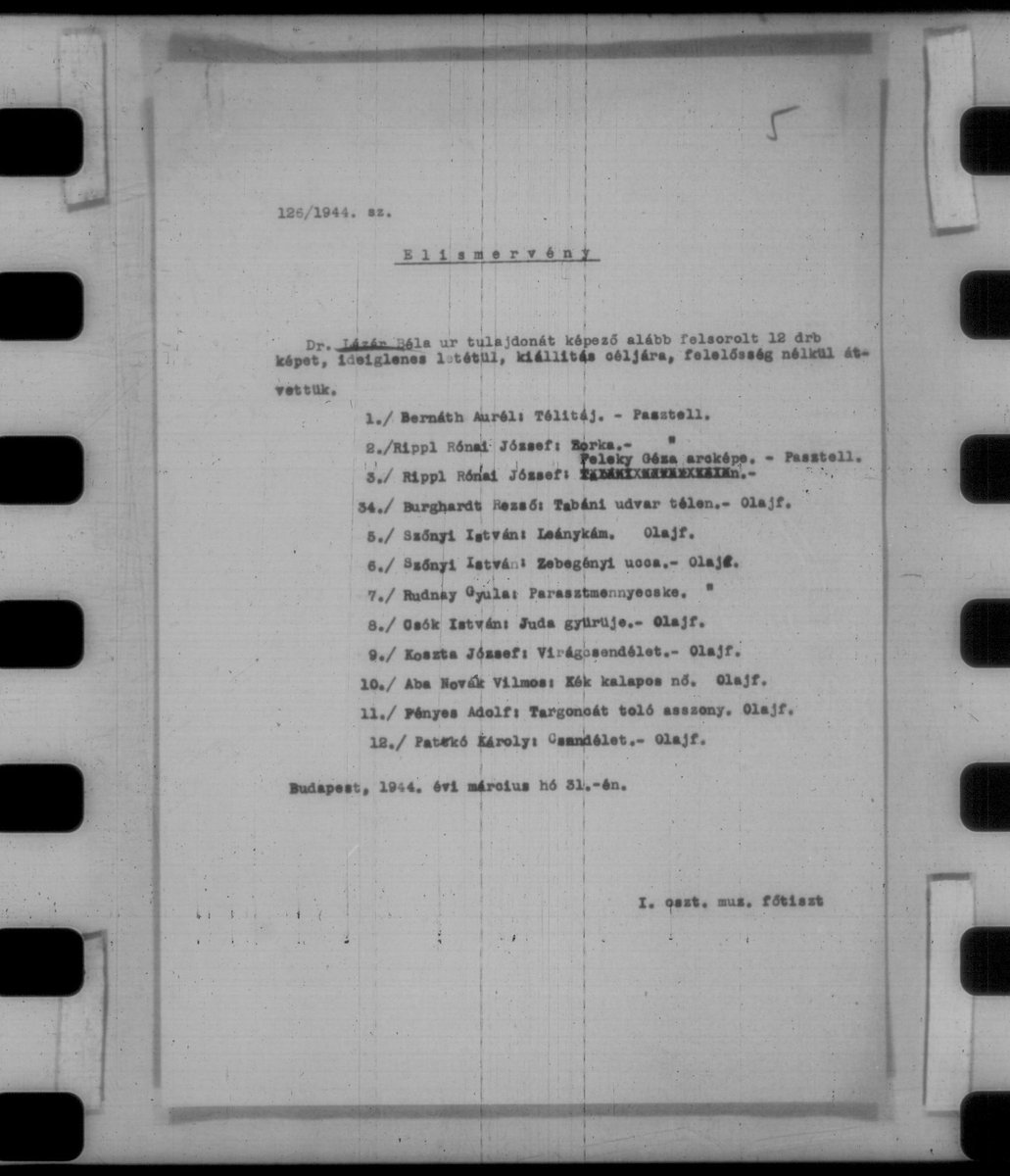
🏛️ A WINTER PASTEL, A 1944 DEPOSIT RECEIPT, AND AN UNRESOLVED PROVENANCE QUESTION
On 31 March 1944, shortly after the German occupation of Hungary, museum officials issued a receipt acknowledging the transfer of twelve artworks belonging to Dr. Béla Lázár into state custody.
Dr. Lázár was one of Hungary’s leading art historians, critics, museum professionals, and collectors. His scholarship helped shape the understanding of modern Hungarian art, yet his own collection became caught up in the machinery of wartime dispossession.
The receipt states:
“We have received the following 12 paintings belonging to Dr. Béla Lázár as a temporary deposit for exhibition purposes, without liability.”
Listed first on the document is:
🎨 Bernáth Aurél — Télitáj (Winter Landscape) — Pastel
After reviewing publicly available museum records, catalogues, exhibition histories, and known Bernáth works, the strongest currently identifiable candidate appears to be:
🖼️ Bernáth Aurél, Tél (Winter), 1929
🖍️ Pastel on cardboard
📏 70 × 100 cm
🏛️ Hungarian National Gallery (Magyar Nemzeti Galéria)
📋 Inventory No. 63.80 T
Hungarian National Gallery:
mng.hu/mutargyak/51201/
English version:
en.mng.hu/artworks/51201/
🔍 WHY THIS CANDIDATE STANDS OUT
• Artist & Medium: The 1944 receipt identifies a Bernáth pastel. The National Gallery work is a Bernáth pastel.
• Title Alignment: Télitáj (“Winter Landscape”) and Tél (“Winter”) are closely related titles, consistent with the abbreviated cataloguing often seen when works moved from private collections into institutional records.
• Chronology: The work dates to 1929, during the period when Dr. Lázár was actively collecting major examples of modern Hungarian art.
• Institutional Pathway: The receipt documents transfer into the Hungarian museum system in 1944. Today, the strongest known candidate remains within Hungary’s national collection.
⚖️ THE PROVENANCE QUESTION
This is a strong candidate correspondence, not a confirmed identification.
Published National Gallery documentation indicates that inventory 63.80 T entered the collection through a 1963 purchase from Oszkár Köves.
That disclosure answers one question but raises several others:
• Was this pastel previously part of Dr. Lázár’s collection?
• If so, how did it move from wartime museum custody into private hands before the 1963 acquisition?
• Was restitution ever attempted after the war?
• What ownership history exists between the 1944 deposit receipt and the 1963 purchase?
• Do museum archives contain references to Dr. Béla Lázár, his heirs, or related wartime transfer records?
At present, publicly available records do not answer these questions.
📂 A CALL FOR TRANSPARENCY
The Holocaust Art Recovery Initiative calls upon the Hungarian National Gallery to publish the complete provenance history for inventory 63.80 T, including:
• Pre-1944 ownership documentation
• Wartime deposit records
• Postwar custody and restitution files
• Documentation relating to the 1963 acquisition from Oszkár Köves
• Any archival references to Dr. Béla Lázár or his heirs
Historical truth, scholarly integrity, and meaningful remembrance depend on transparent provenance research.
#HolocaustArtRecovery #BernáthAurél #LázárBéla #ProvenanceResearch #ArtRestitution #WashingtonPrinciples #HEARAct #MuseumTransparency #ArtLaw #CulturalHeritage
@WJRORestitution @nytimesarts @Telexhu
199