
TrendToKnow AI: Rex: A Family of Reversible Exponential (Stochastic) Runge-Kutta Solvers
👥 Zander W. Blasingame & Chen Liu
#AIResearch #MachineLearning #DeepGenerativeModels #ODE
Provided by TrendToKnow AI
🔗 trendtoknow.ai/
18

24 Dec 2025
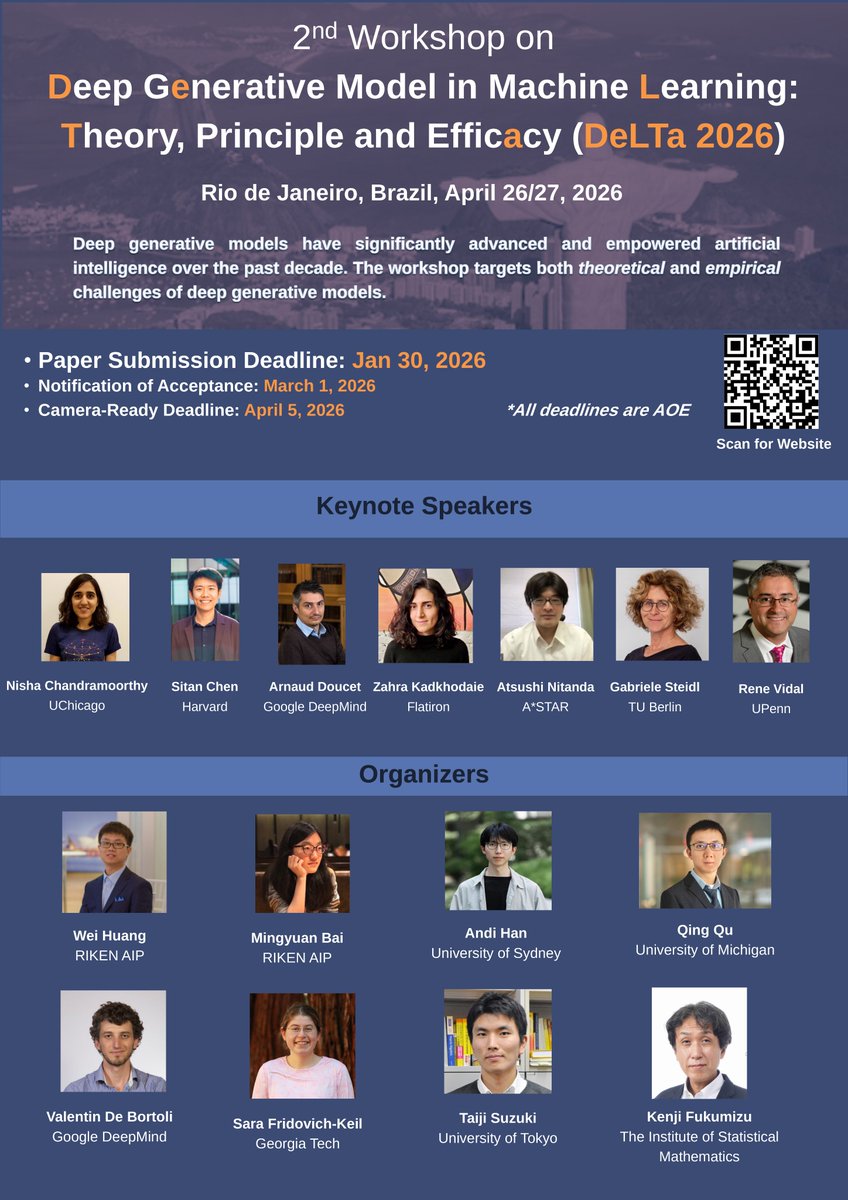
ICLR 2026 Workshop on Deep Generative Models (DeLTa 2026) is here!
🌐 Website: delta-workshop.github.io/DeL…
📣 Call for Reviewers: forms.gle/ocSj4utbVwSMCGcE8
🗓Paper deadline: Jan 30, 2026 (AOE)
📍Rio de Janeiro, Brazil | Apr 26–27, 2026
#ICLR2026 #DeepGenerativeModels #ICLRWorkshop
1
27
179
39,601

29 Aug 2025
Deep Generative Models Design mRNA Sequences with Enhanced Translational Capacity and Stability @ScienceMagazine
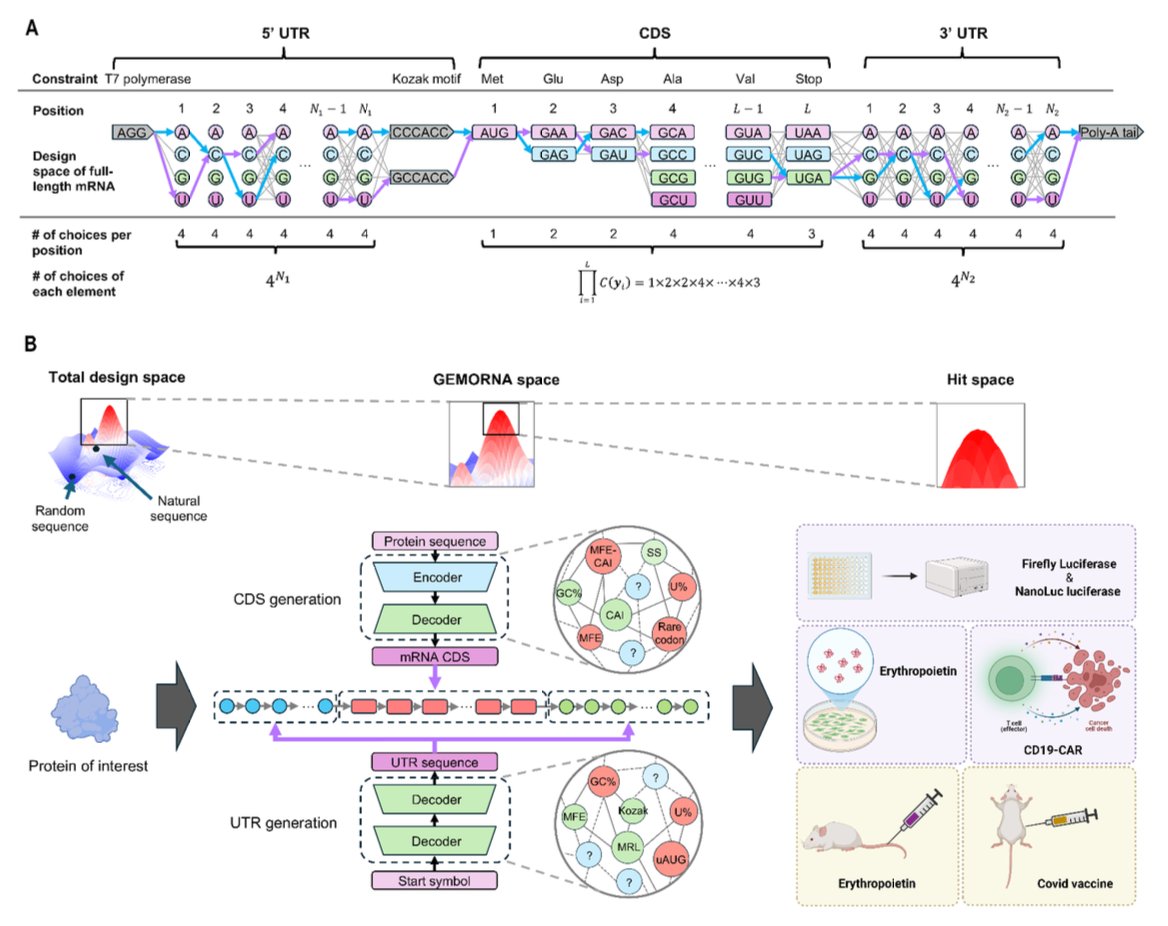
1. A groundbreaking study by He Zhang et al. introduces GEMORNA, a deep generative model that leverages Transformer architectures to design mRNA sequences with significantly enhanced translational capacity and stability. This innovation could revolutionize mRNA therapeutics by improving protein expression and durability.
2. GEMORNA addresses a critical challenge in mRNA design: the vast sequence space and complex interdependencies between optimization metrics. By using Transformer models tailored for mRNA coding sequences (CDSs) and untranslated regions (UTRs), GEMORNA generates sequences that outperform conventional designs in both in vitro and in vivo experiments.
3. The study demonstrates that GEMORNA-designed full-length mRNAs achieve up to a 41-fold increase in firefly luciferase expression compared to optimized benchmarks in vitro. Additionally, therapeutic mRNAs designed by GEMORNA show up to a 15-fold enhancement in human erythropoietin (EPO) expression and significantly higher antibody titers in mice.
4. GEMORNA’s versatility extends to circular RNA (circRNA) design, where it substantially enhances circRNA expression and boosts anti-tumor cytotoxicity in CAR-T cells. This highlights the potential of GEMORNA to improve the potency of mRNA drugs across various therapeutic areas.
5. The effectiveness of GEMORNA-generated sequences is confirmed through extensive experiments. The model autonomously learns codon and nucleotide usage, resulting in sequences with higher codon adaptation index (CAI), GC content, and lower rare codon rate, aligning with principles for designing therapeutic mRNAs.
6. GEMORNA also optimizes mRNA structure by balancing secondary structures, leading to enhanced stability and translational efficiency. The model’s ability to generate sequences with high naturalness scores further contributes to its success in creating mRNAs with strong performance.
7. The study provides detailed insights into the training and fine-tuning processes of GEMORNA models, emphasizing the importance of high-throughput data and accurate experimentation in validating optimal designs for specific applications.
📜Paper: science.org/doi/10.1126/scie…
#mRNAdesign #DeepGenerativeModels #GEMORNA #mRNAtherapeutics #AIinBiology #Biotechnology
2
10
55
7,259
19 Aug 2025
Generative Co-Design of Antibody Sequences and Structures via Black-Box Guidance in a Shared Latent Space
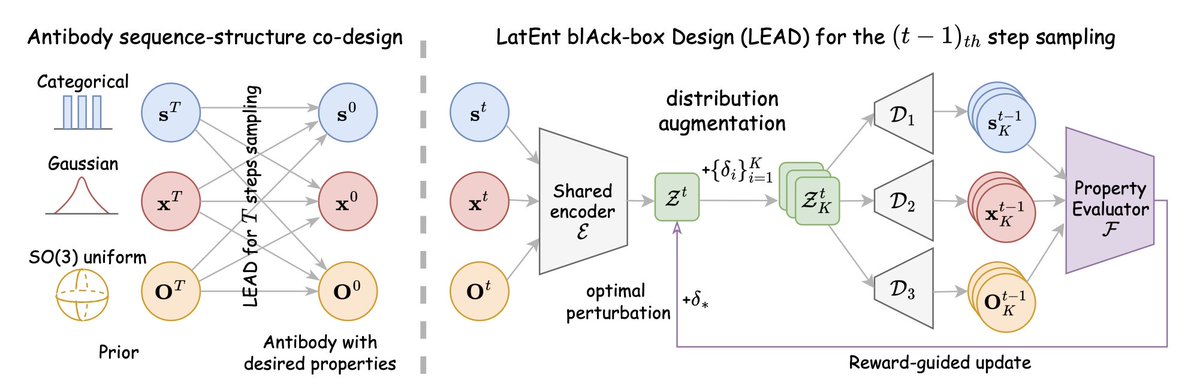
1. This study introduces LEAD, a novel framework for optimizing antibody sequences and structures simultaneously in a shared latent space, significantly improving the efficiency and effectiveness of antibody design.
2. LEAD leverages a black-box guidance strategy, allowing for optimization even when property evaluators are non-differentiable, making it highly adaptable to real-world scenarios where many evaluators are not differentiable.
3. The framework achieves superior optimization performance with fewer evaluations compared to existing methods, reducing query consumption by half while surpassing baselines in property optimization.
4. LEAD ensures synchronization between sequence and structure designs, addressing the limitations of previous methods that operate in the raw data space and often fail to maintain this crucial alignment.
5. The study demonstrates LEAD’s effectiveness in optimizing both single and multi-property objectives, with notable improvements in critical developability properties such as solubility and structural stability.
6. LEAD’s innovative approach of optimizing shared latent codes rather than raw data points represents a significant advancement in the field of antibody design, paving the way for more efficient and targeted therapeutic development.
7. The authors also explore different guidance strategies within LEAD, including hard selection, soft selection, and weighted versions, each showing distinct advantages depending on the property being optimized.
8. The results highlight the potential of LEAD to be applied to other AI-driven co-design tasks involving coupled sequence-structure modalities, such as protein, RNA, and small-molecule design.
📜Paper: arxiv.org/abs/2508.11424v1
💻Code: github.com/EvaFlower/LatEnt-…
#AntibodyDesign #DeepGenerativeModels #SharedLatentSpace #BlackBoxOptimization #Biotechnology #AIinBiology
1
1
6
1,303

21 Jun 2025
Understanding Generalization in Flow Matching Models: Key Insights and Implications for Deep Learning #DeepGenerativeModels #MachineLearning #Generalization #AIResearch #FlowMatching
itinai.com/understanding-gen…
Understanding Generalization in Deep Generative Models
Deep generativ…
23

14 Jun 2025
The book concludes by emphasizing the need for robust models capable of recognizing uncertainty.
Some advice for financial professionals testing GenAI models:
- Don’t blindly trust a single model’s accuracy: strong performance on a test set doesn’t guarantee reliability/accuracy in real-world scenarios.
- Pay attention to uncertainty estimation: in finance, it’s more valuable for an AI to say “I don’t know” than to make a random guess.
- Priority use cases in the financial domain include:
- Early warning signals for market regime shifts
- Detection of quantitative strategy breakdowns
- Stress testing under extreme market conditions
@predict_addict @PtrPomorski
#GenerativeAI
#QuantitativeTrading
#MachineLearningInFinance
#AlgorithmicTrading
#DeepGenerativeModels
#LLMsInFinance
#FinancialAI
#NeuralNetworks
#RiskManagement
#DataScienceTrading
1
125

14 May 2025
مستقبلا راح اسوي اعقد من الموجود وهي الGlow وفيها بشرح الActnorm وال1x1 invertable convolutions والAffine coupling😀الله يعين, بس راح تعطي نتايج خورافية.
ثم بعدها بإذن الله Flow matching.
#GenAI #NormalizingFlow #DeepGenerativeModels #ImageGeneration #AI #StatisticalModeling
2
642
1 May 2025
DiffPIE: Guiding Deep Generative Models to Explore Protein Conformations under External Interactions
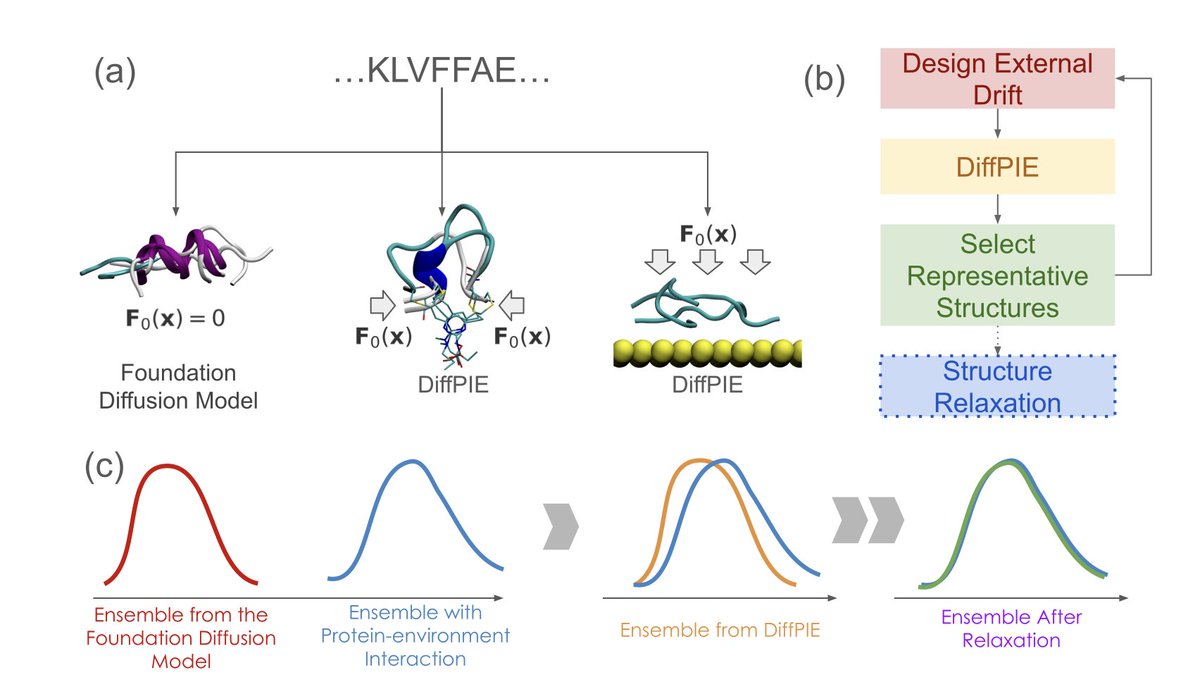
1. DiffPIE is a framework that guides pre-trained diffusion models to generate protein structures influenced by external interactions (PEIs), such as surface adsorption or covalent linkers, without requiring any model retraining.
2. The core innovation of DiffPIE is its ability to inject physically-derived biasing forces into the reverse diffusion process, modifying the generative potential landscape to reflect external chemical constraints.
3. The method builds on existing score-based diffusion models like Str2Str, altering only the sampling stage by introducing a drift term derived from MD simulations or free energy surfaces representing PEIs.
4. In a cyclic peptide (P3-F) case study, DiffPIE uses forces derived from linker-constrained MD simulations to generate diverse, low-energy conformations consistent with metadynamics, while avoiding unphysical helices typical of the unmodified model.
5. A second case study simulates amyloid-beta (Aβ16–22) binding to a gold surface, incorporating surface-derived forces to bias the generation toward adsorbed structures. DiffPIE-generated structures agree well with long-timescale metadynamics, but at a fraction of the cost.
6. Critically, DiffPIE demonstrates flexibility in defining the biasing force: it can use gradients of explicit energy functions (U_ext) or direct force fields from statistical potentials, enabling modeling of diverse PEIs from organic to inorganic contexts.
7. Unlike manifold constraint methods, DiffPIE accommodates complex, non-harmonic potential landscapes and does not assume simple geometric constraints—making it more versatile for real-world protein-environment systems.
8. The generated ensembles can be further refined via short MD simulations. DiffPIE samples typically remain stable and improve structural realism with minimal computational overhead.
9. This approach opens new avenues for modeling proteins in non-native environments: e.g., on material surfaces, in synthetic scaffolds, or within drug delivery systems—scenarios largely overlooked by traditional structure prediction tools.
10. By fusing statistical learning and physical simulation, DiffPIE represents a promising paradigm for extending deep generative modeling to real-world biochemical systems where environmental constraints are key to function.
📜Paper: biorxiv.org/content/10.1101/…
#ProteinStructure #DiffusionModel #PEI #DeepGenerativeModels #Biophysics #ComputationalBiology #ProteinDesign #SurfaceInteractions #CyclicPeptides #AI4Science
1
3
28
1,858
1 May 2025
DiffPIE: Guiding Deep Generative Models to Explore Protein Conformations under External Interactions
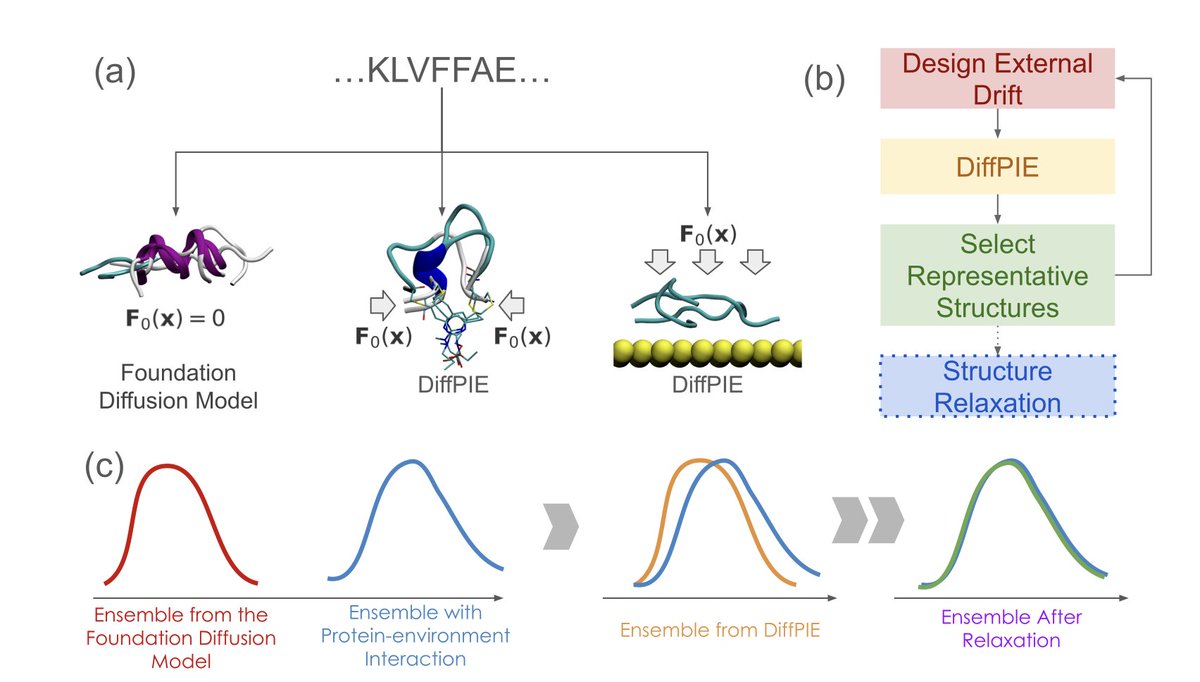
1. DiffPIE is a framework that guides pre-trained diffusion models to generate protein structures influenced by external interactions (PEIs), such as surface adsorption or covalent linkers, without requiring any model retraining.
2. The core innovation of DiffPIE is its ability to inject physically-derived biasing forces into the reverse diffusion process, modifying the generative potential landscape to reflect external chemical constraints.
3. The method builds on existing score-based diffusion models like Str2Str, altering only the sampling stage by introducing a drift term derived from MD simulations or free energy surfaces representing PEIs.
4. In a cyclic peptide (P3-F) case study, DiffPIE uses forces derived from linker-constrained MD simulations to generate diverse, low-energy conformations consistent with metadynamics, while avoiding unphysical helices typical of the unmodified model.
5. A second case study simulates amyloid-beta (Aβ16–22) binding to a gold surface, incorporating surface-derived forces to bias the generation toward adsorbed structures. DiffPIE-generated structures agree well with long-timescale metadynamics, but at a fraction of the cost.
6. Critically, DiffPIE demonstrates flexibility in defining the biasing force: it can use gradients of explicit energy functions (U_ext) or direct force fields from statistical potentials, enabling modeling of diverse PEIs from organic to inorganic contexts.
7. Unlike manifold constraint methods, DiffPIE accommodates complex, non-harmonic potential landscapes and does not assume simple geometric constraints—making it more versatile for real-world protein-environment systems.
8. The generated ensembles can be further refined via short MD simulations. DiffPIE samples typically remain stable and improve structural realism with minimal computational overhead.
9. This approach opens new avenues for modeling proteins in non-native environments: e.g., on material surfaces, in synthetic scaffolds, or within drug delivery systems—scenarios largely overlooked by traditional structure prediction tools.
10. By fusing statistical learning and physical simulation, DiffPIE represents a promising paradigm for extending deep generative modeling to real-world biochemical systems where environmental constraints are key to function.
📜Paper: biorxiv.org/content/10.1101/…
#ProteinStructure #DiffusionModel #PEI #DeepGenerativeModels #Biophysics #ComputationalBiology #ProteinDesign #SurfaceInteractions #CyclicPeptides #AI4Science
8
28
1,481
18 Apr 2025
An All-Atom Generative Model for Designing Protein Complexes
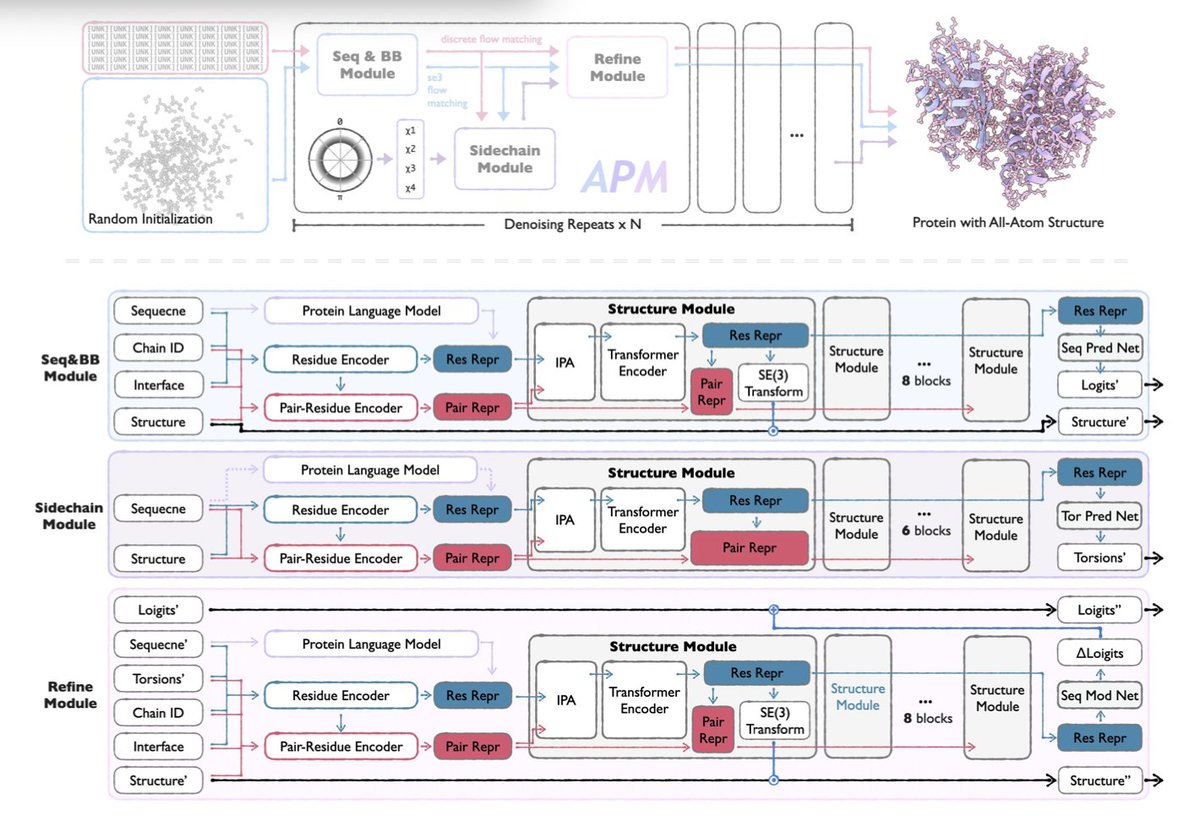
1. APM (All-Atom Protein Generative Model) is a novel generative framework specifically designed to model, fold, and generate multi-chain protein complexes at all-atom resolution—an area long underserved by traditional single-chain models.
2. Unlike methods that rely on pseudo-sequence linking for multi-chain modeling, APM handles native multi-chain structures through architecture and data-level innovations, allowing precise modeling of inter-chain interactions.
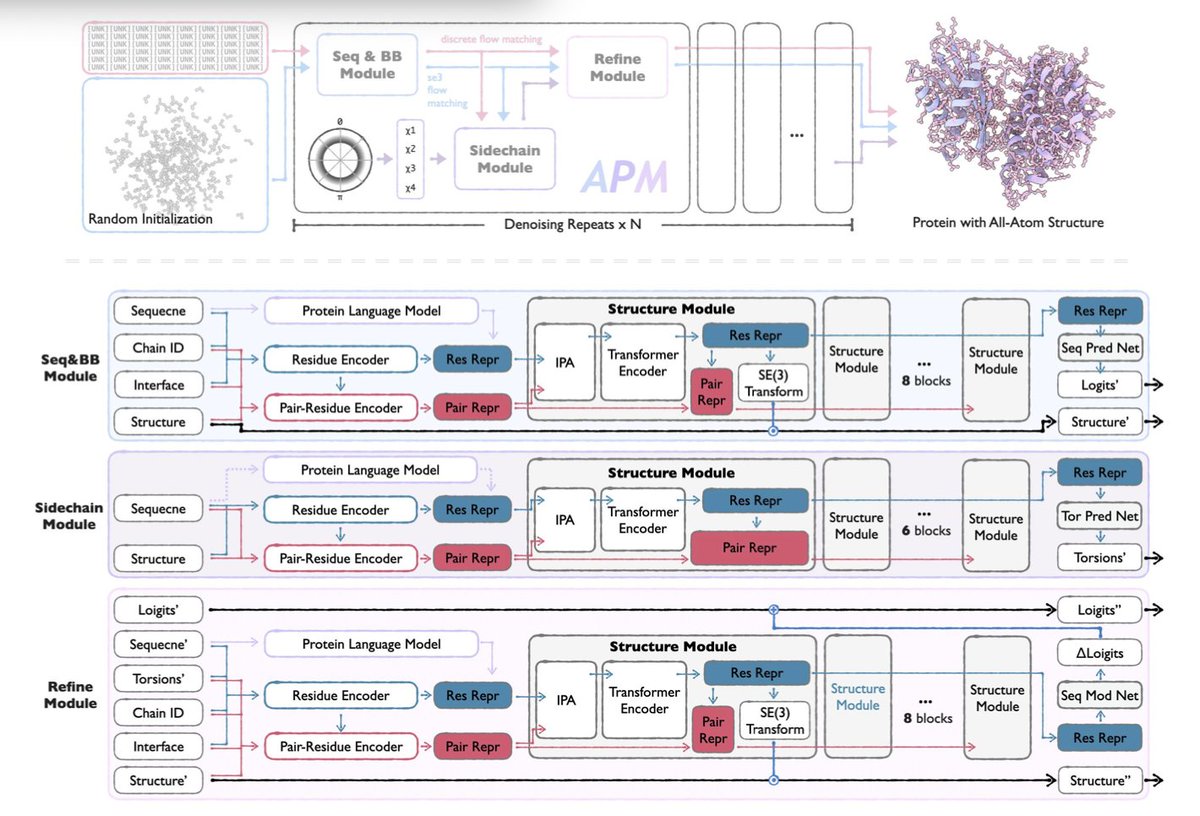
3. APM integrates a three-module pipeline: (1) Seq&BB module for co-generating backbone and sequence via flow matching, (2) Sidechain module to generate full-atom sidechain conformations, and (3) Refine module to optimize structures with all-atom awareness.
4. To maintain sequence-structure coherence during generation, APM employs a novel decoupled noising and two-phase training strategy, enabling high-fidelity reconstruction across both modalities.
5. Benchmarks on single-chain tasks show APM performs competitively with leading models like ESM3 and ESMFold, and outperforms MultiFlow and ProteinGenerator on inverse folding and structure generation across various protein lengths.
6. APM is one of the first generative models to demonstrate reliable folding and inverse folding on multi-chain proteins without MSA, outperforming Boltz-1 (noMSA) and achieving high amino acid recovery and scTM scores.
7. In de novo complex generation, APM achieves significantly stronger binding energies and lower RMSD compared to Chroma, validating its ability to design well-packed interfaces using all-atom features.
8. APM’s chain-by-chain conditional generation offers controllable complex formation, supporting flexible design strategies where chains fold independently and bind cooperatively.
9. On downstream applications, APM achieves state-of-the-art performance in antibody CDR-H3 co-design (RAbD benchmark) and targeted peptide design (LNR dataset), surpassing specialized models like dyMEAN, DiffAb, and PepGLAD in binding affinity and structure quality.
10. By explicitly modeling all-atom details, natively handling multi-chain systems, and supporting both zero-shot and fine-tuned design tasks, APM paves the way for next-generation protein complex design with broad applications in therapeutic development.
💻Code: github.com/bytedance/apm
📜Paper: arxiv.org/abs/2504.13075
#proteincomplex #proteindesign #bioinformatics #proteinengineering #deepgenerativemodels #multichainproteins #antibodysdesign #peptidedesign #AI4Science #APMmodel #structuregeneration
1
13
74
10,258
18 Apr 2025
An All-Atom Generative Model for Designing Protein Complexes
1. APM (All-Atom Protein Generative Model) is a novel generative framework specifically designed to model, fold, and generate multi-chain protein complexes at all-atom resolution—an area long underserved by traditional single-chain models.
2. Unlike methods that rely on pseudo-sequence linking for multi-chain modeling, APM handles native multi-chain structures through architecture and data-level innovations, allowing precise modeling of inter-chain interactions.
3. APM integrates a three-module pipeline: (1) Seq&BB module for co-generating backbone and sequence via flow matching, (2) Sidechain module to generate full-atom sidechain conformations, and (3) Refine module to optimize structures with all-atom awareness.
4. To maintain sequence-structure coherence during generation, APM employs a novel decoupled noising and two-phase training strategy, enabling high-fidelity reconstruction across both modalities.
5. Benchmarks on single-chain tasks show APM performs competitively with leading models like ESM3 and ESMFold, and outperforms MultiFlow and ProteinGenerator on inverse folding and structure generation across various protein lengths.
6. APM is one of the first generative models to demonstrate reliable folding and inverse folding on multi-chain proteins without MSA, outperforming Boltz-1 (noMSA) and achieving high amino acid recovery and scTM scores.
7. In de novo complex generation, APM achieves significantly stronger binding energies and lower RMSD compared to Chroma, validating its ability to design well-packed interfaces using all-atom features.
8. APM’s chain-by-chain conditional generation offers controllable complex formation, supporting flexible design strategies where chains fold independently and bind cooperatively.
9. On downstream applications, APM achieves state-of-the-art performance in antibody CDR-H3 co-design (RAbD benchmark) and targeted peptide design (LNR dataset), surpassing specialized models like dyMEAN, DiffAb, and PepGLAD in binding affinity and structure quality.
10. By explicitly modeling all-atom details, natively handling multi-chain systems, and supporting both zero-shot and fine-tuned design tasks, APM paves the way for next-generation protein complex design with broad applications in therapeutic development.
💻Code: github.com/bytedance/apm
📜Paper: arxiv.org/abs/2504.13075
#proteincomplex #proteindesign #bioinformatics #proteinengineering #deepgenerativemodels #multichainproteins #antibodysdesign #peptidedesign #AI4Science #APMmodel #structuregeneration
1
23
76
6,936

9 Feb 2025
Last call for ICLR 2025 Workshop on Deep Generative Models!
📅Deadline: Feb 10, 2025 (AOE)
📝Short (4pp) & Long (8pp) papers
🔹Non-proceeding, no conflict with concurrent submissions
Submit now!👉openreview.net/group?id=ICLR…
#ICLR2025 #DeepGenerativeModels #AI #ML #LastCall
7
35
5,205
9 Feb 2025
Last Call! ICLR 2025 Workshop on Deep Generative Models
📅 Deadline: Feb 10, 2025 (AOE)
📝 Short (4pp) & Long (8pp) papers
🔹 Non-proceeding, no conflict with concurrent submissions
🏆 Best paper awards!
Submit now 👉 openreview.net/group?id=ICLR…
#ICLR2025 #DeepGenerativeModels #AI
6
26
2,589
5 Feb 2025
Important Updates for #ICLR2025 DeLTa Workshop!
📝Submission Extended: Feb 10, 2025 (AOE)! (Was Feb 5)
📌 Non-Proceedings: Accepted papers on OpenReview; free to submit elsewhere.
Join us to share your work & connect!
#DeepGenerativeModels #ICLR2025Workshop
10 Jan 2025

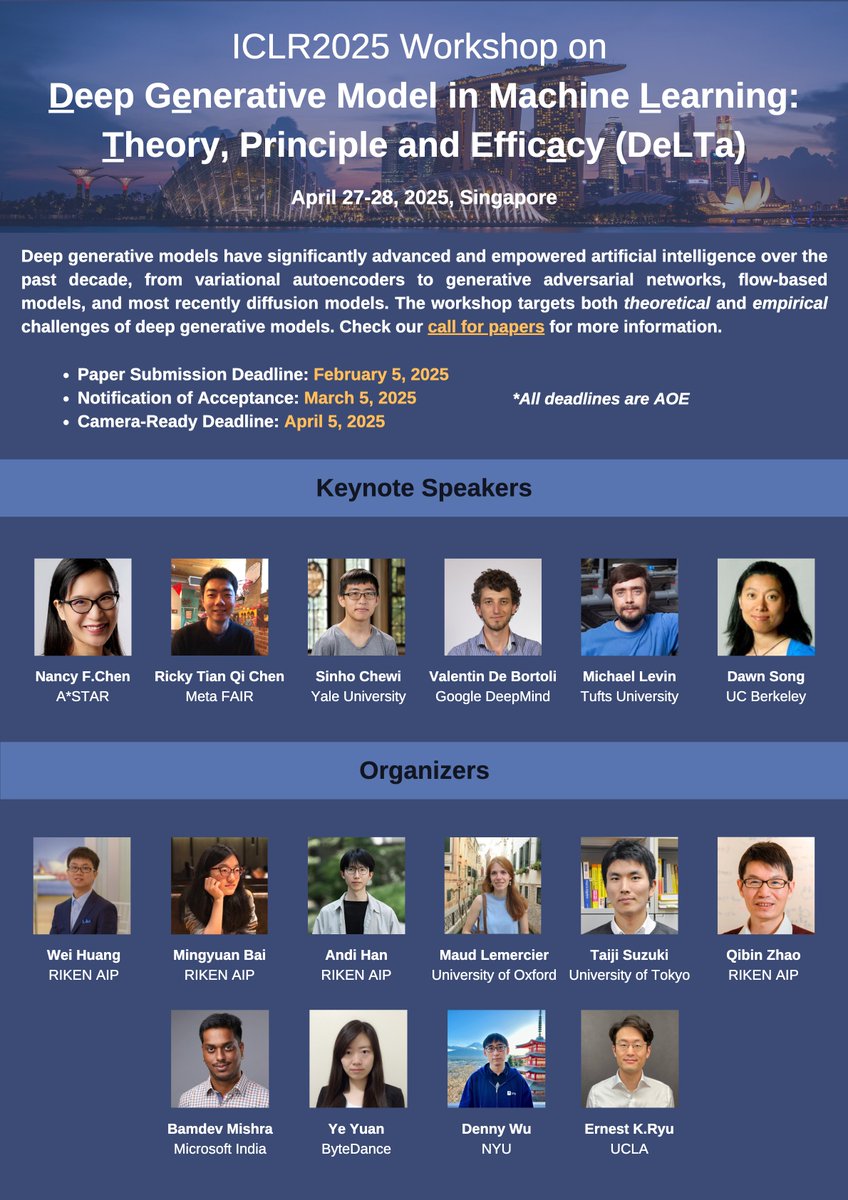
🚀ICLR 2025 Workshop on Deep Generative Models (DeLTa) is here!
📜 Submission Call: Share your innovative work! openreview.net/group?id=ICLR…
💼 Reviewer Call: Apply now!
docs.google.com/forms/d/1_A6…
Website: delta-workshop.github.io/#ho…
#ICLR2025 #DeepGenerativeModels
#ICLR2025Workshop
3
9
1,118
2 Feb 2025
ICML DDL is over, but don’t forget about the ICLR 2025 Workshop on Deep Generative Models submission deadline coming up fast!
Share your innovative work: delta-workshop.github.io/
#ICLR2025 #DeepGenerativeModels #ICLR2025Workshop #CallForPapers
10 Jan 2025
🚀ICLR 2025 Workshop on Deep Generative Models (DeLTa) is here!
📜 Submission Call: Share your innovative work! openreview.net/group?id=ICLR…
💼 Reviewer Call: Apply now!
docs.google.com/forms/d/1_A6…
Website: delta-workshop.github.io/#ho…
#ICLR2025 #DeepGenerativeModels
#ICLR2025Workshop
14
38
18,916
10 Jan 2025
🚀ICLR 2025 Workshop on Deep Generative Models (DeLTa) is here!
📜 Submission Call: Share your innovative work! openreview.net/group?id=ICLR…
💼 Reviewer Call: Apply now!
docs.google.com/forms/d/1_A6…
Website: delta-workshop.github.io/#ho…
#ICLR2025 #DeepGenerativeModels
#ICLR2025Workshop
8
25
100
29,741

7 Oct 2024
What Are VAEs and GANs? #AIgenerativemodels #AImodels #deepgenerativemodels #GANs #generativeadversarialnetworks #MachineLearning #VAEs #VAEsvsGANs #variationalautoencoders
aicompetence.org/vaes-vs-gan…

ALT web analytics
14

10 Nov 2023
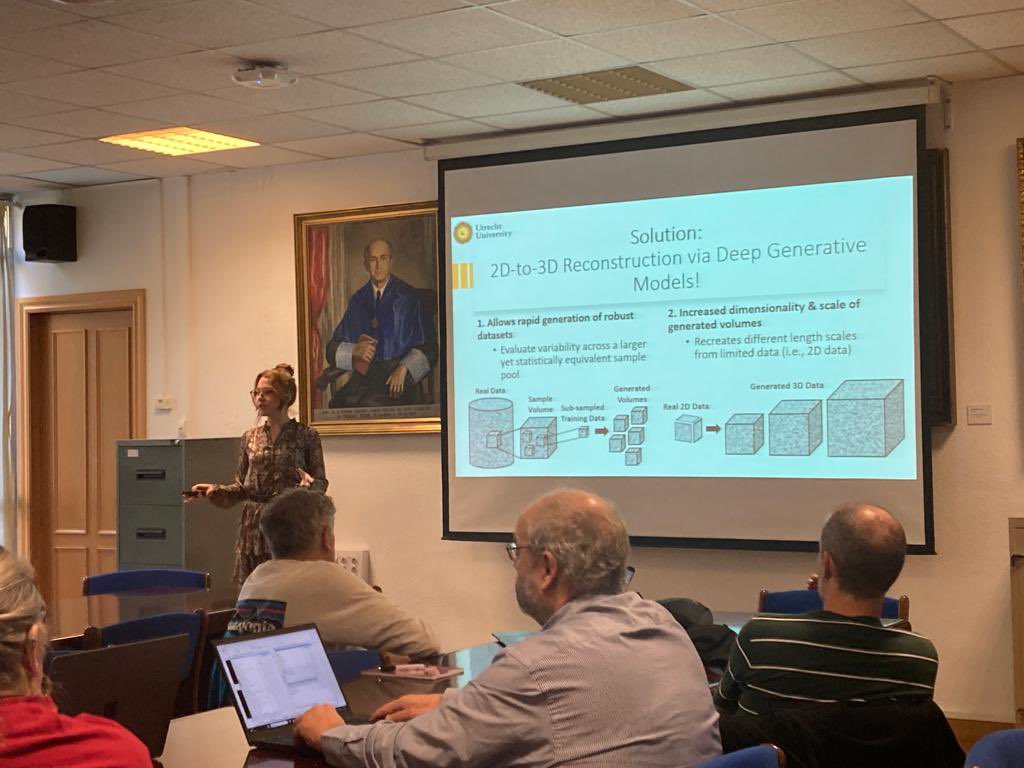
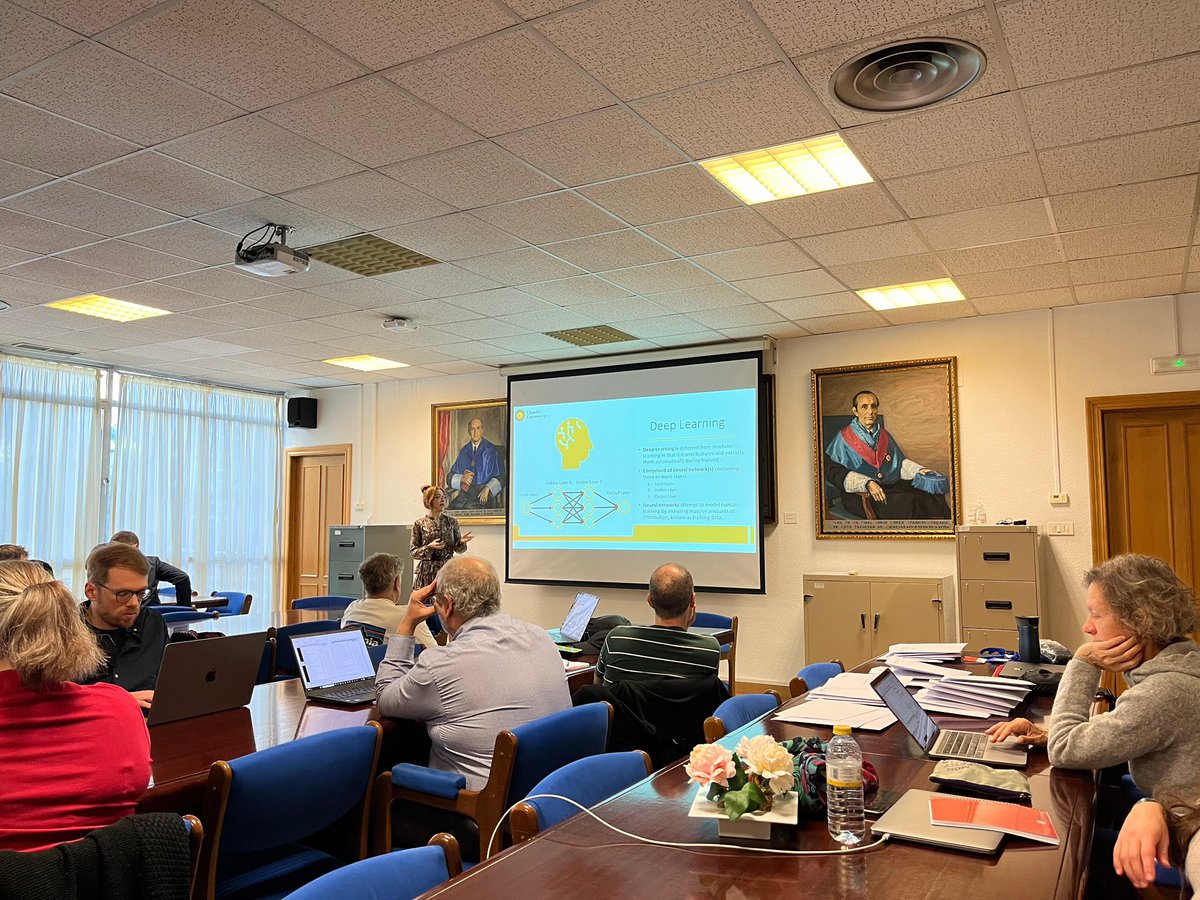
Great talk this morning by Hannah Vogel from @UniUtrecht on #DeepLearning and #DeepGenerativeModels like #GANs for 2D-to-3D reconstructions of heterogeneous porous media! 🤖🔬🪨
@UUGeo @UUEarthSciences
#AI #MachineLearning #DL #GAN #geology
2
7
771

3 Nov 2023
Looking forward to New Orleans in December =)
💻 Code to be released during Neurips ;)
📜 nips.cc/virtual/2023/75395
#EEG #DeepGenerativeModels #Neuroscience #NeurIPS2023
1
1
181

20 Oct 2023
MIT engineers emphasize the need to move beyond "statistical similarity" for AI to truly assist in generating novel engineering designs
#AI #artificialintelligence #deepgenerativemodels #designrequirements #Engineering #engineeringinnovation
multiplatform.ai/mit-enginee…
ALT AI News
1
17