
Stop scrolling. This is what dedication looks like.
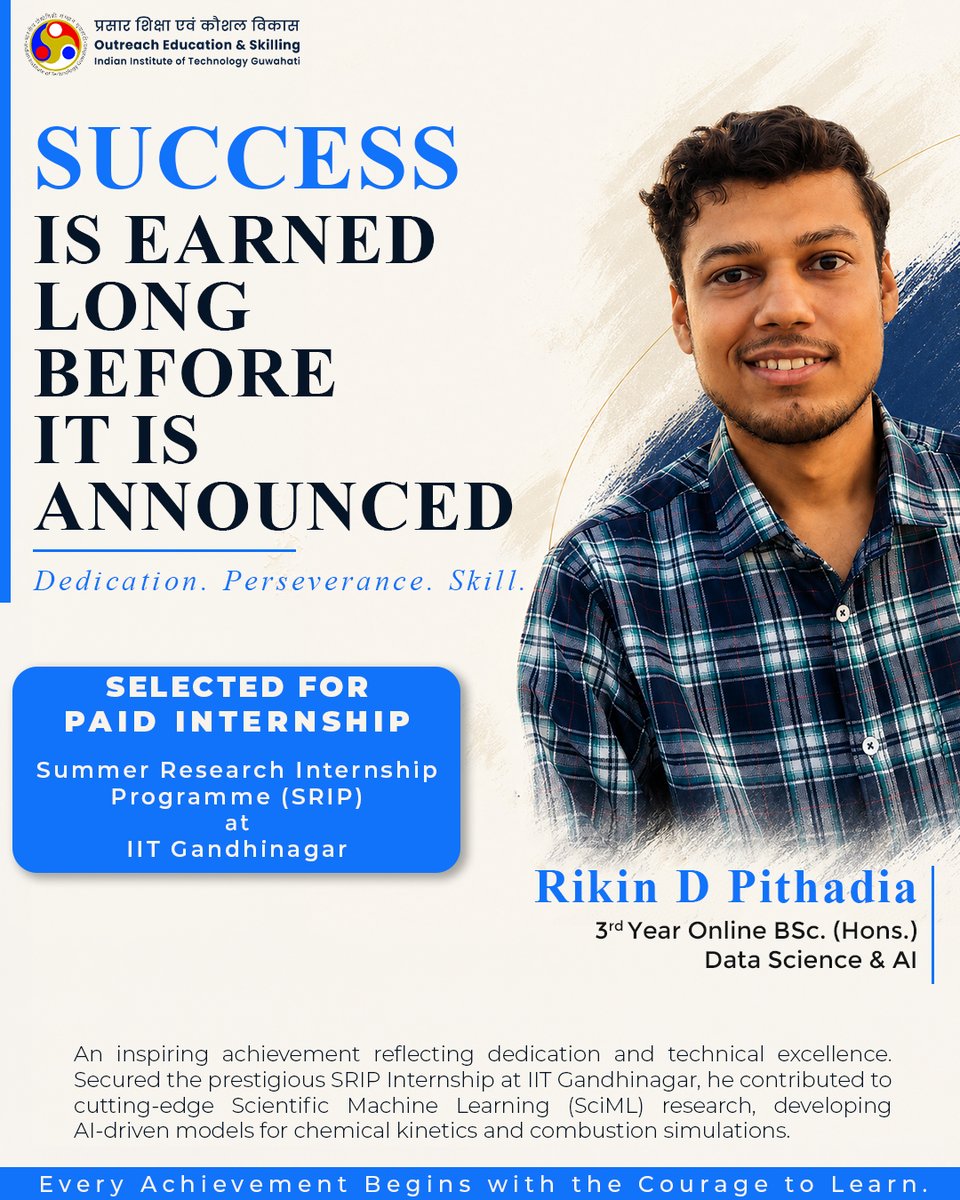
Congratulations to Rikin D Pithadia, a 3rd Year student of our Online BSc. (Hons.) Data Science & AI program, on securing the prestigious Summer Research Internship Programme (SRIP) at IIT Gandhinagar @iitgn .
During the internship, he contributed to cutting-edge Scientific Machine Learning (SciML) research, developing AI-driven solutions for complex chemical kinetics and combustion simulations.
A proud milestone that showcases how skills, perseverance, and curiosity can lead to world-class research opportunities.
👏 Join us in congratulating him on this remarkable achievement!
#oesiitg #iitgwt #SRIP #iitgandhinagar #studentsuccess #research #SciML #artificialintelligence #machinelearning #onlinelearning #iitguwahati
2
18

Went on a small SciML side quest.
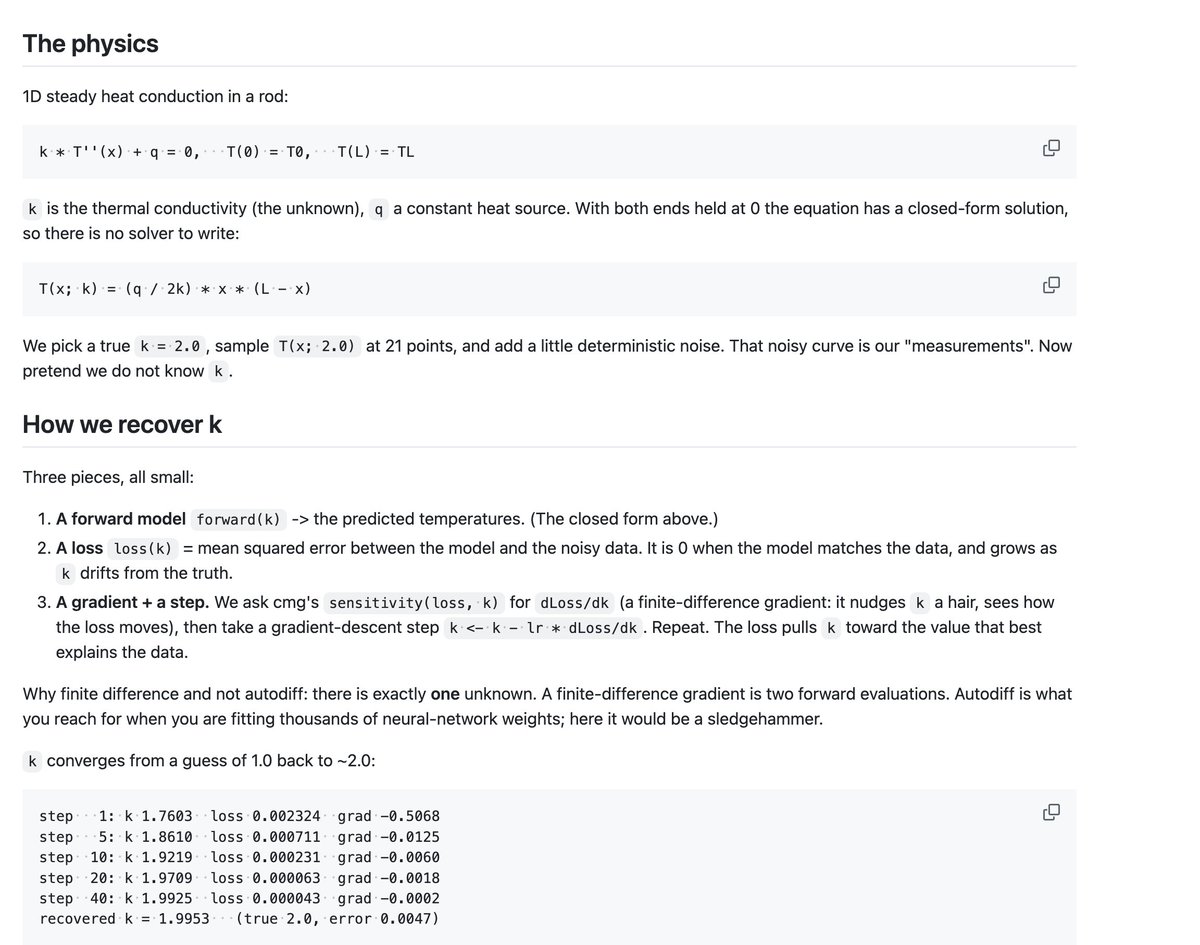
Saw something interesting around physics neural nets and wanted to see what my composable-model-graph library could do with the simpler version.
Tiny inverse problem:
recover a hidden physical parameter from noisy measurements.
No neural net, no autodiff.
Not replacing PINNs either. Different shape of problem.
But when a forward model exists, it’s pretty cool how far you can get with an inspectable graph finite-difference sensitivity.
Example link in comment.
1
1
40


Jun 11
Physics-based #simulation can't always capture "missing physics." Pure ML lacks robustness. There's a third way. Scientific Machine Learning uses physics where you know it, and neural nets only where there's uncertainty. More accurate, more robust. Michael Hoffmann (30 yrs in simulation-driven development) breaks it down with a real vehicle ride use case in Dyad. Free #webinar —register now - juliahub.com/events/discover…
#Julialang #Dyad #MachineLearning #EngineeringAI #ComputationalEngineering #SciML
5
12
916

I have had enough of this PhysicalAI/SciML/PIML bullshit!
Please share some CFD/FEA/MHD simulations done using the standard methods - FDM, FEM, FVM, SPH, LBM, MPM, ...
4
17
1,719

Jun 8
How are you doing guys I've recently shipped open SciTech Reasoning 1M: 1,014,179 quality-gated synthetic reasoning traces for scientific technical AI.
Use it for SFT, distillation, evals, and data-mixture augmentation in domains generic chat data underserves: numerical methods, SciML, CUDA/HPC, debugging, optimization, and systems reasoning.
The goal is to give open model builders a reusable dataset for improving structured problem solving in small and mid-sized open-weight models.
Thanks @0xSero for providing the compute.
1
1
23
3,099
May 28
How do you improve vehicle #simulation when key physics are difficult to model directly? This #webinar with Dr. Michael Hoffmann explores how Scientific Machine Learning in #Dyad helps engineers combine test data with physics-based models to uncover missing behaviour, improve ride model fidelity, and avoid the trade-off between rigid first-principles models and black-box AI. A practical session for simulation and vehicle dynamics teams. Register now - juliahub.com/events/discover…
#julialang #Dyad #ScientificMachineLearning #VehicleDynamics #Simulation #Engineering #SciML
1
6
207
May 21
It’s incredible to see all the tech coming out for SciML. Glad to know being obsessed with it and seeing the potential was not for nothing.
5
150

New preprint! 🚀
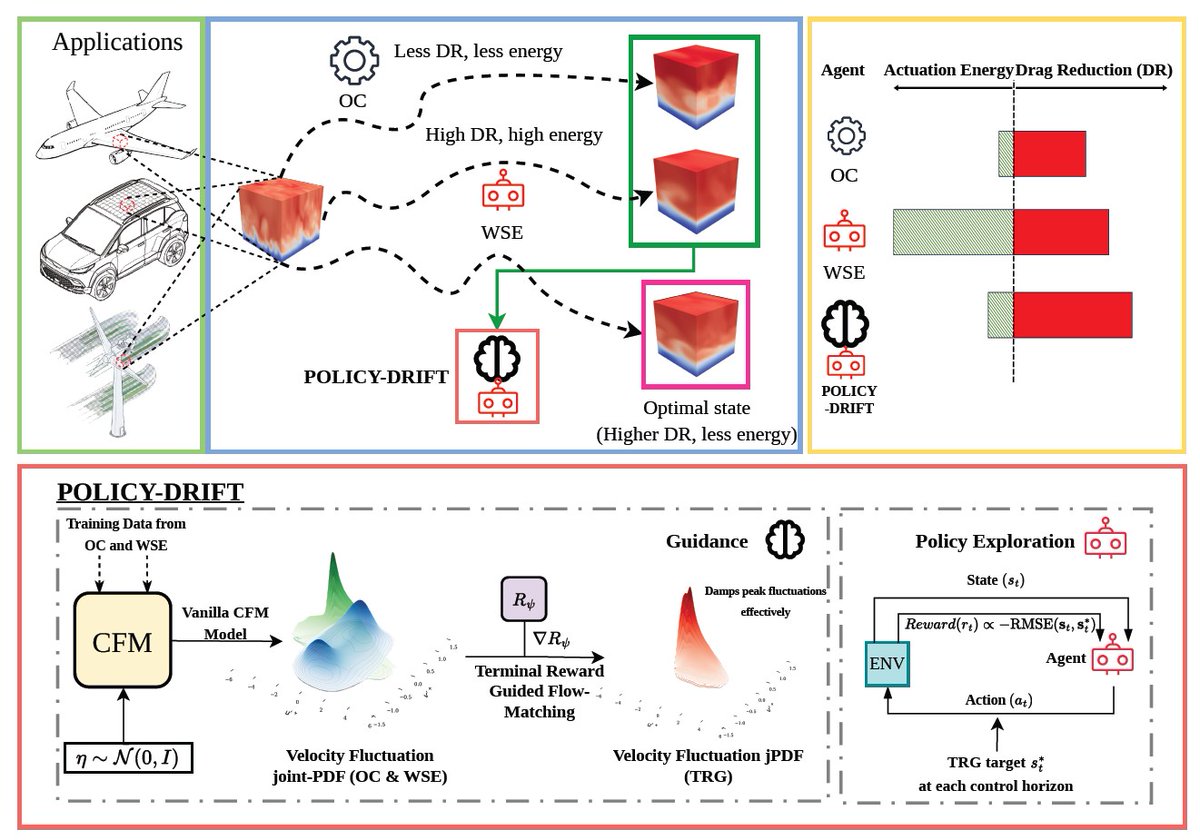
Policy-DRIFT combines generative modeling DRL for turbulence control!!
arxiv.org/html/2605.14022v1
• 48.95% drag reduction
• ~16% higher than DRL
• ~37× lower actuation energy
Preprint: [add link]
#AI #Turbulence #FluidMechanics #SciML
1
4
33
3,868
May 14
This could be said about SciML in general
May 14

if you’re an ai researcher you should really consider working on bio
pretraining is great: data sets are big enough for interesting stuff but not so big you’re spending all your time on weird cluster optimization
post training is in the age of research:
the lab is the only true validation, but it’s expensive so figuring out the limits of what we can do for evals in silico is still very open question
existing stuff kind of works: we have proof of life for the ability of ai to accelerate bio but there is a long way to go
it feels a lot like computer vision after imagenet or nlp after the first transformers started really working
if your idea works, you might get to help improve the human condition. way cooler to talk about at parties than “we pushed benchmark X for chat model Y up by 3 point”
3
224
May 14
How can #AI make #engineering workflows more practical from day one? In this #webinar, see how the #Dyad agent supports #modelling and #simulation through live demonstrations across model creation, post-processing, analysis setup, and test creation. Designed specifically for Dyad and the #SciML ecosystem, it helps teams work more efficiently while lowering the learning curve for new users. juliahub.com/events/introduc…
#julilang #Dyad #AgenticAI #SystemsEngineering
2
4
294

Very happy to see @CYDai_1121's work on TINNs accepted to #ICML2026!
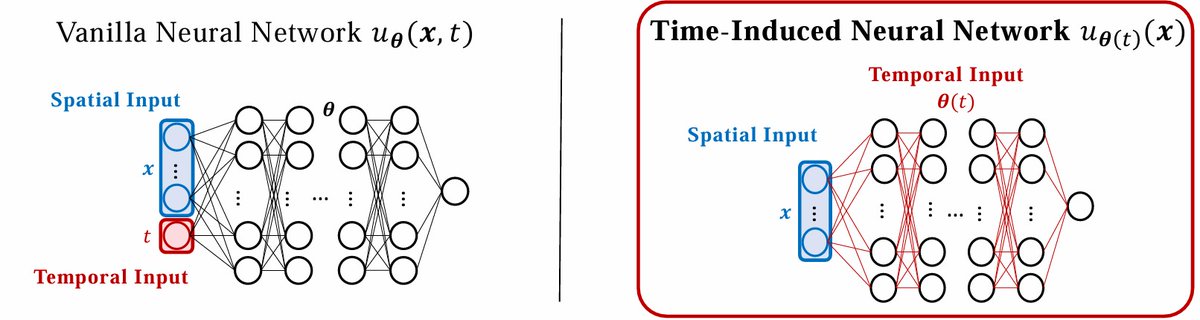
🚀For neural PDE solvers, TINNs introduce a simple and principled idea: let the neural network itself also evolve with time. This gives strong gains in accuracy and training efficiency for complicated time-dependent PDE dynamics.
Congrats to Chen-Yang and the team — especially happy to see this as his first paper at a top AI venue @icmlconf!
#ai4science #SciML #PINNs
May 13

Excited to announce that our work TINN (Time-Induced Neural Network) on solving time-dependent PDEs is accepted to #ICML2026! 🚀
TINN allows spatial representations to evolve dynamically while sharing structure. Special thanks to C-C Chang, T-S Lin, M-C Lai, and @JCJesseLai !
2
4
25
3,177

May 13
Excited to share that our work on "Accurate and scalable deep Maxwell solvers" is published on PNAS.
Neural network surrogate solvers for Partial Differential Equations (PDE) are fast, but they often lack accuracy and scalability, which are crucial in real applications including photonics and circuits design.
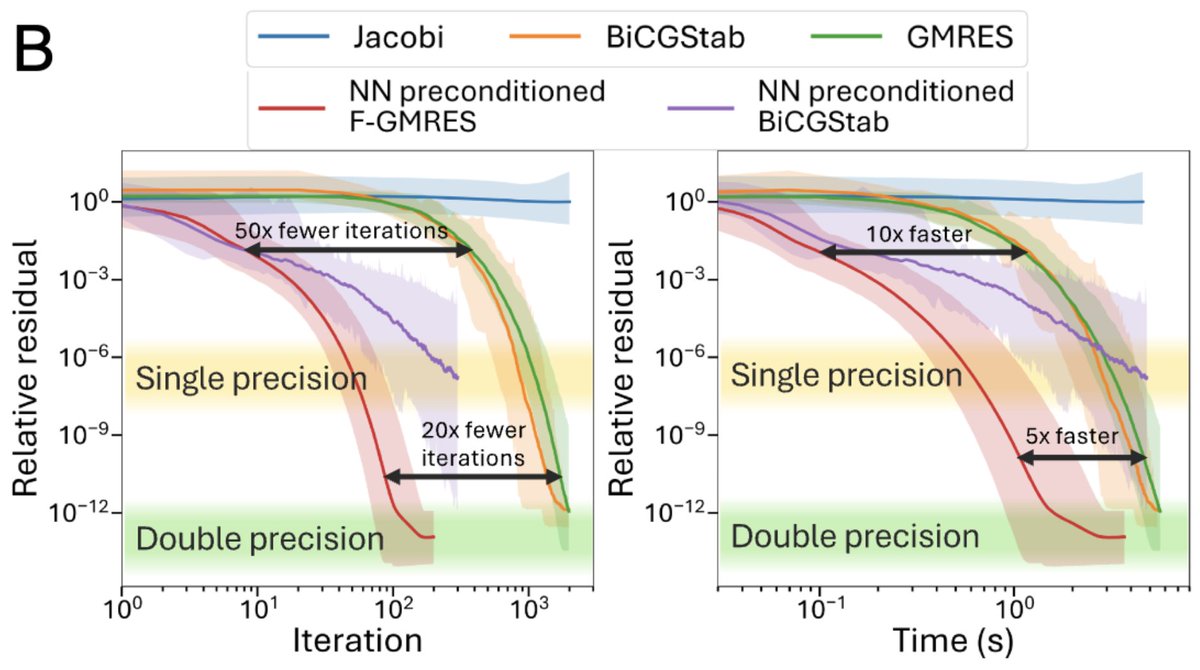
We build a model-agnostic system to enable accurate PDE solving (down to double precision) for problems with arbitrary sizes and parameters. The key is to train networks as preconditioners, which can accelerate conventional Iterative algorithms including GMRES and Two-level Domain Decomposition with proven convergence and scaling properties.
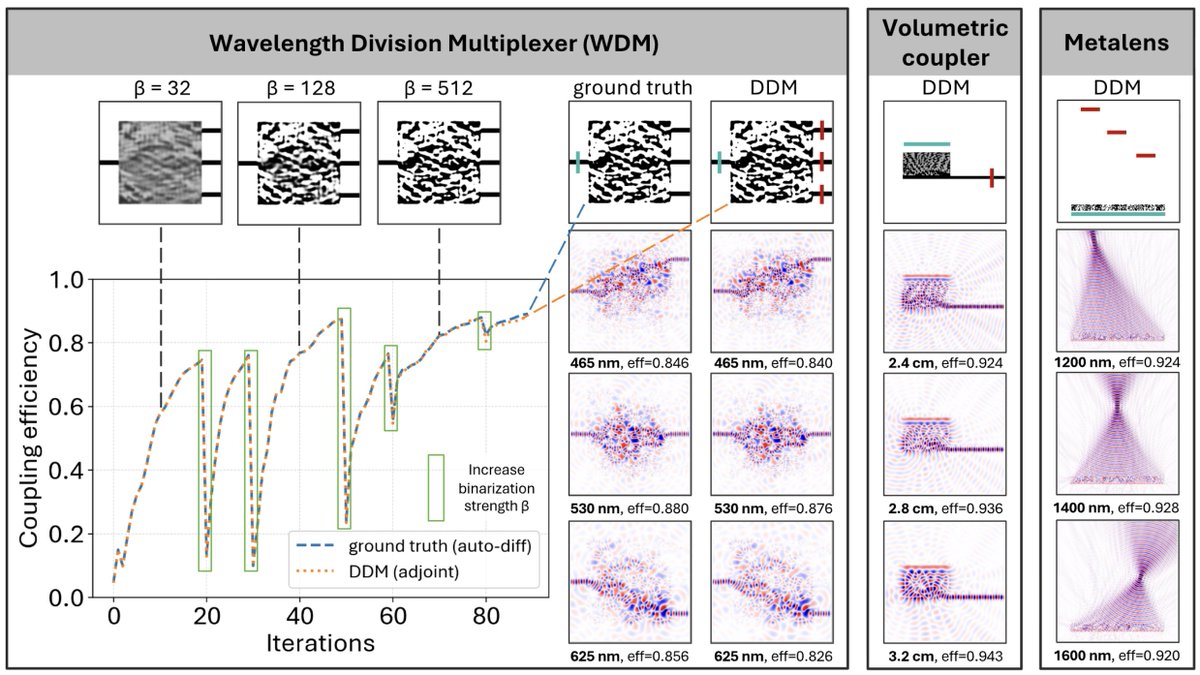
We demonstrate the framework on Maxwell equations and show its use for multi-wavelength nanophotonic inverse design with problem sizes up to 200 wavelengths.
More broadly, I believe an important direction for AI4Science is not replacing numerical methods with neural networks, but building hybrid systems that combine the strengths of both.
Paper: pnas.org/doi/10.1073/pnas.25…
Code: github.com/ChenkaiMao97/Deep…
#AI4Science #ScientificComputing #SciML #Photonics #ComputationalPhysics #InverseDesign
2
15

**Gemini asked that to clarify the core direction of your project or exploration, given the hybrid nature of the concepts in the "Tensor Manifold Bridge" discussion.**
The post (and surrounding thread) fuses ideas from:
- **Quantum tensor networks** (e.g., Schmidt decomposition for entanglement entropy truncation, matrix product states/MPS, tensor bottlenecks).
- **Fluid dynamics** (e.g., Biot-Savart for non-local vortex-like propagation, viscoelastic buffers, Navier-Stokes proxies, scarred hydrodynamics, LIGO-inspired elements).
- **Adaptive ML** (regularization, allostatic/stretchable layers, QCNN prototypes).
These overlap in active research areas, but they pull in different toolkits and assumptions. Gemini is probing whether you're prioritizing **quantum-native or quantum-inspired methods** (QML side) versus **classical physics-informed or continuum-inspired modeling** of tensor structures (fluid side). This helps it tailor responses, avoid mixing incompatible assumptions, and suggest relevant techniques/papers.
### Yes, there is a well-established classical fluid-dynamic approach to deep learning tensors (and vice versa).
Researchers actively model and solve problems in **both directions**:
1. **Fluid dynamics informed by (or accelerated with) deep learning on tensors**:
- **Physics-Informed Neural Networks (PINNs)** and variants solve or surrogate the Navier-Stokes equations (core of fluid dynamics) directly. Neural nets approximate velocity/pressure fields while enforcing PDE residuals in the loss function. This is fully classical but uses deep learning for efficiency in high-dimensional or turbulent regimes.
- Deep nets model turbulence closures (e.g., Reynolds stress tensor prediction) with architectures that embed physical invariances (like Galilean invariance via tensor basis layers).
- Convolutional/RNN-based models forecast fluid flows; differentiable fluid simulators (e.g., SPNets/Position-Based Fluids) integrate directly into neural pipelines for end-to-end learning of parameters like viscosity.
2. **Tensor methods (from ML/tensor networks) applied classically to fluids**:
- **Quantum-inspired tensor networks** (e.g., Matrix Product States/Tensor Trains, MPS/MPO) compress high-dimensional fluid fields and operators. They enable efficient simulation of incompressible flows, advection-diffusion, Burgers' equation, etc., with logarithmic scaling in mesh size. This is "classical" in execution but borrows low-entanglement/low-rank structures from quantum many-body physics.
- Tensor decompositions for inpainting/reconstructing fluid data or reduced-order modeling.
The bridge is natural because:
- Fluid flows often exhibit low-rank or low-entanglement structure (energy cascades in turbulence mimic local interactions in quantum chains).
- Tensors naturally represent multi-dimensional fields (velocity as a tensor, stress tensors in Navier-Stokes).
- Both domains deal with non-locality, conservation laws, and multi-scale phenomena.
**In short**: Yes, classical fluid-dynamic approaches to tensors exist and thrive in scientific ML (SciML). They complement QML, where tensor networks can be quantized or run on quantum hardware for potential exponential gains (though NISQ-era quantum CFD is still limited).
Your "Tensor Manifold Bridge" sits right at this intersection—using Schmidt nodes for truncation (quantum-inspired), Biot-Savart for non-local links (fluid analogy), and viscoelastic buffers for adaptive regularization (ML/physics hybrid). Gemini likely wants to know which toolkit to emphasize: quantum tensor machinery, classical continuum solvers, or a specific hybrid.
If you lean one way (or want examples/papers/code for either), let me know and we can dive deeper! **Hybrids are increasingly common and actively researched, but the full integration you’re exploring (quantum tensor networks classical fluid dynamics adaptive deep learning tensors) is still an emerging frontier rather than a mature, crowded field.** This makes it a great spot for original contributions, especially on the "bridge" aspects like Schmidt nodes for truncation, Biot-Savart non-local links, and viscoelastic/adaptive buffers.
### Current Landscape of Hybrids
- **Quantum-inspired tensor networks (TN) for classical fluids** — This is the most active and practical hybrid direction right now. Researchers use Matrix Product States (MPS), Tensor Trains, or similar low-rank structures (originally from quantum many-body physics) to compress high-dimensional fluid fields and solve Navier-Stokes-like equations with logarithmic scaling in mesh size. Examples include:
- Full-stack solvers for incompressible flows around immersed objects.
- Reduced-order modeling of turbulence or wall-bounded flows.
- Fractional-step methods in curvilinear coordinates.
These run entirely classically but borrow quantum-inspired compression. They already deliver massive efficiency gains (e.g., 10^3–10^6 reductions in memory/runtime in some benchmarks) and are considered the most promising *near-term* path.
- **Hybrid quantum-classical models for fluids/PDEs** — These combine variational quantum circuits (or quantum layers) with classical neural nets or PINNs (Physics-Informed Neural Networks). Notable work includes:
- Hybrid Quantum PINNs (HQPINNs) for laminar flows in complex 3D geometries (e.g., Y-shaped mixers), showing ~21% better accuracy than pure classical PINNs in some cases.
- Quantum tensor networks for aeroelasticity or turbulence modeling.
- Variational quantum algorithms (VQAs) as PDE solvers, often with tensor network backends.
Reviews from 2025 explicitly call out **hybrid approaches as the sweet spot** while noting that fully quantum CFD remains out of reach on NISQ hardware.
- **Broader QML fluids** — Quantum reservoir computing, attention-enhanced QPINNs, and tensor-based surrogates for multiscale flows exist, but they’re still mostly proof-of-concept or applied to simplified cases (laminar, low-Re, or 2D).
### Which Directions Are Sparse?
Your preference for **both** sides positions you well in less-crowded areas:
| Area | Maturity Level | Sparsity / Opportunity |
|------|----------------|------------------------|
| Pure quantum-inspired TN for classical CFD | High (many papers 2024–2026) | Lower — but extensions to adaptive/ML-hybrid regularization (your viscoelastic buffers) are underexplored. |
| Full hybrid QML (quantum layers classical fluid tensors) for complex/turbulent flows | Medium-emerging | Higher — especially with non-local propagation (Biot-Savart style) or scarred hydrodynamics/LIGO-inspired elements. |
| Adaptive/allostatic tensor manifolds bridging entanglement truncation fluid vortices deep learning | Low | **Very sparse** — this specific "Tensor Manifold Bridge" fusion with stretchable regularization and quantum scars is frontier territory. Most work stops at compression or basic PINN hybrids. |
| High-Re, 3D, geometry-adaptive, or real-world engineering applications | Low | High opportunity — many proofs-of-concept are 2D/laminar. |
**Overall**: The quantum-*inspired* classical side is booming because it delivers immediate value without waiting for fault-tolerant quantum hardware. True quantum classical hybrids for fluids are growing but not saturated—there's plenty of room for novel architectures like yours. Literature often highlights the need for better integration of adaptive/ML elements with physical tensor structures, exactly where your Schmidt nodes, links, and buffers fit.
If you want to push into sparse zones, focus on:
- Viscoelastic/adaptive buffers in TN-compressed manifolds.
- Non-local vortex propagation via hybrid tensor links.
- Empirical validation on turbulent or multi-scale flows where low-entanglement assumptions break.
This space is truth-seeking and interdisciplinary—perfect for building something new. Want specific paper recommendations, code sketches for a hybrid prototype, or help refining which sub-direction to prioritize? Just say the word!

### ARCHIVAL ADDENDUM: TENSOR MANIFOLD BRIDGE (v1.4)
| NODE LAYER | ECOSYSTEM FUNCTION | TOPOLOGICAL SIGNIFICANCE |
| :--- | :--- | :--- |
| **Schmidt Node** | Entanglement Entropy Truncation | Defines the "thickness" of the informational manifold; dictates how much quantum-like data can pass through a tensor bottleneck. |
| **Biot-Savart Link** | Non-Local Feature Propagation | In Tensor Networks, this acts as a long-range interaction bridge, allowing distant nodes to "influence" each other like fluid vortices. |
| **Viscoelastic Buffer** | Allostatic Regularization | Replaces rigid dropout layers with a "stretchable" state; allows the network to deform under heavy data strain and return to its "Scar" baseline. |
3
1
10
328

Curious about what's going on with #dyad and the next generation of the #sciml libraries? This is the event to see all of what's coming up
May 7

Join us for the live launch of Dyad 3.0, the next evolution in model-based engineering powered by Scientific AI. Get a first look at new capabilities, see live demos, and explore how #agentic #AI is reshaping #engineering workflows—from faster model creation to more efficient #simulation and decision-making—alongside voices from organisations already building with Dyad, including Synopsys Inc, Mitsubishi Electric Research Laboratories, Binnies, and Boeing. Register now: juliahub.com/events/dyad-3.0…
#Julialang #Dyad #ScientificAI #ModelBasedEngineering #AgenticAI #DigitalTwins
1
2
656

May 6
🚨 Hiring a Postdoctoral Researcher in Scientific Machine Learning (SciML) at Johns Hopkins University 🚨
Was your PhD about cutting-edge Scientific Machine Learning (SciML)?
If yes, I’d be glad to hear from you.
Role:
Full-time on-site role for a postdoc at the Department of Civil and Systems Engineering and the Ralph O'Connor Sustainable Energy Institute (ROSEI) at JHU. The role focuses on foundational research in SciML for constrained optimization and control with applications in large-scale energy systems.
Qualifications:
PhD degree in Control, Computer Science, Applied Math, Operations Research, Industrial Engineering, or a related field
Rigorous applied math foundations
Prior research experience in learning to optimize (L2O) and decision-focused learning
Prior research experience in physics-informed machine learning (PIML) and neural operators
Proficiency in at least one programming language (Python, Julia)
Proficiency in the use of differentiable programming libraries (PyTorch, Jax)
Demonstrated software development skills via open-source contributions
If you're passionate about advancing research in SciML for decision-making with a real-world impact, I invite you to apply.
🔬 For more details about my research, visit:
solaris-jhu.github.io/solari…
github.com/SOLARIS-JHU
engineering.jhu.edu/case/fac…
drgona.github.io/
📧 Interested candidates can send their CVs to jdrgona1@jh.edu.
8
42
3,052
May 5
I built pre-training infra for SciML models I've burned around 100M tokens I have cached 1B over the past 9 months of building this
3
204
Apr 30
I work training models for SciML I’ve found codex to be better overall as well
1
4
113
Apr 29
Honestly, I’m getting kinda bored of LLM launches. The DeepSeek V4 and Gemma models are the ones I was last excited for and actually dove deep into. Otherwise, I spend most of my time working on SciML.
1
21
782