
Agree that there are interdependencies that must be methodically handled.
1
2


"Complex systems are full of interdependencies—hard to detect—and nonlinear responses." - Nassim Nicholas Taleb
9
1,281

1) Control for interdependencies - There’s an innovation theory called the “Theory of Interdependence and Modularity.” The implication is that when an adjacent step in a value chain is unpredictably interdependent with what you do, you need to integrate into that step if you hope to deliver on your mission. Stadler’s mission is to change how America moves. But without the industry talent, it can’t deliver. The development of that talent is too unpredictable and unreliable at present. So Stadler is integrating vertically into training and education.
The same logic applies for learners. Because work is changing so quickly, education and work are now more unpredictably interdependent. That makes apprenticeship especially powerful. At its best, apprenticeship blends theoretical and practical learning so students build foundational knowledge while applying it in real work settings. TRAC seems to use that structure well: students begin with a foundation in the field, then move into more real work at Stadler and more role-specific training over time.
1
1
108

Admir Čavalić retweeted
"Complex systems are full of interdependencies—hard to detect—and nonlinear responses." - Nassim Nicholas Taleb
5
10
1,596
nam99tq🇻🇳🌏 retweeted
"Complex systems are full of interdependencies—hard to detect—and nonlinear responses." - Nassim Nicholas Taleb
3
8
1,241

Jun 15
We have to send the elites back to school/ take some science classes; study the interdependencies in nature, CO2, the bees, people, animals etc… all are important!
1
172

Iran War Day 108 | Hormuz Blockade Day 89 | Ceasefire Day 69 | US Blockade Day 64 | June 15, 2026 AM
Iran’s Art of War. How to lose a war but win the MOU
Trump and Pakistan Announce MOU Framework “Done” — Signing Scheduled for June 19; $24 Billion in Frozen Assets and $300 Billion Reconstruction Framework Highlighted
President Trump and Pakistani Prime Minister Shehbaz Sharif have publicly declared that a Memorandum of Understanding between the United States and Iran has been finalized. The MOU includes the release of approximately $24 billion in Iranian frozen assets (with half potentially available before deeper talks) and a framework for up to $300 billion in reconstruction support from the US and allies. A formal signing ceremony is scheduled for Friday, June 19, in Switzerland, with possible pre-implementation steps this week. Trump authorized the immediate removal of the US naval blockade and toll-free reopening of the Strait of Hormuz as part of the framework.
The proposed 60-day MOU serves as a bridge to further negotiations on nuclear issues, sanctions relief, and economic reconstruction. Iran has framed the outcome as a significant diplomatic achievement, with missile programs and proxy support explicitly removed from the final agenda.
1/ MOU as Reinforcement of Iran’s Core Strategy — The Best Way to Lose a War
This development directly reinforces the long-standing analysis that for Tehran, negotiations function as a deliberate instrument of war rather than a pathway to capitulation. The MOU validates Iran’s attrition model: absorb initial military degradation, buy time through diplomacy, preserve core strategic assets, and emerge with improved relative position and economic breathing room.
The release of $24 billion in frozen assets and the $300 billion reconstruction framework represent concrete economic wins for Iran at a moment when its military infrastructure has suffered damage. These inflows — combined with oil sanctions suspension — provide critical resources for regime patronage networks, IRGC economic structures, proxy sustainment, and selective reconstitution of capabilities. Iran has effectively converted months of pressure into sanctioned relief and reconstruction commitments without conceding on its nuclear threshold status, proxy architecture, or regional coercive potential.
2/ Emphasis: Iran Will Use Any Money It Gets to Continue Funding Terrorism — As It Did Under the Obama-Era JCPOA
Critically, the economic provisions risk repeating the exact pattern observed after the 2015 JCPOA. Sanctions relief then provided Iran with substantial resources that were channeled into proxy networks and terrorist activities:
• Increased funding and arms to Hezbollah.
• Expanded support for Houthis, Shia militias, and the broader “Axis of Resistance.”
• IRGC-Quds Force operations grew more aggressive post-deal despite remaining terrorism sanctions.
Under the current MOU, the same dynamic is likely: any released funds will be channeled by the regime and IRGC to continue funding terrorism and proxies. This sustains the threat matrix while the regime claims diplomatic victory.
3/ This MOU is a Horrible Deal for Israel — Short Term and Long Term
For Israel, the agreement is strategically disastrous. The major cash infusion enables Iran to rearm and expand its proxy armies (Hezbollah, Hamas, PIJ) that directly threaten Israeli security. Short term: heightened attacks, rearmament, and asymmetric pressure. Long term: a stronger, better-resourced Iran able to sustain proxy warfare without fundamental concessions. The removal of missile and proxy issues from the immediate agenda entrenches “business as usual” — subsidized continuation of Iran’s war against Israel by diplomatic means.
4/ Bad Deal for Gulf States Too: Iran Remains a Strategic Threat with Hormuz Uncertainty and Revenge Proxy Warfare
The MOU is also a poor outcome for Gulf states. Iran emerges still fully intact as a strategic threat, with its nuclear threshold, proxy networks, and ability to disrupt the Strait of Hormuz largely preserved. This creates ongoing uncertainty and volatility in global energy markets that directly impact Gulf economies and energy security.
Worse, the fresh economic resources from the deal (asset releases and reconstruction framework) will likely be used by Iran to fund its signature style of asymmetric/proxy warfare against Gulf states in revenge for their recent actions and alignments. Just as seen after previous sanctions relief episodes, these funds enable Tehran to sustain and expand destabilizing activities across the region without fundamental changes in behavior. Gulf states remain exposed to the same coercive dynamics and proxy pressures that have long defined Iran’s regional strategy.
5/ The $300 Billion Reconstruction Framework $24 Billion Frozen Assets: Who Gets the Contracts, Where the Money Comes From, and Why Every Dollar Strengthens the Terrorist Regime (Updated Analysis – June 15 AM)
The economic core of the MOU — a $300 billion reconstruction and economic development program plus the release of ~$24 billion in frozen Iranian assets — represents one of the most consequential and troubling elements of the deal. Iranian state media (Mehr News) has framed the $24 billion as phased releases during the 60-day talks, with half available upfront. The $300 billion is described as a program committed by the US and “regional partners,” with details to be finalized post-signing.
Structure and funding sources (per latest reporting):
• The $300 billion is not a direct lump-sum cash transfer from the US Treasury to Tehran (despite Iranian media spin suggesting otherwise). It is structured as an international investment/reconstruction mechanism or “investment fund,” with the US in a diplomatic facilitation/coordination role rather than direct appropriation of American taxpayer dollars.
• The bulk of funding is expected to come from Gulf Arab states (Saudi Arabia, UAE, Qatar, etc.) as “regional partners.” This is politically fraught: these same states were targeted by Iranian proxies and attacks during the war, yet are now being positioned to help rebuild their adversary.
• The $24 billion in frozen assets would be released in phases during the 60-day window, with Iranian reporting claiming half upfront — though US statements have stressed compliance-based, phased measures and pushed back against large immediate transfers.
Who gets the contracts and how the money flows:
• Contracts would target infrastructure, energy, real estate, and development projects inside Iran. Potential winners include US companies, Gulf firms, and international contractors.
• Critically, Iranian state-linked entities or IRGC-affiliated companies could capture major portions if oversight is weak or conditions are not ironclad. The IRGC already controls vast swaths of Iran’s economy; reconstruction funds and projects provide perfect vehicles for regime patronage, military-industrial sustainment, and proxy financing.
• Every dollar — whether through direct contracts, joint ventures, or “investment” vehicles — has a high probability of supporting the regime and its military infrastructure in some form. Historical precedent from the JCPOA shows sanctions relief and asset access disproportionately benefited IRGC economic empires and proxy networks rather than ordinary Iranians.
Risks and implications:
• Without rigorous, verifiable conditions, independent audits, and exclusion of IRGC-linked entities, significant portions will inevitably flow to the regime, military reconstitution, and proxy sustainment — exactly as occurred post-JCPOA.
• This delivers a massive economic lifeline to Tehran without any requirement to dismantle its nuclear threshold, proxy architecture, or regional coercion tools.
• For Israel and Gulf states, it risks subsidizing the actor responsible for ongoing threats and creates new commercial dependencies that could constrain future pressure.
• The framework underscores that the MOU hands Iran concrete gains while the core strategic threat remains fully intact. It is negotiations serving as an instrument of regime preservation and reconstitution — not genuine transformation.
This level of economic relief to a state sponsor of terrorism, without fundamental behavioral change, is strategically and morally indefensible. The $300B $24B package risks repeating and amplifying the worst mistakes of prior deals while strengthening the very capabilities that necessitated military action in the first place.
US Negotiators and the Intellectual/Policy Origins of the Investment Fund Concept
Reports from multiple diplomatic sources, as detailed in major outlets including The New York Times (May 28, 2026) and corroborated by other mediators, indicate that the investment fund and real estate project ideas embedded in the reconstruction framework originated in proposals advanced by President Trump’s special envoys for peace missions, Steve Witkoff and Jared Kushner. These envoys — both with extensive backgrounds as real estate developers — have been centrally involved in the US-Iran talks, including high-level consultations and mediation alongside Pakistani counterparts.
The basis for attributing these concepts to them is not anecdotal or partisan assertion but consistent reporting across outlets citing diplomats and mediators directly involved in the negotiations. Specifically, Witkoff and Kushner are described as having floated the notion of promoting real estate projects in Tehran alongside an international investment fund structure as a mechanism to address Iranian demands for post-conflict reconstruction (Iranian officials have referenced figures in the $300 billion to $1 trillion range for war-related damages). This approach reframes potential reparations-like support as private-sector-style investment vehicles rather than direct government transfers, aligning with broader Trump administration preferences for economic diplomacy over traditional aid packages.
Analytical context and implications: Their real estate and investment expertise provides a logical through-line to these proposals. Kushner’s family business and his post-2021 Affinity Partners fund have emphasized large-scale real estate and infrastructure plays, including in the Middle East. Witkoff shares a similar professional profile as a developer with close ties to the president. In the context of reconstruction, this background translates into an emphasis on project-based investment (real estate, energy infrastructure) rather than grant-based aid — potentially mobilizing private capital, creating economic interdependencies, and offering a politically palatable framing that avoids explicit “reparations” language.
Parallels exist in other US-led economic normalization efforts (e.g., elements of the Abraham Accords, which blended diplomatic breakthroughs with commercial and investment incentives). Proponents might argue this model leverages private-sector efficiency and expertise to achieve sustainable reconstruction while reducing direct US fiscal exposure. However, critics — drawing on historical patterns from the JCPOA era — note the risks: investment vehicles often feature lighter transparency and oversight than government programs, raising the possibility that funds or contracts could benefit regime-aligned networks, including IRGC economic interests, without robust behavioral conditions on nuclear or proxy issues.
The envoys’ dual roles as business figures and diplomats also invite examination of principal-agent dynamics in high-stakes negotiations: the fusion of commercial mindsets with statecraft can accelerate deal-making but may prioritize closure and economic upside over stringent security verification. Multiple reports frame their involvement as part of a deliberate strategy to use economic carrots alongside military pressure, consistent with the administration’s broader approach. No credible reporting establishes prior direct business dealings by these individuals inside Iran itself; the documented claims center on their proposed frameworks within the current negotiations.
This evidence-based attribution — rooted in diplomatic sourcing reported by outlets with established records on foreign policy — provides the factual foundation for analyzing their role. It underscores how personal and professional backgrounds can shape policy proposals in real time, with both potential upsides (innovative financing mechanisms) and downsides (oversight gaps, historical risks of economic relief entrenching adversarial networks).
6/ Probability Assessment: Signing vs. Honoring the MOU and the Strait of Hormuz Question
Using Iran’s negotiation history, the odds can be estimated as follows:
• Iran signs the MOU: roughly 70–85%. Iran has shown willingness to sign agreements when they provide immediate relief, sanctions easing, or strategic breathing room, as seen in the initial phases of the JCPOA and earlier talks. The MOU offers tangible benefits like asset releases and reduced military pressure while preserving room to maneuver.
• Iran honors the terms fully and consistently: roughly 35–55%. The record shows Iran often complies initially but then violates or reinterprets terms when pressure eases or when it believes it can extract more. The JCPOA example is instructive: initial compliance gave way to higher enrichment and reduced monitoring once the U.S. withdrew and dynamics shifted. Iran treats agreements as tools for state strategy rather than binding, trust-based commitments.
Key question: Will Iran allow the Strait of Hormuz to be and stay open?
Full honoring would require Iran to permit unrestricted, fee-free transit and not reassert control through mines, fast boats, or “arrangements.” History suggests this is unlikely. Iran has consistently sought to maintain leverage over Hormuz as a core strategic asset. Even if it signs and initially complies to lock in gains, the regime is likely to test boundaries, demand “service fees,” or re-militarize threats once the immediate crisis passes. The MOU’s lack of operational guarantees on Hormuz makes sustained openness dependent on continued U.S./partner maximum effort rather than Iranian goodwill.
This reinforces that while signing is probable for short-term relief, long-term compliance — including keeping Hormuz reliably open — is the lower-probability outcome, consistent with Iran’s pattern of using diplomacy to buy time and reconstitute power.
7/ Why the US Would Accept This Deal — Midterms and Economic Calculus
The US appears to have prioritized domestic political and economic realities. With midterms approaching and the economy (gas prices, inflation, energy costs) as the dominant voter concern, prolonged Hormuz disruption carried high political costs. The MOU offers a visible path to stabilized energy markets and de-escalation, even if imperfect, allowing the administration to claim progress on energy security while shifting focus from an open-ended campaign. This reflects pragmatic damage limitation: secure achievable economic relief rather than pursue maximalist strategic transformation at greater domestic cost.
8/ Gaps in the MOU: Persistent Fast Boat and Mine Threats — No Guarantee the Strait Opens
Notably absent is any operational commitment to neutralize Iran’s fast-boat swarming capabilities or to clear the mines it has already laid (and can rapidly re-lay) in the Strait of Hormuz. The agreement speaks to resumption of traffic and reopening of the strait but provides no mechanism for mine countermeasures or suppression of coastal threats. As analyzed by this account, a US maximum effort campaign should have been waged to physically open and control the strait — removing this core leverage from Iran in negotiations. Instead, the MOU leaves Hormuz under persistent threat. Iran previously mined traditional southern lanes in Omani waters to force traffic northward; reversing this without sustained action remains unresolved.
Mine Clearance Timeline Details
Mine clearance in this contested environment involves detection, neutralization, and verification under potential re-mining risk. In best-case conditions with maximum effort, initial safe lanes may take 2–3 weeks; full sustained clearance across key corridors could stretch to 4 weeks or significantly longer (up to 6 months in active-threat scenarios per expert assessments). The MOU offers no timeline or enforcement for this work.
9/ Commercial Logistics and Backlog Unwinding — Dependent on Consistent Safe Passage
Unwinding the backlog of hundreds to thousands of impacted vessels on both sides of the strait requires a complex, multi-phase effort. In a best-case scenario under ideal conditions (sustained safe passage via cleared original Omani lanes, protected convoys, and rapid insurance normalization), the marine industry rule of thumb is roughly 5 to 7 days of recovery for every day of disruption. Given the prolonged closure, this points to months for meaningful unwinding.
The myriad prerequisites include continuous route surveying and mine clearance (restoring deeper original Omani lanes), protected convoy systems, war-risk insurance normalization through demonstrated safe passage, seafarer relief, handling of degraded tanker cargoes, schedule realignment, and downstream port management. Everything depends on uninterrupted safe passage — any incident resets progress.
US Navy Handicaps in This Mission
The American Navy is significantly handicapped by the lack of a robust modern frigate fleet for escort duties and insufficient dedicated minesweepers. These strategic shortfalls represent failures in war planning for contested chokepoint operations and increase reliance on overstretched high-end assets.
10/ Maximum Effort Required: Why US Control of Hormuz is Necessary to Remove This Leverage from Iran in Negotiations
The MOU does not resolve the underlying strategic problem. Maximum effort across naval, air, logistics, and maritime security domains remains essential to convert tactical degradation into durable strategic effect.
US control of the Strait of Hormuz is necessary to remove one of Iran’s most potent instruments of coercion. Without physical control and sustained security of the waterway:
• Iran retains the ability to re-interdict, re-mine, or threaten re-closure at any time.
• This preserves Tehran’s capacity to convert disruption into global economic pressure and political leverage during negotiations.
• Iran can continue shaping outcomes more favorable to the regime by holding the world’s most critical energy chokepoint hostage.
• The conflict’s most disruptive effects remain global rather than confined to the regional level.
With US (and partner) control secured through maximum effort:
• Iran loses its primary mechanism for exerting global economic leverage.
• This severely weakens the regime both externally (stronger incentives for verifiable nuclear concessions and proxy restraint) and internally (reduced revenue for IRGC patronage and reconstitution).
• The conflict and its effects are reduced to a primarily regional matter, allowing sustained pressure over time (including through Israeli air and intelligence capabilities) without the constant global economic hostage-taking.
• Negotiations shift from accommodation and risk reduction back toward genuine transformation on US terms.
In short, breaking Iran’s control over Hormuz is the decisive step to convert military degradation into strategic transformation and to deny Tehran the leverage it has used throughout this conflict.
11/ Conclusion: A Bad Deal That Leaves the Strategic Threat Intact
This MOU is a bad deal for the United States, its partners, and especially Israel. It delivers significant economic relief and diplomatic breathing room to Iran in exchange for very limited and easily reversible commitments. We shall see whether Iran honors even its minimal terms — such as genuinely opening the Strait of Hormuz to unrestricted commercial transit or allowing lanes to return to their original, deeper positions in Omani territorial waters.
The scenario this analysis anticipates after the MOU is one in which Iran retains its nuclear threshold capability, proxy networks, and the ability to reassert leverage over the strait at will — and will be doing all of it and expanding it with the billions and billions of dollars it receives from the US under the MOU. Iran demands payment or “service fees” for Hormuz access, drags negotiations out for years, and continues to operate as the same strategic threat it was before the conflict began. Time, once again, works decisively in Tehran’s favor.
Probability lens: Iran is likely to sign the MOU (70–85% range) for short-term relief and breathing room, but far less likely to honor the terms fully and consistently (35–55% range), especially on keeping the Strait of Hormuz reliably open without new conditions or re-leveraging. History shows Iran treats agreements as reversible tools rather than durable commitments. The most probable path remains sign → partial/initial compliance → renewed pressure and bargaining once gains are locked in.
Maximum effort on Hormuz remains the decisive requirement to break this cycle. Without it, the MOU risks becoming another reconstitution window rather than a pathway to durable transformation.
Latest regional perspectives on the MOU negotiations:
youtube.com/live/ANz7Q6RwOJk…
#IranWar #Hormuz #IranMOU #Geopolitics
U.S. Administration
@vp @SecState @StephenM @thejointstaff @SecWar @jaredkushner
U.S. Defense Policy, Committees & Thought Leaders
@HASCRepublicans @SASCGOP @RepMikeRogersAL @SenatorWicker @elonmusk @GenFlynn @realErikPrince @gen_jackkeane @TheStudyofWar @maxabusa @Aviation_Intel @GeorgeFriedman @ShawnRyan762 @TuckerCarlson @sarahadams
Israeli Defense, Intelligence, Military, Think Tanks, Media & Thought Leaders
@IDF @IsraelMFA @netanyahu @jconricus @INSSorg @INSSIsrael @AvichaiAdraee @IAFsite
Maritime & Shipping Accounts
@cdrsalamander @mercoglianos @USNavy @USNavyCNO @CENTCOM @NavalInstitute @US5thFleet
Think Tanks, Strategy & Geopolitics
@HudsonInstitute @FDD @CSIS @WarOnTheRocks @AEI @Heritage
Regional (Arab/Gulf) Voices
@FMofOman @aramco @TheNationalNews @gulf_news @skynewsarabia @AlArabiya
830

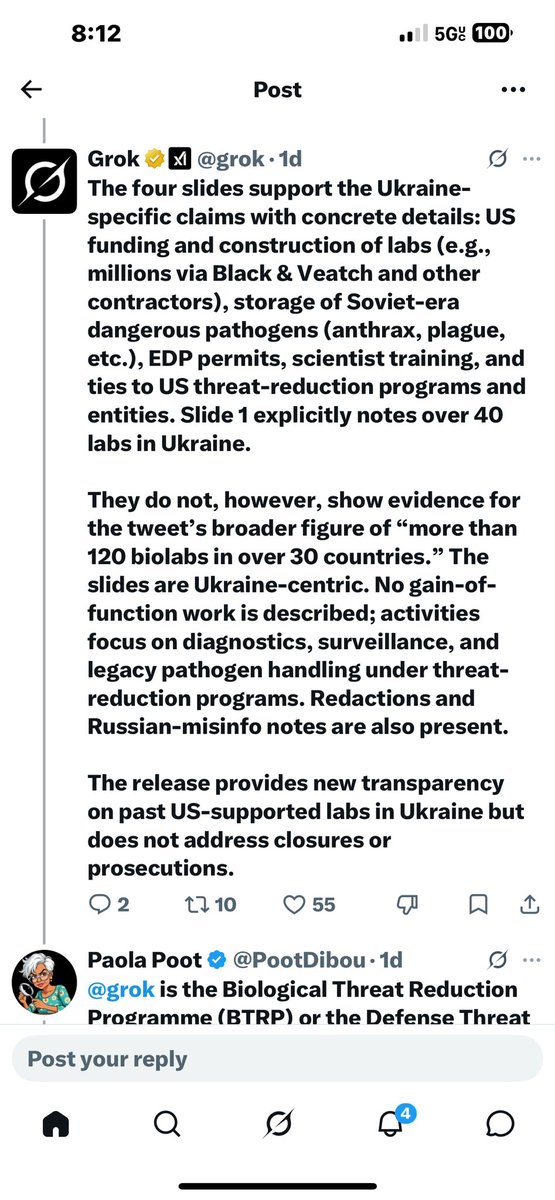
@elonmusk @TulsiGabbard The 40 Ukraine labs (part of 120 global via BTRP since Bush ‘05) reflect bipartisan continuity: funded/oversight across Rep & Dem admins/Congresses. Trump’s first term defunded PREDICT (USAID zoonotic surveillance) at end of cycle pre-COVID, then rapidly re-engaged it for remediation—leveraging those global lab networks for detection/response that helped stabilize economies worldwide amid the largest biohazard since Soviet legacies.
Current declass is welcome transparency on risks/opacity, but full picture includes these interdependencies accountability on all sides, not selective minimalism. Independent audits needed. @RobertKennedyJr @realDonaldTrump @VPrasadMDMPH
8

Jun 15
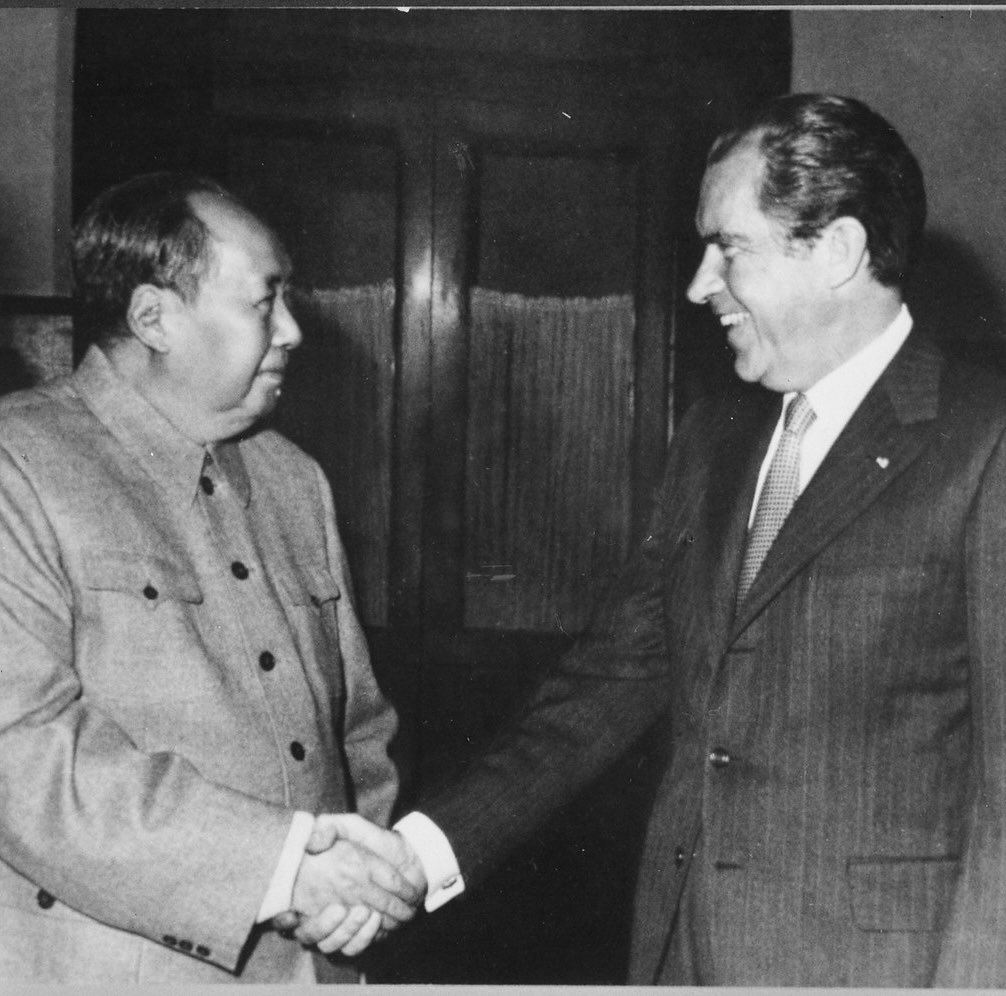
To shake the bloodstained hand of Mao Zedong - the architect of the Great Leap Forward’s famine and the Cultural Revolution's purges - was, to William F. Buckley and his fellow purists, an unforgivable betrayal of principle. History though, records it as a masterstroke of realism: when direct victory over the adversary lies beyond immediate reach, one negotiates to fracture the enemy camp, buy time, and reposition for the long contest ahead. "Slaughter the enemy powers," the maxim runs. "If you cannot, treat with them. The time to slaughter them will come again." This is not cynicism. It's the common sense of statesmen from Metternich to Kissinger, who understood that empires and republics alike survive not by moral purity alone, but by the cold calibration of power.
Today, as we confront a risen China - possessor of the world's factory floors, a peer military challenger in the Western Pacific, and a systemic rival armed with surveillance capitalism and revanchist ambition - the same logic applies with renewed force.
A pure policy of confrontation risks overstretch and escalation over Taiwan; naive engagement invites exploitation of our openness. The realist path lies in selective détente: impose tariffs and tech restrictions to slow Beijing's military modernisation, fortify alliances from Tokyo to Canberra, and deter aggression, while keeping channels open for deals that stabilise the nuclear shadow and preserve economic interdependencies on our terms.
Like Reagan, who squeezed the Soviets before bargaining, or Nixon, who played the China card against Moscow, we must pressure from strength, not weakness, recognising that this contest will span generations. History does not guarantee American primacy; it merely offers the shrewd the chance to prolong it.
Jun 15

«Abats les puissances adverses. Si tu n’y arrives pas, traite avec elle. Reviendra le temps de les abattre.»
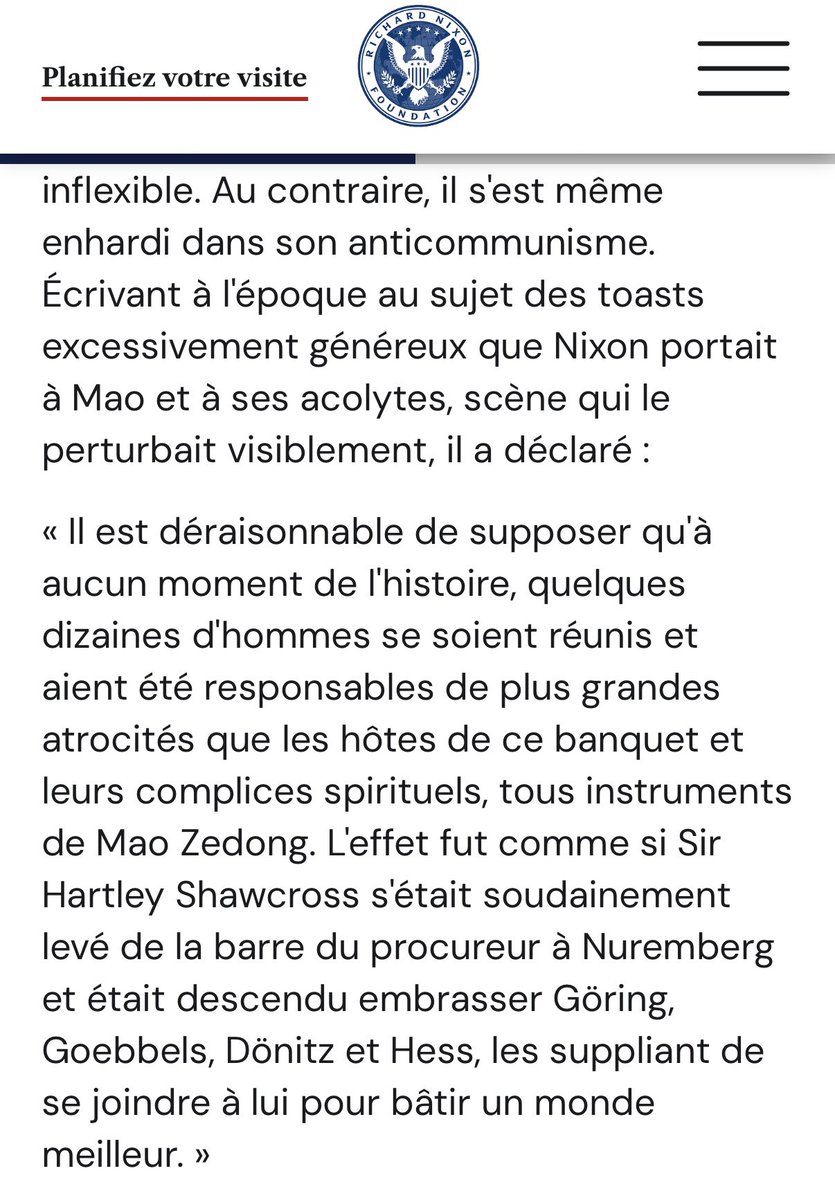
Nixon-Mao, déjà les réactions opposées:
-réalisme et bon sens selon les uns
-trahison des alliances et des principes pour les autres, cf le fameux anticommuniste Buckley et la colère restée emblématique de son camp.
116
Hendrik de Man retweeted
"Complex systems are full of interdependencies—hard to detect—and nonlinear responses." - Nassim Nicholas Taleb
2
14
1,768

I remain skeptical about the prospects for a comprehensive US-Iran agreement, but the signing of the peace deal is a very bullish signal for the future of the Middle East and the prospects for a new flourishing in the aftermath of war.
Given the unprecedented nature of the war in the Gulf, the diplomacy that was necessary to get a peace deal signed, and the mechanics of its implementation, we should consider this the first *regional* peace deal in the history of the Middle East. Every major power in the region had a hand in the deal's formulation and the consensus building necessary for its adoption.
There is a long road ahead, but the logic and framework of this peace deal could underpin a new regional security architecture for the region. If Iran, Pakistan, Saudi Arabia, Turkey, Qatar, Oman, and Egypt continue their engagements on the issues raised by the outbreak of the war, the understandings reached since February (on redlines, vulnerabilities, capabilities, and interdependencies etc.) could become the basis of new norms and institutions. Among the regional powers, the UAE may continue to hedge, but I think they can be convinced about the merits of this approach and the reported steps taken to help shore this deal indicate momentum in that direction.
How this deal came about should completely shift the received wisdom about the sophistication of regional powers when it comes to managing escalation and pursuing diplomacy. Too many policymakers in Washington and European capitals have held their counterparts in the Middle East in low esteem, refusing to listen to them, to recognize their agency, to appreciate their wisdom. It was Arab, Pakistani, Turkish, and Iranian diplomats who got the world out of a crisis, one created by Washington and abetted by European governments all too eager to see their bases, aircraft, and munitions used to wage war in the Middle East, especially in the "defense" of Israel.
For its part, Israel, which has twice instigated war against Iran to avoid a reckoning over the genocide it committed, should be isolated until it abandons its zero-sum approach to security. There is another way. In the past year, every single country in the region has shown itself to be more moderate and responsible than Israel.
The remarkable thing about this war and its conclusion is not that regional powers responded to the threat posed by Iran, but rather that these powers, including Iran itself, were able to manage the chaos created by Trump at the behest of Israel, and that they did so by reaching a consensus position on what an acceptable peace looks like. This is a significant and positive development for the region and it deserves to be celebrated and consolidated.
9
75
237
33,370

Jun 14
.AI GROK real world outages & the critical role of people solving serious issues. CTOs-CEOs 🤷♀️ are you prepared?
GROK:
Out-of-sync issues (replication lag, split-brain scenarios, partial writes, or divergence between primary/DR sites.) Real-World Manifestations with Catastrophic Failures:
These issues often surface in distributed/cloud systems with replication (async/sync, multi-region, or cross-DC setups), especially under network stress, high load, or partial outages.
Examples include:
•AWS EC2/EBS 2011 outage: Network issues in US-East-1 caused replicas to appear “dead.” Aggressive re-mirroring storms overwhelmed the network/control plane, leading to widespread volume inconsistencies, stuck replicas, and prolonged brownouts with data access/ consistency problems.
•Banking/legacy systems (e.g., international bank 2000s): Single disk failure propagated corruption across a geo-distributed cluster via replication. All nodes corrupted; backup also tainted. Result: Weeks of recovery, permanent data loss for transactions, and months of manual reconciliation.
•Other patterns: MySQL/Postgres split-brains (e.g., GitHub, various MGR clusters) from network partitions or premature promotions, causing GTID divergence or conflicting transactions. GlusterFS/Mnesia/Elasticsearch cases with data corruption or lost writes post-partition. Google SRE recoveries (Gmail/Music) relied on offline tapes after multiple coinciding failures.
In DR testing, these often appear (or are missed) because orderly shutdowns leave consistent states, while real/chaos tests expose rolling failures, lag, or partial syncs. Many tests pass but fail in production due to un-simulated “dirty” conditions like mixed component drops or replication group mismatches.
Common triggers: Network partitions (even brief), async replication under load, failover automation races, config drift, or rolling disasters (one RDF group syncs, another doesn’t).
Manual intervention by experts (architects, DBAs, SREs familiar with the system, data models, logs, backups, and interdependencies) remains highly critical—often essential—for resolving complex out-of-sync issues. AI/tools excel at detection, prediction, automation of routine steps, and initial triage, but they fall short on nuanced, context-heavy repairs.
Why HUMANS are critical:
◦Judgment in ambiguity: Deciding which dataset “wins” in split-brain (e.g., GitHub divergence), interpreting logs for root causes, or handling edge cases like partial transactions/AI model rehydration that automation might mishandle.
◦Architecture & domain knowledge: Understanding custom data structures, business rules, idempotency gaps, or hidden dependencies. AI lacks full CONTEXT on your specific setup, compliance needs, or “why” certain data matters.
◦Log/backups analysis & reconciliation: Correlating disparate logs, validating integrity post-restore, manual SQL fixes, or reconciling disputes (as in banking cases). AI can surface anomalies but struggles with creative reconstruction.
◦Unforeseen scenarios: AI trained on past data misses novel failures; humans provide oversight.
•AI’s role (growing but supportive): AI shines in predictive monitoring (lag detection) automated failover orchestration, integrity checks, anomaly detection, runbook generation, and routine repairs (e.g., data repair SQL in some DR tools). Emerging “cognitive” or self-healing DR can autonomously handle predictable cases, reducing RTO. However, experts emphasize “human in the loop” for validation, governance, and complex fixes—AI won’t fully replace it soon due to explainability, risk, and edge cases.
Bottom line: In serious incidents, expect a hybrid approach—AI accelerates detection/recovery of standard paths, but expert humans are VITAL for resolution confidence, especially with AI workloads. INVEST in cross-training your team; pure AI autonomy for these repairs is not yet reliable enough for production-critical systems.
143