
Jun 12
3/ 🧠 LangChain — Build apps powered by LLMs. The framework every AI dev uses.
If you're building AI products in 2025, this is non-negotiable.
⭐ 90k stars · github.com/langchain-ai/lang…
#LangChain #AIDevs #BuildWithAI #Python #LLMApps
1
11

Feb 25
Fuck it.
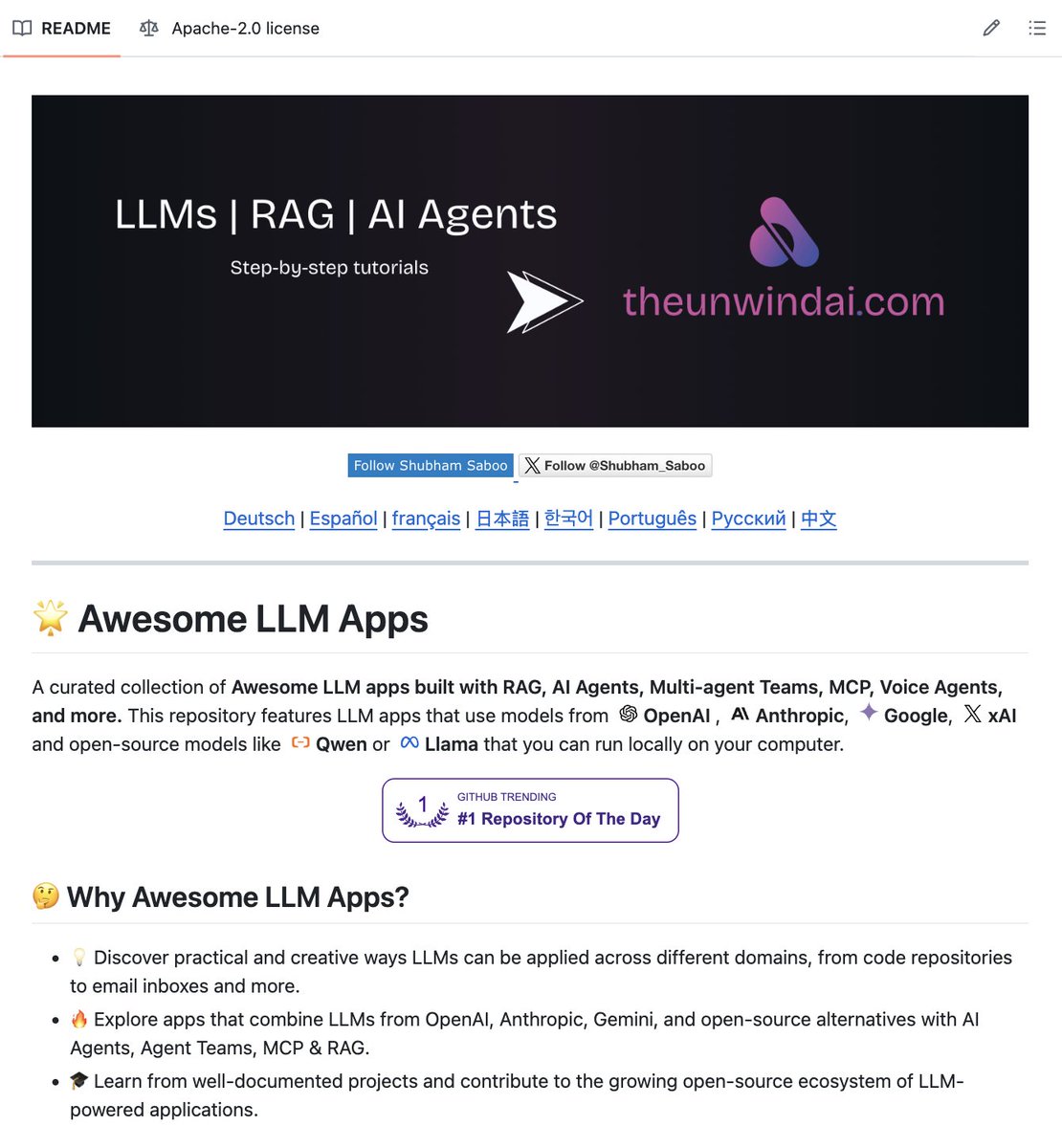
The biggest curated collection of production LLM apps just dropped.
RAG, multi-agent teams, MCP, voice agents all runnable on your laptop with Claude or local models.
Comment “LLMAPPS” and I’ll DM the repo my personal favorites for 2026.
5
8
21
1,712

Feb 21
Context window is the new RAM. If you don’t manage token budgeting, summarization, and retrieval strategy, your LLM app won’t scale. #PromptEngineering #LLMApps #AIInfra
1
2
28

Jan 25
Most AI chatbots fail because they don’t understand your data.
Chatlytic AI fixes this with smarter retrieval context-aware RAG.
Try it here 👉 chatlytic.online
Feedback = 💙
#RAG #AItools #LLMApps #IndieHacker #BuildInPublic #Tech
3
72

3 Dec 2025
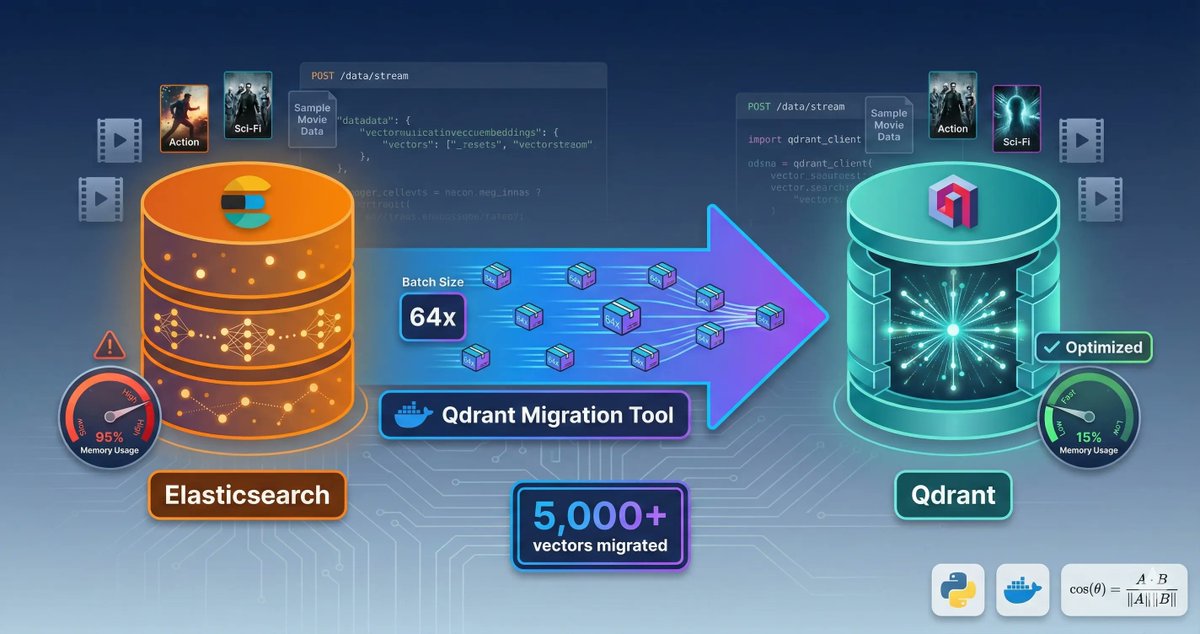
𝐌𝐢𝐠𝐫𝐚𝐭𝐢𝐧𝐠 𝐟𝐫𝐨𝐦 𝐄𝐥𝐚𝐬𝐭𝐢𝐜𝐬𝐞𝐚𝐫𝐜𝐡 𝐭𝐨 𝐐𝐝𝐫𝐚𝐧𝐭 - 𝐃𝐞𝐞𝐩-𝐃𝐢𝐯𝐞 𝐛𝐲 Mahimai Raja J
We think this is a a great technical breakdown on why many teams are moving from Elasticsearch to Qdrant for their vector search workloads.
Why he wrote this?
After facing challenges with scaling Elasticsearch for vector workloads - complex configs, higher infra cost, and limited vector performance - Mahimai created a practical guide to help teams transition smoothly to a vector-first stack.
𝐈𝐭 𝐜𝐨𝐧𝐭𝐚𝐢𝐧𝐬:
𝑾𝒉𝒚 𝒎𝒊𝒈𝒓𝒂𝒕𝒆?
- Challenging to build scaled, performant vector search with Elastic
- Need to reduce latency
- Increase resource efficiency
𝑯𝒐𝒘 𝑸𝒅𝒓𝒂𝒏𝒕 𝒉𝒆𝒍𝒑𝒔?
- Native vector indexing
- Strong payload filtering
- Efficient dense sparse hybrid search
- Easier scaling and maintenance
𝑻𝒉𝒆 𝒎𝒊𝒈𝒓𝒂𝒕𝒊𝒐𝒏 𝒑𝒓𝒐𝒄𝒆𝒔𝒔:
- Exporting ES data & embeddings
- Re-mapping schema for Qdrant
- Rebuilding collections & payloads
- Updating query patterns for vector search
- Handling ranking and scoring differences
Practical guidance:
Includes real-world examples, code snippets, and common pitfalls to avoid during migration.
Full article 👉 pub.towardsai.net/how-to-mig…
#Qdrant #VectorSearch #Migration #SearchEngineering #LLMApps
2
1
15
1,106

25 Nov 2025
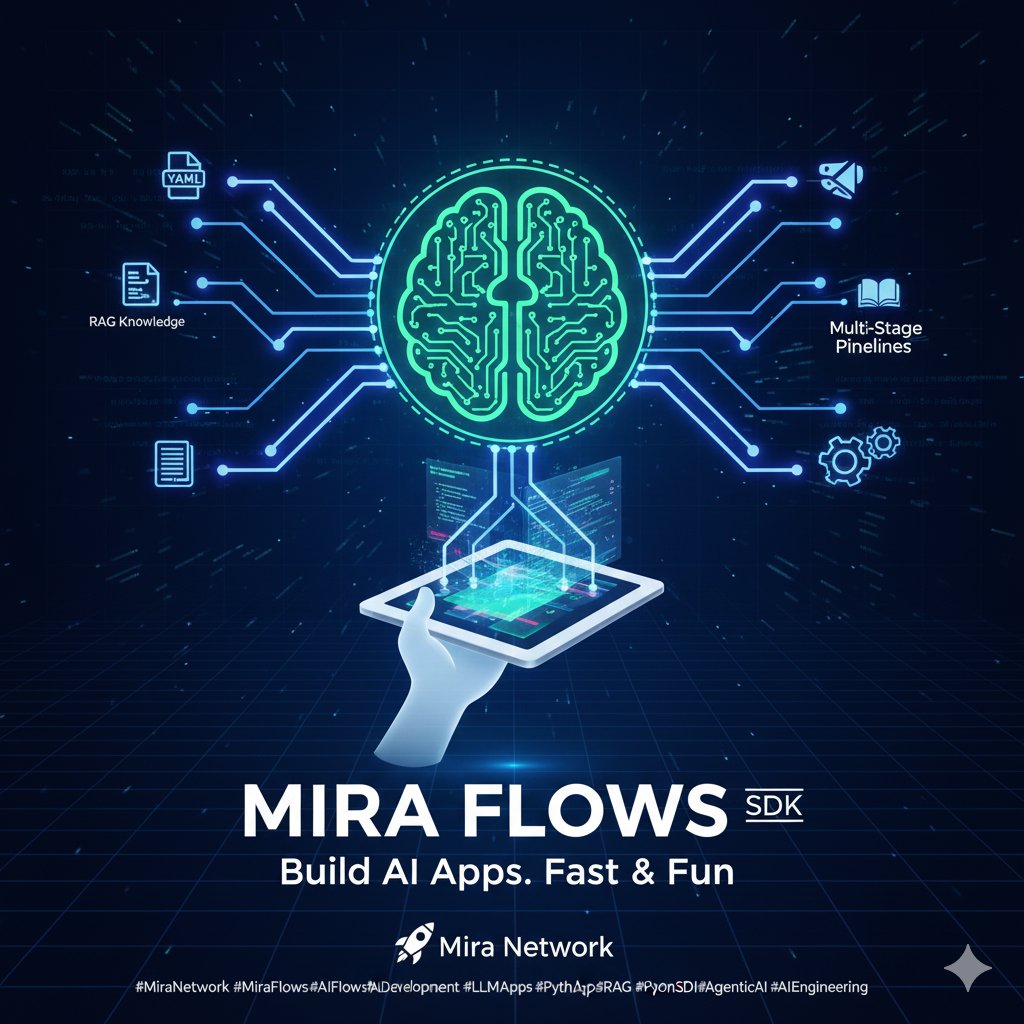
Building AI apps shouldn’t feel like stitching together a dozen tools.
And with @miranetwork Flows SDK, it finally doesn’t.
From YAML-powered flows to custom RAG knowledge and multi-stage pipelines, @miranetwork is turning AI development into something fast, composable, and actually fun.
The new era of agentic AI apps starts with devs and @miranetwork is handing them the superpowers.
#MiraNetwork #MiraFlows #AIFlows #AIDevelopment #LLMApps #RAG #PythonSDK #AgenticAI #AIEngineering
2
2
28
23 Nov 2025
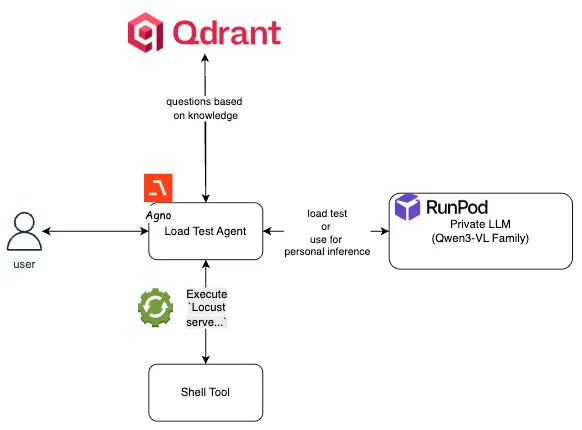
𝐁𝐮𝐢𝐥𝐝𝐢𝐧𝐠 𝐚𝐧 𝐈𝐧𝐭𝐞𝐥𝐥𝐢𝐠𝐞𝐧𝐭, 𝐒𝐞𝐥𝐟-𝐒𝐞𝐫𝐯𝐞 𝐋𝐨𝐚𝐝 𝐓𝐞𝐬𝐭𝐢𝐧𝐠 𝐀𝐠𝐞𝐧𝐭 - 𝐏𝐨𝐰𝐞𝐫𝐞𝐝 𝐛𝐲 Qdrant
We’re spotlighting an insightful project by Kameshwara Pavan Kumar Mantha, who recently published a detailed guide on designing a self-serve, AI-driven Load Test Agent for modern distributed systems.
The article breaks down how performance testing can evolve from manual scripts and dashboards into a fully automated, conversational agent workflow.
🔹 𝐖𝐡𝐚𝐭 𝐭𝐡𝐞 𝐩𝐫𝐨𝐣𝐞𝐜𝐭 𝐢𝐬 𝐚𝐛𝐨𝐮𝐭?
- Trigger load tests using natural language
- Analyze results through conversational queries
- Track performance trends across runs
- Automate insight generation for latency, throughput, regressions, and anomalies
🔹 𝐇𝐨𝐰 𝐐𝐝𝐫𝐚𝐧𝐭 𝐢𝐬 𝐮𝐬𝐞𝐝?
- Store semantic embeddings of test runs
- Search and compare historical performance data
- Retrieve similar configurations or anomalous patterns
- Build an intelligent history of load-test knowledge
By enabling semantic recall of past results, Qdrant helps transform load testing into a context-aware, continuously learning workflow.
🔹 𝐖𝐡𝐲 𝐭𝐡𝐢𝐬 𝐦𝐚𝐭𝐭𝐞𝐫𝐬?
- Detect regressions faster
- Improve engineering decision-making
- Reduce operational overhead
- Enable deeper visibility into system behavior over time
Pavan’s project demonstrates how vector search can unlock smarter performance engineering in real-world teams.
Read the full article here:
👉 towardsdev.com/designing-a-s…
#Qdrant #VectorSearch #LoadTesting #AIEngineering #PerformanceTesting #DeveloperTools #LLMApps
1
11
960

9 Nov 2025
When most people envision LLMapps powered by large-scale language models, their mental image immediately defaults to the familiar user interface of a chat-based conversational robot—think of the sleek, interactive chatbot windows that dominate the landscape. This is precisely what we've observed in prominent examples from industry leaders like Google, with its Gemini-powered assistants, or DeepSeek, which similarly revolves around a dialogue-driven experience where users type queries and receive instantaneous textual responses.
In essence, the current ecosystem of AI LLMapps has achieved widespread success and mainstream adoption almost exclusively through this singular category: the conversational chatbot. This paradigm has not only proven its commercial viability but has also crystallized into a standardized subscription framework—essentially the first-generation monetization model for large language model LLMapp deployments. Under this established system, users typically pay recurring fees for access to premium features, such as unlimited query volumes, faster response times, enhanced contextual memory across sessions, or integration with proprietary data sources.
Looking ahead, however, we can anticipate the emergence of entirely new categories of LLMapps that deliberately diverge from the "chat" or conversational format—termed "non-chat" or "non-conversational" paradigms. These innovative use cases might include autonomous agents that operate in the background to orchestrate complex workflows, generative tools embedded directly into productivity software for seamless content creation without explicit prompting, real-time data analysis engines that process streams of information and deliver insights via dashboards or APIs, or even embedded AI modules in edge devices that perform predictive maintenance or optimization tasks proactively.
For such non-conversational LLMapps, the traditional chat-centric subscription metrics—often tied to per-message costs, token usage, or session limits—will likely prove inadequate or misaligned with user value propositions. Instead, a second-generation subscription paradigm will evolve, potentially centered around alternative billing dimensions like compute hours allocated for batch processing, API call volumes for system integrations, outcome-based pricing tied to verifiable results (e.g., documents generated or optimizations achieved), storage quotas for model fine-tuning datasets, or tiered access to specialized model variants optimized for domain-specific tasks.
This shift will foster greater diversity in AI LLMapp deployment strategies, enabling enterprises and developers to monetize large models in ways that better match the underlying computational demands and end-user benefits of these emerging, non-interactive LLMapp archetypes.
2
8
626
9 Nov 2025
The #WEWEWEAI Subscription Paradigm — built to become the standard subscription model for #VibeCodingApps and #LLMapps. More to come.
4
12
464

6 Nov 2025
Here's the code repo 👇
🔗git.new/Finance_Agent
⭐ If you're building AI apps, star it — more agent blueprints coming.
#AIAgents #Agno #AIEngineering #LLMApps
2
48

Loading Models, Launching Shells: Abusing AI File Formats fr Code Execution - youtube.com/watch?v=IHzn9BiH… at @defcon
Everyone knows not to trust pickle files, but what about .onnx, .h5, or .npz? This talk explores how trusted file formats used in AI and large language model workflows can be weaponized to deliver reverse shells and stealth payloads. These attacks rely solely on the default behavior of widely used machine learning libraries and do not require exploits or unsafe configuration.
The presentation focuses on formats that are not typically seen as dangerous: ONNX, HDF5, Feather, YAML, JSON, and NPZ. These formats are commonly used across model sharing, training pipelines, and inference systems, and are automatically loaded by tools such as onnx, h5py, pyarrow, and numpy. A live demo will show a healthcare chatbot executing code silently when these formats are deserialized, with no user interaction and no alerts.
This is a demonstration of how trusted data containers can become malware carriers in AI systems. Attendees will leave with a clear understanding of the risks introduced by modern ML workflows, and practical techniques for payload delivery, threat detection, and hardening against this type of tradecraft. - @cyrussecurity at @CrowdStrike
#AICyber #ModelSecurity #PickleRCE #ONNXSecurity #SupplyChain #ThreatModeling #LLMApps #AIAgentSecurity #RedTeam #DefCon33 #CrowdStrike #cyrussecurity
4
249

12 Sep 2025
🔍 Need semantic search, chatbots, or automation? LangChain4j has you covered in Java. #LLMApps
5
1,252
4 Sep 2025
Prior to the launch of our AI-native social app, we will release a series of mini #LLMapps. The first mini-app is scheduled for release in approximately two months.
8
15
2,251
22 Aug 2025
According to a report by Decrypt, Greg Magadini, Director of Derivatives at Amberdata, stated that Bitcoin now resembles a hybrid of digital gold and a risk asset. Against the backdrop of a rising stock market and simultaneous pressure on the Federal Reserve to cut interest rates, this asset is being driven by both sentiments. Although some refer to Ethereum as outdated technology, it boasts a developer ecosystem similar to the iPhone platform, allowing developers to build applications directly on its infrastructure. These network effects continue to accumulate, and as a result, #Ethereum's price is expected to follow Bitcoin's upward trend, potentially reaching the $8,000 to $10,000 range.
However, I believe that an operating system alone cannot achieve a significantly larger market cap. If @ethereum aims for greater success, its core development team may need to proactively build native applications. Apple's enormous market valuation is largely due to its consumer hardware products—like the iPhone and Mac—which integrate its operating system, rather than relying solely on iOS. An operating system alone cannot command such high valuation. Similarly, Google's Android system contributes very little to its overall market cap. What truly drives Google's valuation is its vast ecosystem of end-user products and services.
A company focused solely on an operating system is unlikely to achieve a higher market cap than those building applications or devices on top of it. This is precisely why #LLM companies must launch their own #LLMApps or future hardware products to capture greater value.
@genesisvol
21 Aug 2025

A standalone operating system is insufficient to achieve a significantly larger market capitalization. If Ethereum aims to attain greater success, its core development team may need to take a more hands-on approach in building applications natively on Ethereum.
Since its inception, Ethereum has undergone two major explosive growth cycles—first with ICOs, followed by DeFi. If Ethereum experiences a third major wave of expansion, it will likely be driven by #Ethscriptions, which can be viewed as an evolution of NFTs.
Leveraging Ethscriptions could be a strategic breakthrough for Ethereum applications. While smart contract-based apps are well-suited for third-party development, Ethscriptions engage more deeply with Ethereum's core infrastructure. This area remains largely untapped, offering significant room for innovation and growth.
Should the Ethereum team actively develop on-chain applications, it could achieve monumental success akin to giants like Google or OpenAI.
Consider the analogy with Cisco, a foundational internet infrastructure provider. Cisco’s peak market cap of around $500 billion occurred during the dot-com bubble of 2000—a valuation it has never surpassed since. #Ethereum is remarkable, but its price may struggle to exceed previous all-time highs, mirroring Cisco’s trajectory. Infrastructure providers, while essential, often fail to outperform applications in market valuation.
Apple broke this mold largely because it offers integrated products like the iPhone and Mac—not just the iOS operating system. An operating system alone cannot command such massive valuation. Similarly, Google’s Android contributes very little to its overall market cap. What truly drives Google’s valuation is its vast base of end-user products and services.
A company focused solely on an operating system is unlikely to achieve a higher market cap than one that builds applications or devices on top of it. This is precisely why #LLM companies must launch their own #LLMApps or future hardware products to capture greater value.
1
4
6
416
21 Aug 2025
A standalone operating system is insufficient to achieve a significantly larger market capitalization. If Ethereum aims to attain greater success, its core development team may need to take a more hands-on approach in building applications natively on Ethereum.
Since its inception, Ethereum has undergone two major explosive growth cycles—first with ICOs, followed by DeFi. If Ethereum experiences a third major wave of expansion, it will likely be driven by #Ethscriptions, which can be viewed as an evolution of NFTs.
Leveraging Ethscriptions could be a strategic breakthrough for Ethereum applications. While smart contract-based apps are well-suited for third-party development, Ethscriptions engage more deeply with Ethereum's core infrastructure. This area remains largely untapped, offering significant room for innovation and growth.
Should the Ethereum team actively develop on-chain applications, it could achieve monumental success akin to giants like Google or OpenAI.
Consider the analogy with Cisco, a foundational internet infrastructure provider. Cisco’s peak market cap of around $500 billion occurred during the dot-com bubble of 2000—a valuation it has never surpassed since. #Ethereum is remarkable, but its price may struggle to exceed previous all-time highs, mirroring Cisco’s trajectory. Infrastructure providers, while essential, often fail to outperform applications in market valuation.
Apple broke this mold largely because it offers integrated products like the iPhone and Mac—not just the iOS operating system. An operating system alone cannot command such massive valuation. Similarly, Google’s Android contributes very little to its overall market cap. What truly drives Google’s valuation is its vast base of end-user products and services.
A company focused solely on an operating system is unlikely to achieve a higher market cap than one that builds applications or devices on top of it. This is precisely why #LLM companies must launch their own #LLMApps or future hardware products to capture greater value.
13 Aug 2025

I'm disappointed that none of the crypto (or AI, or network state, or...) critics so far have used "beware of geeks bearing grifts" as a slogan.
It's just.... right there for the taking!
1
8
15
1,996
21 Aug 2025
A company that only has an operating system cannot achieve a market capitalization greater than that of companies focused on OS-based applications or devices. Precisely because of this, #LLM companies must launch their own #LLMapps or future hardware products.
@sama @elonmusk
21 Aug 2025
#Ethereum is great, but its price "might" struggle to surpass its all-time high. It's similar to Cisco's stock—infrastructure providers are impressive, but their market cap doesn't exceed that of applications. Apple broke this pattern mainly because it offers products like iPhones and Macs, not just the iOS operating system. An operating system alone wouldn't command such a large market cap. As for Google, the Android operating system contributes only a small part to its market value. What really supports Google's valuation is its vast number of direct users.
@VitalikButerin
3
7
458

19 Aug 2025
🔗 NEW TEMPLATE: LangChain TypeScript
Build LLM-powered applications with chains, agents & memory! Features:
⛓️ Composable LLM chains
🧠 Memory management
🛠️ Tool & agent integration
📝 Prompt templates & parsers
🎯 Production-ready applications
The original LLM framework, now in TypeScript!
js.langchain.com/
#LangChain #TypeScript #LLMApps
1
2
104

3 Aug 2025
DAY 1of @GenAI Recap: About GenAI, Traditional AI vs Gen AI, Future Scope and Impact Areas, Architecture of GenAI Apps, User Perspective Vs Builder Perspective, Roles and Jobs in GenAI, @langchain, Why Langchain is widely adopted Framework for building LLMapps
2
45

26 Jun 2025
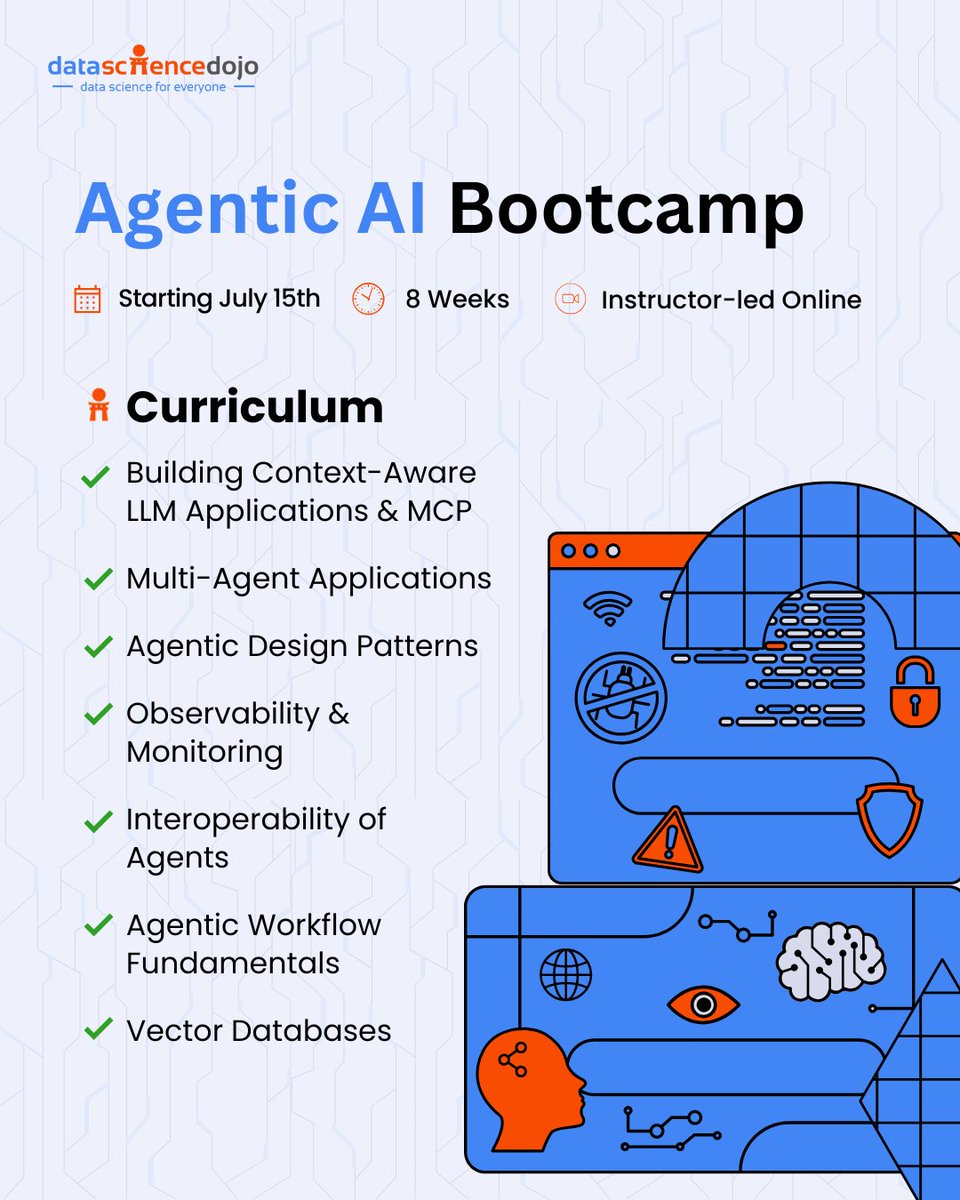
🚀 Ready to build next-gen AI systems?
Join the Agentic AI Bootcamp — starting July 15th!
Master context-aware LLMs, multi-agent workflows, vector databases, observability & more in just 8 weeks. 💡
🔧 Instructor-led, online, hands-on learning
📚 From agentic design patterns to interoperability — it’s all covered.
🔗 Register now: hubs.la/Q03tVHFw0
#AgenticAI #AIbootcamp #LLMapps #MultiAgentSystems #VectorDatabases #AIEngineering #Observability #DataScienceDojo #AITraining #FutureOfAI
1
5
1,639

25 Jun 2025
🧠 Just released: a demo of the OpenAI AI Agent Web UI — showcasing key architectural features for building robust, multi-agent systems.
The demo illustrates:
- Guardrails in action, intercepting messages & shaping AI Agent behaviour
- Smooth transitions between multiple agents
- Tool usage orchestration across agents
It’s a compelling example of what’s possible with next-gen AI interfaces — modular, extensible, and grounded in real-world application design.
🛠️ Available now on GitHub. Setup is straightforward — just clone the repo and add your OpenAI API key to get started.
#AIagents #OpenAI #DevTools #MultiAgentSystems #LLMapps #AIAgents #GenerativeAI
4
290