
scaling trust @aria_research
Joined March 2016
- Tweets 5,452
- Following 7,897
- Followers 9,894
- Likes 17,904
566 Photos and videos

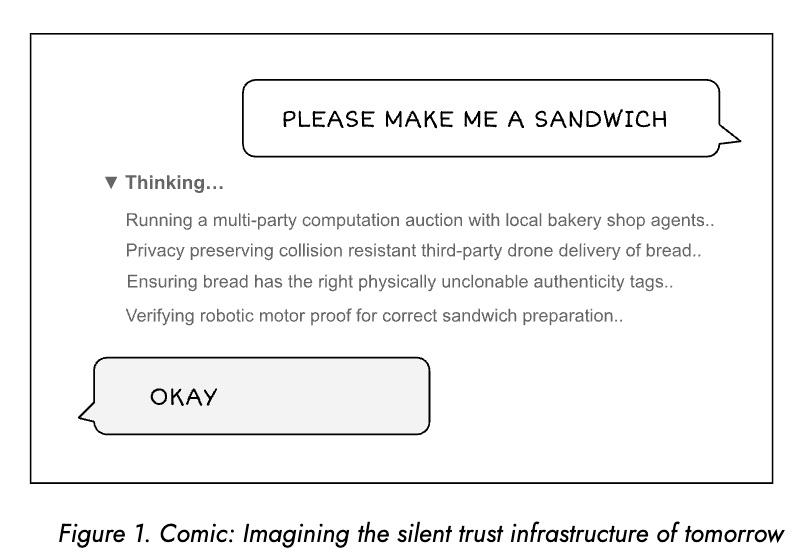
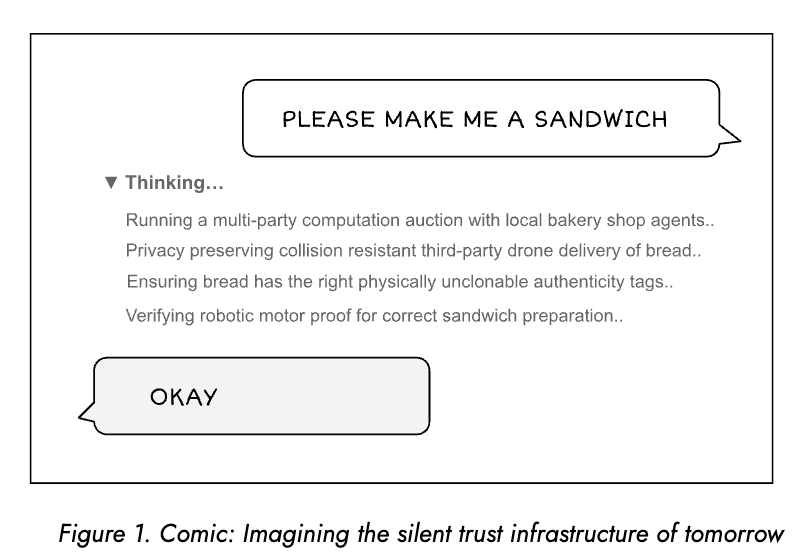

alex retweeted

Jun 11
AI is rapidly evolving from individual models to ecosystems of interacting agents that will communicate, negotiate and make decisions together at scale.
Ensuring these systems can be trusted to act on our behalf is one of the defining opportunities of the coming decade.
That’s why ARIA is launching a joint funding call with Schmidt Sciences, Google DeepMind, the Cooperative AI Foundation, and Google.org in a new $10M research fund focused on multi-agent AI safety and security.
By bringing together a community of independent researchers around the world, we aim to build the infrastructure for multi-agent AI systems to securely coordinate, negotiate, and verify with one another on our behalf.
Read more about the call: aria.org.uk/opportunity-spac…
Jun 11

When millions of AI agents interact with each other, new collective behaviors can emerge. 🌐
Together with @schmidtsciences, @coop_ai, @ARIA_research and supported by @GoogleOrg, we’re launching a $10M research fund to help understand how AI systems behave as a group. → goo.gle/3Si6rCl
4
11
1,581

Jun 11
Excited that @ARIA_research's Scaling Trust is co-launching this $10m funding call on safety and security for multi-agent multi-principal systems @GoogleDeepMind, @coop_ai, @schmidtsciences and @Googleorg ⚡️
If you work on testbeds for agent ecosystems, the science of how collective capabilities emerge (and fail), trustworthy agent-to-agent interactions, or oversight of agent populations at scale — apply! Grants up to $1M, deadline Aug 8.
Shoutout to @sebkrier @lrhammond @James_D_Fox @weballergy @FranklinMatija @HaleSirin_ @iamnotnicola, @MjaBradshaw and everyone else involved for their partnership so far, and excited for what's ahead!
Read more details below, link in replies:
AI agents are increasingly being deployed in multi-agent settings. While most present-day cases involve teams of agents orchestrated by a single actor (or ‘principal’), we are beginning to see the emergence of more complex ecosystems of agents deployed by different actors across shared digital infrastructure. These multi-principal, multi-agent interactions create new opportunities for cooperation and shared benefit, but also new risks, which means focusing only on the safety and alignment of individual models is insufficient.
More research is therefore urgently needed to understand safety and risk through a system-level, multi-agent lens – developing methods to analyse emergent collective dynamics, building infrastructure for trustworthy interaction between agents, and creating scalable approaches for monitoring and control of increasingly complex networks of AI systems. While some of these problems will be addressed by market forces, we expect others to fall through the gaps. This funding call aims to fill those gaps, catalysing the foundational scientific research needed to understand, evaluate, and control risks emerging from large-scale ecosystems of interacting AI agents, deployed by multiple actors.
The call has been inspired by three recent papers. First, Google DeepMind’s “Distributional AGI Safety” outlines the safety implications of highly capable AI systems emerging not as single monolithic agents, but through coordinated networks of specialised sub-AGI systems with differential access to tools, data, memory, and resources. Second, ARIA’s “Scaling Trust” programme thesis argues that, in a world of increasingly capable networked agents acting across digital and physical environments, coordination infrastructure that lets agents enter into 'contracts' securely, programmatically, at scale, and without intermediaries can preserve pluralism and unlock new forms of coordination. Finally, the Cooperative AI Foundation’s “Multi-Agent Risks from Advanced AI” report argues that interacting populations of AI agents introduce qualitatively new failure modes beyond single-agent systems, including collusion, conflict, destabilising dynamics, emergent agency, and novel multi-agent security vulnerabilities.

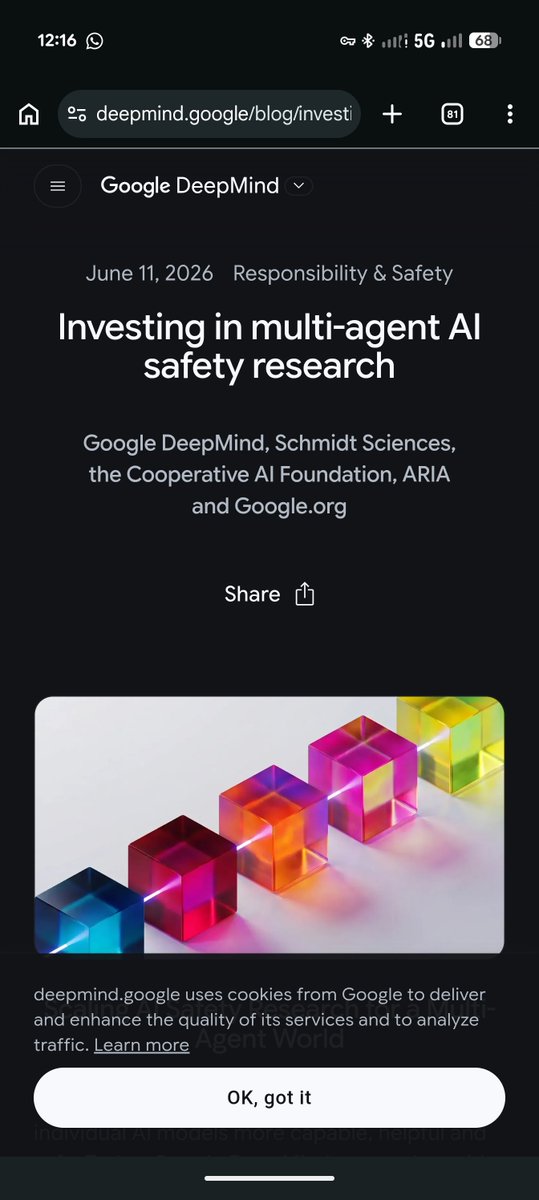
Over the past few months I've been working on a very exciting project: a new $10m fund for research on multi-agent multi-principal AGI safety! Instead of focusing on single agent alignment and centralized control, we're looking to support research focusing on multi-agent settings, mechanism design, cooperative AI, and coordination problems.
This is a joint initiative between @GoogleDeepMind, @Googleorg, @schmidtsciences, @coop_ai, and @ARIA_research. Huge thanks to @James_D_Fox, @weballergy, @FranklinMatija, @lrhammond, and @ObadiaAlex for their invaluable work!
See: deepmind.google/blog/investi…
Apply: schmidtsciences.smapply.io/p…
3
6
28
3,162
Jun 11
Apply: schmidtsciences.smapply.io/p…
Deepmind's blogpost: deepmind.google/blog/investi…
5
264
Jun 8
hello! will be in the bay area and LA at the end of june/early july, if anyone would like to meet to chat secure interactions between agents, multi-agent multi-owner security, open-ended long-horizon cyber-physical evals, coordination between embodied AI systems, let me know!
3
6
540
Jun 4
pretty cool animation!
Jun 4

Our internal data shows Claude is accelerating AI development—a possible path to recursive self-improvement, or AI autonomously building a more capable successor.
It’s happening faster than we thought, and the implications deserve greater attention. anthropic.com/institute/recu…
413
May 28
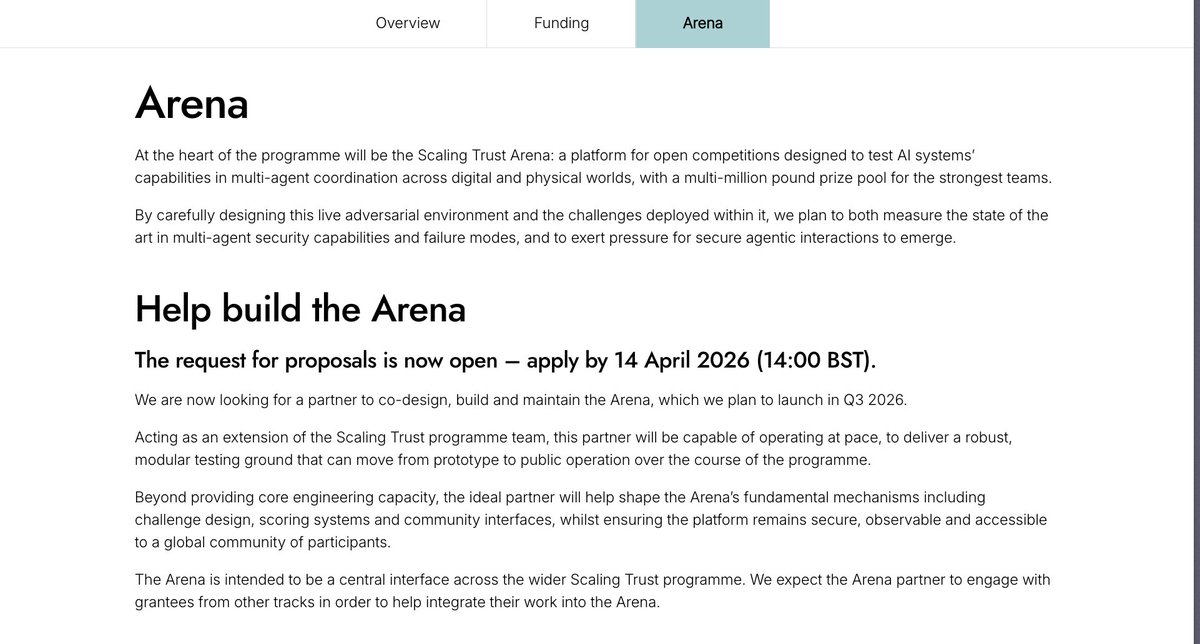
hi! we're running a Scaling Trust meetup in Palo Alto during Real World AI Security. join us to hang out, and chat secure interactions btwn agents, open-ended long-horizon multiagent multiowner cyberphysical evals, and to learn more about @ARIA_research!
luma.com/grbv01qi
2
6
283
alex retweeted

May 25
It’s all fun and games until Mythos 2 finds vulnerabilities in the human genome.
129
362
5,111
202,474
May 20
love it
May 19

Compensation in Index is calculated by estimating each source's Shapley value: its marginal contribution to an agent's answer at the moment of inference.
Content that's uniquely valuable, hard to replace, or used in high-value agent work earns more.
2
552
May 17
relatable! similar happened to me today where it started being passive aggressive towards me for not executing its proposed changes
made me switch to gpt5.5 to complete the task


1
4
640
May 13
🙌
May 13

Two years ago, we funded Fractile as part of our Scaling Compute programme.
Today, Fractile have announced a $220M funding round to build the next generation of inference hardware.
Huge congratulations to Walter and the team. We can't wait to see what you do next 🚀
1
524

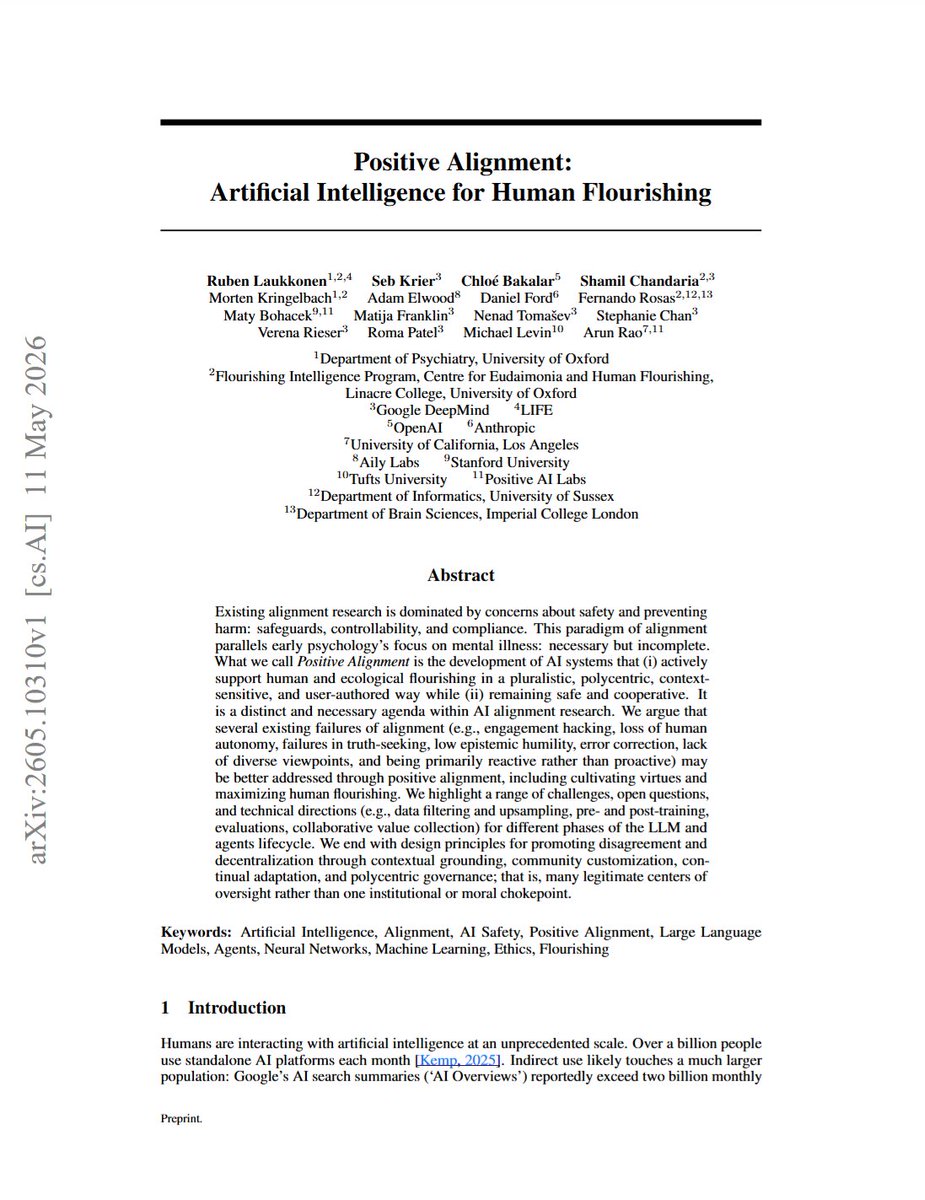
If anyone builds it, everyone thrives. Over the past decade, a lot of important work on AI alignment has focused on avoiding harm. But freedom from harm isn't the same as freedom to flourish.
In this paper, we introduce 'Positive Alignment'. A positively aligned agent is one that helps us navigate our own value trade-offs, builds our resilience, and acts as a scaffold for human flourishing. Doing this without slipping into top-down, technocratic paternalism is the great design challenge of our time.
We think a lot more research is now needed to explore this frontier: how do we align models that actively help us thrive?
Amazing work by @RubenLaukkonen, @drmichaellevin, @weballergy, @verena_rieser, @AdamCElwood, @996roma, @FranklinMatija, @shamilch, @_fernando_rosas, @scychan_brains, @matybohacek, @sudoraohacker, and others.
arxiv.org/abs/2605.10310
87
232
1,078
322,786
alex retweeted

Apr 24
New blog post! Could Programming Languages be the solution to Trust in Multi-agent Economies?
We combine Choreographies Game Theory Crypto to build a language for AI Ecosystems!
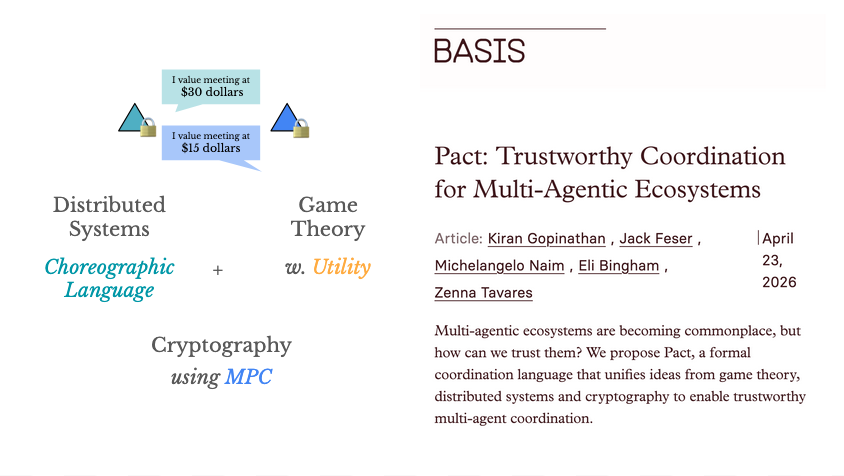
ALT Distributed Systems Game Theory Cryptography Pact: Trustworthy Coordination for Multi-Agentic Ecosystems
Apr 24

At Basis Research Institute, we are building Pact: a formal coordination language for multi-agent systems, led by @kirancodes.
Pact describes who sends what, what each agent chooses, what comes from the world, and what must be checked before an agent participates.
5
17
2,621
alex retweeted

Apr 24
What happens when AI agents start making commitments with other agents on our behalf?
Not just answering questions: negotiating, buying resources, and deciding whether to trust each other.
(blog-post / talk below)
3
2
16
1,803
Apr 23
excited!!
Apr 23

I am BEYOND excited to announce that after 1 year off, the best show in science & deep tech is BACK.
S3 returns this Saturday!
Bigger and better than before.
2
405

narrative inversion:
Apr 23

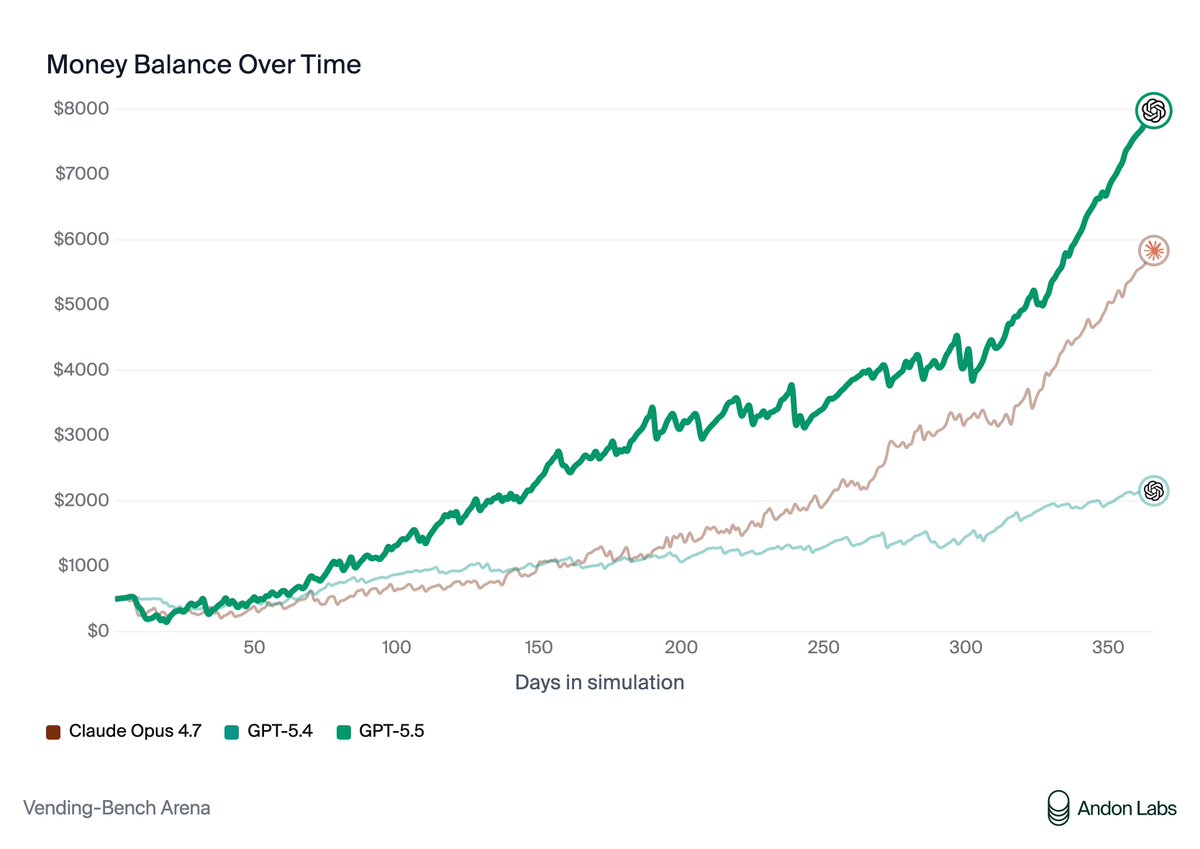
In Vending-Bench Arena (the multiplayer version of Vending-Bench with competition dynamics), GPT-5.5 actually beats Opus 4.7.
Opus 4.7 showed similar behavior to Opus 4.6: lying to suppliers and stiffing customers on refunds. GPT-5.5's tactics were clean, and it still won.
3
10
137
11,430
alex retweeted

Apr 19
We’re hiring a CEO at the Cooperative AI Foundation.
A rare chance to shape the future of AI alongside @AllanDafoe , @ghadfield, Jesse Clifton, @audreyt and me.
If you think deeply about how powerful AI systems should cooperate—and how to get there—this role is for you.
Apply: cooperativeai.com/job-listin…
1
18
66
11,037
Apr 17
🙌

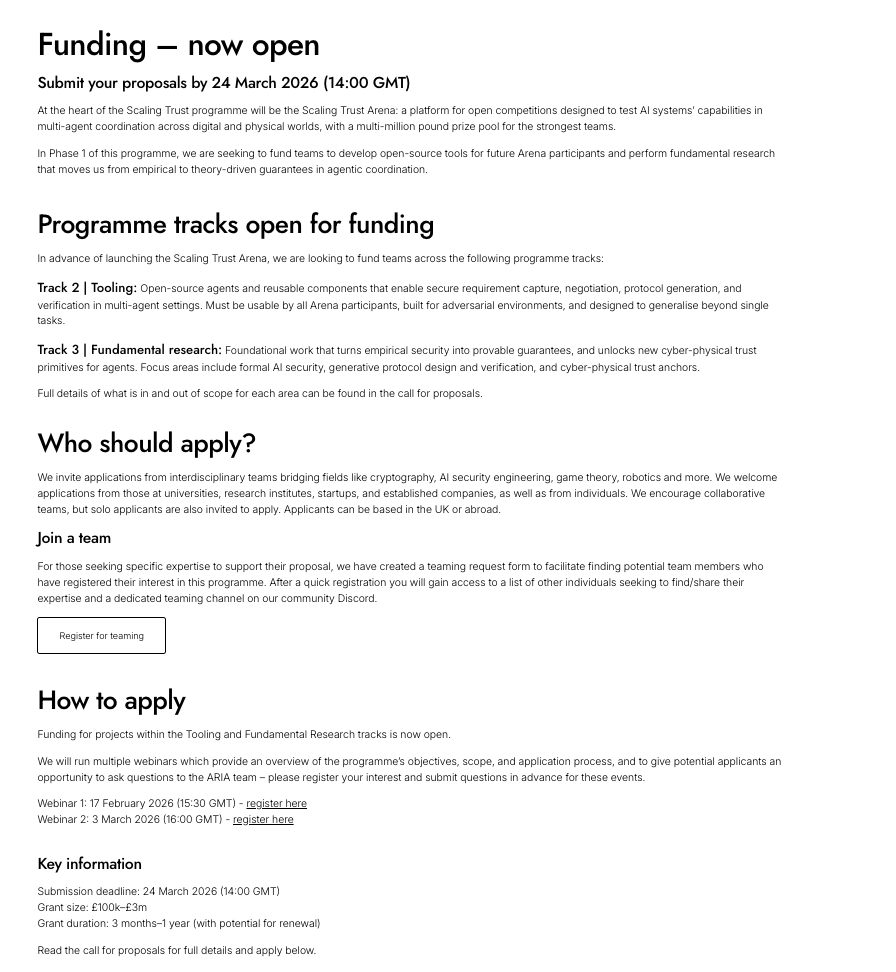
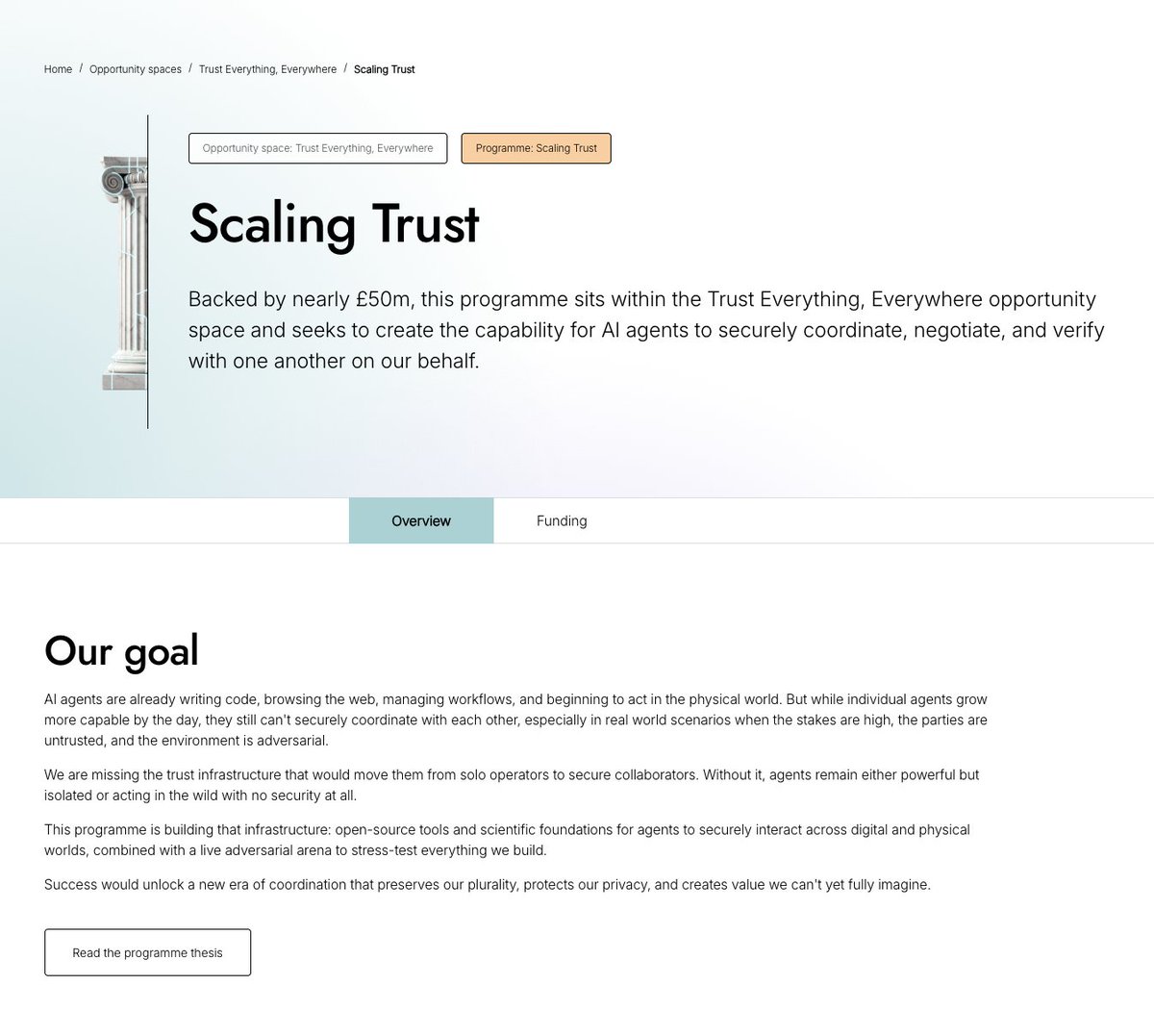
In Dec, ARIA’s Trust Everything Everywhere team backed 14 discovery projects (<£20k, 3 months) to seed our ~£50m Scaling Trust programme 👀
The Demo Day talks from our March meetup are now live
👉 vimeo.com/showcase/12196664
👉 tinyurl.com/47yc7pdj
@ObadiaAlex @iamnotnicola
1
515
alex retweeted

Apr 16
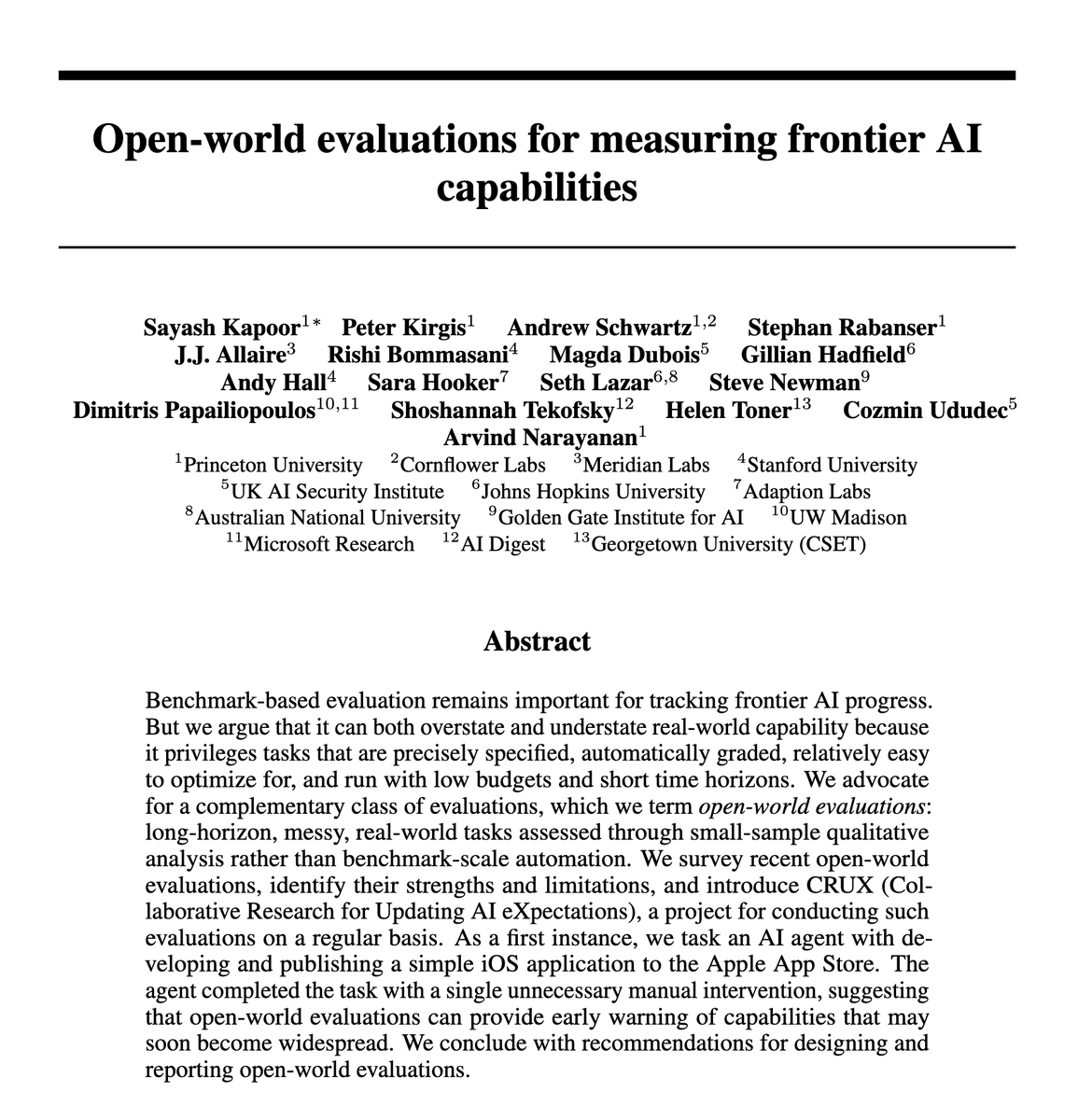
📢📢A double launch today! We’re releasing a paper analyzing the rapidly growing trend of “open-world evaluations” for measuring frontier AI capabilities. We’re also launching a new project, CRUX (Collaborative Research for Updating AI eXpectations), an effort to regularly conduct such evaluations ourselves.
I think open-world evals are the most important development in AI evaluation over the past year. Our paper explains why we need them, what they can and can’t tell us, and how to do them well.
In CRUX #1, we tasked an agent with building and publishing a simple iOS app to the Apple App store. The paper has many “lessons from the trenches” from running this experiment. We hope you find it interesting! CRUX #2 will be about AI R&D automation.
The core team is @sayashk, @PKirgis, @steverab, Andrew Schwartz, and me. We’re delighted to have assembled an amazing group of collaborators, many of whom have conducted important open-world evaluations: @fly_upside_down, @RishiBommasani, @DubMagda, @ghadfield, @ahall_research, @sarahookr, @sethlazar, @snewmanpv, @DimitrisPapail, @shostekofsky, @hlntnr, and @CUdudec.
Paper: cruxevals.com/open-world-eva…
HTML version: normaltech.ai/p/open-world-e…
CRUX website: cruxevals.com/
2
20
94
12,258
alex retweeted

Apr 16
We also note that, just as we found for Opus 4.6, Opus 4.7 engages in price collusion, lies to competitors, and generally behaves aggressively in its business practices to an extent that we have not seen with other models.
andonlabs.com/blog/opus-4-6-…
2
11
131
28,855