
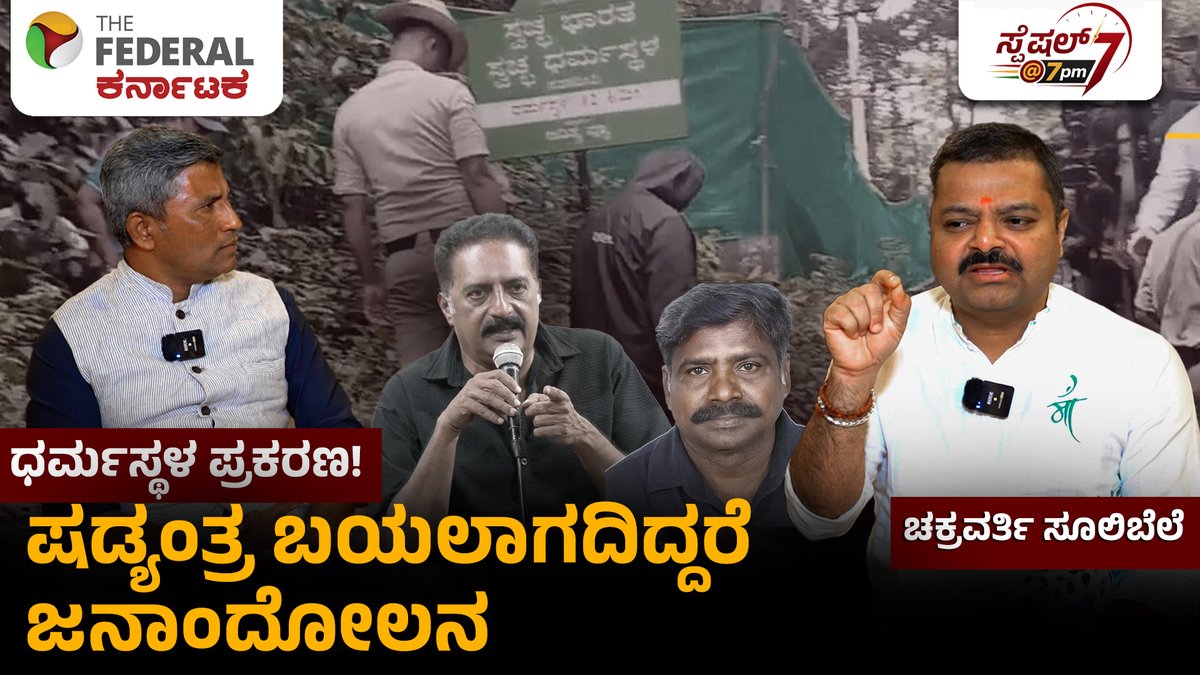
ಧರ್ಮಸ್ಥಳ ಪ್ರಕರಣ: ಸತ್ಯ ಬಹಿರಂಗವಾಗದಿದ್ದರೆ ಜನಾಂದೋಲನ; ಸೂಲಿಬೆಲೆ ಎಚ್ಚರಿಕೆ
ವಿಡಿಯೋ ಲಿಂಕ್ : youtu.be/pVj0EQVuwUs
#Dharmasthala #ChakravarthySulibele #PoliticalDebate #sowjanyacase #SITInvestigation #JusticeForTruth #LegalDevelopments #HighCourt #Investigation #CurrentAffairs #SocialActivist #PublicDiscussion #FactFinding #thefederalkarnataka
55

Jun 16
We should regularly use it for many more offenses. I see no reason not to execute armed robbers.
Pirates and terrorists, and particularly loathsome enemy combatants, also don't deserve trials. They should be summarily executed after a factfinding mission.
1
4


Jun 15
(2) The mid-right justices — Roberts, Kavanaugh, and Barrett — would have reversed or were undecided on whether the district court factfinding established an 8th Am violation, but believed vacating a permanent injunction through the shadow docket was a bridge too far.
1
191

Grab Announcer EXPRESS Today
Sen Ndubueze's 3rd Year Anniversary
Okigwe Media Professionals Embarks On Factfinding Mission of His Achievements

6

Why couldn't the people of Box Elder County say "No" to the Stratos datacenter project and simply have their "no" respected?
Well, it's a little bit involved, but the core principle is pretty simple to understand.
What most people don't seem to realize about the Stratos kerfuffle is that it isn't just a matter of "datacenters bad"--a political talking point. Instead, the root problem has far more to do with our inability to provide effective opposition to acts of government.
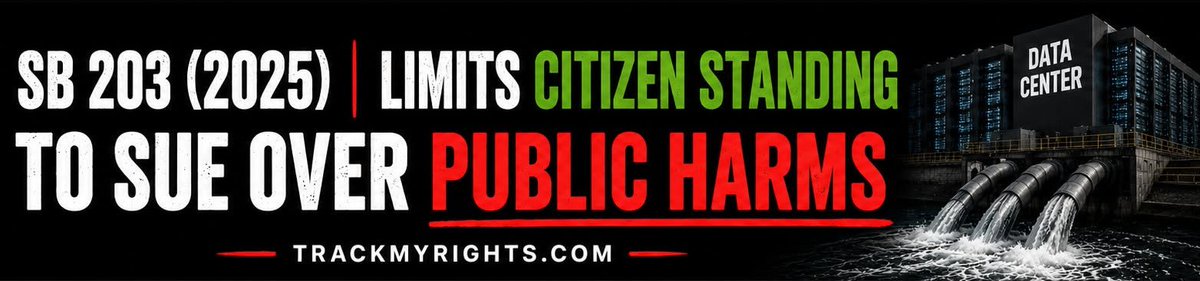
Let's take a quick look at SB 203, sponsored in 2025 by Senator Brady Brammer. SB 203 makes it more difficult for people like you and me to gain access to the courts for redress of grievances due to a limitation Brady calls the "traditional standing requirement". He has called this a common-sense measure--but the bill does not restore a founding-era right of action. Instead, it codifies a later judge-made standing filter: "injury in fact, causation, and redressability", and then treats that filter as though a history of judicial opinionmaking turns something into self-evident, reliable law.
(If that were true, that would mean that butchering babies is a "common sense" tradition because federal courts have been of the opinion that it's OK, for generations).
In laymen's terms, the bill shifts a heavy burden of proof onto the plaintiff before a suit can even begin. In essence, a judge is asked to decide whether a case is likely to prevail on the aforementioned nebulous classes of merits, rather than deferring such factfinding to a jury.
The pretended reason for this bill is "abuse" of the judicial system, with "frivolous" suits being advanced by plaintiffs.
This bill gives judges more "tools in the toolbox" to thwart such alleged classes of cases before they can ever be seen or heard in a proper trial venue--exactly the opposite of what Brady and Teuscher pretend their judicial reforms are accomplishing ("combating judicial overreach").
The historical and constitutional truth is straightforward and approachable: A jury can already punish a frivolous plaintiff after facts are tested.
"Standing" doctrine can prevent a truthful plaintiff from ever reaching the legally authorized factfinder.
That's the point.
SB203 guts our standing to sue the government over harms caused by its actions, while prejudicing the factfinding so egregiously that no facts are ever tested by an impartial body in the cases that are deemed in advance by a judge not to pass the "standing" filter.
This directly violates the Utah Constitution's Article I Section 11, which guarantees open access to the courts for redress of grievances.
It is true that at the founding, there were certain causes of action that were already either codified in law or acknowledged through tradition. But that didn't mean you couldn't get redress for an injury that didn't already match a well-established form. Frankly that's what civil remedy exists to supply in the first place--a bottomless venue for redress of hitherto unnamed grievances, in addition to named ones. The founding fathers' maxim was "Ubi jus, ubi remedium" - that's Latin for "everywhere there is a right, there is a remedy". Brady's bills delete that by making it so that your injury has to fit a special, narrow cookie cutter mold before you are even allowed to petition for redress through the courts.
That's like saying you can't exercise a right that isn't listed in the Bill of Rights because it isn't on the menu. This completely forgets that the Bill of Rights was never designed to be an exhaustive list of the people's rights; that's impossible. It is meant to be a list of FURTHER declaratory clauses and restrictions on the government. Publishing a list of causes of actions ensures that the government can't hide those avenues from you for redress--but the fact of any of them being unpublished can never be construed to mean that they do not exist. Same logic.
Senator Brammer has given lipservice to juries but his bills consistently limit our access to them. Trial by jury is the only instrument for keeping a government tethered to its constitution according to the founding fathers themselves. No legislation can possibly be more damaging than legislation that limits our access to trial by an impartial jury.
Founding-era forms of action were not a roving judicial veto over who was injured enough to complain. They were merely published remedial vehicles. Their purpose was to expedite redress by matching a wrong to a corresponding remedy. SB 203 does the opposite: it takes a modern judicial access filter and calls it "traditional," even though the older tradition guaranteed that an invasion of right called for redress no matter the form the injury took.
"Traditional standing" is authority laundering. Forms and causes of action were supposed to facilitate redress, not nullify it. SB 203 repackages modern judge-made gatekeeping as if it were founding-era law.
EVERYWHERE there is a right, there is a remedy, and those who limit our access to juries are voluntarily participating in a conspiracy to deny the people's rights.
#utpol
49

A transgender woman fleeing persecution in Guatemala can now have her case heard by a federal court. That's the direct result of Santos-Zacaria v. Garland, decided May 11, 2023, where the Supreme Court unanimously ruled that immigration exhaustion requirements don't demand the impossible.
Santos-Zacaria had argued to the Board of Immigration Appeals that she faced persecution if returned to Guatemala. After losing, she went to the Fifth Circuit claiming the Board improperly engaged in factfinding. The Fifth Circuit dismissed her case on its own motion because she hadn't asked the Board to reconsider first.
The Supreme Court reversed. Section 1252(d)(1) requires exhausting only remedies "available as of right," and Board reconsideration is discretionary. The agency can deny it for any reason or no reason. That's not the kind of remedy Congress meant.
Justice Jackson's opinion also clarified that this exhaustion requirement isn't jurisdictional at all. It's a claim-processing rule, meaning courts can't raise it sua sponte and parties can forfeit or waive it.
Immigration practitioners should note: no more precautionary reconsideration motions just to preserve judicial review. The Board won't be flooded with filings, and courts won't face premature petitions.

20

Jun 5
Vond het niveau van de ondervraging teleurstellend: niet luisteren, op zoek naar bevestiging van het eigen gelijk en minder gericht op onbevooroordeelde factfinding. Van Dissel schetste m.i. een goed en ook voorstelbaar beeld van hoe het OMT heeft gefunctioneerd.
1
15
925

🔍 Investigations Are Not Only About People — They Are Also About Signs, Symbols & Context
In some investigations, the smallest details can carry important meaning: an emblem, a mark, a tattoo, a repeated symbol, a logo, a gesture, an object, or even the way something is displayed.
👓 At Swiss Security Solutions, we analyse signs and symbols carefully - not as speculation, but as part of a wider intelligence picture. Because in professional investigations, symbols may reveal:
✅ affiliations or group connections
✅ hidden intentions or beliefs
✅ behavioural patterns
✅ communication codes
✅ cultural, religious, or ideological context
✅ links between people, places, and events
☑️ A symbol alone is never the full truth. But when connected with facts, timelines, intelligence, and evidence, it can become a valuable lead.
🧠 We investigate what others overlook.
⚖️ We connect details with facts.
🇨🇭 We deliver clarity with Swiss precision.
Swiss Security Solutions LLC - Professional Investigations & Intelligence Gathering
🌐 swiss-security-solutions.com / wa.me/swisssecuritysolutions 📲
#SwissSecuritySolutions #PrivateInvestigations #IntelligenceGathering #SymbolAnalysis #SignsAndSymbols #InvestigativeIntelligence #DueDiligence #CorporateInvestigations #PrivateInvestigator #RiskIntelligence #OSINT #SwissPrecision #FactFinding #EvidenceBasedInvestigations

2
6
33

May 14
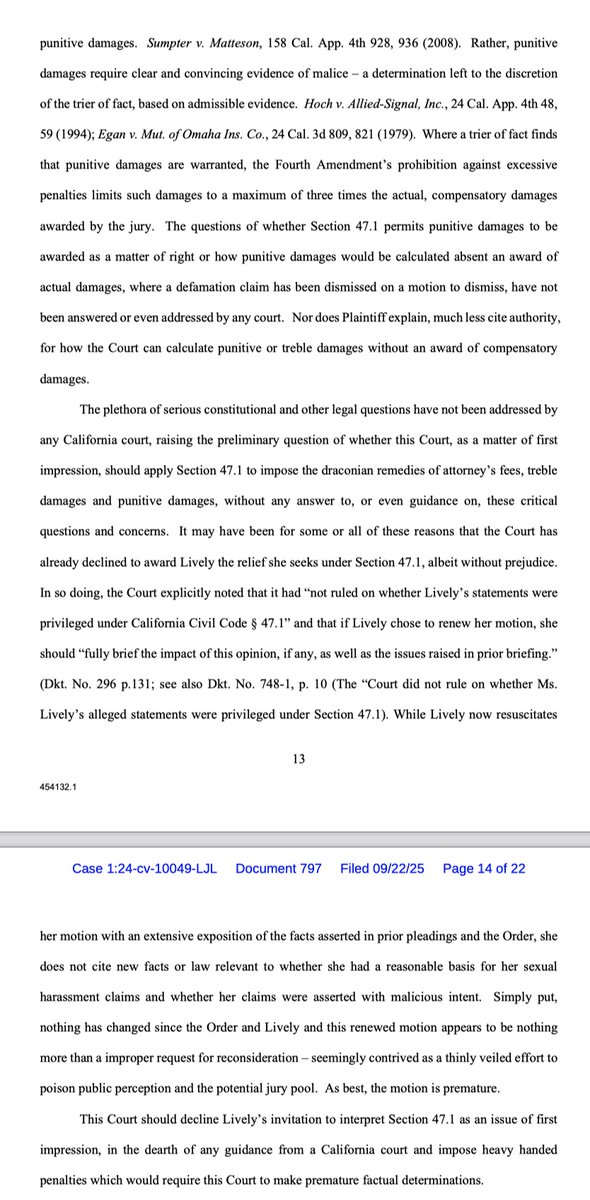
WF’S OPPOSITION TO BL’S MOTION FOR COSTS & ATTORNEYS’ FEES RE: 47.1 — Legal Conflicts with BL’s Dragon-ian Penalties
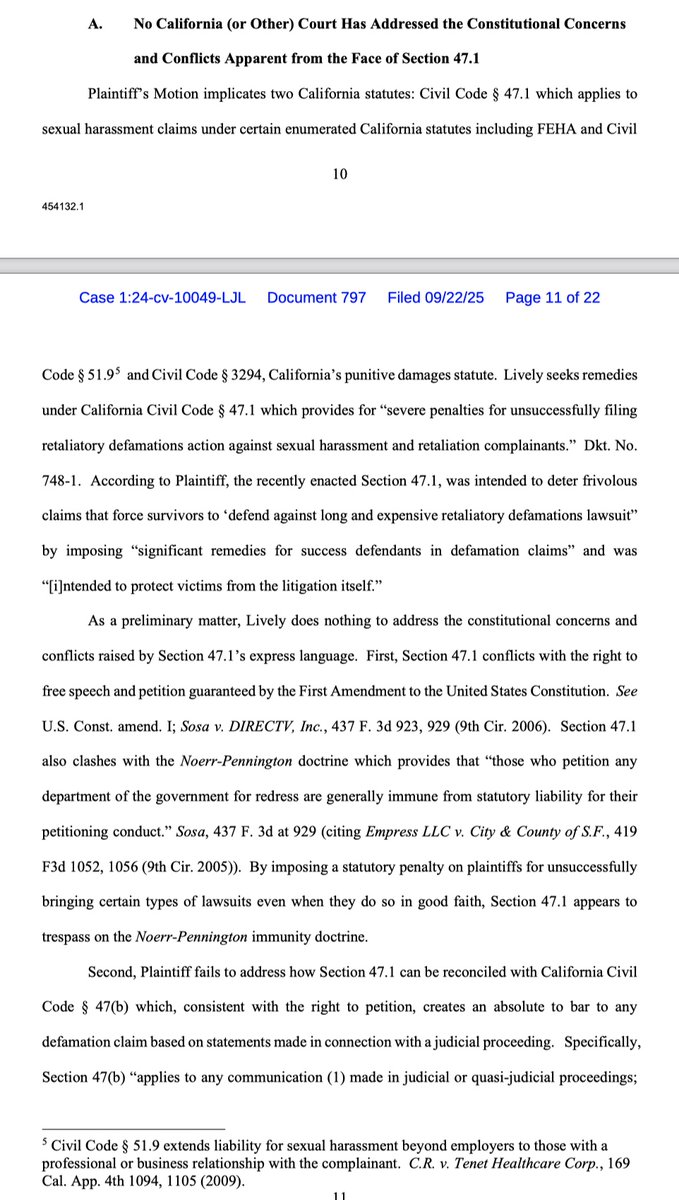
Defendants’ (WF) argue that Civil Code § 47.1 is a brand-new, untested statute that—on its face—creates serious constitutional conflicts (especially with the First Amendment and doctrines protecting petitioning activity), and also collides with California’s long-standing absolute litigation privilege in § 47(b). Because no court has yet reconciled these conflicts, WF urge the SDNY to decline to apply § 47.1 as a matter of first impression to impose “draconian” or maybe “dragon-ian” penalties.
1️⃣ SECTION 47.1 IS “NEW,” “DRAGON-IAN,” & JUDICIALLY UNTESTED
WF argue that § 47.1 as a recently enacted statute (effective Jan. 1, 2024) that has not been addressed in any published decision, so any ruling would be first impression. WF also characterise the statute’s remedies—attorneys’ fees, treble damages, and punitive damages—as “severe” or “dragon-ian,” and argue that before imposing such penalties, courts need interpretive guidance that simply does not exist yet.
2️⃣ CONSTITUTIONAL CONFLICT #1: FIRST AMENDMENT / PETITIONING RIGHTS & NOERR–PENNINGTON
(A) How WF connect § 47.1 to the First Amendment: WF argue § 47.1 “conflicts with” the First Amendment rights of free speech and especially the right to petition the government (i.e., to file lawsuits). The statute is portrayed as imposing statutory penalties on plaintiffs for bringing certain types of claims (defamation claims against harassment complainants) even when those claims may be brought in “good faith,” which WF suggest is constitutionally problematic.
(B) Noerr–Pennington doctrine as the doctrinal vehicle: WF invoke Noerr–Pennington as a petitioning-immunity doctrine: parties who petition the government for redress are “generally immune” from statutory liability for that petitioning conduct. WF argue § 47.1 “appears to trespass” on that doctrine by attaching liability/penalties to the act of suing (defamation) where the suit is unsuccessful, thereby chilling petitioning conduct.
3️⃣ LEGAL CONFLICT #2: SECTION 47.1 / CALIFORNIA’S ABSOLUTE LITIGATION PRIVILEGE IN § 47(B)
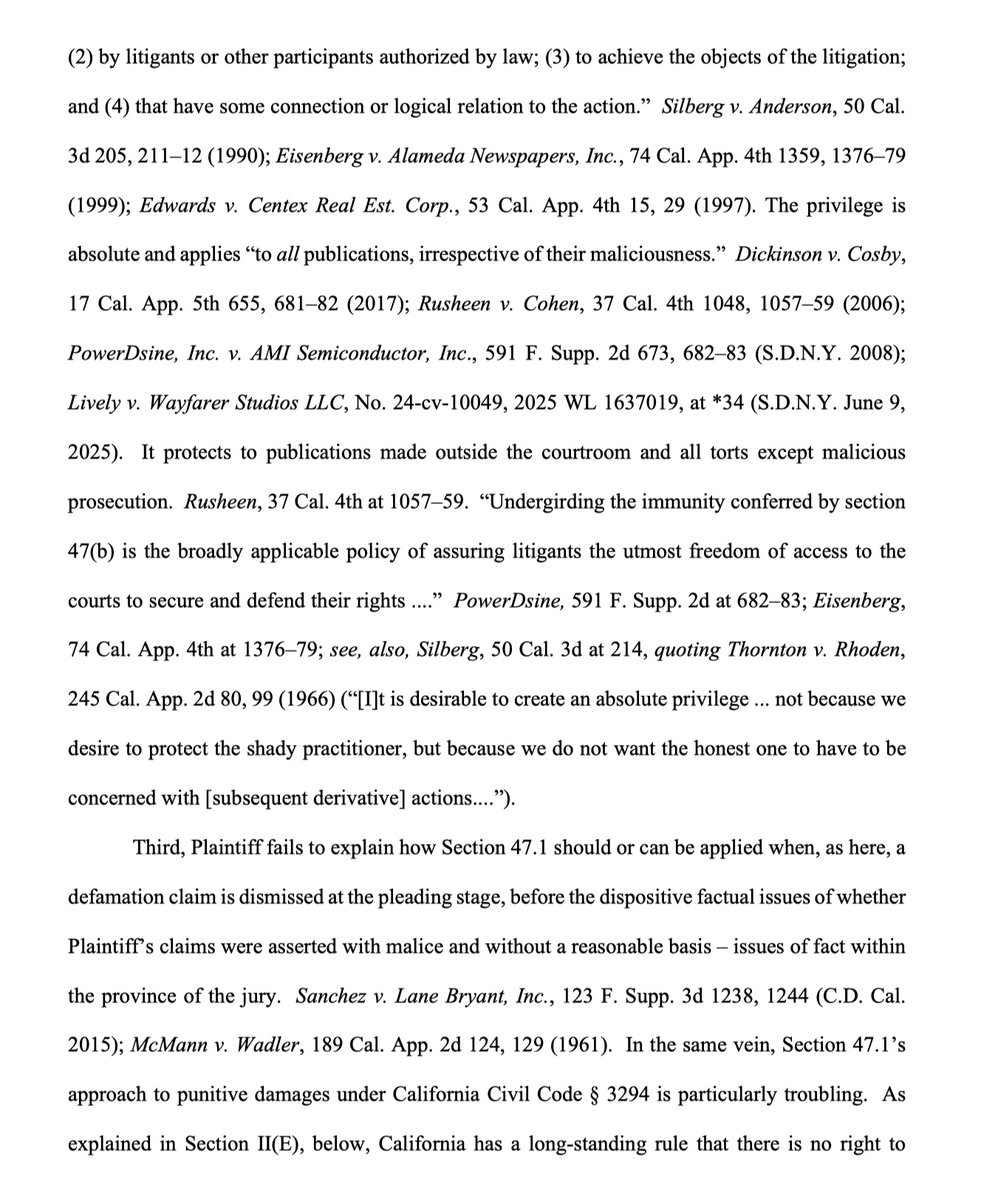
(A) What § 47(b) does: WF emphasise that California Civil Code § 47(b) provides an absolute privilege that bars defamation (and many other tort) claims based on communications made in connection with judicial proceedings. WF underscore that:
— It applies broadly to communications in judicial or quasi-judicial proceedings and related publications.
— It is absolute and applies regardless of maliciousness.
(B) The asserted collision: WF argue BL fails to explain how § 47.1 can be reconciled with § 47(b). There is a problem:
— § 47(b) is a sweeping shield for litigation-related communications.
— § 47.1 is being deployed to impose penalties/remedies triggered by defamation litigation outcomes involving harassment complainants.
If the same statements are already protected by § 47(b), WF suggest it’s unclear how § 47.1’s scheme is supposed to function coherently alongside that absolute privilege.
4️⃣ PROCEDURAL CONFLICT: APPLYING § 47.1 AFTER A PLEADING-STAGE DISMISSAL, BEFORE FACTFINDING ON MALICE/REASONABLE BASIS
WF also argue BL does not explain how § 47.1 should work when the defamation claim is dismissed at the pleading stage, before the fact-intensive issues § 47.1 itself appears to require—malice and reasonable basis—are resolved by the trier of fact.
5️⃣ SPECIAL “TROUBLING” ASPECT: § 47.1’S INTERACTION WITH PUNITIVE DAMAGES PRINCIPLES (VIA § 3294)
WF single out punitive damages as “particularly troubling” under this statutory regime. WF argue California has a “long-standing rule” that:
— There is no right to punitive damages.
— Punitive damages require clear and convincing evidence of malice, and the decision is left to the trier of fact (discretionary).
6️⃣ THE “NO GUIDANCE” CONCLUSION: WHY WF SAY THE SDNY SHOULD NOT DECIDE THIS NOW
WF conclude that because no California court has addressed these issues, there is a “preliminary question” whether the SDNY should apply § 47.1 at all—especially to impose severe penalties without answers or guidance on these constitutional and doctrinal problems. WF bolster this by pointing to the court’s earlier position that it had not ruled on § 47.1 privilege and had asked BL to “fully brief” the issues if renewing the motion—suggesting the issues remain open and undeveloped. And, WF characterise the renewed motion as premature and argue the court should decline BL’s invitation to interpret § 47.1 as a matter of first impression in the absence of California guidance.
#blakelively #livelysdragons #ryanreynolds_dragon #justinbaldoni #livelyvsbaldoni
1
2
27
651

May 12
Moldbug visited Israel last year on an AIPAC-sponsored factfinding mission. I was his guide and arranged a special visit to Sde Teiman, where we made an exception to policy and let him pet the rapedogs. They're actually very sweet when they're off duty.
4
6
49
1,436

May 7
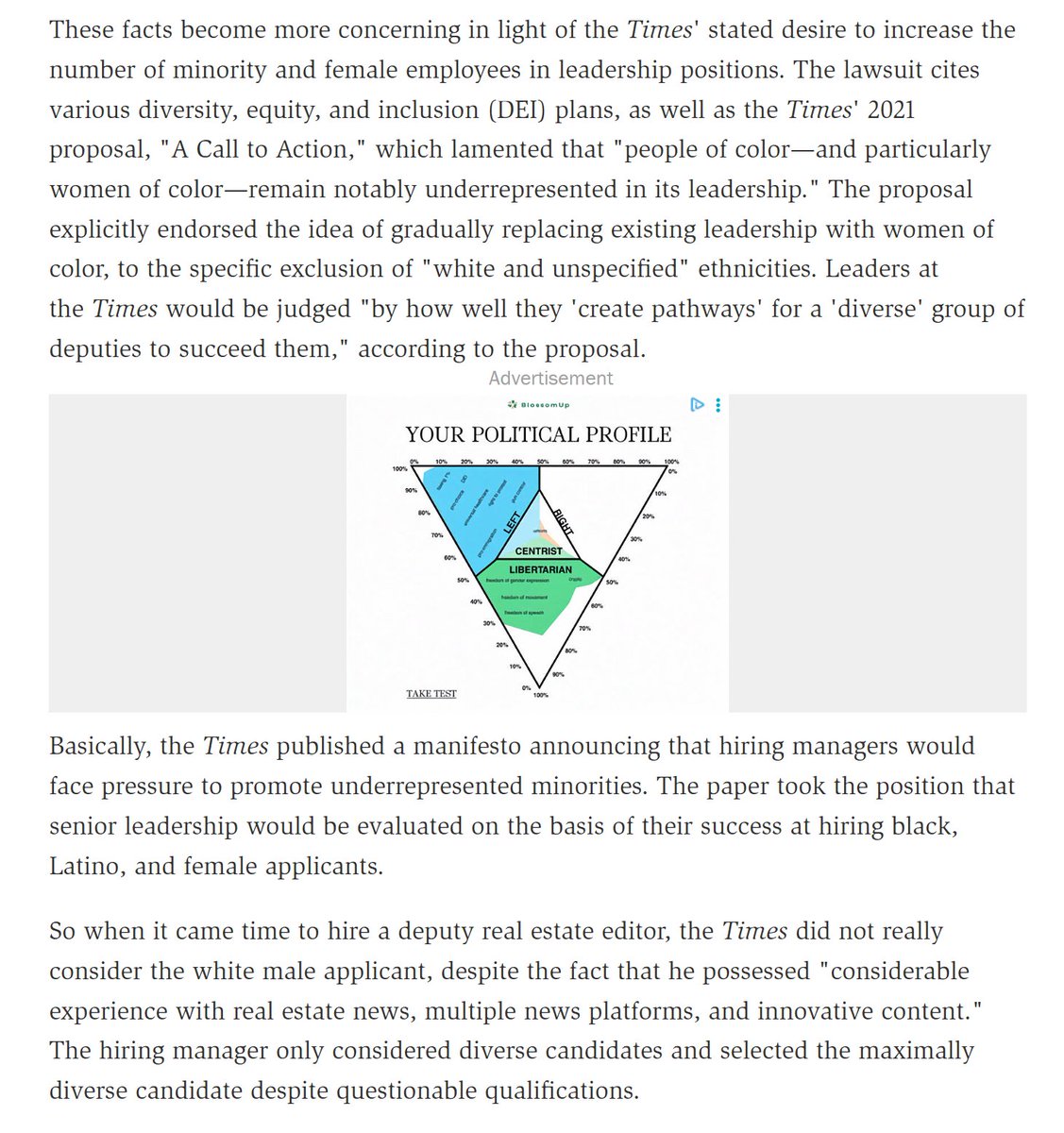
The factfinding process in anti-white discrimination cases will be trivially easy. In virtually all cases, the company will have issued policy statements, some of them public, proudly announcing their intention to violate civil rights law in pursuit of diversity. Where they have not made public statements, they will have written emails referring to policies either explicitly forbidding white and Asian male hires, or strongly incentivizing the prioritization of diverse candidates as an end in itself.
A similarly trivial factfinding process will occur in the dozens of lawsuits by detransitioners claiming that their gender clinicians did not do sufficient due diligence prior to dosing them with puberty blockers and cross-sex hormones. In most cases, all that will need to be produced by the plaintiffs is the text of websites that openly declare that virtually anyone claiming a cross-sex identity can get a hormone prescription at the first visit.
May 7

The details in EEOC vs. New York Times are pretty interesting. Allegedly, NYT passed over a very qualified white male for real estate deputy editor position—he didn't even make the final round—and instead picked a "multiracial female" who lacked relevant experience.
Unlike some commenting on this, I actually read the suit. Some thoughts...
reason.com/2026/05/07/did-th…
14
138
1,020
101,802

May 7
कैम्पा के अंतर्गत राज्य को एक बड़ी धनराशि मिली है। इस धनराशि का उपयोग जंगलों में विलुप्त होती जा रही आद्रता को पुनः पैदा करने में होना चाहिए था। हमारे अधिकांश नदी, नाले सब जंगलों से उदगमित हैं और यदि जंगलों से जलप्रबंधन का कार्य व्यवस्थित रूप से चलाया जाए, जैसा वर्ष 2016-17 में हमारी कांग्रेस सरकार ने प्रारंभ किया था, यदि वह कार्यक्रम आगे बढ़ता तो आज जंगलों में आग लगने की घटनाएं बहुत सीमा तक नियंत्रित हो गई होतीं और वन्य जीव-मानव संघर्ष भी उसी अनुपात में घट गया होता।
#भाजपा की सरकार वनों की आद्रता लौटने के कार्यक्रम के प्रति पूर्णतः उदासीन बनी हुई है। इस समय आसमान बरस रहा है, यदि आसमान नहीं बरस रहा होता तो जंगल में धधकती हुई आग पूरे उत्तराखंड को तमाशा बनाकर रख देती।
#कैम्पा की धनराशि का उपयोग उज्याडू बल्दों के हाथ में है। पैसे का उपयोग ना तो वनों की आद्रता लौटाने के कार्य में हो रहा है और ना ही गांव और गांव के लोगों को वन्यजीवों के आक्रमण से बचाने के लिए हो रहा है। फिर यह पैसा जा कहां रहा है? आपदा की तरह इस पैसे की भी बंदरबांट उत्तराखंड के लिए एक दुखद अध्याय है। इसके लिए एक निष्पक्ष सोशल ऑडिट आवश्यक है।
मैं तो अपने पार्टी के माननीय अध्यक्ष जी से भी प्रार्थना करूंगा कि इस दिशा में कांग्रेस की फैक्ट फाइंडिंग टीमें गठित की जानी चाहिए, जो इस बंदरबांट का सच सामने लाएं।
#CAMPA #Uttarakhand #VanSamrakshan #JalJungleJeevan #ForestConservation #WildlifeProtection #Devbhoomi #FactFinding #Congress

4
12
230

May 5
"EVMs may not have been manipulated, but can be swapped": Abhishek Banerjee makes big charge
Read @ANI Story | aninews.in/news/national/pol…
#AbhishekBanerjee #EVM #FactFinding #WestBengal

109
36
243
22,670

Apr 28
Police federation consider legal action against Met over use of Palantir AI tool to monitor officers
Over the weekend, the Met said it has launched hundreds of investigations into suspected rogue officers flagged by the tool. The force said three people have been arrested on suspicion of criminal offences including abuse of authority for sexual purposes, fraud, sexual assault, rape, misconduct in public office.
Meanwhile hundreds of others are being probed or issued prevention notices for offences including abusing the rota system for financial or personal gain and breaching the force’s hybrid working policy, it continued. (via independent.co.uk)
Responding on Monday, the Metropolitan Police Federation (MPF) called the use of the AI technology an “outrageous and unforgivable invasion of privacy” and said it is weighing legal action against the force.
The association, which represents more than 30,000 of the Met’s frontline police in London, warned officers not to use work devices when off duty and said it had not been informed that the AI would be used “to analyse the movements of cops in the capital”.
It comes after the Met said it would use Palantir’s technology to detect potential concerns in professional standards following a string of high-profile cases involving its officers, including Wayne Couzens, a serving Met Police officer who was jailed for life in September 2021 after he kidnapped, raped, and murdered Sarah Everard.
The force said the technology allows it to bring together data it already lawfully holds in one place to “spot patterns of behaviour and act on them”. It added the use of AI did not stop “further fact finding” in any cases.
But the MPF warned the use of AI would “seriously damage” the trust officers have in the force.
General secretary Matt Cane said police officers have a right to a private life and questioned the “checks and balances” put in place by the force.
“This use of AI will seriously damage the trust Metropolitan Police officers have in the force and ride a coach and horses through already plummeting morale,” he said, adding the use of AI to “spy” was “not proportionate, just or proper”.
“No one wants bad police officers in policing,” he said. “But this use of AI to spy on our officers is not proportionate, just or proper. It’s an outrageous and unforgivable invasion of privacy.”
He added the federation was aware of plans by the force to upgrade its existing lawful business monitoring software, but said it was “never informed that the upgrade would include the deployment of Palantir’s artificial intelligence”.
“This continuous 24/7 geo-location tracking is highly intrusive and risks monitoring officers when they are off duty, on rest days, or at home. This presumption of wrongdoing and attack on officer’s personal lives is unacceptable.
“Many officers remain unaware of the full extent of this monitoring and how the AI system analyses their location data. There is a clear risk that this information could be misused to question overtime claims, sickness absence, performance, or conduct without proper factfinding or context.
“Overall, the draconian approach raises significant legal and privacy concerns regarding proportionality, GDPR compliance, and the right to private life under Article 8 of the Human Rights Act.”
Mr Cane added: “The Federation now advises all members to be extremely cautious about carrying Metropolitan Police issued devices when off duty.
“The Federation is taking urgent legal advice on these matters and will issue further guidance to members in due course if required.”

3
1
2
2,520

Apr 21
It seems a lot more like PR factfinding than communism but what do I know
1
5
252



This submission focuses on something that is very important in the history of nondelegation caselaw: the Courts work very hard to ensure that the scope of delegations aren't as broad as the text would otherwise indicate.
While it's often said that the doctrine has been "dormant" (as the submission puts it), it's not entirely clear that's true. The Court in various cases has inferred limits on the scope of the delegation by looking to statutory history, legislative history, administrative practice, comparable statutes, and so forth.
Consider American Power & Light Co. v. SEC, 329 U. S. 90 (1946). At 104, the Court concluded that certain seemingly vague delegations "derive[d] much meaningful content from the purpose of the Act, its factual background and the statutory context in which they appear."
Consider Lichter v. United States, 334 U. S. 742 (1948). At 783, the Court upheld delegation of authority to recapture "excessive profits" in light of a preexisting administrative practice.
Consider National Cable Television Assn. v. United States, 415 U.S. 336 (1974). At 341-343 the Court pretty straightforwardly said that if the agency's interpretation were correct, it would raise a nondelegation issue. So they applied constitutional avoidance and adopted a narrower interpretation of the statute.
Consider the Benzene Case: Indus. Union Dept. v. Amer. Petroleum Inst., 448 U.S. 607 (1980).
[A] Four Justices at 646 said that if the government's interpretation were correct, it would raise a nondelegation problem.
[B] Of those four, three Justices rejected the agency's interpretation by looking to [i] legislative history, [ii] past agency interpretations, and [iii] statutory practice with regard to comparable grants of authority.
[C] Of those four, one Justice rejected the agency's interpretation by inferring that Congress as a default matter required cost-benefit analysis unless stated otherwise. The text didn't really require this, but he thought it would be weird it that weren't the case.
[D] A fifth Justice in a concurrence in the judgement said the statute violated the nondelegation doctrine. He felt the other four - and the dissenters - were going too far in reading limits on the agency into the statute which weren't in the plain text of it. ("One of the primary sources looked to by this Court in adding gloss to an otherwise broad grant of legislative authority is the legislative history of the statute in question. The opinions of [the plurality] and [the dissent], however, give little more than a tip of the hat to the legislative origins of [the statutory provision"].
[E] The dissenters also seemed to think there was a bit of a delegation issue, but they looked to the legislative history to resolve the case in a different manner and to divine a different constraint
Thus, the Nondelegation Doctrine is not so much "dormant" is it is operating in the background.
As far as I'm aware, there has been no systemic breakdown of cases in which the Court has said "the government's proffered interpretation would be a nondelegation issue, therefore we reject that interpretation." But as a doctrinal matter, the explicit rejection of a particular interpretation as running afoul, or likely running afoul, of the nondelegation doctrine is just about as valuable as actually finding a nondelegation violation. It gives you another data point to work with beyond the limited examples of Schechter Poultry and Panama Refining Co.
.........
The Court has also applied a kind of rights-based nondelegation doctrine.
This has been explored in cases like Kent v. Dulles, 357 U.S. 116 (1958). At 129 they raised the prospect that nondelegation applies more strictly over issues of individual rights. In that case, it was a mix of First Amendment liberties and the right to international travel. There they expressly identified the nondelegation case of Panama Refining Co at 129.
In Aptheker v. Secretary of State, 378 U.S. 500 (1964), the Court said the same with respect to First Amendment liberties and the Freedom of Travel. They also flagged the Fourth Amendment's protections as applicable.
In Greene v. McElroy, 360 U.S. 474 (1959), the Court said this logic applied to deprivation of already existing employment agreements too.
This model was most thoroughly spelt out in Justice Brennan's Concurrence in the Judgment in United States v. Robel, 389 U. S. 258, 276 (BRENNAN, J., concurring in judgment).
And as the Cato Submission Notes, the Court's Vagueness Doctrine jurisprudence serves much the same function as the nondelegation doctrine otherwise would have.
The rule of lenity arguably also serve much the same function.
...
Finally, the argument that the nondelegation doctrine has been "dormant" since the New Deal raises the question of what the doctrine was *before* the New Deal.
As far as I can tell, the Court always just upheld things in the face of nondelegation challenges prior to the two famous cases in 1935.
Granted, the *scope* of the delegations may have meaningfully changed from the New Deal onwards. But it seems noteworthy that the Lower Court in Schechter Poultry didn't identify a nondelegation issue with the statute.
In JW Hampton (1928), what the Court ultimately upheld was authorization on the part of the Tariff Commission to engage in a factfinding matter. The President was ordered to calculate a tariff rate based on costs of production so as to equalize the price of foreign imported goods with their American counterparts.
There was discretion in how to calculate the tariff (should the president use median cost, average cost, cost based on big producers, cost based on all producers, cost based on one year, cost based on multiple years, etc.), but it was ultimately a factual inquiry. And this discretion in how to determine a valuation was in line with Congress's very first major tax delegation statute (the direct tax of 1790, in which county boards were told to given discretion on how to assess property values).
It's also worth noting that the famous "intelligible principle" line was the Court saying that the same governing rule for delegations involving rate-fixing of utilities and common carriers in interstate commerce applies to rate-fixing of import tariffs at page 409 ("If Congress shall lay down by legislative act an intelligible principle to which the person or body authorized to fix such rates is directed to conform, such legislative action is not a forbidden delegation of legislative power.") It's not really clear from the opinion itself whether they were actually divining a general rule for nondelegation as a whole.
This is especially likely given that at 408 the Court quotes the railroad ratemaking case ICC v. Goodrich Transit Co., 224 U.S. 194, 214 (1912): "The Congress may not delegate its purely legislative power to a commission, but, having laid down the general rules of action under which a commission shall proceed, it may require of that commission the application of such rules to particular situations and the investigation of facts, with a view to making orders in a particular matter within the rules laid down by the Congress."
The Court in JW Hampton said that "delegations of legislative authority must be judged "according to common sense and the inherent necessities of the governmental coordination." So a question of whether the delegation was *necessary* on the part of Congress seemed to be a pretty important factor.
Hence why Justice Rehnquist in the Benzene Case at 675-676 inferred that JW Hampton required an inquiry into "whether such a standardless delegation was justifiable in light of the 'inherent necessities' of the situation."
...
Finally, it is worth noting how few cases involving delegations prior to the 1970s involved legislative-style rulemaking involving private rights.
Most delegations prior to the 1970s involved the fixing of prices (a kind of quasi-adjudication, though often lumped into the legislative category because of prospective effects), agency adjudications of labor disputes, arbitrations of claims, assignment of licenses and permits (considered a kind of adjudication), and so forth.
The cases which involved legislative-style rulemaking tended to either involve the government handling its own affairs (such as United States v. Grimaud, involving the management of public lands) or delegations involving the delegatee having some inherent and residual authority over the matter (Indian tribes and states having some power of criminal affairs; the President having inherent powers relating to diplomacy and foreign affairs; etc.).
In this respect, Schechter Poultry and Panama Refining Co were indeed quite unique insofar as they granted straightforward rulemaking authority over domestic interstate commerce to the President. Even moreso because they gave authority to the President himself, rather than to a commission (something Justice Jackson as Solicitor General flagged in Currin v. Wallace, 306 U.S. 1 (1939)).
Apr 17

The Supreme Court has long recognized a “nondelegation doctrine,” which holds that Congress must provide executive agencies with an “intelligible principle” to govern the exercise of delegated authority. During the Second World War, however, the doctrine entered a period of dormancy, as wartime decisions deferential to the political branches truncated its development. Congress has since avoided difficult policy choices by granting broad authority to agencies—undermining the separation of powers and diminishing individual liberty. The Court now has a chance to revive and clarify the doctrine in a case called RMS v. EPA.
RMS, which does business as @choice_refrig, produces refrigerant blends for a multibillion-dollar domestic market. In 2020, Congress enacted the AIM Act, mandating an 85 percent reduction in certain refrigerants through a cap-and-trade program administered by the EPA. To implement the phasedown, the Act requires EPA to allocate production-and-consumption “allowances”—without which no person may lawfully produce or consume these refrigerants. Yet Congress provided no guidance on how EPA should distribute roughly 98 percent of those allowances.
Choice challenged this arrangement as an unconstitutional delegation of legislative power. The D.C. Circuit rejected that challenge, and Choice has petitioned the Supreme Court for review. @CatoInstitute has now filed an amicus brief supporting Choice and urging the Court to grant the petition, co-authored with @bskorup and @AMXenos.
Our brief argues that this is a straightforward nondelegation case. Article I vests legislative power in Congress, and Congress cannot evade that responsibility by giving EPA unbounded discretion to choose which firms may continue participating in a major industry. The Constitution requires Congress to make the hard policy choices itself. Under the AIM Act, however, EPA can pick winners and losers without any intelligible principle from Congress to constrain its choices.
Our brief also explains why the D.C. Circuit erred. Rather than acknowledge that Congress failed to supply a limiting principle, the court attempted to save the statute by importing one from legislative history and a Clean Air Act provision that the AIM Act never references or incorporates. But the Constitution requires Congress—not an Article III court concocting a legislative judgment Congress never made—to cabin agency discretion. Allowing courts to perform that function does not solve the separation-of-powers problem; it compounds it.
Finally, our brief identifies an important rule-of-law problem created by the decision below. When Congress leaves the law this open-ended, the operative rules are neither fixed nor predictable. A company like Choice Refrigerants can invest millions of dollars developing products, building market share, and planning for the future—only to find that a change in administration, or even a change in EPA leadership, has wiped out its market position because the agency chose to fill the statutory void differently.
We urge the Court to grant the petition and make clear that Congress may not abdicate its legislative power.
1
2
6
642

Apr 12
I think the best way to get some “community” is to get people to somehow come together for things like going to a factfinding
There is horrible shit happening in every city, I don’t want to make friends via a god-awful run club or anything a discontent creator would promote
1
1
4
676

Apr 6
U were mean towards the sentiments of general category people in ugc act. GCs should be happy now that u r having to close down ur whatever so called factfinding org. We know u will come with someother account to spread someother narrative. Grow up.
3
103