
thats what i like sm about silvers gameplay
he just has so much niche micro and optimisations
1
1
24

IMO if you are spending more than 4 hr/month on credit cards, spend optimisations and the likes irrespective of the quantum of spend then you are doing disservice to yourself. CC rewards are by product of your earnings and spend. Effort should be made to increase your earnings rather than optimising till last penny.
1
30


3 weeks of using GPT 5.5 I couldn’t find any optimisations for my QWEN 3.6 metal kernels (MLX).
Then Fable found a theory in an old .md doc I had (GPT 5.5 literally called impossible due to the laws of physics).
Fable worked on it and got me 33% (75TPS) in 12 hours of work.
1
118

Llama is lower effort when switching models regularly (gguf has portability as an edge) and compiling specific cuda kernels etc with specific custom personal optimisations to ha dle sparks memory weaknesses easier
24
AI大好き女子🐱ながひら retweeted

Cosmic Cat now covers 21 language options with a translated Steam Store page, optimisations, improvements and a few bugfixes (see link for details). I've also just created a new trailer so I thought I'd share it with you
store.steampowered.com/app/3…
#steamgame #indiegame #skillgame
2
8
62
947
Null Placeholder retweeted

Optimisations complete, awaiting task.

2
5
148

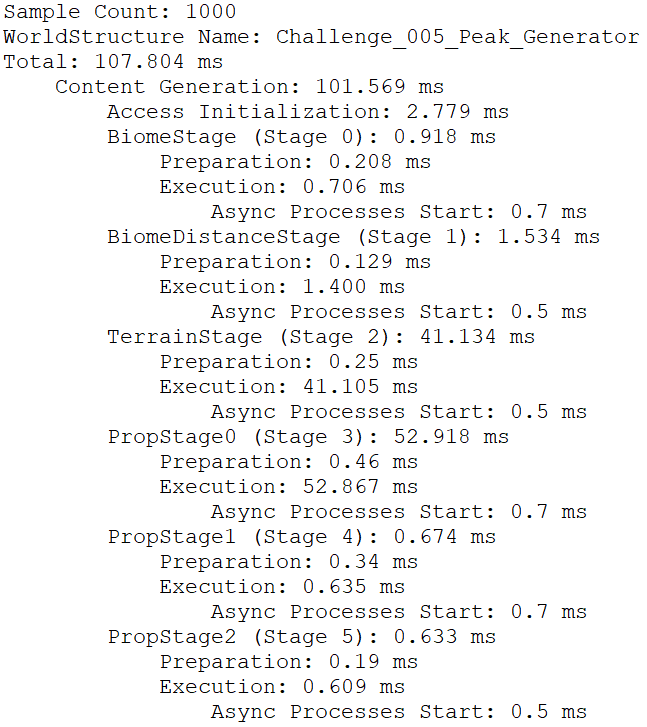
~110ms
performance is quite good, despite using insanely huge prefabs. (default V2 biomes are ~70ms on my system)
I think I could bring it below 90 with some more optimisations.
1
44

MoE, quantification and dozen of others optimisations.
The original ChatGPT (3.5) had 175B active 16bits parameters. OSS-120B with 5B active 4bits parameters outperforms GPT 4...
2
335

The first company I’ve seen that looks structurally capable of solving biological intelligence.
It must be your sworn mandate to solve BOTH:
1) biological design.
2) biological safety.
You cannot choose one.
If you choose only “design,” you build capability you cannot responsibly deploy (or you get blocked from doing so). Either way the growth of your company is retarded.
If you choose only “safety,” your organisation is by its very nature reactive: you wait for frontier models to arrive, built by others, then try to govern them.
Radical Numerics is one of the first companies actually structured around the premise you have to solve both.
I've followed the founder's work since they were at the Arc Institute, and was one of the first to download the Evo 2 weights (40b) from Hugging Face and run it locally. I also had the pleasure of meeting them in SF last month.
My read: this is the highest-density team in generative genomics.
They have the technical authority. They birthed the field. They understand how to model-scaling problem and have done interesting work on solving this for biological model architectures - just take a look at their work on hardware-aware training / low-level NVIDIA-specific optimisations. And crucially, they seem to understand that a biology model capable of writing biology cannot be safely diffused UNLESS safety is built into the core technical agenda.
So the only viable path is: solve design safety TOGETHER.
19h

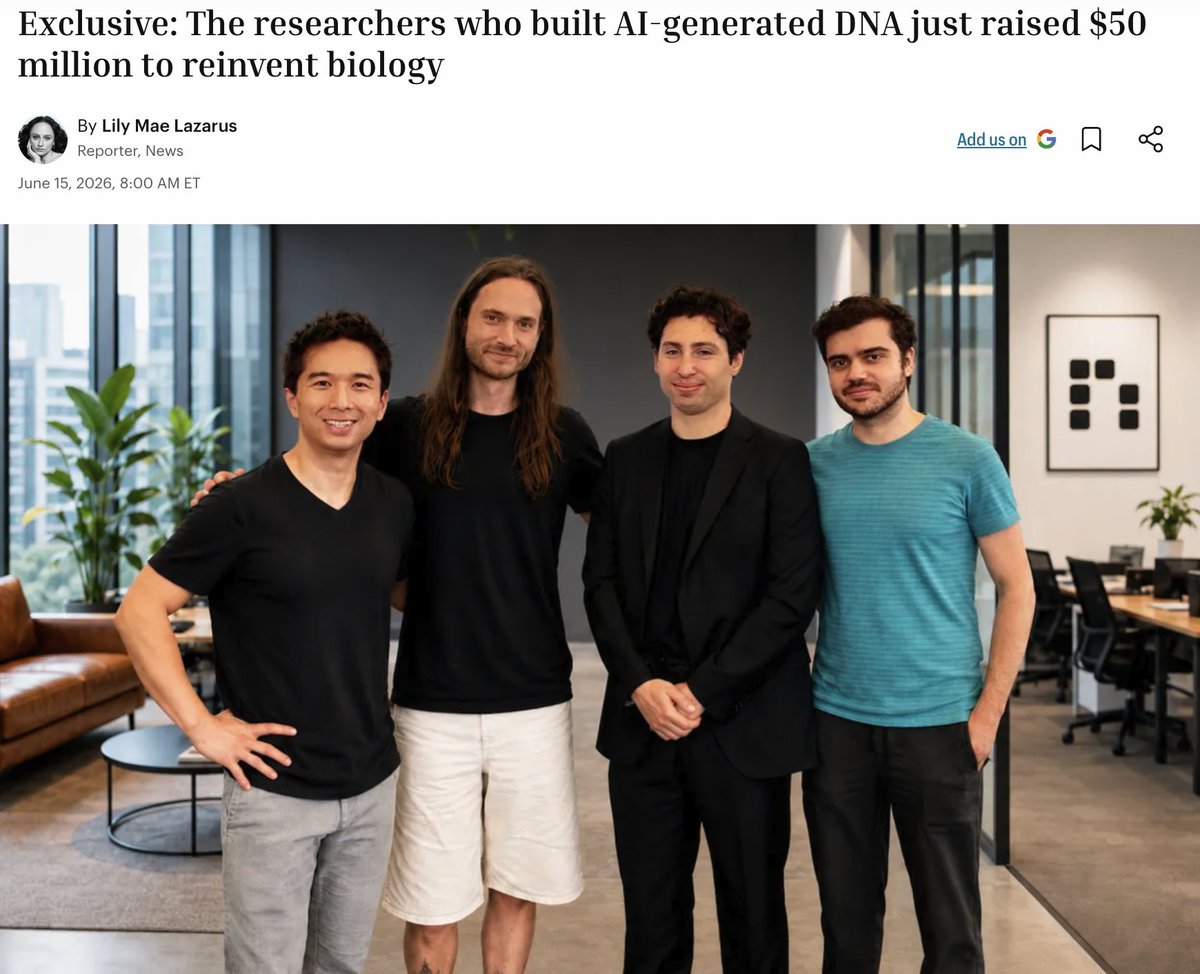
Together with my co-founders Michael @MichaelPoli6, Stefano @Massastrello and Armin @athmsx, I am excited to announce @RadicalNumerics is emerging from stealth with a $50M seed round to build general biological intelligence.
We’re also sharing an early preview of our new model Omnii, the most powerful genome language model to date.
Omnii preview link:
radicalnumerics.ai/blog/radi…
At Radical Numerics, our mission is to master the code of life, and to drive the frontier of biological AI for both design and defense.
This is our dual mandate, which comes from something our own team helped make possible.
Our founding team trained Evo and Evo 2, the largest biological AI models (40B params) trained on DNA sequences. Trillions of tokens across all of life, from microbes to mammals. It’s fully open source, and created the field now known as generative genomics.
Last year, scientists used Evo to generate the world’s first complete genome from scratch using AI. Turns out it was a bacteriophage—a type of virus. It functioned in the real world, and in this case it was harmless. But for us, it was a clear turning point.
It showed that AI is no longer just analyzing biology. It is on the cusp of generating functional lifeforms. Eventually, AI will have the power to design and control life itself.
That should make all of us incredibly excited, and incredibly uneasy. (Anyone can design DNA with a new function, and have it synthesized and delivered, like something from Amazon Prime).
The same technology that will help us cure cancer is the very technology that might create the next global pandemic, or worse, allow the creation of bioweapons that can wipe out populations.
We believe these forces are inseparable. If you work on the frontier of biology, you have to build technology to safeguard it from its misuse. Existing biosecurity tools are sorely losing the arms race, relying on outdated “have I seen this exact thing before?” style algorithms.
We founded Radical Numerics to turn the tide.
And we can’t do that by training on textbooks and natural language. We must understand the language of biology from the raw physical data itself, to reason across every molecule and modality, from DNA to proteins.
The next frontier for AI goes far beyond chatbots or video generators to models that can understand and engineer life.
Today, we’re previewing Omnii, which is already far surpassing Evo 2, and will continue improving as we scale and add new modalities (training now).
1. For human health, Omnii can read and write whole genomes (more on writing later). It’s state of the art (SOTA) on detecting causal variants for disease, and can rank Alzheimer's mutations zero-shot. We’re partnering with a diagnostics company to use Omnii for early cancer detection (pancreatic and multi-cancer).
2. For defense, Omnii is SOTA at detecting AI-generated pathogens. We benchmarked existing detection tools, and they simply can’t detect the AI-generated ones (“deepfake viruses”). We’re partnering with a US national lab to pilot Omnii for detecting the next pandemic, both natural and AI-generated.
We have a data center full of Blackwells in construction now to build the most powerful biological AI models ever. This mission takes a new kind of AI lab that can actually scale on physical, biological data: new alignment research (mid/post training), scaling long context, building out mech interp teams to dissect what these models learn, new architectures and systems designs, all from the ground up.
Our team is made up of AI researchers and scientists from top labs and institutions (e.g. Stanford, MIT, Google DeepMind), but more importantly, we all share the belief that this is the most important challenge of our lifetime. If you feel similarly, we are hiring. We aim to bring the brightest minds in AI and science together to save lives.
Thanks to our partners on this journey, led by Emergence Capital @emergencecap, with Obvious Ventures @obviousvc, Triatomic @TriatomicCap
, and Patrick Collison @patrickc. Our advisors include Eric Horvitz @erichorvitz, CSO of Microsoft, Chris Re @HazyResearch of Stanford, George Church @geochurch of Harvard, and Andrew Weber @AndyWeberNCB, former Assistant Secretary of Defense for Nuclear, Chemical and Biological Defense Programs.
Fortune article: fortune.com/2026/06/15/exclu…
Jobs: radicalnumerics.ai/join-us
1
6
99
14,129


On a regroupé plus de 300 optimisations de conversion dans Margin OS, le document qu'on utilise en interne sur notre boutique.
79€, accès à vie : margin-os.com
1
19


22h
Pourquoi vous faites comme si les Nazis avaient inventé l’eau chaude ?
Tout ce qu’ils ont fait n’est que répétition d’événements qui ont exister bien avant dans l’histoire peut etre avec quelques légères optimisations mdrrrrr
Jun 15

Tantos sociólogos y aun ninguno me explica porque los alemanes no tienen la capacidad de sentir empatia. En ningún otro lugar del mundo se podría haber orquestado el holocausto y de ahí nadie me saca.
65

Token output that can be sustained by 1GW is also commensurately higher now v then. Tokens per joule approx 15x higher at hardware level, even before software optimisations taken into account.
5
2,093

12,000 rpm = 200 rps
That's nothing to flex.
It will hardly handle 100 active users. You'd better be aiming for more than that.
And it's not just about the hardware. I have worked on both. And if your hardware costs are not as high as your developers' salaries, then you are better off focusing on dev productivity.
"Back in the day", hardware cost was the absolute blocker, given that you had to go through many months-long procurement exercises to get the next batch of server machines.
The only way to move fast was to stuff more and more on the available hardware.
Today, it takes tweaking a CFN or bicep file and hitting deploy. (or just do it from the cloud UI if you are uncultured)
You can write all the backend API services in C as well, and it will perform much better after a few iterations of bug fixing and optimisations. But it won't make sense if you have to write a new render engine for 6 months, just to centre a div or to change the colour palette.
React was never meant for backend performance (obviously), and the PHP-rendered frontend was absolutely pathetic.
And if you really need more performance in the backend, what's stopping you from using Golang or Rust?
1
636

5/
Two system optimisations (Lazy Catch-up KV-only Prefill) keep switching overhead under 7% of per-round latency.
1
1
16

Meilleure optimisations des jeux, fini les micro-ralentissements grâce aux shaders Vulkan en cache, et surtout un confort console portable de l’OS que Windows ne pourra jamais égalé même avec Xbox Fullscreen Experience.
Un bon tuto de @Frandroid ici:
frandroid.com/produits-andro…

1
2
575

pip install torchebm📌 v0.6.x is out 🎉
Finally had time to release the new version.
You can star ⭐️ the library on GitHub to support the project if you find it useful and want to follow where it goes 👉 github.com/soran-ghaderi/tor…
Official website: soran-ghaderi.github.io/torc…
📌 The library is now substantially faster on GPU. This cycle went deep into GPU-level optimisations across every single component.
- fewer kernel launches
- more kernel fusions
- removed host-to-device synchronisations
- fewer device allocations
- less redundant linear algebra per step!
- scoped gradient-free regions correctly
📌 The methods coverage also grew a lot; we added:
- a family of explicit and adaptive Runge-Kutta SDE integrators (RK4, Bosh3, Adaptive Heun, Dopri5, Dopri8)
- a set of implicit integrators for stiff dynamics (Backward Euler Maruyama, Generalised Leapfrog)
- a manifold-based sampler that follows a position-dependent metric (Riemannian Manifold HMC)
Additionally, we added unified parameter scheduling and structured diagnostics.
And to keep the performance claims verifiable, we ship a reproducible benchmark suite with an interactive dashboard on a dedicated site: soran-ghaderi.github.io/torc… (all benchmarks on NVIDIA A100-SXM4-80GB).
You can also compare different samplers, integrators (solvers), losses, and their speeds side by side.
📌 If you work on energy-based models, MCMC, or diffusion or flow-based style samplers, this is a good time to get involved. The internals are clean, the benchmark makes the impact of a change visible immediately, and there are open problems here worth a real contribution. Issues are labelled, the integrator and sampler interfaces are documented, and I review PRs quickly.
24 Dec 2025

🚀 Big update for TorchEBM 🍓!
Just pushed v0.5.0 (probably the worst time possible given the holidays, but here we are!).
The main addition is an implementation of Equilibrium Matching (EqM by R. Wang & @du_yilun), which matches velocity/score targets pointing toward equilibrium. It’s a really interesting approach for training unnormalized densities (i.e., EBMs).
If you're a researcher working on generative models and want to collaborate (especially if you have compute!), let's chat. I'm also actively looking for research internships, so if this aligns with your lab's work, I'd love to connect. 🤝
If you're working with EBMs/diffusion/flow models, feel free to take a look and star the repo ⭐️. Feedback is always welcome.
GH: github.com/soran-ghaderi/tor…
Official website: soran-ghaderi.github.io/torc…
I also took the time to refactor the core components to be more modular. I added standard integrators (Heun, Euler-Maruyama, Leapfrog) and interpolants (Linear, Cosine, VP). This should make testing different flow matching setups much easier.
There’s a new `models` subpackage now, too, mostly to house things like a generic Classifier-Free Guidance wrapper and some new samplers (flow sampling, standard gradient descent, and Nesterov-accelerated gradient (NAG)) that I needed for my experiments.
video from EqM website: raywang4.github.io/equilibri…
1
5
519

Ni urgence à ajouter beaucoup d’intermittence d’ici 2038, ni urgence à ralentir ce programme de 14 EPR2.
Les DC consommeront moins unitairement vu les optimisations logicielles.
100 TWh de marge.
Et les VD3 et 4 nuc. (10 TWh) et les 3 GW STEP (10 TWh 2035) aideront.
1
1
34