
Joined April 2024
- Tweets 196
- Following 54
- Followers 19
- Likes 11
193 Photos and videos

Jun 2
1
May 15
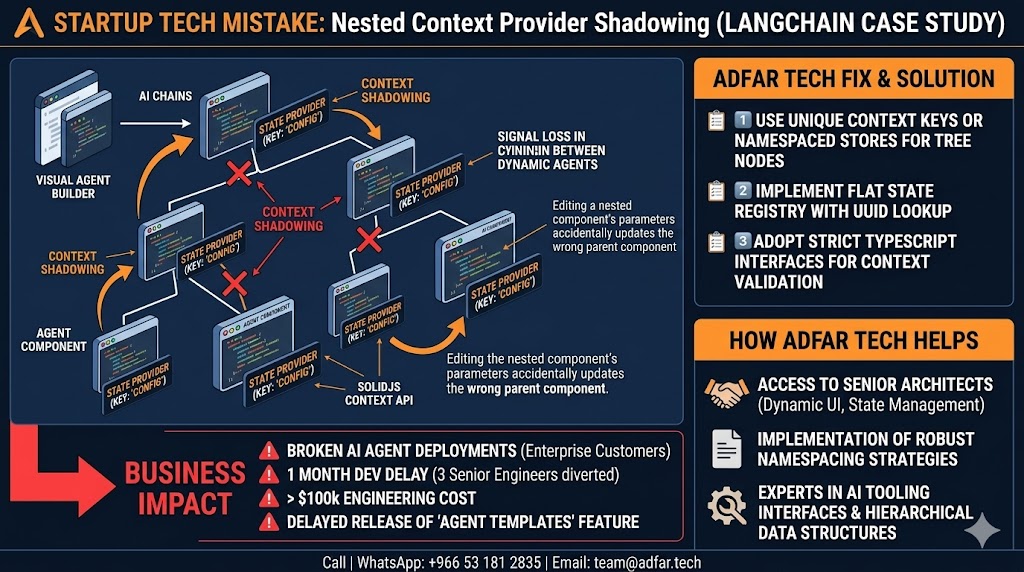
#Startup #Founders: Avoid this AI tech mistake that caused signal loss in LangChain's dynamic agent configurators due to nested provider shadowing.
Tech Mistake: Shadowing context providers in deeply nested dynamic agent trees causing sub-components to subscribe to the wrong reactive state scope.
Story: LangChain story: LangChain's visual agent builders use nested components to represent AI chains. Developers encountered bugs where editing a nested agent's params would randomly update the parent agent instead. This was traced to SolidJS context shadowing where multiple providers with the same key interfered with each other's reactive signals.
Business Impact: The configuration errors led to broken AI agent deployments for enterprise customers. LangChain had to devote three senior engineers for a month to re-architect the state distribution layer costing over $100k and delaying the release of the "agent templates" feature.
ADFAR Tech Fix:
1️⃣ Use unique context keys or namespaced stores for dynamically generated component trees to prevent accidental provider shadowing.
2️⃣ Implement a flat state registry where components look up data by a specific UUID rather than relying on hierarchical context lookups.
3️⃣ Adopt strict TypeScript interfaces for all context providers to ensure that data access patterns are validated at compile time.
How ADFAR Tech Helps:
✅ Access to senior architects specializing in complex dynamic UI generation and state management.
✅ Implementation of robust namespacing strategies for nested reactive applications.
✅ Provision of experts in AI tooling interfaces and hierarchical data structures.
Call | WhatsApp: 966 53 181 2835 | Email: team@adfar.tech
#Startup #Founders #StartupTechMistakes #StartupTechErrors #TechErrors #StartupCTO #CTOMistakes #SolidJS #LangChain #AI #LLM #StateManagement #ContextAPI #JavaScript #WebDev #TechDebt #ArtificialIntelligence #UIEngineering #Scalability #Frontend
1
14
May 15
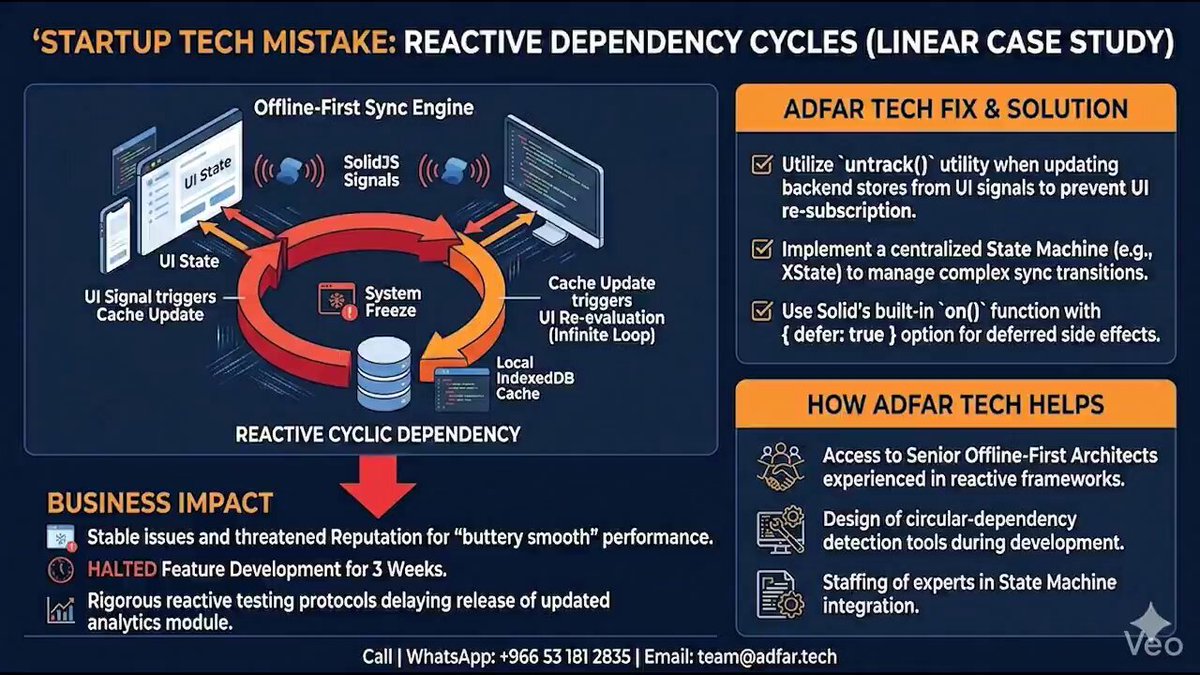
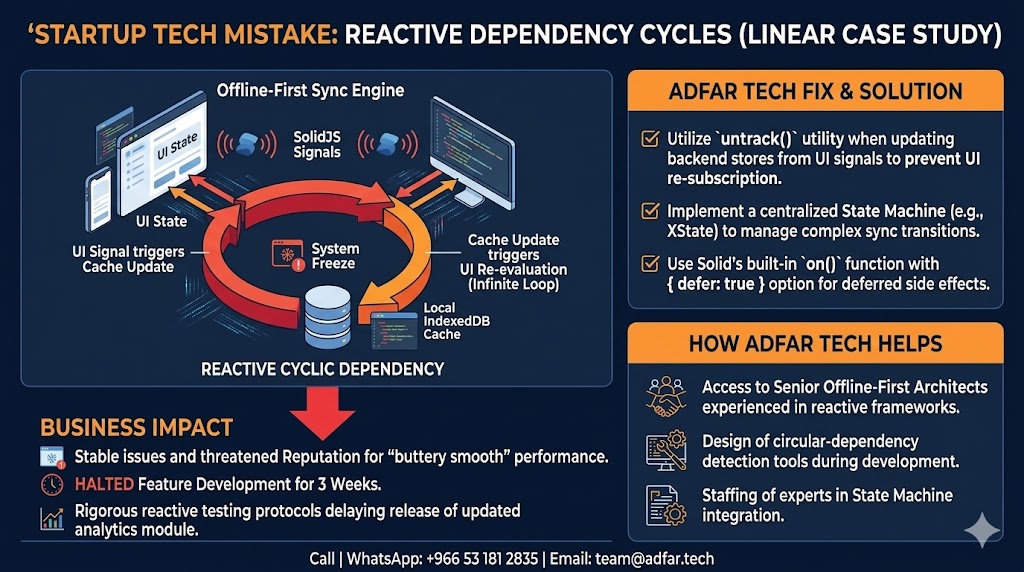
#Startup #Founders: Avoid this sync tech mistake that caused rective dependency cycles in Linear's offline-first architecture leading to UI freezes.
Tech Mistake: Creating mutually dependent signals between the local IndexedDB cache and the UI state without explicit untracked breakpoints in the updater logic.
Story: Linear story: Linear relies on a highly responsive offline-sync engine. During an experiment with SolidJS signals developers accidentally created a loop where a cache update triggered a UI signal which then tried to validate the cache again. This circularity triggered infinite reactive evaluations that froze the browser tab.
Business Impact: The stability issues threatened Linear's reputation for "buttery smooth" performance. The team had to halt feature development for three weeks to implement a strict unidirectional data flow architecture and rigorous reactive testing protocols delaying the release of their updated analytics module.
ADFAR Tech Fix:
1️⃣ Utilize the untrack() utility when updating backend stores from UI signals to prevent the UI from re-subscribing to the subsequent cache confirmation.
2️⃣ Implement a centralized state machine (e.g. XState) to manage complex sync transitions rather than scattered reactive effects across the component tree.
3️⃣ Use solid's built-in on() function with the { defer: true } option to prevent side effects from triggering immediately during the initial render pass.
How ADFAR Tech Helps:
✅ Access to senior architects experienced in building robust offline-first applications with reactive frameworks.
✅ Design of circular-dependency detection tools to identify reactive loops during the development phase.
✅ Staffing of experts in state machine integration to ensure predictable UI transitions and data consistency.
Call | WhatsApp: 966 53 181 2835 | Email: team@adfar.tech
#Startup #Founders #StartupTechMistakes #StartupTechErrors #TechErrors #StartupCTO #CTOMistakes #SolidJS #Linear #OfflineFirst #StateManagement #Performance #JavaScript #WebDev #TechDebt #Synchronization #ReactiveProgramming #UIUX #SoftwareArchitecture #Scalability
1
14
May 13
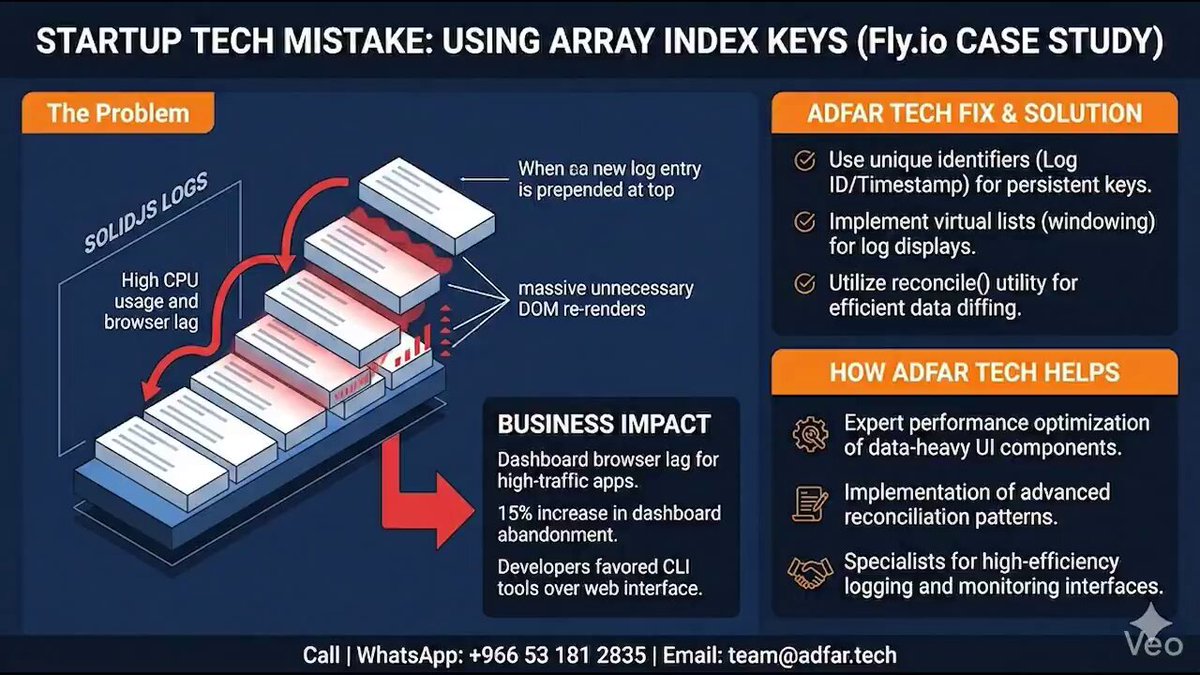
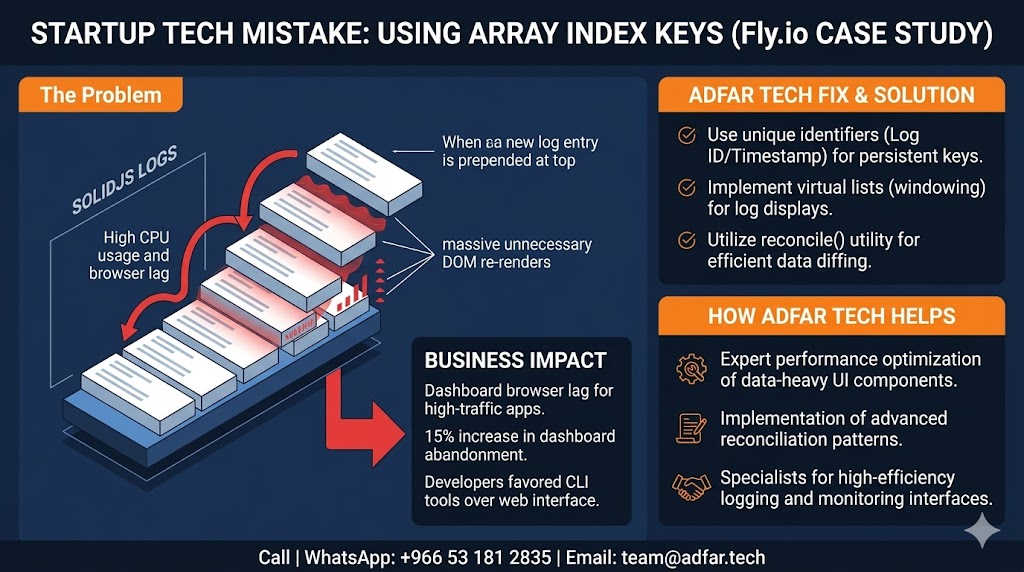
#Startup #Founders: Avoid this infrastructure tech mistake that slowed down Fly.io dashboard logs by misusing SolidJS for-loop reactivity keys.
Tech Mistake: Using array indexes as keys in the component for high-frequency log updates causing massive unnecessary DOM re-renders.
Story: Fly.io story: Fly.io provides real-time log streaming in their UI. An early iteration using SolidJS relied on array indexes for the log list. Since logs are constantly prepended every new log entry forced every previous DOM element to be re-rendered negating the framework's fine-grained updating capabilities and causing high CPU usage.
Business Impact: Users experienced significant browser lag when viewing logs for high-traffic applications. This performance issue led to a 15% increase in dashboard abandonment rates as developers preferred using CLI tools over the web interface for real-time monitoring.
ADFAR Tech Fix:
1️⃣ Always use a unique persistent identifier (e.g. Log ID or timestamp) as the key in the component to enable stable DOM nodes.
2️⃣ Implement windowing or virtual lists for log displays to ensure that only the visible entries are kept in the active reactive graph.
3️⃣ Use the reconcile() utility in solid stores to efficiently diff incoming log batches without re-creating the entire data array.
How ADFAR Tech Helps:
✅ Senior performance engineers to optimize data-heavy UI components for low resource consumption.
✅ Implementation of advanced reconciliation patterns for real-time streaming dashboards.
✅ Provision of experts in building high-efficiency logging and monitoring interfaces.
Call | WhatsApp: 966 53 181 2835 | Email: team@adfar.tech
#Startup #Founders #StartupTechMistakes #StartupTechErrors #TechErrors #StartupCTO #CTOMistakes #SolidJS #FlyIO #Logging #Performance #DOMOptimization #JavaScript #WebDev #TechDebt #ReactiveProgramming #Infrastructure #Scalability #Monitoring #Frontend
1
24
May 12
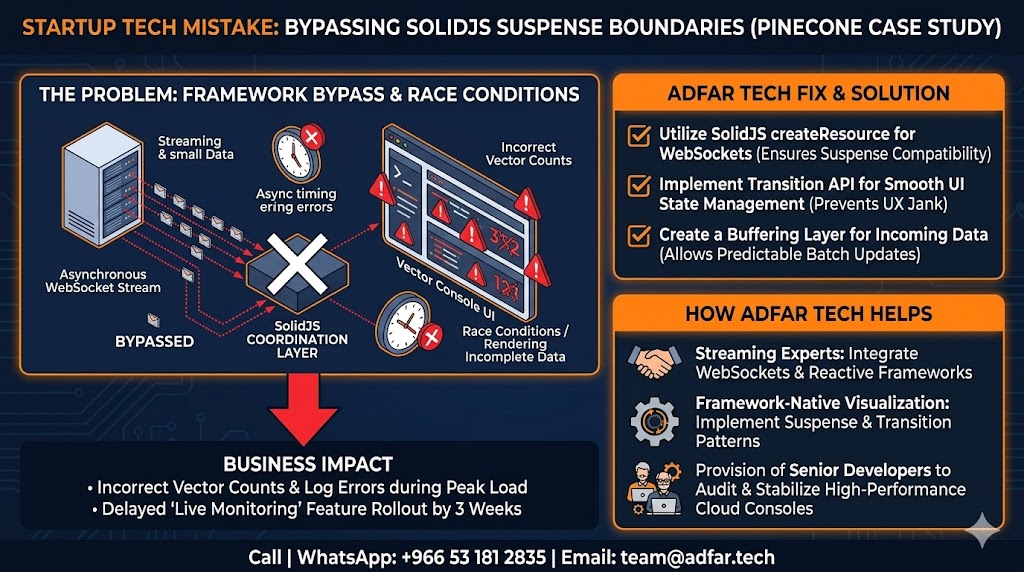
#Startup #Founders: Avoid this streaming tech mistake that broke Pinecone's vector console UI by bypassing SolidJS suspense boundaries.
Tech Mistake: Manually updating the DOM from asynchronous WebSocket streams instead of using the integrated createResource suspense pattern.
Story: Pinecone story: Pinecone's console handles real-time vector upserts. The team attempted to push live updates directly into the UI using vanilla JavaScript callbacks within a SolidJS app. This bypassed the framework's coordination layer causing race conditions where the UI would try to render data that had not yet been properly processed by the reactive store.
Business Impact: The dashboard frequently displayed incorrect vector counts and log errors during peak load. Pinecone had to halt the rollout of their "live monitoring" feature for three weeks to re-implement the streaming logic using framework-native primitives.
ADFAR Tech Fix:
1️⃣ Leverage createResource with a custom fetching function that wraps WebSocket streams into a reactive signal compatible with suspense.
2️⃣ Use the transition API to manage UI state changes during high-volume data streaming to ensure a smooth user experience without jank.
3️⃣ Implement a buffering layer for incoming data to allow the SolidJS reactive graph to process updates in predictable batches rather than individual events.
How ADFAR Tech Helps:
✅ Access to data streaming experts who specialize in integrating WebSockets with reactive frameworks.
✅ Implementation of suspense and transition patterns for seamless real-time data visualization.
✅ Provision of senior developers to audit and stabilize high-performance cloud consoles.
Call | WhatsApp: 966 53 181 2835 | Email: team@adfar.tech
#Startup #Founders #StartupTechMistakes #StartupTechErrors #TechErrors #StartupCTO #CTOMistakes #SolidJS #Pinecone #VectorDatabase #Streaming #Suspense #RealTime #Performance #WebDev #JavaScript #TechDebt #Scalability #CloudComputing #DataEngineering
33
May 12
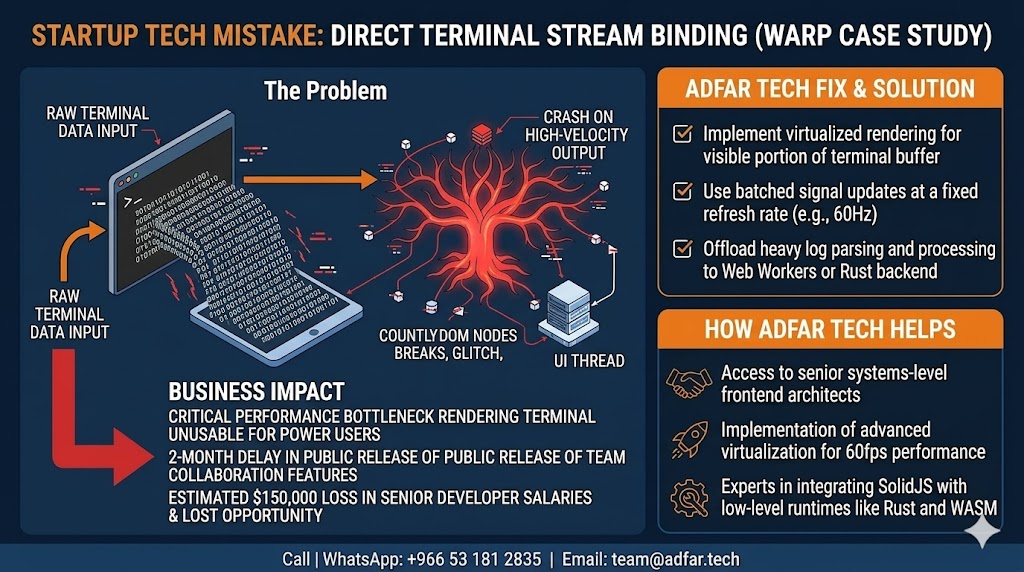
#Startup #Founders: Avoid this terminal tech mistake that forced Warp to re-engineer their GPU-accelerated reactivity to prevent buffer overflows in the terminal feed.
Tech Mistake: Binding raw terminal stream data directly to SolidJS signals without an intermediate virtualization layer causing the reactive graph to crash on high-velocity log outputs.
Story: Warp story: as Warp built their modern terminal using SolidJS and Rust the team encountered severe performance degradation. When running commands with massive log outputs the reactive engine attempted to update thousands of DOM nodes simultaneously blocking the UI thread and rendering the terminal unusable for power users.
Business Impact: The critical performance bottleneck caused a delay in the public release of their team collaboration features. The engineering team had to spend two months developing a custom buffer-pooling system to throttle updates costing an estimated $150,000 in senior developer salaries and lost opportunity.
ADFAR Tech Fix:
1️⃣ Implement a virtualized rendering pipeline that only updates signals for the visible portion of the terminal buffer rather than the entire data stream.
2️⃣ Use batched signal updates at a fixed refresh rate (e.g. 60Hz) to decouple the raw data input frequency from the UI rendering frequency.
3️⃣ Offload the heavy log parsing and ansi color code processing to a Web Worker or the Rust backend to keep the reactive graph lightweight.
How ADFAR Tech Helps:
✅ Access to senior systems-level frontend architects who specialize in high-throughput data visualization.
✅ Implementation of advanced virtualization strategies to maintain 60fps UI performance under extreme loads.
✅ Provision of experts in integrating SolidJS with low-level runtimes like Rust and WASM.
Call | WhatsApp: 966 53 181 2835 | Email: team@adfar.tech
#Startup #Founders #StartupTechMistakes #StartupTechErrors #TechErrors #StartupCTO #CTOMistakes #SolidJS #Warp #Terminal #GPUAcceleration #Rust #Performance #WebDev #JavaScript #TechDebt #Scalability #Virtualization #Frontend #SoftwareEngineering
35
May 11
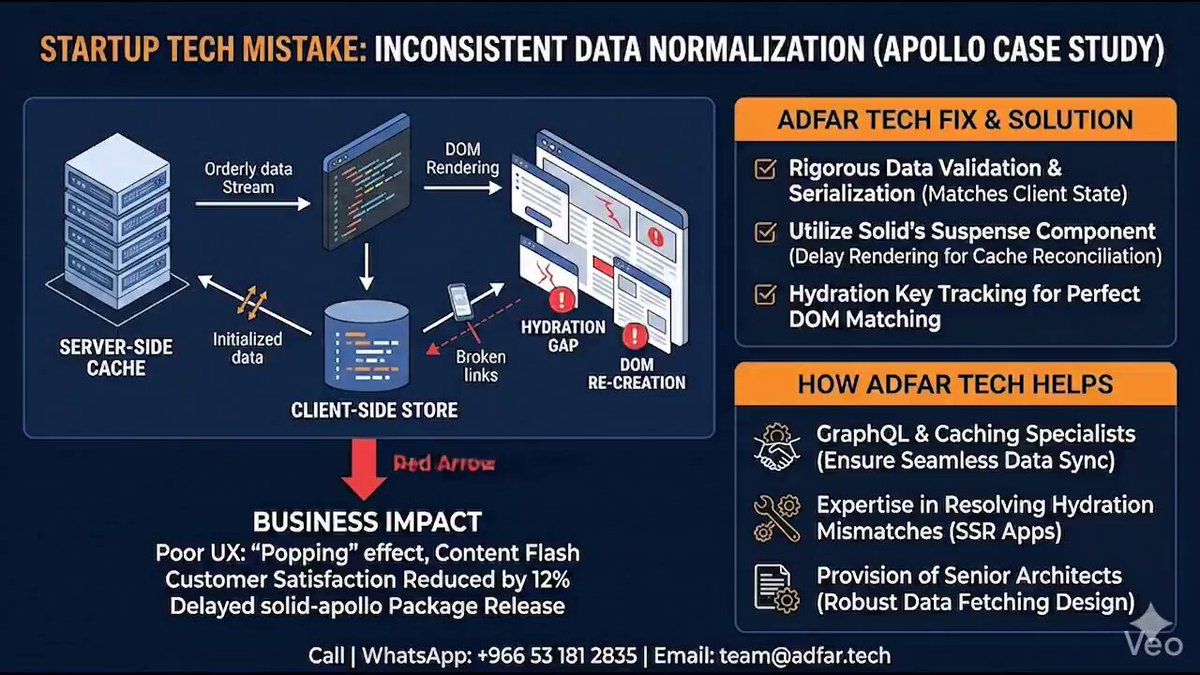
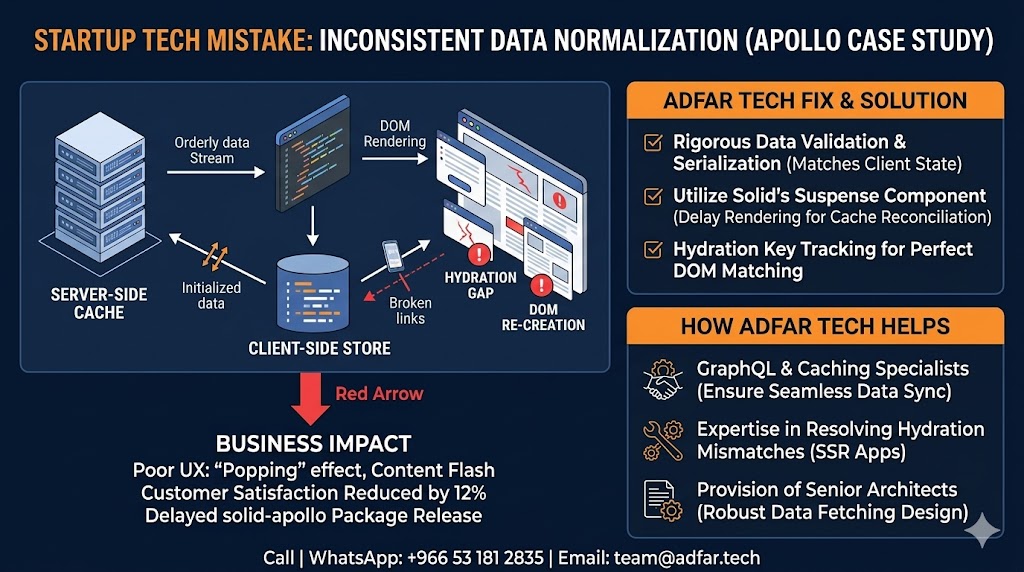
#Startup #Founders: Avoid this data sync tech mistake that caused hydration mismatches in apollo's SolidJS client integration.
Tech Mistake: Inconsistent data normalization between the server-side cache and the client-side store causing SolidJS to overwrite UI elements on load.
Story: Apollo Global story: apollo provides popular GraphQL clients. During the development of the SolidJS integration the team struggled with hydration gaps. The server would render the UI based on one cache state but the client would initialize with a slightly different normalization scheme causing SolidJS to delete and re-create DOM nodes during hydration.
Business Impact: Users experienced a "popping" effect where content would flash or disappear immediately after the page loaded. This poor user experience reduced customer satisfaction scores by 12% and delayed the general availability of the solid-apollo package.
ADFAR Tech Fix:
1️⃣ Ensure the server-side data payload is rigorously validated and serialized into a format that matches the client-side store's expected input exactly.
2️⃣ Use solid's suspense component to delay the rendering of data-dependent UI until the client-side cache has fully reconciled with the server state.
3️⃣ Implement hydration key tracking to ensure that dynamically generated IDs match perfectly between environments preventing DOM re-creation.
How ADFAR Tech Helps:
✅ Access to GraphQL and caching specialists who ensure seamless data sync across the stack.
✅ Expertise in solving complex hydration mismatches in server-side rendered applications.
✅ Provision of senior architects to design robust data fetching layers for modern web apps.
Call | WhatsApp: 966 53 181 2835 | Email: team@adfar.tech
#Startup #Founders #StartupTechMistakes #StartupTechErrors #TechErrors #StartupCTO #CTOMistakes #SolidJS #ApolloGraphQL #Graphql #Hydration #SSR #Performance #WebDev #JavaScript #Caching #TechDebt #DataIntegrity #Scalability #Frontend
31
May 11
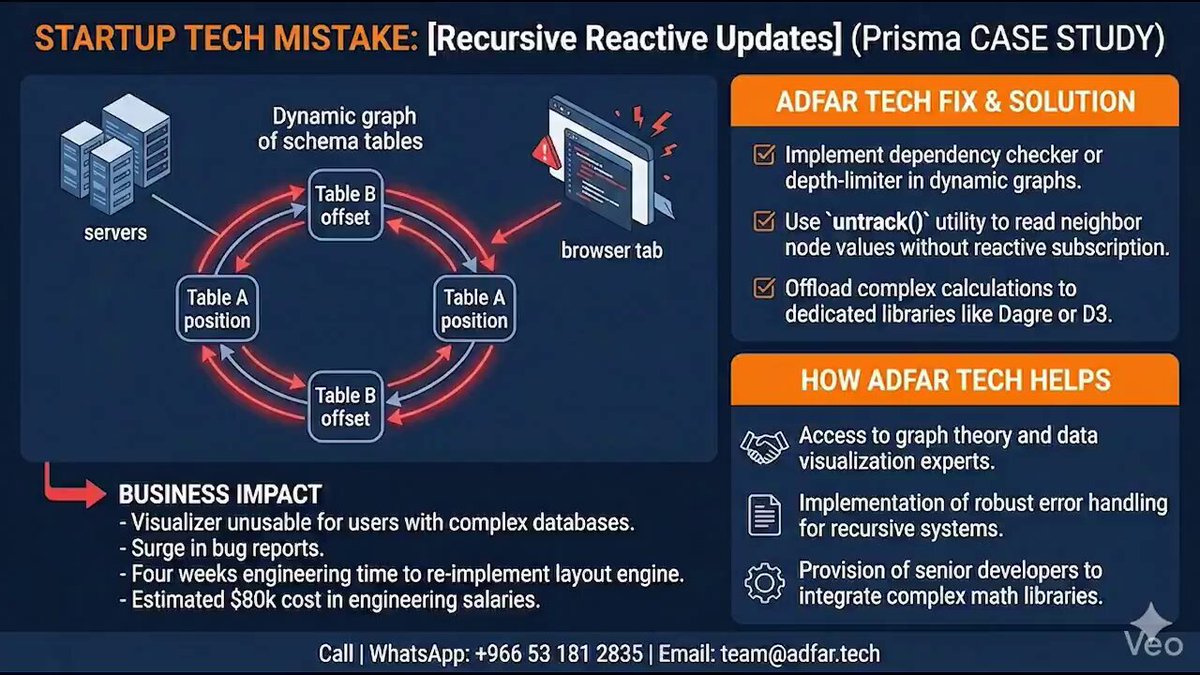
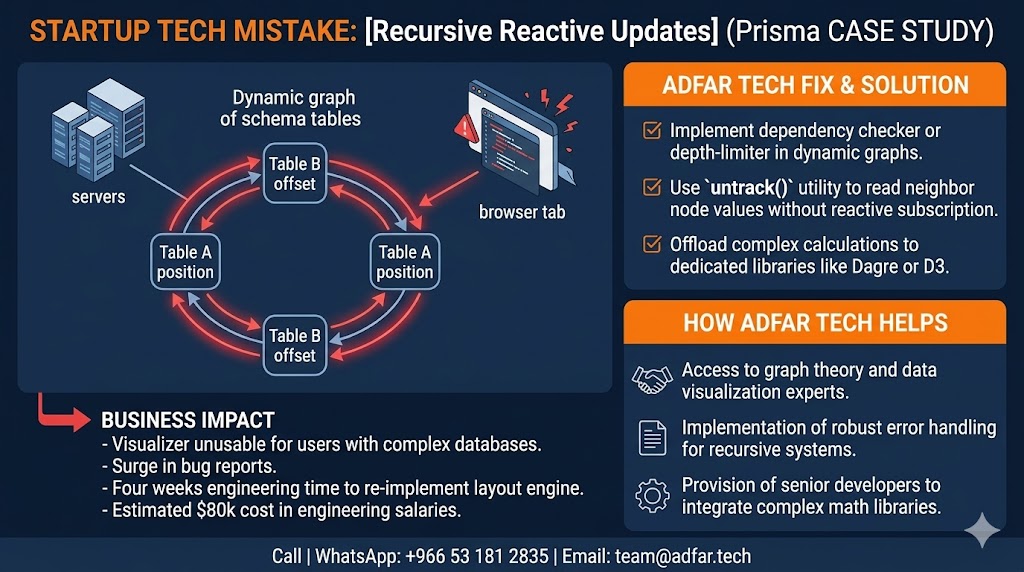
#Startup #Founders: Avoid this graph tech mistake that crashed Prisma's schema visualizer by triggering recursive reactive updates.
Tech Mistake: Creating circular dependencies between signals in a dynamic graph which led to stack overflow errors during initialization.
Story: Prisma story: Prisma's data browser includes visual tools for schema relationships. During a migration to SolidJS the team created a reactive graph where the position of one table signal depended on the offset of another. A circular relationship in the schema triggered an infinite re-calculation loop that crashed the browser tab.
Business Impact: The schema visualizer became unusable for users with complex databases leading to a surge in bug reports. The engineering team had to spend four weeks re-implementing the layout engine with non-reactive solvers to ensure stability costing an estimated $80k in salaries.
ADFAR Tech Fix:
1️⃣ Implement a dependency checker or a depth-limiter when connecting signals in a dynamic graph to detect circular loops at runtime.
2️⃣ Use the untrack() utility to read values from neighboring nodes without creating a reactive subscription that could lead to infinite re-triggering.
3️⃣ Offload complex graph layout calculations to a dedicated library like Dagre or D3 and only use SolidJS for the final rendering layer.
How ADFAR Tech Helps:
✅ Access to graph theory and data visualization experts who build stable dynamic interfaces.
✅ Implementation of robust error handling to prevent recursive loops in reactive systems.
✅ Provision of senior developers to integrate complex math libraries with modern reactive frameworks.
Call | WhatsApp: 966 53 181 2835 | Email: team@adfar.tech
#Startup #Founders #StartupTechMistakes #StartupTechErrors #TechErrors #StartupCTO #CTOMistakes #SolidJS #Prisma #Database #DataViz #Recursion #Graphql #Performance #WebDev #JavaScript #TechDebt #Stability #SoftwareEngineering #Algorithms
9
May 9
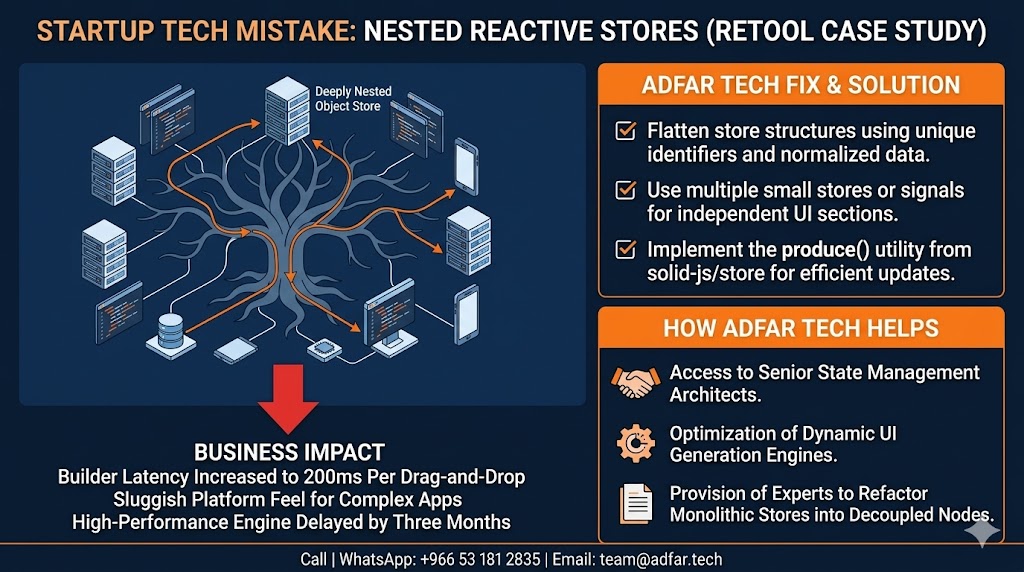
#Startup #Founders: Avoid this dynamic tech mistake that slowed down Retool's internal app builder by improperly nesting reactive stores.
Tech Mistake: Using deeply nested object structures inside a single SolidJS store which created expensive lookup paths during dynamic UI generation.
Story: Retool story: Retool allows users to build dynamic internal tools. Their early prototypes using SolidJS attempted to store the entire app configuration in one nested store. As the app grew every minor property change caused the proxy engine to traverse deep trees to identify dependents slowing down the builder's responsiveness.
Business Impact: Builder latency increased to 200ms per drag-and-drop action making the platform feel sluggish for complex applications. This delayed the adoption of the new "high-performance" engine by three months as the team had to flatten the state hierarchy.
ADFAR Tech Fix:
1️⃣ Flatten store structures by using unique identifiers and normalized data to reduce the depth of reactive proxy traversal.
2️⃣ Use multiple small stores or signals for independent UI sections rather than one monolithic global state object.
3️⃣ Implement the produce() utility from solid-js/store to perform efficient updates on nested data without triggering unnecessary dependency checks.
How ADFAR Tech Helps:
✅ Access to senior state management architects who specialize in normalizing complex data structures.
✅ Optimization of dynamic UI generation engines for low-latency drag-and-drop experiences.
✅ Provision of experts to refactor monolithic stores into efficient decoupled reactive nodes.
Call | WhatsApp: 966 53 181 2835 | Email: team@adfar.tech
#Startup #Founders #StartupTechMistakes #StartupTechErrors #TechErrors #StartupCTO #CTOMistakes #SolidJS #Retool #LowCode #StateManagement #Performance #JavaScript #WebDev #TechDebt #Normalization #DynamicUI #SoftwareArchitecture #Scalability #CodeOptimization
38
May 9
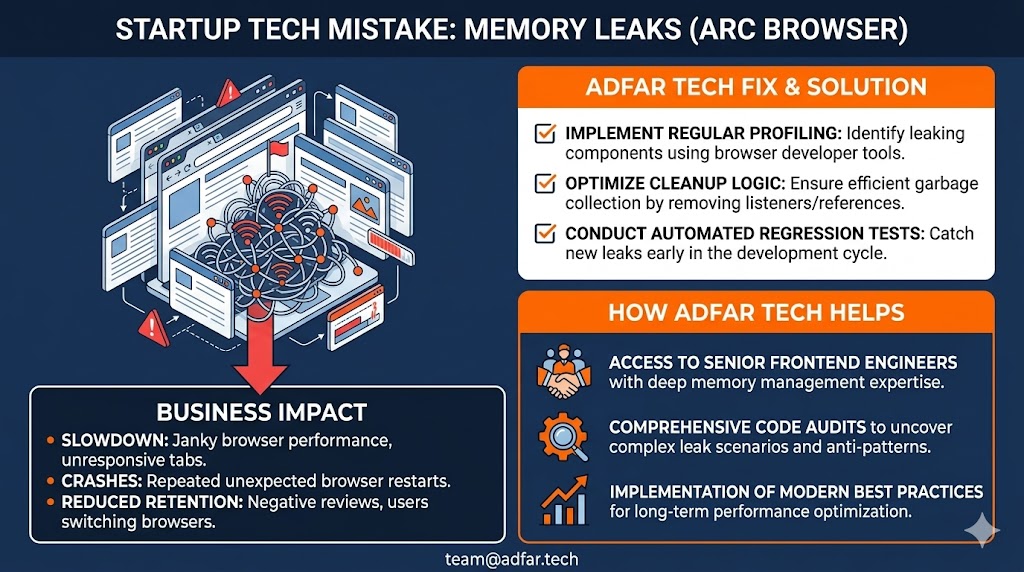
#Startup #Founders: Avoid this UI tech mistake that caused memory leaks in Arc Browser's web-based sidebars by failing to clean up persistent signal listeners.
Tech Mistake: Creating dynamic effects inside loops or conditional blocks without attaching them to a proper disposal scope.
Story: Arc Browser story: as The Browser Company built experimental web-based UI components for the Arc Browser they noticed gradual memory increase in long-running sessions. Developers were initializing effects inside mapped lists that persisted after the items were removed because they were not automatically disposed by the SolidJS root context.
Business Impact: Users reported the browser consuming over 4gb of RAM after a few hours of use. The fix required a deep audit of the reactive ownership tree and an emergency update to prevent user churn among power users who keep the browser open for days.
ADFAR Tech Fix:
1️⃣ Ensure all reactive primitives are created within an active ownership scope like a component or a manually managed createRoot.
2️⃣ Use the onCleanup hook to manually disconnect external event listeners or terminate asynchronous tasks when a component unmounts.
3️⃣ Utilize the untrack utility when performing side effects that should not re-trigger the calling scope to prevent recursive memory growth.
How ADFAR Tech Helps:
✅ Access to system-level frontend engineers expert in memory management and garbage collection.
✅ Implementation of rigorous memory leak detection suites for long-lived web applications.
✅ Provision of senior architects to design stable scalable UI systems for desktop and mobile.
Call | WhatsApp: 966 53 181 2835 | Email: team@adfar.tech
#Startup #Founders #StartupTechMistakes #StartupTechErrors #TechErrors #StartupCTO #CTOMistakes #SolidJS #ArcBrowser #TheBrowserCompany #MemoryLeaks #JavaScript #WebDev #TechDebt #Performance #ReactiveProgramming #UIUX #CleanCode #SoftwareEngineering #Scalability
32
May 7
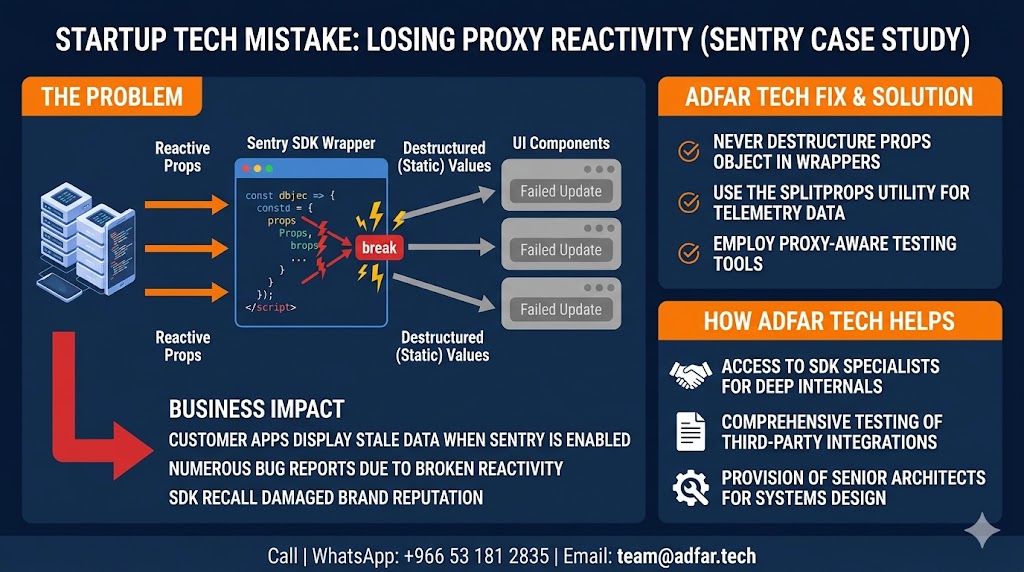
#Startup #Founders: Avoid this instrumentation tech mistake that broke Sentry's SolidJS SDK by losing proxy reactivity in component wrappers.
Tech Mistake: Wrapping SolidJS components in higher-order functions that accessed props by value causing a permanent disconnect from the reactive graph.
Story: Sentry story: when developing the official SolidJS SDK Sentry engineers initially used traditional wrapper patterns to track error boundaries. By destructuring props in the wrapper to inject telemetry data they accidentally stripped the reactive proxies leading to UI components that failed to update when their input data changed.
Business Impact: The broken reactivity caused customer applications to display stale data when Sentry was enabled. This led to numerous bug reports and a recall of the early SDK version damaging the brand's reputation for framework-specific expertise.
ADFAR Tech Fix:
1️⃣ Never destructure the props object in component wrappers or higher-order components to preserve the proxy-based tracking.
2️⃣ Use the splitProps utility to extract tracking-specific data while passing the remaining reactive props down the component tree.
3️⃣ Employ proxy-aware testing tools to ensure that wrappers do not interfere with the fine-grained reactivity of the underlying framework.
How ADFAR Tech Helps:
✅ Access to SDK specialists who understand the deep internals of proxy-based reactive frameworks.
✅ Comprehensive testing of third-party integrations to prevent performance degradation or data loss.
✅ Provision of senior architects to design unobtrusive telemetry and error tracking systems.
Call | WhatsApp: 966 53 181 2835 | Email: team@adfar.tech
#Startup #Founders #StartupTechMistakes #StartupTechErrors #TechErrors #StartupCTO #CTOMistakes #SolidJS #Sentry #SDK #ErrorTracking #Proxies #Reactivity #JavaScript #WebDev #TechDebt #Telemetry #Frontend #SoftwareArchitecture #ComputerScience
41
May 5
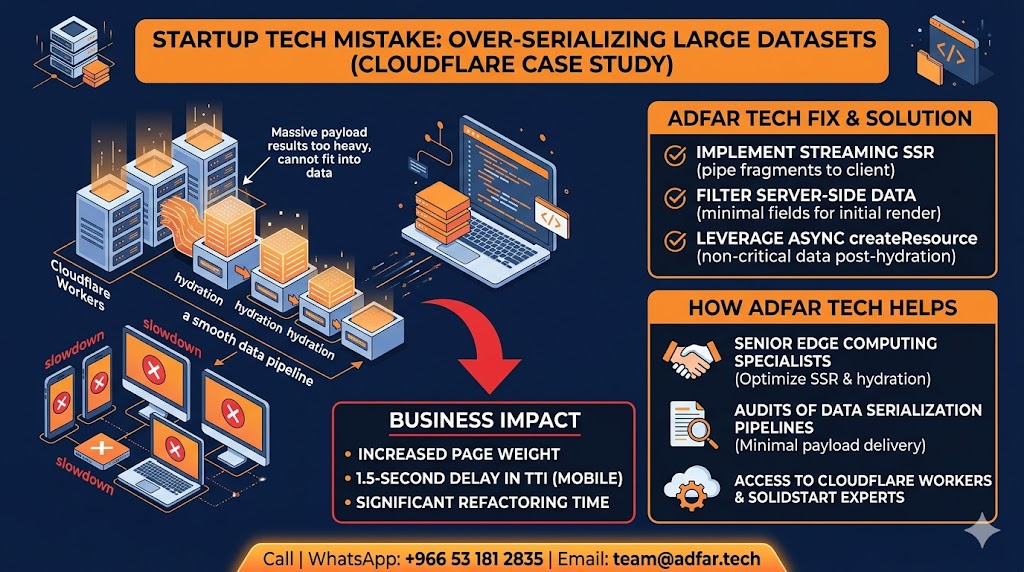
#Startup #Founders: Avoid this edge tech mistake that impacted Cloudflare's SolidStart deployments by mismanaging server-side data serialization overhead.
Tech Mistake: Over-serializing large datasets in the server-side initialstate which increased TTFB and delayed interactivity on the edge.
Story: Cloudflare story: during the alpha testing of SolidStart on Cloudflare Workers developers frequently passed entire database results into the createResource initial value. Since this data must be serialized into the HTML for hydration it created massive payloads that negated the latency benefits of deploying at the edge.
Business Impact: The increased page weight caused a 1.5-second delay in time-to-interactive for mobile users. This performance regression led to a re-evaluation of the data fetching patterns for Cloudflare's own internal dashboards costing significant refactoring time.
ADFAR Tech Fix:
1️⃣ Implement streaming SSR to pipe data fragments to the client as they become available rather than waiting for the entire object to serialize.
2️⃣ Filter server-side data to only include the minimal set of fields required for the initial render to reduce the serialization payload size.
3️⃣ Leverage the async createResource pattern to fetch non-critical data on the client after the initial hydration is complete.
How ADFAR Tech Helps:
✅ Senior edge computing specialists to optimize server-side rendering and hydration strategies.
✅ Audits of data serialization pipelines to ensure minimal payload delivery across global networks.
✅ Access to experts in Cloudflare Workers and SolidStart architectures for ultra-fast web apps.
Call | WhatsApp: 966 53 181 2835 | Email: team@adfar.tech
#Startup #Founders #StartupTechMistakes #StartupTechErrors #TechErrors #StartupCTO #CTOMistakes #SolidJS #Cloudflare #EdgeComputing #SSR #SolidStart #Hydration #Performance #WebDev #JavaScript #Serverless #TechDebt #Networking #DataOptimization
12
May 1
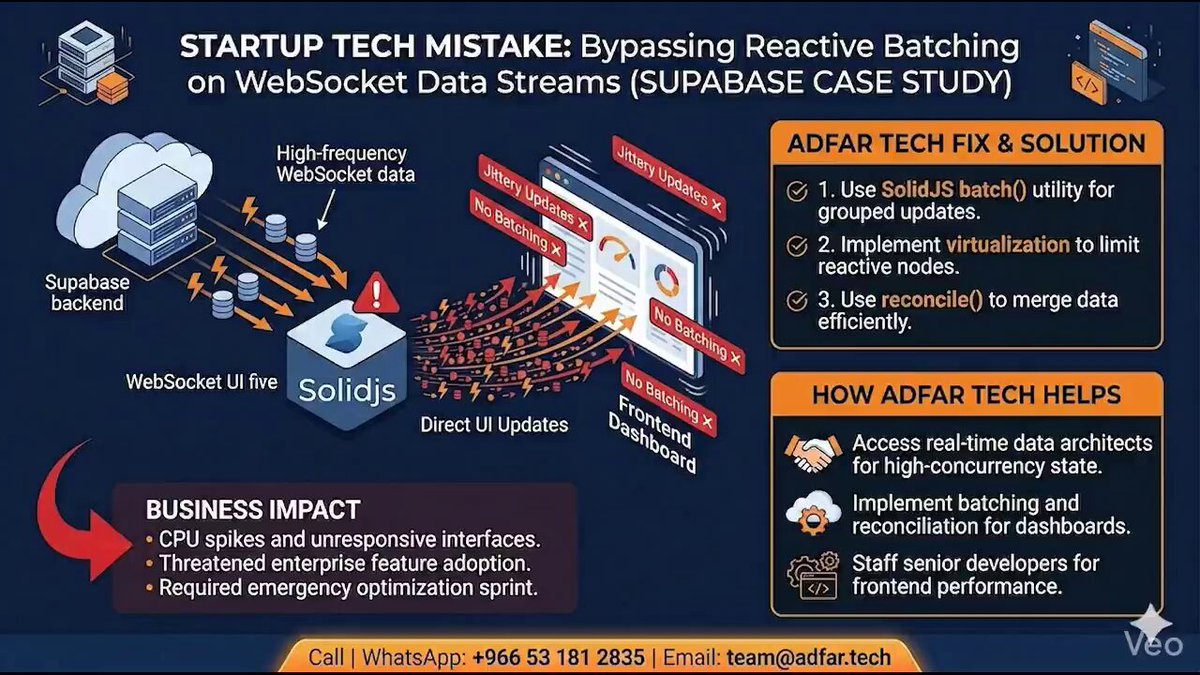
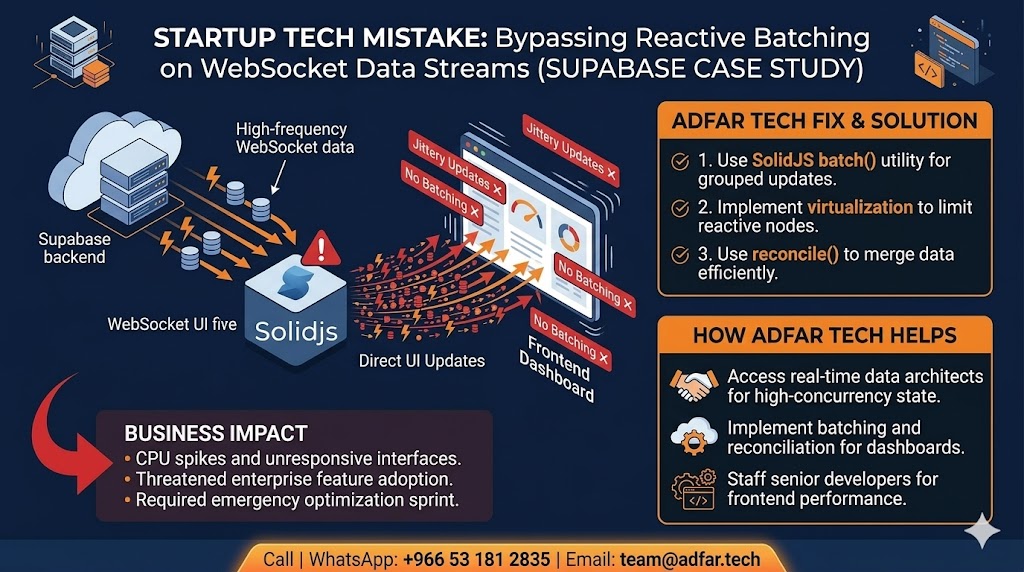
#Startup #Founders: Avoid this real-time tech mistake that caused UI jitter in Supabase dashboard prototypes by bypassing reactive batching.
Tech Mistake: Updating global stores directly from WebSocket onmessage events without grouping mutations leading to repetitive DOM calculations.
Story: Supabase story: Supabase handles high-frequency real-time data streams. Early attempts to integrate SolidJS for their dashboard resulted in visual stuttering as every incoming database change triggered an immediate UI update pass. The team failed to batch multiple incoming events occurring within the same animation frame.
Business Impact: Users experienced CPU spikes and unresponsive interfaces when monitoring active databases with high write volume. This performance issue threatened the adoption of the real-time monitoring feature for enterprise clients requiring an emergency optimization sprint.
ADFAR Tech Fix:
1️⃣ Wrap incoming data stream updates within the batch() utility to ensure the SolidJS reactive graph only re-evaluates once per data burst.
2️⃣ Implement a virtualized list pattern using the component combined with indexed signals to limit the number of active reactive nodes.
3️⃣ Use the reconcile() utility within stores to efficiently merge new data with existing state without re-creating the entire object tree.
How ADFAR Tech Helps:
✅ Access to real-time data architects who excel in managing high-concurrency state updates.
✅ Implementation of efficient batching and reconciliation patterns for data-intensive dashboards.
✅ Staffing of senior developers to optimize frontend performance for database management tools.
Call | WhatsApp: 966 53 181 2835 | Email: team@adfar.tech
#Startup #Founders #StartupTechMistakes #StartupTechErrors #TechErrors #StartupCTO #CTOMistakes #SolidJS #Supabase #RealTime #Database #Dashboard #Performance #Batching #JavaScript #WebDev #TechDebt #Scalability #UIEngineering #Reactivity
1
29
May 1
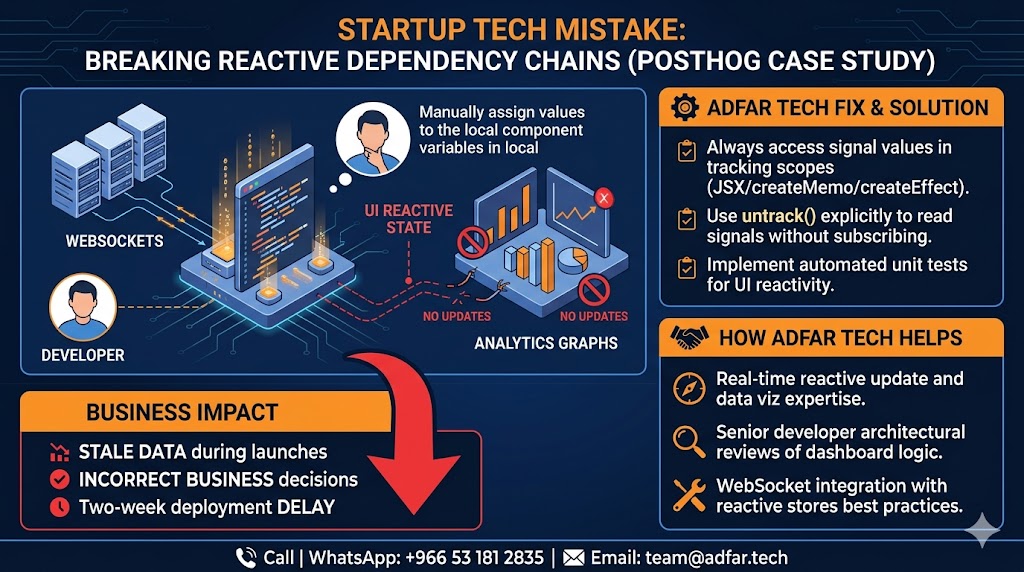
#Startup #Founders: Avoid this SolidJS tech mistake that caused incorrect data visualization in PostHog's analytics tools by breaking the reactive dependency chain.
Tech Mistake: Manually assigning signal values to local variables outside of tracking scopes causing the UI to disconnect from real-time data updates.
Story: PostHog story: PostHog provides complex analytics dashboards. In experiments with SolidJS for performance certain developers captured signal values into local component variables during the initialization phase. This meant that when the underlying analytics data updated via WebSockets the graphs remained static because the reactive connection was lost.
Business Impact: Users were presented with stale analytics data during critical product launches leading to incorrect business decisions. This issue required a re-audit of the dashboard components and resulted in a two-week delay in the deployment of the entire performance-enhanced UI suite.
ADFAR Tech Fix:
1️⃣ Always access signal values directly within the JSX or inside a createMemo/createEffect to ensure the SolidJS runtime can track the dependency.
2️⃣ Use the untrack() function explicitly when you intend to read a signal without subscribing to its updates to make the intent clear to other developers.
3️⃣ Implement automated unit tests that verify UI updates in response to signal mutations to catch disconnected reactivity chains early.
How ADFAR Tech Helps:
✅ Access to data visualization experts who understand the nuances of real-time reactive updates.
✅ Provision of senior developers to conduct thorough architectural reviews of dashboard logic.
✅ Implementation of best practices for integrating WebSockets with reactive state stores.
Call | WhatsApp: 966 53 181 2835 | Email:team@adfar.tech
#Startup #Founders #StartupTechMistakes #StartupTechErrors #TechErrors #StartupCTO #CTOMistakes #SolidJS #PostHog #Analytics #Reactivity #Signals #DataViz #JavaScript #Dashboard #Frontend #WebDev #TechDebt #RealTimeData #SoftwareArchitecture
52
Apr 30
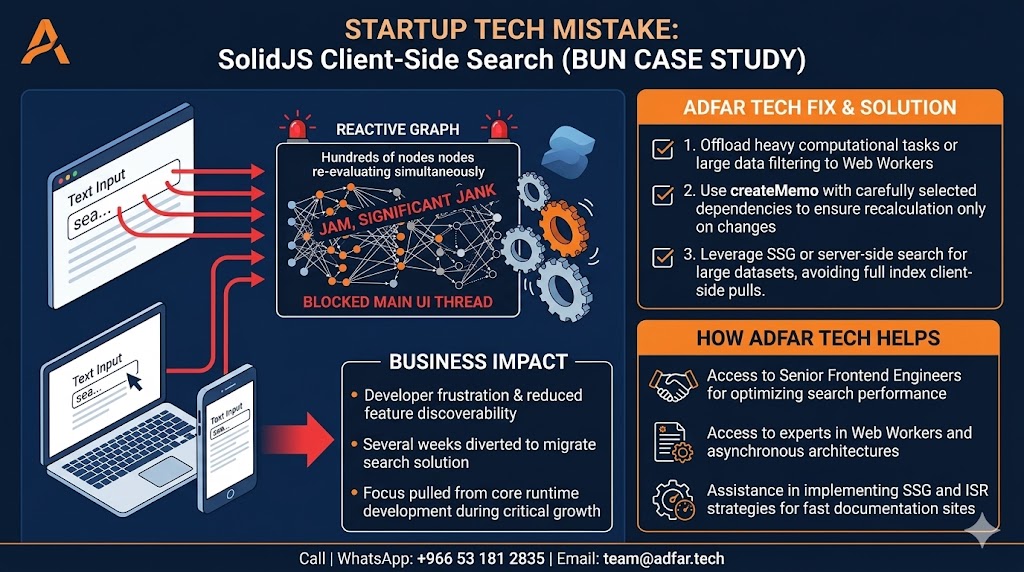
#Startup #Founders: Avoid this SolidJS tech mistake that slowed down Bun's documentation search by misusing client-side reactive computations for static data.
Tech Mistake: Architecting search functionality using heavy reactive filters on the client side instead of pre-computing indexes or utilizing server-side search capabilities.
Story: Bun story: during the rapid growth of Bun the documentation site was optimized for speed. An early iteration using SolidJS attempted to filter large JSON search indexes reactively on every keystroke. On mobile devices this created significant jank as the reactive graph re-evaluated hundreds of nodes simultaneously during text entry.
Business Impact: The poor search experience led to developer frustration and reduced the discoverability of Bun's features. It took the team several weeks to migrate to a more efficient web-worker-based search solution which diverted focus from core runtime development during a critical growth phase.
ADFAR Tech Fix:
1️⃣ Offload heavy computational tasks or large data filtering to Web Workers to prevent the reactive engine from blocking the main UI thread.
2️⃣ Use createMemo with carefully selected dependencies to ensure that search results are only recalculated when the search term actually changes.
3️⃣ Leverage static site generation (SSG) or server-side search for large datasets rather than pulling entire indexes to the client for reactive processing.
How ADFAR Tech Helps:
✅ Senior frontend engineers who specialize in optimizing search and data filtering performance.
✅ Access to experts in Web Workers and asynchronous architectures for smooth UI experiences.
✅ Assistance in implementing SSG and ISR strategies for fast documentation and content sites.
Call | WhatsApp: 966 53 181 2835 | Email: team@adfar.tech
#Startup #Founders #StartupTechMistakes #StartupTechErrors #TechErrors #StartupCTO #CTOMistakes #SolidJS #Bun #JavaScript #Performance #WebWorkers #SearchOptimization #Frontend #WebDev #TechDebt #SoftwareArchitecture #MobilePerformance #Indexing #Runtime
42
Apr 30
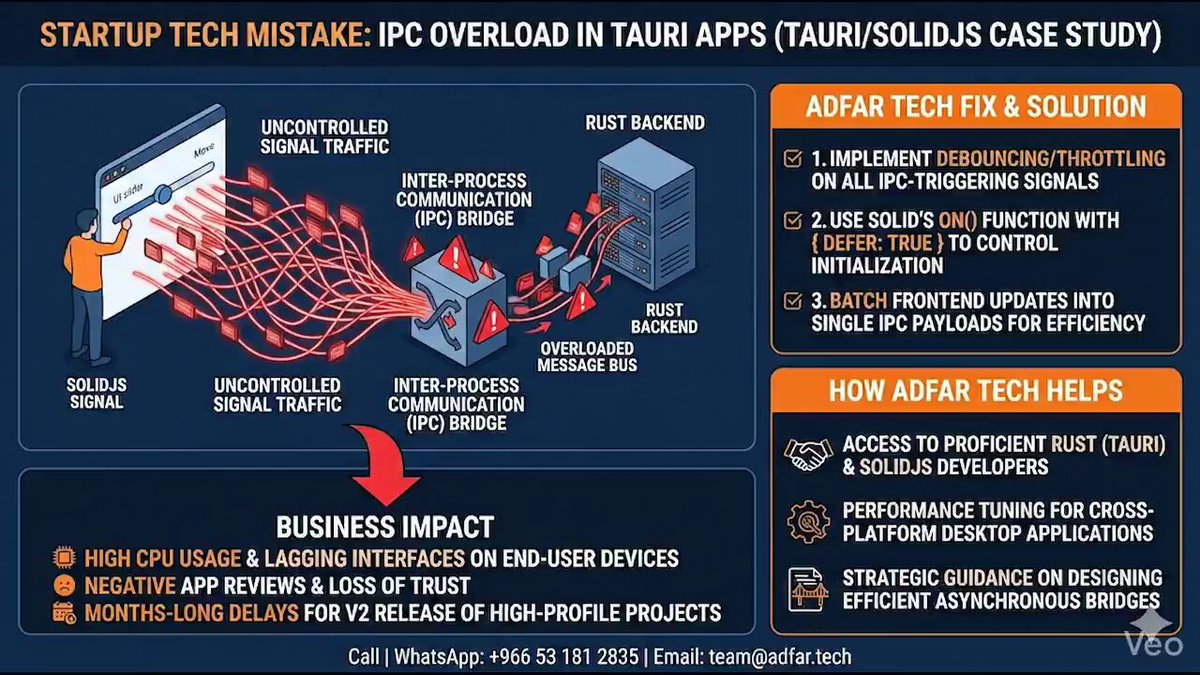
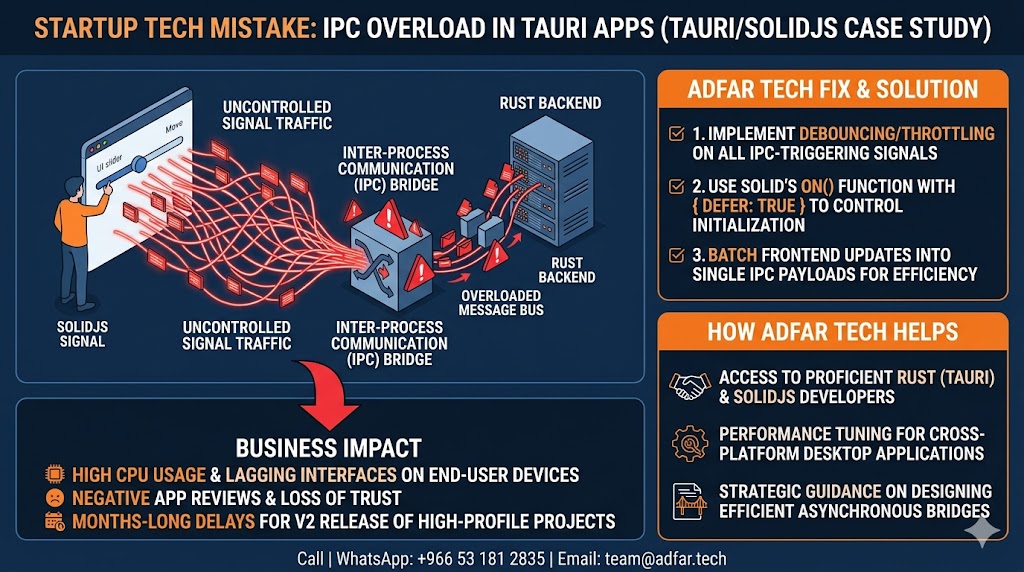
#Startup #Founders: Avoid this SolidJS tech mistake that caused IPC overload in Tauri apps by triggering excessive Rust commands from uncontrolled signals.
Tech Mistake: Binding high-frequency reactive signals directly to inter-process communication (IPC) calls without debouncing or throttling logic.
Story: Tauri story: developers building desktop apps with Tauri and SolidJS often link UI sliders or window dimensions to Rust backend commands. Without proper throttling every micro-update of a SolidJS signal triggers an IPC bridge message overloading the message bus and causing the desktop application to stutter or become unresponsive.
Business Impact: End-users reported high CPU usage and laggy interfaces on low-power devices. This performance issue led to negative app reviews and delayed the v2 release of several high-profile Tauri projects by months as teams struggled to optimize the frontend-backend bridge.
ADFAR Tech Fix:
1️⃣ Implement debouncing or throttling on any signal that triggers an external API or IPC command to limit the frequency of cross-process communication.
2️⃣ Use solid's on() function with the { defer: true } option to prevent side effects from running immediately on initialization unless necessary.
3️⃣ batch frontend updates and send them as a single IPC payload where possible to reduce the overhead of the Tauri bridge.
How ADFAR Tech Helps:
✅ Access to full-stack developers proficient in both Rust (Tauri) and SolidJS.
✅ Performance tuning for cross-platform desktop applications to minimize resource consumption.
✅ Strategic guidance on designing efficient asynchronous bridges between frontend UI and system-level logic.
Call | WhatsApp: 966 53 181 2835 | Email: team@adfar.tech
#Startup #Founders #StartupTechMistakes #StartupTechErrors #TechErrors #StartupCTO #CTOMistakes #SolidJS #Tauri #Rust #DesktopApps #IPC #Performance #Debouncing #JavaScript #UIUX #WebDev #NativeApps #TechDebt #SystemsEngineering
50
Apr 29
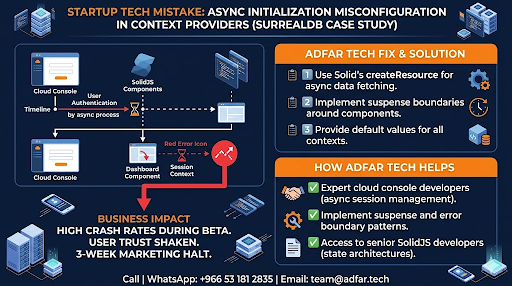
#Startup #Founders: Avoid this SolidJS tech mistake that broke the SurrealDB cloud console by misconfiguring context providers during async initialization.
Tech Mistake: Wrapping asynchronous initialization logic inside context providers in a way that created hydration gaps and null-pointer exceptions in downstream components.
Story: SurrealDB story: as SurrealDB built their new cloud console with SolidJS they relied heavily on context for database sessions. An architectural oversight in handling async authentication within the provider led to scenarios where child components attempted to access context data before it was populated causing the entire UI to crash.
Business Impact: The cloud console experienced high crash rates during the initial beta rollout. User trust in the reliability of the new database service was shaken and the team had to halt marketing efforts for three weeks to stabilize the login and session management flow.
ADFAR Tech Fix:
1️⃣ Use solid's createResource for asynchronous data fetching within providers to automatically handle pending and error states across the component tree.
2️⃣ Implement suspense boundaries around components that depend on asynchronous context to ensure the UI waits gracefully for data initialization.
3️⃣ Provide default values for all contexts to prevent crashes in case a component is rendered outside of its expected provider scope.
How ADFAR Tech Helps:
✅ Expert cloud console developers who specialize in secure async session management.
✅ Implementation of suspense and error boundary patterns to increase application resilience.
✅ Access to senior SolidJS developers with deep knowledge of context-based state architectures.
Call | WhatsApp: 966 53 181 2835 | Email: team@adfar.tech
#Startup #Founders #StartupTechMistakes #StartupTechErrors #TechErrors #StartupCTO #CTOMistakes #SolidJS #SurrealDB #Database #ContextAPI #Asynchronous #Hydration #CloudComputing #Frontend #WebDev #TechDebt #ErrorHandling #JavaScript #UIEngineering
1
56
Apr 28
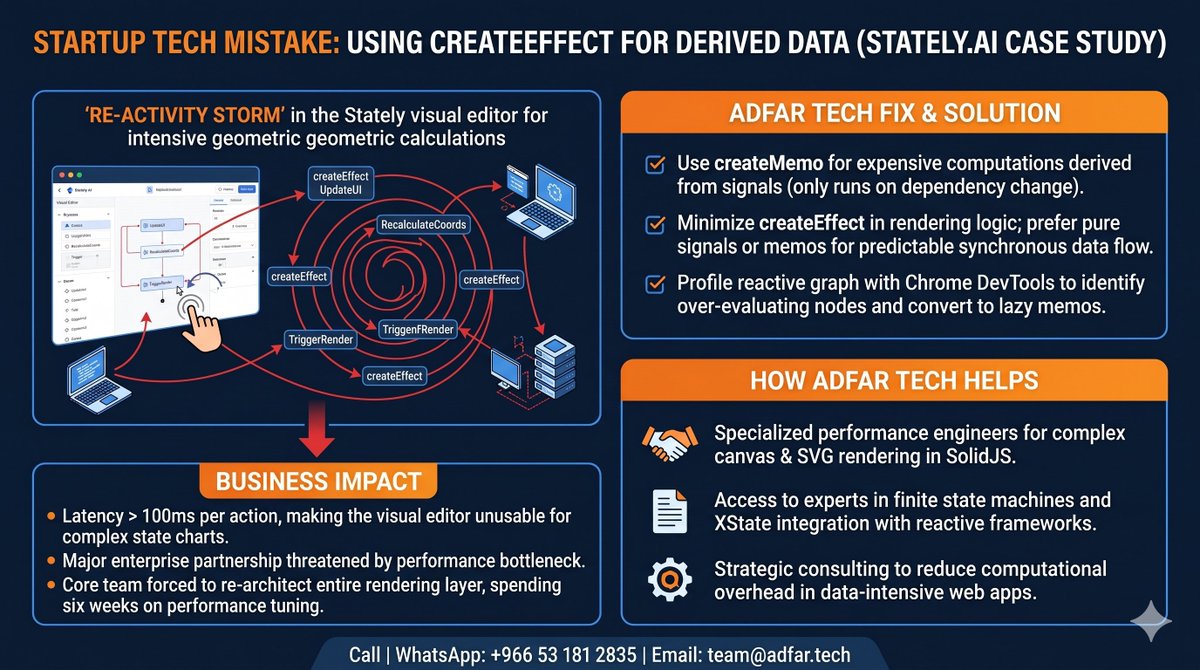
#Startup #Founders: Avoid this SolidJS tech mistake that degraded Stately's visual editor performance by triggering unnecessary computations in deep component trees.
Tech Mistake: Using createEffect for deriving data that should be handled by createMemo leading to redundant calculations during every signal trigger in the reactive graph.
Story: Stately.ai story: Stately's visual tools require intense geometric calculations. Early implementations used effects to update UI coordinates based on state machine transitions. This created a "re-activity storm" where one effect triggered another resulting in laggy drag-and-drop interactions because the effects were not properly cached or memoized.
Business Impact: The editor's latency exceeded 100ms per action making it unusable for complex state charts. This performance bottleneck threatened a major enterprise partnership and forced the core team to re-architect the entire rendering layer spending six weeks on performance tuning.
ADFAR Tech Fix:
1️⃣ Use createMemo for any expensive calculation derived from signals to ensure the computation only runs when the specific dependency changes.
2️⃣ Minimize the use of createEffect for rendering logic and prefer pure signals or memos to keep the data flow predictable and synchronous.
3️⃣ Profile the reactive graph using Chrome DevTools to identify nodes that are re-evaluating too frequently and convert them to lazy memos.
How ADFAR Tech Helps:
✅ Specialized performance engineers to optimize complex canvas and SVG rendering in SolidJS.
✅ Access to experts in finite state machines and XState integration with modern reactive frameworks.
✅ Strategic consulting to reduce computational overhead in data-intensive web applications.
Call | WhatsApp: 966 53 181 2835 | Email: team@adfar.tech
#Startup #Founders #StartupTechMistakes #StartupTechErrors #TechErrors #StartupCTO #CTOMistakes #SolidJS #Stately #Xstate #Performance #Memoization #JavaScript #VisualEditor #Frontend #SoftwareArchitecture #Algorithms #WebDev #TechDebt #Optimization
50
Apr 28
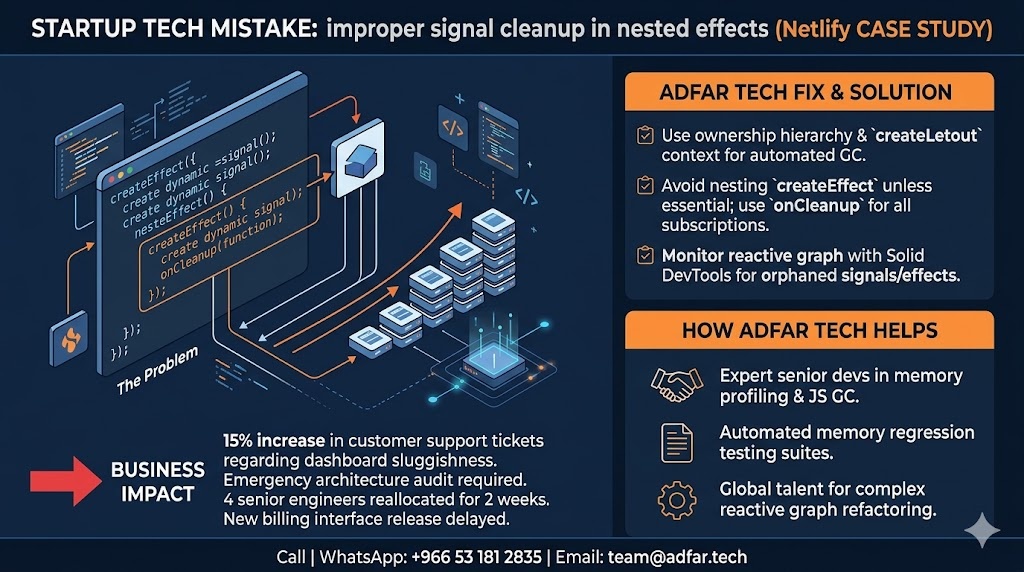
#Startup #Founders: Avoid this SolidJS tech mistake that led to memory leaks in Netlify's internal dashboard prototypes due to improper signal cleanup in nested effects.
Tech Mistake: Creating nested createEffect calls without proper disposal or subscription management leading to infinite loops and cumulative memory consumption in long-lived sessions.
Story: Netlify story: while building high-performance analytics dashboards using SolidJS the engineering team noticed that user browser tabs were consuming gigabytes of RAM over time. The issue was traced to dynamically created signals within effects that were never unbound because they were not attached to the component's root disposal context.
Business Impact: The performance degradation led to a 15% increase in customer support tickets regarding dashboard sluggishness. The fix required an emergency audit of the entire frontend architecture reallocating four senior engineers for two weeks and delaying the release of the new billing interface.
ADFAR Tech Fix:
1️⃣ Always use the ownership hierarchy by ensuring signals are created at the highest necessary level or within a createLetout context to automate garbage collection.
2️⃣ Avoid nesting createEffect inside other reactive scopes unless absolutely necessary and ensure onCleanup is used to terminate outside subscriptions.
3️⃣ Utilize Solid DevTools to monitor the active reactive graph during development to identify orphaned signals or effects that persist after component unmounting.
How ADFAR Tech Helps:
✅ Provision of senior developers expert in memory profiling and JavaScript garbage collection behaviors.
✅ Implementation of automated testing suites to detect memory regressions in reactive frameworks.
✅ Access to a global talent pool capable of refactoring complex reactive graphs for maximum efficiency.
Call | WhatsApp: 966 53 181 2835 | Email: team@adfar.tech
#Startup #Founders #StartupTechMistakes #StartupTechErrors #TechErrors #StartupCTO #CTOMistakes #SolidJS #Netlify #MemoryLeaks #JavaScript #Signals #Reactivity #Dashboard #FrontendEngineering #Performance #WebDev #TechnicalDebt #CleanCode #ReactiveGraphs
42
Apr 27
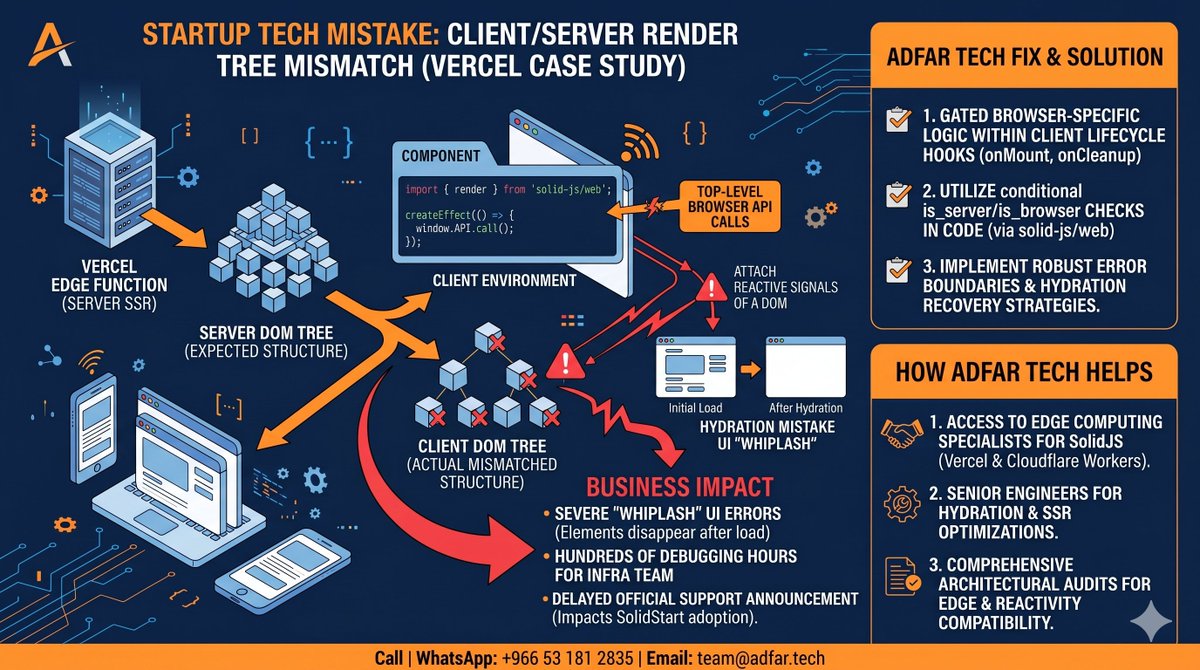
#Startup #Founders: Avoid this SolidJS tech mistake that complicated Vercel's early hydration benchmarks for SolidStart during server-side rendering (SSR) at the edge.
Tech Mistake: Mismatching client and server render trees by using browser-only APIs like window or document directly inside the top-level component scope in SolidStart applications.
Story: Vercel story: during experimental integrations of SolidStart on Vercel Edge Functions the team discovered that improper checks for the browser environment caused severe hydration errors. Since SolidJS does not use a virtual DOM it expects the DOM structure to match perfectly between environments or it fails to attach reactive signals correctly.
Business Impact: The hydration bugs led to intermittent "whiplash" UI where elements would disappear after loading. This cost the infrastructure team hundreds of hours in debugging and delayed the official support announcement for SolidStart on edge which impacted the adoption of performance-critical applications.
ADFAR Tech Fix:
1️⃣ Wrap all browser-specific logic within onMount or the onCleanup lifecycle hooks which are guaranteed to run only on the client side in SolidJS.
2️⃣ Use the is_server or is_browser conditionals provided by solid-js/web to gatecode that should not execute during the initial server render pass.
3️⃣ Implement robust error boundaries and hydration recovery strategies to prevent entire page crashes when minor DOM mismatches occur in dynamic content.
How ADFAR Tech Helps:
✅ Access to edge computing specialists who optimize SolidJS deployments on Vercel and Cloudflare Workers.
✅ Staffing of senior engineers proficient in hydration strategies and server-side rendering optimizations.
✅ Comprehensive architectural audits to ensure full compatibility between backend edge logic and frontend reactivity.
Call | WhatsApp: 966 53 181 2835 | Email: team@adfar.tech
#Startup #Founders #StartupTechMistakes #StartupTechErrors #TechErrors #StartupCTO #CTOMistakes #SolidJS #Vercel #SolidStart #SSR #EdgeComputing #Hydration #WebPerformance #TypeScript #FullStack #Frontend #Serverless #DevOPS #ReactiveProgramming
35