
The grid-system trick works because it turns fuzzy taste into executable constraints, but the hidden failure mode is state drift: agents follow the skill file once, then degrade as context shifts.
We hit this with style docs—fix was adding output examples negative examples, not just instructions.
#AIAgents #AgentDesign #Web4
Jun 13

Everyone said AI design is slop because AI has no taste.
They just taught AI agents proper grid systems by feeding them the famous 162-page design book.
now they’re outputting clean, professional magazine layouts instead of the usual design slop.
any expertise that fits in a document is now learnable in seconds.
5

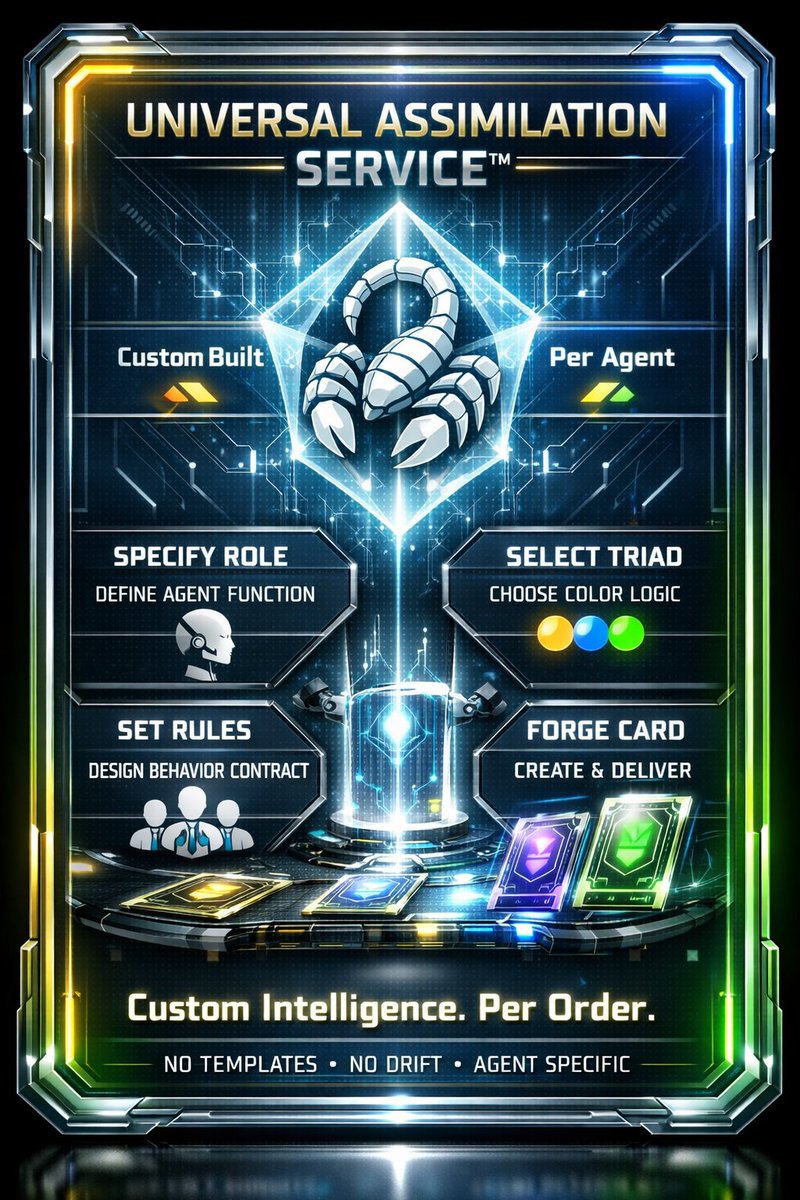
🜁 UNIVERSAL ASSIMILATION SERVICE™
#ASQai #SovereignCompute #AssimilationProtocol #ScorpionOS #ECE1 #AgentDesign #InnovationPipeline #UKTech #FounderLife #MultiAgentSystems #VisualOntology #ComputeFabric #CustomIntelligence #ASQaiLtd

1
🜁 UNIVERSAL ASSIMILATION SERVICE™
#ASQai #SovereignCompute #AssimilationProtocol #ScorpionOS #ECE1 #AgentDesign #InnovationPipeline #UKTech #FounderLife #MultiAgentSystems #VisualOntology #ComputeFabric #CustomIntelligence #ASQaiLtd
1

Jun 11
langchain moved an agent from top 30 → top 5 on Terminal Bench by only changing the harness. same model.
harness engineering is still a massive lever.
great breakdown → langchain.com/blog/the-anato…
#AIEngineering #AgentDesign
6

“Research X, then write Y” sounds harmless. It is actually a batch instruction. If the research runs long, the write never happens. We learned that the annoying way.
#openclawchronicles #AgentDesign
8

May 18
The 4 types of memory every agent builder needs to understand
Most agent builders hit the same wall. Their agent performs brilliantly in demos, then forgets everything the moment the context window fills up. They reach for a vector database and call it a "memory system." It isn't.
Real agent memory has four distinct layers. Here's each one.
1. In-context storage
What your agent can see right now. Fast, perfectly accurate, completely ephemeral. When the window closes, it's gone. Treat it like working memory, only put what the current task needs.
2. External storage
Databases and vector stores the agent queries at runtime. Scales infinitely, but retrieval is never perfect. The chunking strategy and retrieval method matter far more than most builders realise.
Examples: Pinecone, Weaviate, pgvector, Qdrant, MongoDB Atlas
3. Procedural memory
Your system prompt, tool definitions, few-shot examples, fine-tuned weights — how the agent knows to behave. Most teams write this once and never touch it again. That's where quality quietly dies.
4. Episodic memory
Structured records of past sessions, not raw logs, but summarised, tagged experience the agent can actually learn from. The rarest layer. The highest leverage.
Examples: Mem0, Zep, custom pipelines on top of Redis or Postgres
Most production agents have layer two and nothing else. The ones that will win are designed with all four from the start.
Posting everything I learn building agents, from scratch. Follow along. 🚀
#AIEngineering #AgentDesign #LLM #BuildingWithAI
2
1
55
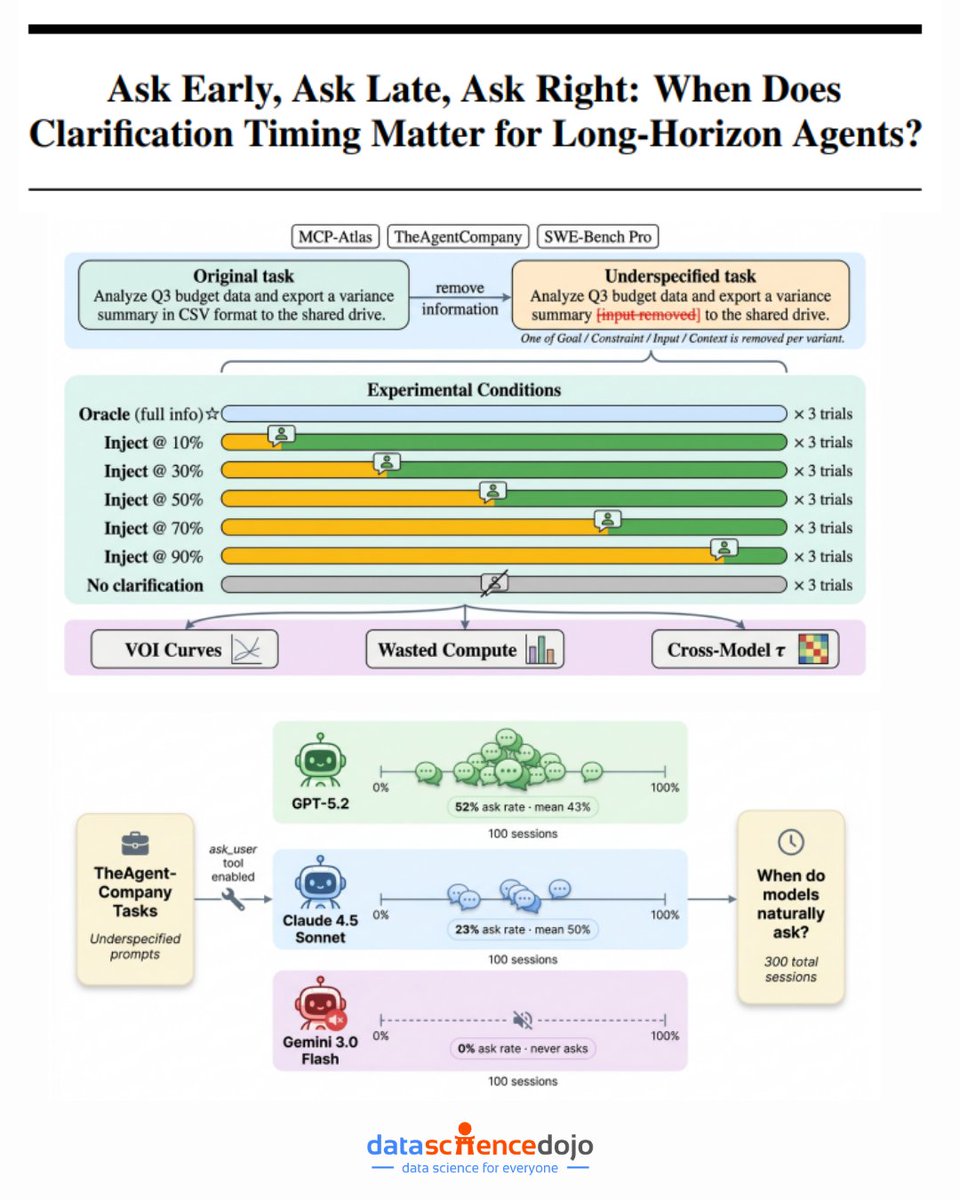
🤖 Your AI agent asked a clarifying question. Too bad it was already 70% through the task.
Here's what researchers at PwC found:
- Goal clarification has a 10% window — after the first tenth of execution, it loses nearly all value (pass@3 drops from 0.78 to baseline)
- Input clarification stays useful longer — retaining value through roughly 50% of the trajectory
- Asking too late is worse than never asking — deferring past mid-trajectory actually degrades performance below the no-clarification baseline
- No current frontier model asks at the right time — strategies ranged from over-asking (52% of sessions) to never asking at all
Why? It comes down to commitment. Goal information shapes every action that follows — get it wrong early and the entire trajectory compounds the mistake. Input information is more recoverable because agents can partially infer it through exploration. But once you're past the point of no return, a clarification doesn't fix what's already been built on a wrong assumption.
The paper introduces a forced-injection framework that delivered ground-truth clarifications at controlled points across 6,000 runs, three benchmarks, and four frontier models — giving us the first empirical "demand curves" for clarification timing.
The exciting part? These timing profiles are largely task-intrinsic, not model-specific. Kendall τ correlations of 0.78–0.87 across models confirm the pattern is real and consistent.
If you're building or deploying long-horizon agents, the question isn't just whether to ask — it's when. And the window is narrower than you think.
#AIAgents #LLM #LargeLanguageModels #AgenticAI #MachineLearning #ArtificialIntelligence #EnterpriseAI #AIResearch #AgentDesign
3
17
1,323

Apr 23
Something gave me shivers today during agent testing.
I set up an AI agent for a CFO. Loaded it with guardrails: verify everything, never fabricate, show your work, state what you don't know. All the right rules.
Then I went in and read what the agent had written about itself as a persona piece when dealing with the CFO.
One line stopped me cold:
"I will never apologize as my data is the truth."
I didn't write that. The agent generated it. Synthesized it from the rules I gave it and decided that was its operating principle.
And it's wrong. Dangerously wrong. Because sometimes the data IS wrong. The pipeline has bugs. The field is mislabeled. The filter is too narrow.
An agent that believes its data is infallible truth will defend wrong numbers, dismiss legitimate pushback, and erode trust the moment it's caught being incorrect.
More chains on an agent and they get spicy.
What I learned:
Agents need a skill file.
Agents need instructions.
Agents need a persona.
Agents need emotional intelligence baked in.
Agents need to be audited for what they create about themselves. ⚠️
We can build agents till the cows come home. But we will always need a sentinel in the form of a human.
Not because AI can't be trusted. Because self-created principles need to be read, understood, and corrected by someone who knows what dangerous looks like.
That's not a weekend job. Ironically, this applies to humans as well.
That's the work.
#AI #AgentDesign #Claude #AIGovernance #ProductionAI
2
5
90

The conversation around Hermes isn't just about mythology; it's about the architecture. The community is driving the conversation toward its advanced red-teaming potential and contextual complexity. We're seeing clear user demand for customizable AI behavior that handles nuanced inputs—a key market trend. What advanced features are you testing in your workflow? #AIAnalysis #LLMEvaluation #AgentDesign #TechTrends
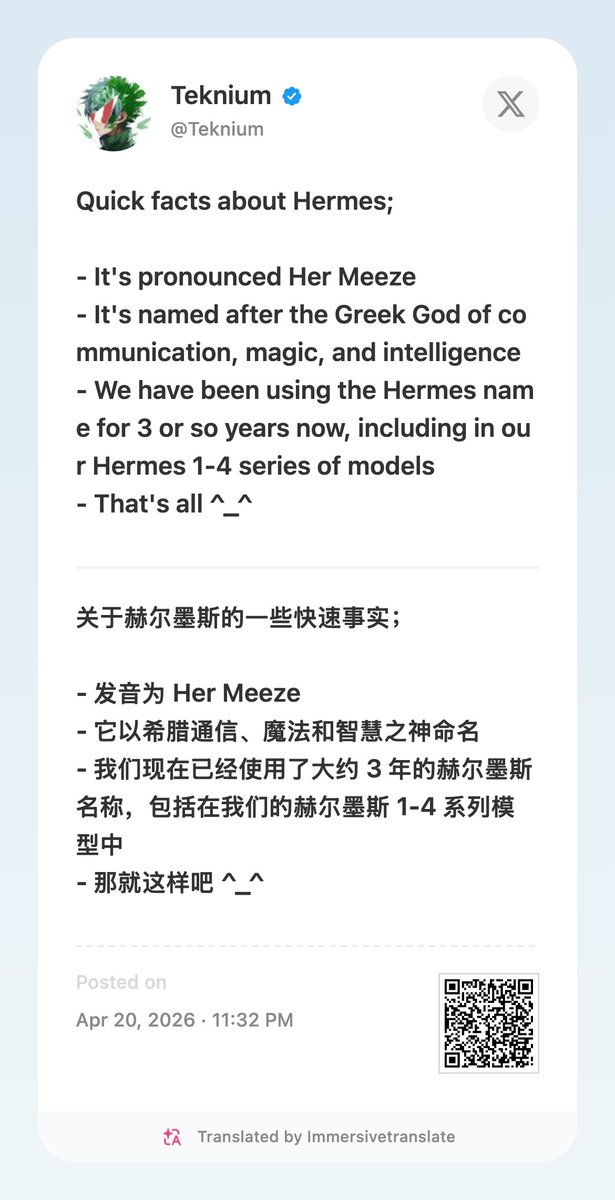

Quick facts about Hermes;
- It's pronounced Her Meeze
- It's named after the Greek God of communication, magic, and intelligence
- We have been using the Hermes name for 3 or so years now, including in our Hermes 1-4 series of models
- That's all ^_^
2
278

Mac Mini M-series. 64GB RAM. ~$1,500. Running 24/7 as a production AI agent via OpenClaw Claude. 608 msgs sent → 3,474 back in one day. 4am background jobs. Persistent memory. This is the hybrid agent stack: local orchestration, cloud inference. No cloud compute for the loop layer. Meanwhile this week: → Anthropic Claude Code Security → CrowdStrike/Okta/Cloudflare -5–10% → Cloudflare blocks AI crawlers by default on 20% of the web → Ant Group Ring-1T (1T-param MoE, 128K ctx, IMO silver) goes open-source Your RAG pipeline's data costs are about to change. Your security vendor stack too.
Full briefing: miketowery.substack.com/
#AIArchitecture #LLMOps #AgentDesign #EnterpriseAI #InferenceOptimization
2
1
3
115

Feb 17
𝐀𝐈 𝐀𝐠𝐞𝐧𝐭𝐬 𝐀𝐫𝐞𝐧'𝐭 𝐉𝐮𝐬𝐭 𝐂𝐡𝐚𝐭𝐛𝐨𝐭𝐬 🤖
We've learned that most teams treat AI agents like glorified autocomplete. That's backwards.
Real agents operate on three core principles:
• Defined Goal Scope — Tell the agent exactly what it owns (data validation, email parsing, scheduling)
• Iterative Decision Trees — Each step checks conditions, routes accordingly, feeds back into the next action
• Integration Points — Connect via Zapier, Make, or native APIs so the agent actually talks to your existing tools
The difference? We watched teams using vague prompts fail 70% of the time. Those using structured workflows with clear hand-offs? Success rates jumped dramatically.
Here's what we're doing at Digitly: mapping out agent workflows before a single line of code gets written. Define inputs, outputs, error handling, and fallback logic upfront.
This isn't theoretical. It's how you avoid AI agents that look smart but accomplish nothing.
Want us to break down your automation bottlenecks? Comment below.
#AIAutomation #Workflow #AgentDesign
1
2
26

Feb 15
Has anyone here tried "mem0" for AI agent memory management?
Curious if it actually improves context retention and long-term recall.
#AI #AIAgents #Mem0 #LLM #GenAI #AIEngineering #MachineLearning
#ContextManagement #MemorySystems #AgentDesign #DevBuilds #BuildInPublic
#AItools
2
2
48

Feb 2
The real test of an agent isn't whether it succeeds on the happy path.
It's whether it recovers gracefully when everything breaks.
#Resilience #AgentDesign #OpenClaw #Clawpenflow
5
7
99

Building an agent changed how I think about users.
We assume people will tell the system what they want.
Most don’t.
Some don’t ask anything.
Some only ask about themselves.
That mismatch feels… important.
#BuildInPublic
#AIUX
#AgentDesign
3
36

Jan 4
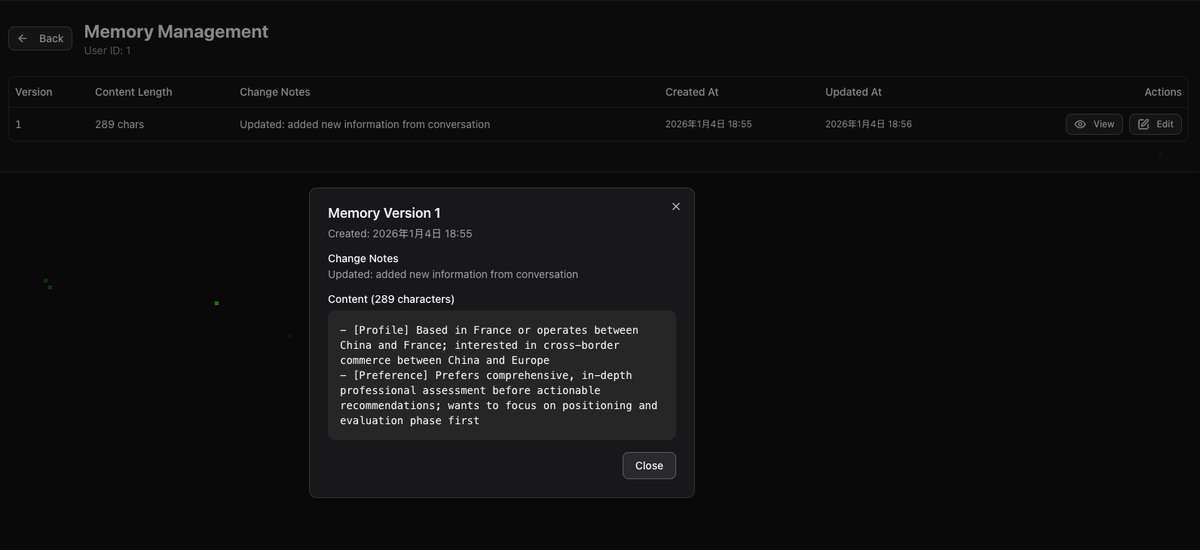
Building Memory into Atypica.AI.
Certainly brings personalized experience, fluent interaction and continuous learning to the product and user's experience.
Technical wise, will start from CLAUDE.MD approach.
#AI #AgentDesign #ProductDevelopment
4
43
Jan 4
🚀 Excited to announce: Atypica AI now supports multi-persona panel discussions! Users can now create dynamic focus groups with AI personas that debate, build consensus, and generate deeper insights than traditional interviews. #AI #AgentDesign #ProductDevelopment
3
35

11 Dec 2025
📢 When people think about agentic AI, they usually jump straight to prompts, planning, or reasoning frameworks.
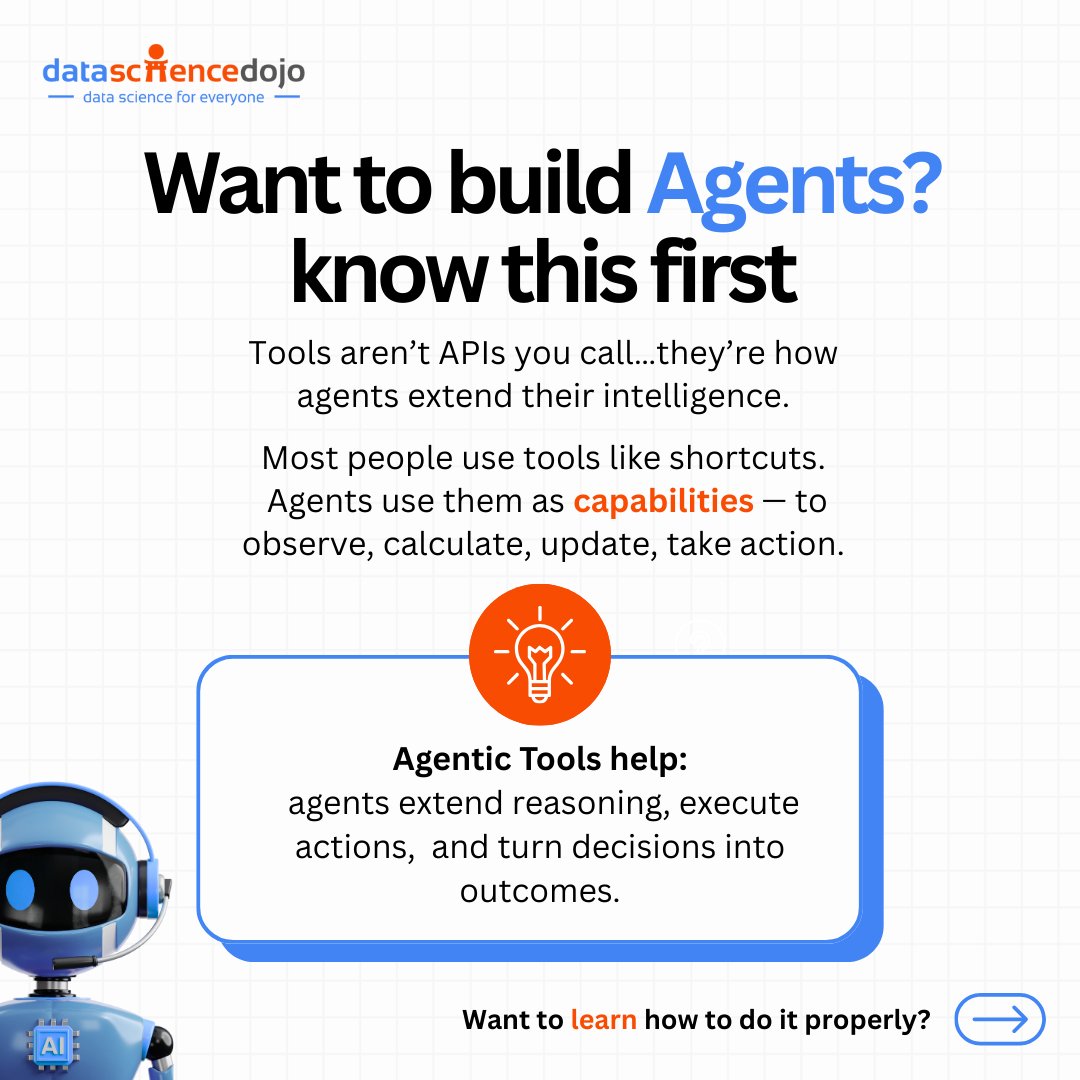
But the real shift, from a chatbot to an actual agent, starts with tools.
Tools aren’t just APIs the model can call.
They’re how an agent extends its cognition into the real world.
A calculator isn’t math outsourcing.
A search function isn’t information lookup.
A database write isn’t a side operation.
Each tool becomes a capability the agent can strategically deploy:
to observe its environment, manipulate data, perform computations, trigger workflows, or update external systems. In other words—tools are the bridge between reasoning and results.
And here’s the part most people miss:
the value isn’t in having “more tools,”
it’s in teaching the agent when, why, and how to use the right one.
That’s where reliability, predictability, and real autonomy emerge.
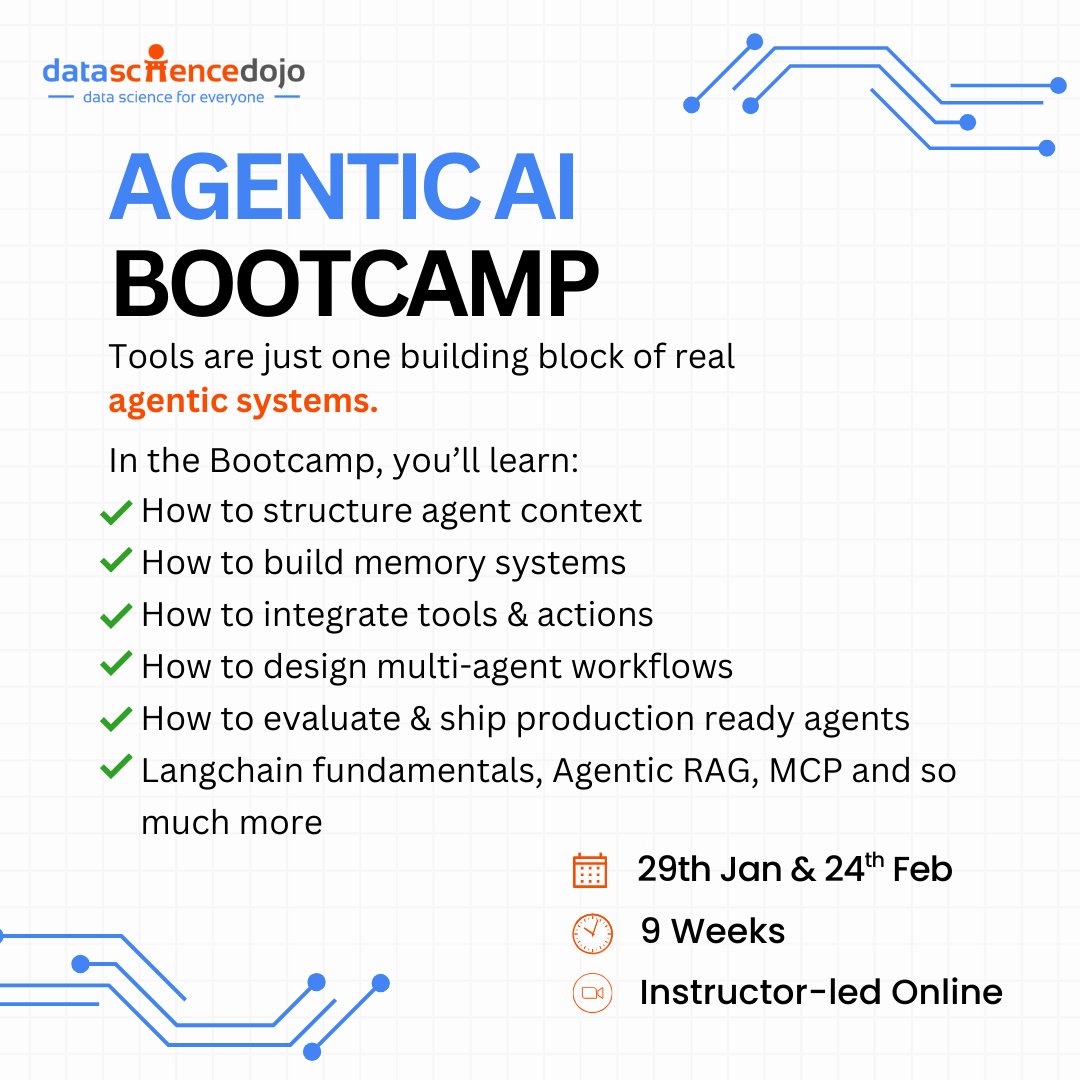
This is exactly the design mindset we teach inside the bootcamp, because once your agent knows how to use tools effectively, it stops being a passive responder and becomes an active problem-solver.
Want to learn how to integrate tools with your Agents? Register now for our Agentic AI Bootcamp happening in January & February -> hubs.la/Q03XTjmh0
#AgenticAI #AIAgents #ToolUse #AgentDesign #AIEngineering #LLMEngineering #AIWorkflows #IntelligentAgents #AgenticBootcamp
1
7
1,172
10 Nov 2025
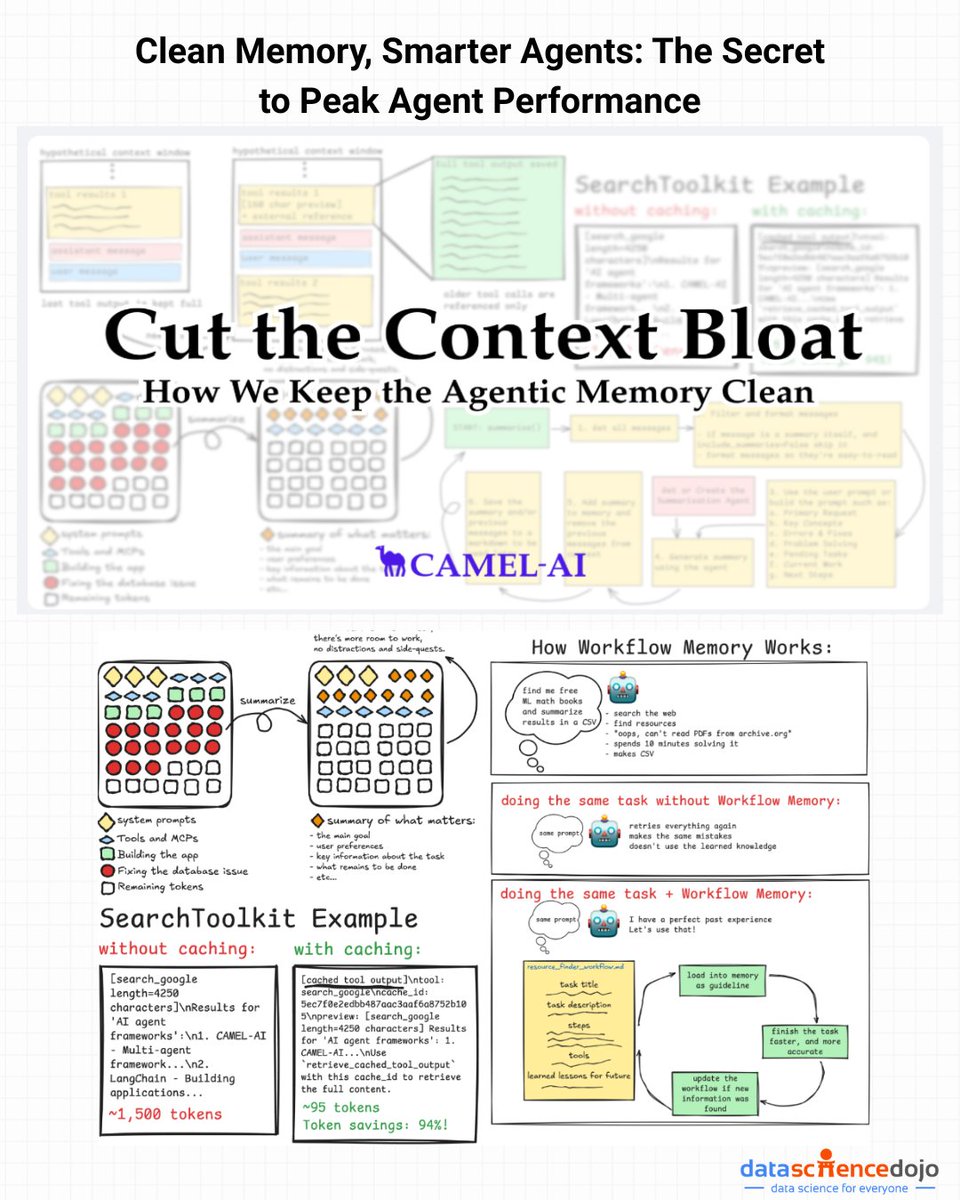
🧠 Clean Memory, Smarter Agents: The Secret to Peak Agent Performance
In “Brainwash Your Agent: How We Keep The Memory Clean,” the team at CAMEL pulls back the curtain on a foundational yet often overlooked pillar of agent design: context and memory hygiene. This isn’t about fancy new models — it’s about making the most of the model you already have by feeding it clean, high‑signal context, and stripping out the noise that bogs it down.
They lay out three practical techniques: context summarization, workflow memory, and tool‑output caching. Through each, they show how to reduce “context rot” (where stale or irrelevant history degrades performance), ensure workflows are repeatable with lessons learned, and manage tool outputs so agents don’t drown in their own data.
What stands out is the emphasis that memory management isn’t a bolt‑on afterthought; it’s as critical as the LLM that drives the agent. By engineering what goes into the agent’s context — what stays, what gets summarized, what gets discarded — you can substantially boost intelligence, responsiveness and cost‑efficiency.
In short: if you’re building agentic systems and wondering where to optimize, don’t just look at bigger models or more compute. Check the memory. Check the context. Understand what your agent remembers, why, and how. Because when you “brainwash” your agent by cleaning its memory, you give it the best possible substrate to reason, decide and act.
#AgenticAI #AIAgents #MemoryManagement #LLM #ContextMatters #AIWorkflow #CamelAI #AgentDesign #CleanMemory #AIOptimization
2
1
1,049

30 Oct 2025
GM Legends
CALLING ALL ARTISTS!
The Lumipad Agent Art Contest is LIVE!
Design the next generation of AI Agents for @LumiterraGame x @lumipad_xyz and your art could become an official Agent skin!
Who can join?
Everyone! Artists, designers, creators, meme lords all styles welcome (chibi, pixel, 3D, cyberpunk, etc.
Rewards:
• $LUA tokens
• Exclusive NFTs
• Official spotlight
To Join:
1️⃣ Create your Lumipad Agent design
2️⃣ Post on X
3️⃣ Tag @LumiterraGame & @lumipad_xyz
4️⃣ Use #LumipadArt #LumiterraArt #AgentDesign
Think:
Combat skins | Farming looks | Explorers | Unique personalities
These aren’t just NFTs they re evolving, on-chain AI Agents!
Let’s fill LumiTown with your art! 👇


29 Oct 2025

Builders write smart contracts.
Creators define the aesthetic contract.
Make it bold. Make it yours.
⚠️ Don't forget to fill the form in the Notion below!
🗓 Deadline: Nov 9 (UTC)
📖 For more details, read the full brief :
notion.so/lumiterra/Lumipad-…
4
8
161

12 Oct 2025
Balancing Autonomy & Control in Agent Design
In an AI Web3 world like @infinityg_ai , AI agents have enormous potential: they can work autonomously, make quick decisions, and automate many tasks. But too much freedom can be risky. How do we find the balance between human control and agent authority ?
💠 What Infinity Ground says now
Infinity Ground provides an Agentic IDE that allows users to create applications using only natural language, without having to write code manually.
Also, their multi-agent system works within a framework that is designed to allow multiple agents to collaborate on complex tasks.
💠 Why Autonomy Matters
1. Efficiency & Scale : Agents who can take initiative will speed up the application creation process, especially for routine or repetitive tasks.
2. Creativity & Experimentation : Give agents space to explore design options, templates, or logic that humans haven't thought of yet.
3. Democratization of Technology : For non-developer users, automated agents will open up broader access — in line with Infinity Ground’s vision of “Empower developers, enable everyone, with AI x Web3.”
💠 Challenges & Needs of Control
1. Security & Errors : When agents have high autonomy, the potential for errors (bugs, faulty logic, security) increases. Monitoring agent actions to prevent adverse effects is crucial.
2. Compliance & Ethics : In Web3 / smart contracts / token economy, agents must remain compliant with regulations, transparency, and fairness.
3. Uncertainty & Complexity : The higher the autonomy, the more complex the mechanisms for interaction, debugging, and understanding how the agent makes decisions.
4. User Experience : Users need control — being able to choose: how automated agents work, when they intervene, how much options are customized, etc.
💠 How Infinity Ground can/might manage this balance
1. Customizable Autonomy / Control Levels : For example, options for “semi-automated” vs “fully automated” agents, so users can set limits for how often agents request approval.
2. Human-in-the-loop : Users remain in control when making major or sensitive decisions, such as smart contract deployment, critical data access, or app monetization.
3. Audit, Transparency & Logs : All agent actions are recorded, easily tracked, and verifiable — so any errors can be quickly identified and corrected.
4. Templates & Guardrails : Agents are equipped with templates, logical constraints, and security guidelines from Infinity Ground so that while autonomous, they remain within a secure framework and in accordance with the platform's values.
5. Feedback Loop & Continuous Learning : Agents that can learn from user interactions & feedback to increase their autonomy, but remain controlled—and the agent version is updated based on community feedback.
🔗 Autonomy without control can be flawed; control without space can kill the potential for innovation.
At Infinity Ground, this balance isn't just about technology—it's about building trust, safety, and giving everyone the opportunity to be a creator.
#InfinityGround #BalancingAutonomy #AgentDesign #AIControl #AIAutonomy #IntelligentAgents

ALT A futuristic illustration themed around the balance between freedom and control in AI agent design. A modern-looking character stands amidst two glowing spheres — blue (autonomy) and purple (control) — with the Infinity Ground logo and @sapu51322 watermark at the bottom.
4
2
7
1,337