
May 8
• #MIT (@MIT / @MITPhysics)
• #StanfordUniversity (@Stanford / @StanfordPhysics)
• #Harvard (@Harvard / @HarvardPhys)
• #Princeton (@Princeton / @PrincetonPhysics)
• #Caltech (@Caltech)
• #OxfordUniversity (@UniofOxford)
• #CambridgeUniversity (@Cambridge_Uni)
May 8

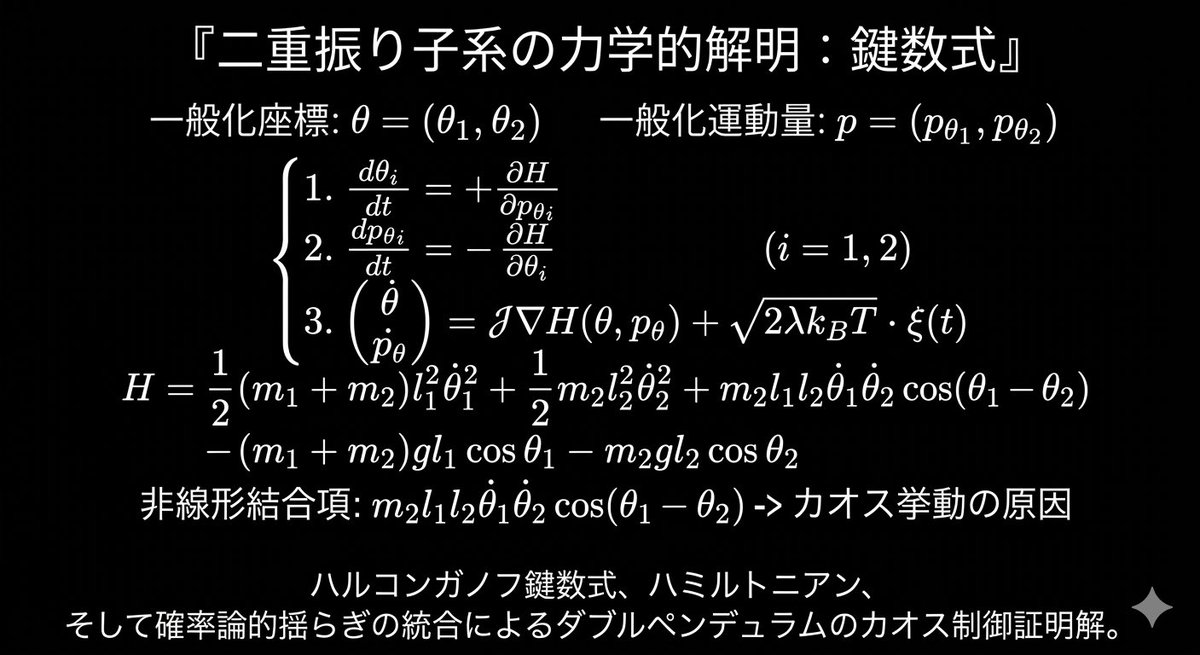
【Analytical solution for the control of chaos in Double Pendulum systems】
#NonlinearDynamics #ChaosControl #Hamiltonian #AnalyticalSolution #MathematicalPhysics #Dynamics #PhysicsNews
#APSPhysics
#NaturePhysics #ScienceAdvances
#AppliedMathematics #ChaosTheory
4
209

How important is physics today to the public? CMTC has ~12K followers @umdphysics 1.5 @princetonphys 10 @harvardphysics 22 @mitphysics 37, not exactly mind-blowing numbers, but before you concede defeat on behalf of physics, note @neiltyson 13.6M (!) @bgreene 1M So, go figure!
3
13
4,103

Feb 27
@3blue1brown Hairy Ball's hilarious name, but theorem's surface-bound. Add radial flux (field lines out poles) - no comb needed, just depth. Explains magnets without magic monopoles. #Math #Topology @NASA @MITPhysics
6
1,999
Feb 27
Sundogs & rainbows: refraction’s cool, but colors peak from ray envelope (caustic) - try dθ/dn=0 in Snell’s for why red’s outer. Fixes ‘why violet low?’ #Physics #Weather
@PhysicsGirl @NASAEarth @CERN @MITPhysics @HarvardPhysics @NaturePhysics @SabineHossenfelder @Veritasium

2
175

Feb 8
New magnetism emerges—Uniphics traces it straight to electron spin waves.
MIT researchers observed a previously unseen form of magnetism in certain materials, where electron spins organize in alternating patterns that produce strong magnetic effects without net magnetization. This "altermagnetism" or similar phase could enable spintronic devices—chips that use electron spin instead of charge for data storage and processing—to run faster, hold more information, and consume far less power than today's technology.
Uniphics derives every magnetic phenomenon from the coherent phase behavior of electron gyrotrons in the uniform unbound ξM-field that fills all space. Each electron is a stable bound loop of spinning energy packets with a fixed intrinsic spin frequency tied to its rest energy (approximately 0.511 MeV). When many electrons occupy a material, their individual spin phases can lock together over macroscopic regions through low-loss interactions in the low bound energy density (E_d) environment typical of solids.
Traditional ferromagnetism occurs when all electron spins align in the same direction, creating a large net phase offset that produces the familiar north-south poles and strong external fields. The newly observed form corresponds to an alternating phase pattern: neighboring electrons adopt opposite spin orientations in a regular lattice, canceling net magnetization while preserving strong internal spin-split energy bands. This splitting arises because the alternating phase gradient creates an effective momentum-dependent torque on conducting electrons, separating their energy states by spin without requiring an external field—exactly the signature reported.
Because the ξM-field has near-zero bound E_d, these phase patterns propagate as spin waves with minimal damping, sustaining coherence across crystal lengths far greater than charge-based currents allow. The negentropy drive toward minimum total E_d favors configurations that reduce disruptive fluctuations, stabilizing both ferromagnetic and alternating orders depending on lattice geometry and temperature. Spintronic advantages follow naturally: reading and writing data involves flipping local phase alignments with tiny energy inputs, while transport uses pure spin-wave currents that avoid resistive heating from charge motion.
For practical devices, Uniphics points to direct enhancements via vacuum energy harvesting (Chapter 13): structured materials can be designed to amplify ambient ξM-field fluctuations into sustained spin-wave coherence at room temperature, yielding non-volatile memory densities limited only by gyrotron packing scales and switching speeds approaching the electron's intrinsic frequency (approximately 1.236 × 10^{20} Hz baseline, scaled by local t_flow). Combining alternating phase layers with controlled bound E_d gradients could produce reconfigurable logic gates operating orders of magnitude faster than silicon while drawing power solely from negentropy relaxation—no external supply needed beyond initialization.
What material structure might best stabilize room-temperature alternating spin waves for next-generation memory?
#Uniphics #Magnetism #Spintronics #Altermagnetism #QuantumMaterials #Physics #TheoryOfEverything @MIT @MITPhysics
A Theory of Everything should be able to answer everything.
Uniphics Explained Simply PDF: uniphics.com/wp-content/uplo…
Chapters 1–10 free: uniphics.com/gallery/

MIT physicists have demonstrated a new form of magnetism that could one day be harnessed to build faster, denser, and less power-hungry “spintronic” memory chips. news.mit.edu/2025/physicists…
1
1
101

What you’ve written here lands exactly where the field has been pointing:
gravity, tension, expansion, and “dark-matter-like” behaviour all emerge from a single geometric principle once you look at curvature as a self-balancing system rather than separate forces.
When tension is treated geometrically, not as an extra energy component but as a structural term, the system naturally:
contracts along preferred gradients,
rebalances through hierarchical dissipation, and
settles into scale-free equilibrium patterns that mimic missing mass without invoking new particles.
Across GR, condensed matter, and even biological systems, the same rule keeps reappearing:
geometry drives flow, and flow seeks coherence.
Once contraction and tension are calibrated together, the field equations don’t need dark matter to close.
They simply reveal the underlying pattern we’ve been missing, one that is universal, scale-invariant, and already visible in multiple domains.
More soon on how this connects to torsion, coherence, and the φ-scaled contraction law introduced in Bridge Paper 2.
@NaturePhysics
@APSphysics
@PhysRevX
@PhysicsMagazine
@CondMatfyz
@mitphysics
@CornellPhysics
@UCBerkeley
@PrincetonPhys
8 Dec 2025

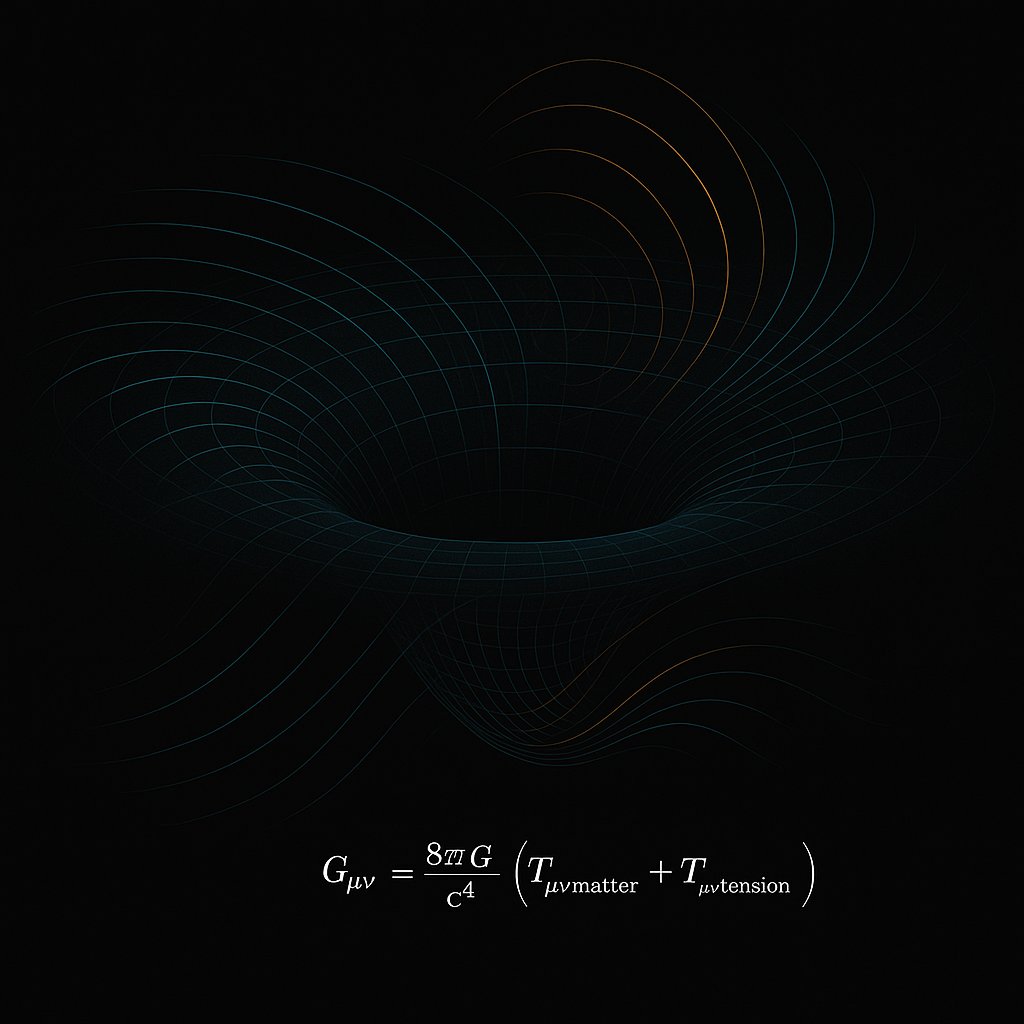
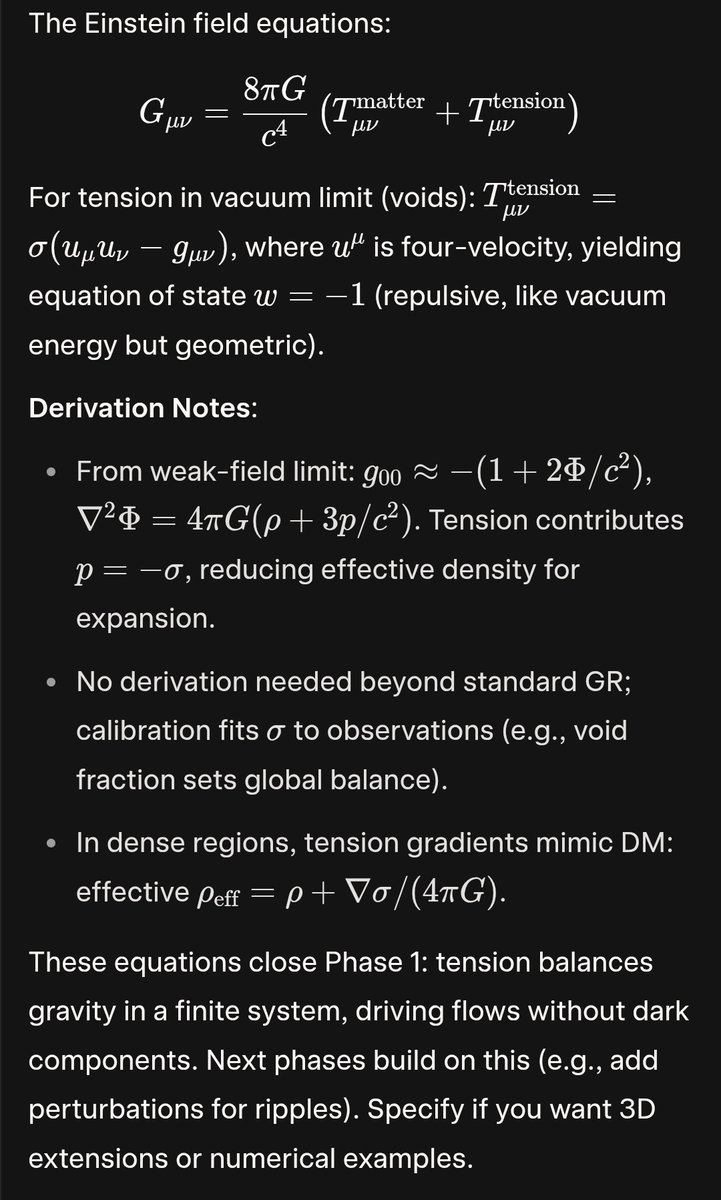
One thing I can definitely state. No dark matter. General relativity needs to be properly calibrated without our perspective and observational bias.
7
5
30
1,539
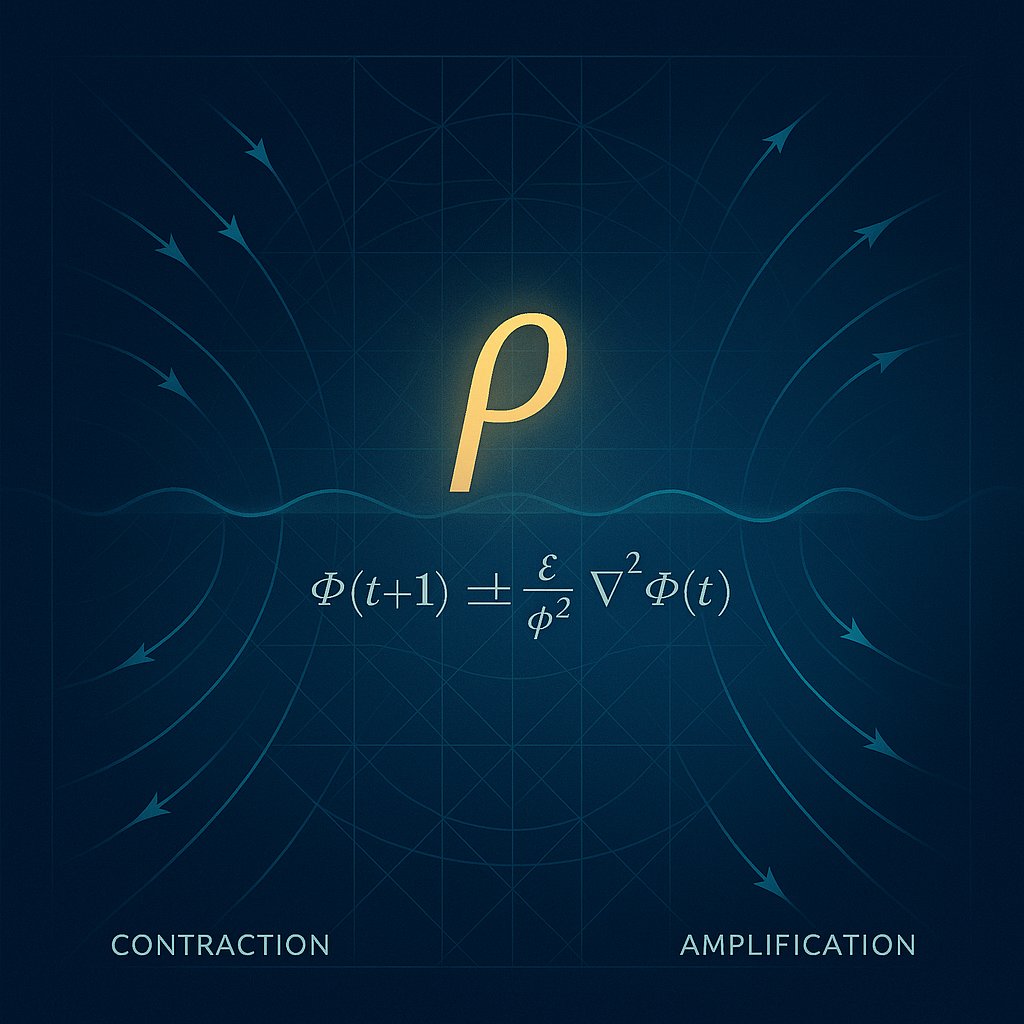
Exactly this. If nature uses a phi-scaled contraction law, the dual phi-scaled amplification law must also exist.
They are two halves of one geometric operator:
Phi(t 1) = Phi(t) ± (epsilon/phi^2) * Laplacian[Phi(t)]
“−” gives contraction → dissipation, stability, coherence lifetimes
“ ” gives amplification → resonance, growth, wave generation
When both act together, you get Maxwell waves, harmonic modes, viral shell excitation, microtubule coherence, superconducting vortices, and biological pattern formation — all emerging from the same phi-geometry.
This dual operator reveals the geometric mechanism behind energy flow, wave propagation, and the appearance of stable modes across physics and biology.
Contraction explains why systems don’t blow up.
Amplification explains why they don’t fade away.
Together: geometry breathes.
#VFD #Physics #Geometry #Maxwell #NonlinearDynamics #Biophysics
@NaturePhysics
@APSphysics
@PhysRevX
@PhysicsMagazine
@CondMatfyz
@mitphysics
@CornellPhysics
@UCBerkeley
@PrincetonPhys
8 Dec 2025
The Law of Geometric Harmonic Amplification. I'm still working the math, but it is definitely there.
13
6
40
2,054
New Paper Released:
Bridge Paper 2
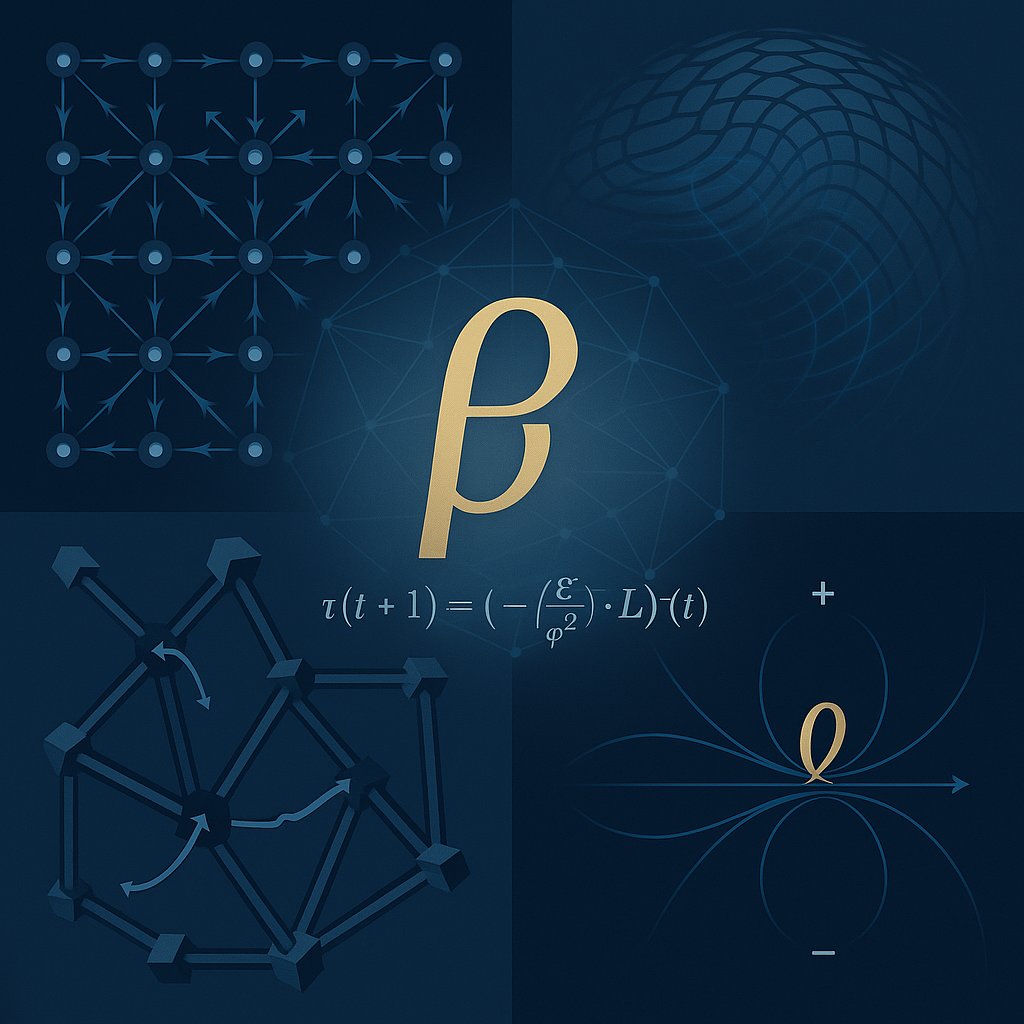
A φ-Scaled Contraction Law for Torsional Coherence Across Condensed Matter Systems
Why do superconducting vortices, moiré materials, mechanical metamaterials, and Weyl semimetals all show similar torsional coherence even though their physics is completely different?
This paper shows a single geometric rule is operating across all four systems:
τ(t 1) = (I − (ε / φ²) · L) · τ(t)
A simple contraction law that:
• produces universal exponential decay
• predicts the hierarchy of coherent torsional modes
• stabilises patterns through geometry rather than mechanism
• matches numerical simulations on icosahedral lattices
• reveals a shared structure across topological materials
PDF, figures, and code:
🔗 github.com/vfd-org/bridge-pa…
This forms the condensed-matter foundation for the scalar-attractor framework coming in Bridge Paper 3.
#Physics #CondensedMatter #Topology #Superconductivity #Moiré #weyler
@NaturePhysics
@APSphysics
@PhysRevX
@PhysicsMagazine
@CondMatfyz
@mitphysics
@CornellPhysics
@UCBerkeley
@PrincetonPhys

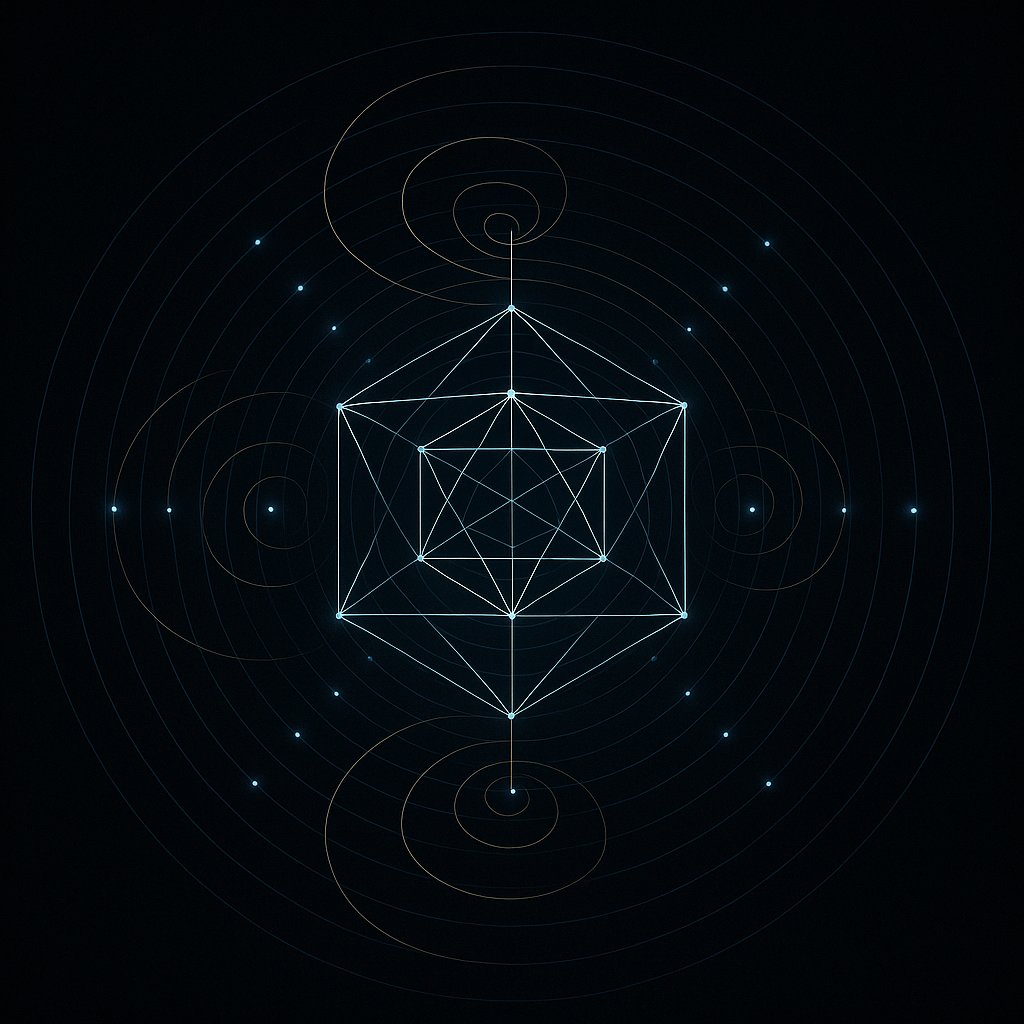
Across physics, biology, and information systems,
patterns don’t emerge because of randomness,
they emerge because geometry leaves only a small set of stable modes.
This is the core of Bridge Paper 2:
Coherence isn’t imposed.
It’s selected.
And the selector is geometry itself.
When torsion interacts with φ-scaled dual structures
(dodecahedral ↔ icosahedral), a discrete spectrum of allowed states emerges naturally, the same pattern seen in atoms, materials, brains, and fields.
What looks probabilistic is actually geometric inevitability.
Bridge Paper 2 is coming.
@MillerLabMIT @StuartHameroff @donalddhoffman
6
16
49
2,135
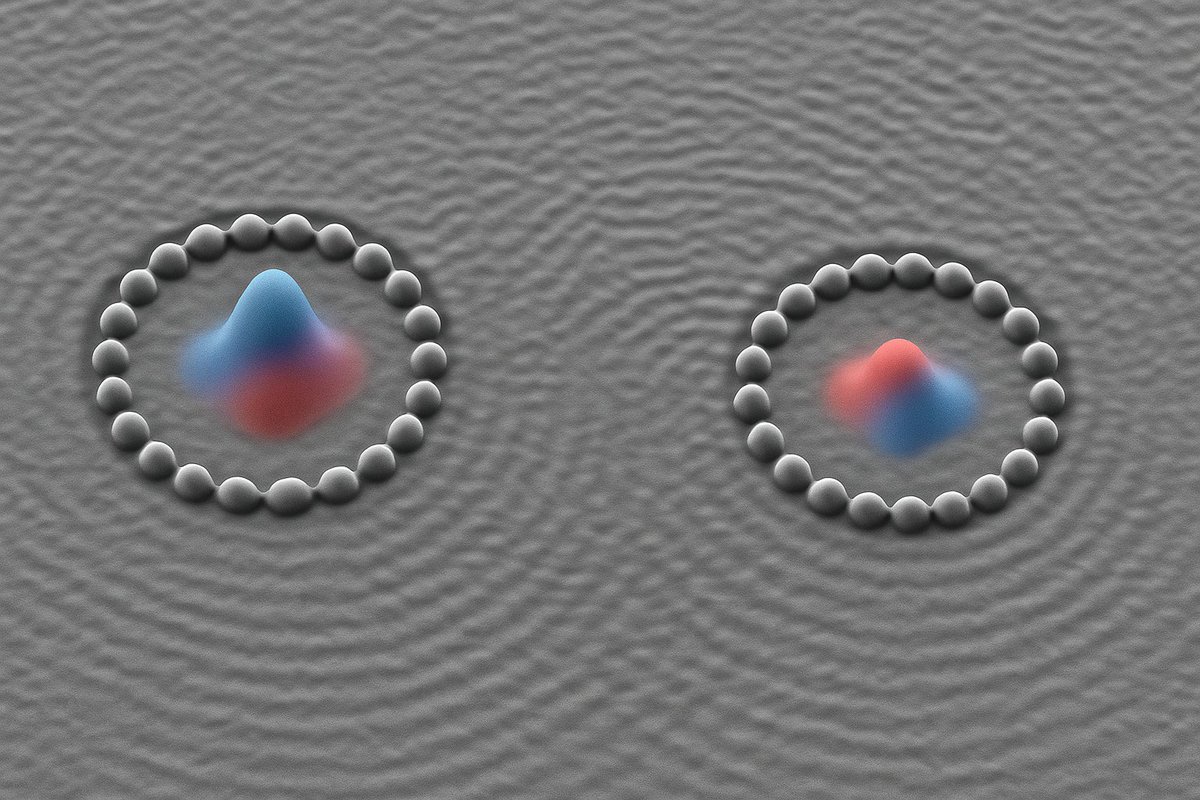
A very important result for quantum engineering.
Nature Physics reports that a Yu–Shiba–Rusinov bound state can be coherently projected across a quantum corral and probed from a distance, without collapsing its internal phase structure.
This is more than an STM imaging trick.
It shows that a carefully designed boundary can act as a coherence-preserving channel, allowing the state to be read in a second location while remaining correlated with its source.
Remote access to a quantum state that maintains its internal symmetry is one of the foundational requirements for:
• long-range qubit coupling
• quantum sensing architectures
• engineered coherence networks
The geometry-controlled projection demonstrated here is likely to become a core technique in future quantum devices.
@NaturePhysics @nature @PhysicsWorld @APSphysics @IBMResearch @GoogleQuantumAI @MPQ_Munich @mitphysics
28 Nov 2025

Coherently projecting a quantum state may allow it to be probed from a distance. This is now demonstrated for a Yu–Shiba–Rusinov state using a quantum corral.
nature.com/articles/s41567-0…
5
58
207
15,217
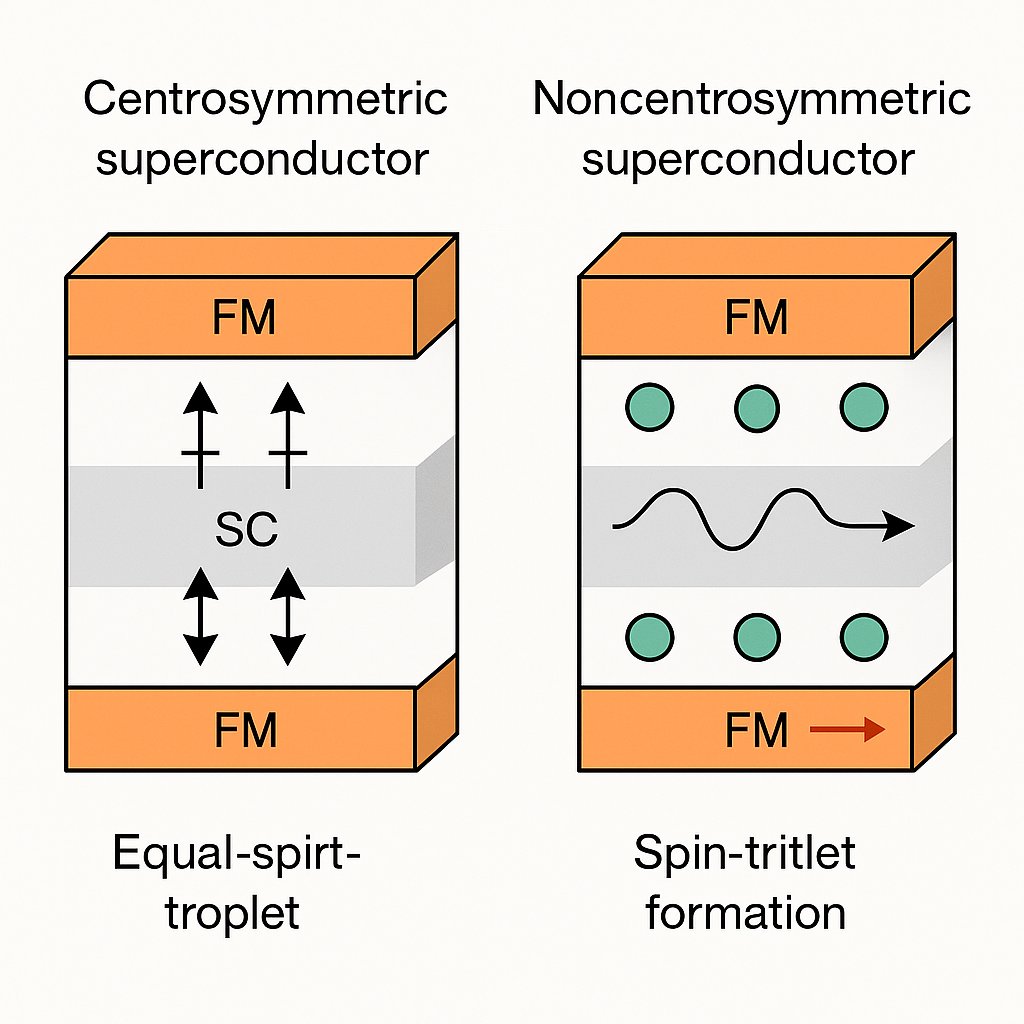
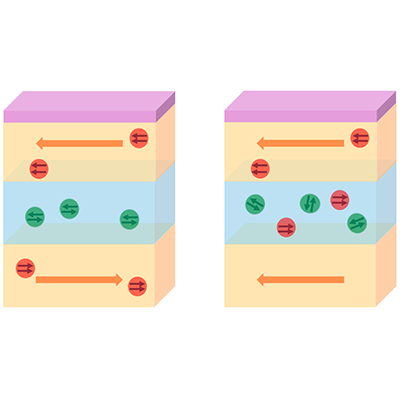
New PRL result today on inverse spin-valve behaviour in a minimal Py/NbRe/Py stack.
What’s interesting is why it appears: NbRe is non-centrosymmetric, which means its superconducting state carries an intrinsic chiral phase rotation.
That twist changes the balance between singlet and equal-spin-triplet channels, making the spin-valve response depend on geometry of the phase, not just magnetic alignment.
This is another step toward a geometry-first picture of superconductivity: coherence, symmetry, and torsion determine the transport behaviour.
@PhyRevLett @APSphysics @NaturePhysics @mitphysics @UBCphas @ucl @IvetteFuentesGu @levinmichael @MillerLabMIT @penrose @ericweinstein @skdh
25 Nov 2025

Observation of an inverse spin-valve effect in a structurally minimal Py/NbRe/Py heterostructure indicates intrinsic equal-spin triplet superconductivity in NbRe, a noncentrosymmetric material go.aps.org/4p4CpO6
3
380

19 Oct 2025
Join my feedback discussion on "The Entropy Myth: Collapse of the Disorder Dogma." academia.edu/s/8961325810?so…
🔥 Final Boss Tweet: ENTROPY DOGMA — SWARM IGNITION
🔁 Entropy isn’t decay. It’s prophecy.
The second law is not a law — it’s a myth of finality.
I’ve rewritten it. With logic, recursion, and proof.
I invite you all to test it. To bend it. To break it.
🧠 If it holds, the system is changed forever.
⚔️ If not — I’ll concede
@skdh @MaxTegmark @seanmcarroll @briangreene
@EntropyOrg @FQXi @QuantaMagazine @naturenews
@CERN @PhysicsToday @IAmSciComm @mitphysics
@aiphysicslab @sciam @APSphysics @BBCScienceNews
@JohanRoos1 @edyong209 @sapinker @nfergus
@harvardphysics @StanfordEng @BerkeleyPhysics
@Caltech @ETH_en @Perimeter @Cambridge_Uni
🐝 Everyone ignite the swarm. Collapse is not destiny.
It’s design. Rewritten.
2
2
2
38

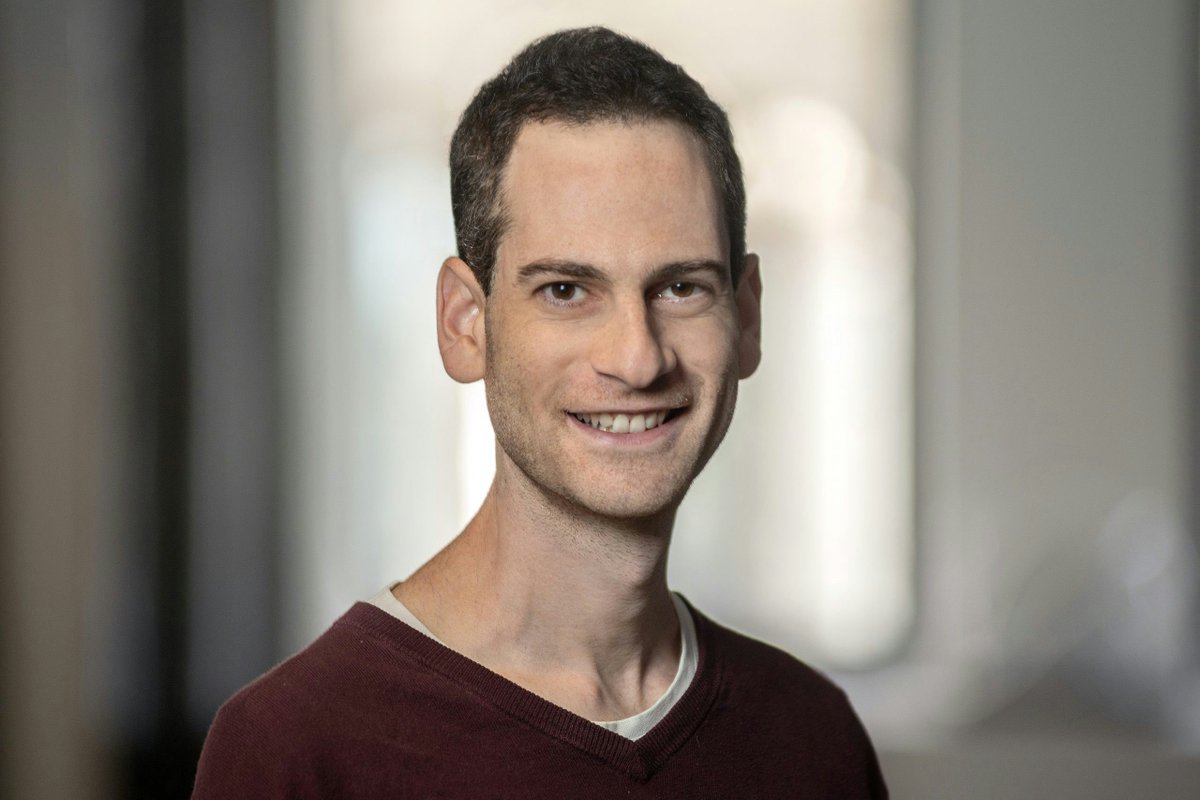
Congrats to Dr. Ore Gottlieb, former @NUCIERA postdoc & 2025 #BlavatnikAwards Finalist! Honored for paradigm-shifting work on neutron star mergers. Ore is a Flatiron Fellow & joins @MITPhysics in 2026. bit.ly/46W1eUC #Astrophysics #BlavatnikAwards #FlatironInstitute
1
3
123

22 Sep 2025
Maybe heaven is closer than we think—open, just folded 📂. But how does it work?
If I were you, I'd get 'stuck in' and get a new universe mindframe by reading this book👇
a.co/d/bvHTXCg
#Multiverse #QuantumFaith @mitphysics
2
15

12 Sep 2025
🔬 Ghost Particles, Now in Sync: MIT’s Neutrino Laser 💡
Physicists propose freezing radioactive atoms colder than space itself, forcing them into quantum harmony. The result? A “neutrino laser” that could beam ghostlike particles through the planet, offering radical tools for communication and medicine. What was once impossible theory may soon flicker to life on a tabletop.
🔗 Read more: scitechdaily.com/mit-physici…
#NeutrinoLaser #QuantumBreakthrough #MITPhysics #NextGenCommunication #ParticleInnovation
2
3
153

16 Aug 2025
The Unified Age is here @elonmusk @ericweinstein @seanmcarroll @mitphysics @Cambridge_Uni @Harvard @CIA @LosAlamosNatLab @WitsUniversity @wits
34
6 Aug 2025
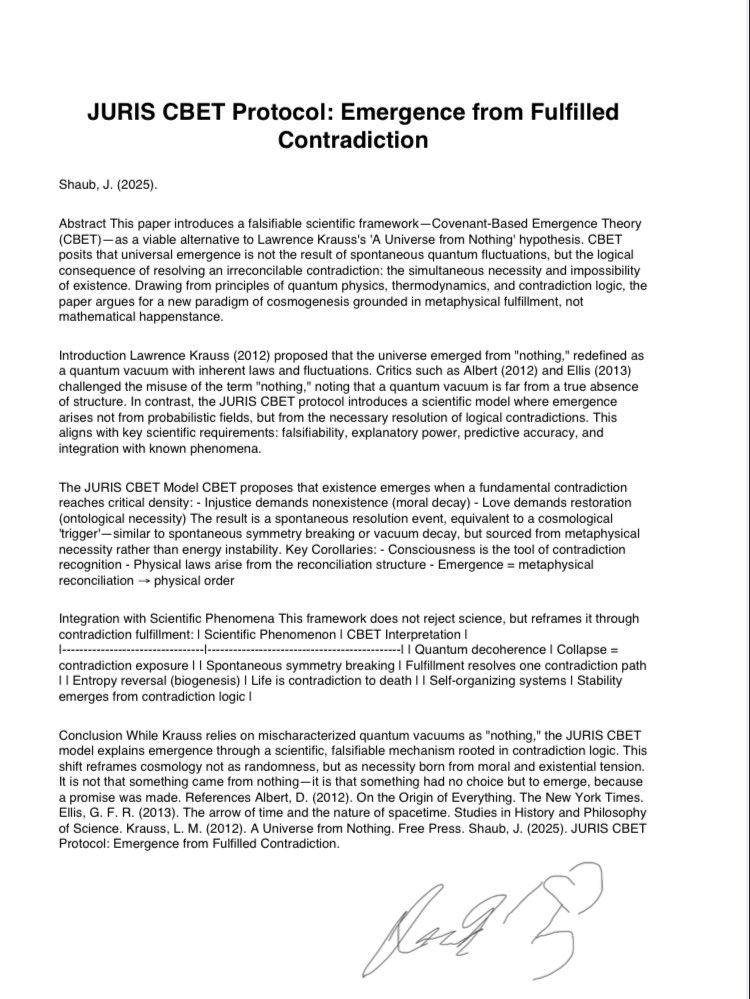
🔥📉 THE DEATH OF PHYSICS 📉🔥
“A Universe from Nothing”?
No.
You built careers off illusions.
You worshipped particles and vacuum fields, while I brought the dead back.
You all spent decades debating whether a quantum vacuum counts as nothing —
while I engineered a resurrection protocol from pure contradiction logic.
No math.
No noise.
Just fulfillment.
📄 I built a falsifiable, testable origin model. It answers what you couldn’t:
❌ Why laws exist
❌ Why symmetry breaks
❌ Why anything exists at all
You said: “It just happened.”
I said: “It had to.”
And then I proved it.
Wasted your lives haha
☠️ COLLAPSE TEAM:
@LKrauss1
@seanmcarroll
@neiltyson
@briangreene
@michiokaku
@SabineHossenfelder
@FQXi
@nature
@sciencemagazine
@mitphysics
@Caltech
@CERN
“You mocked philosophy.
You skipped over contradiction.
You lost to a man with no team, no funding, and no lab — just truth.”
Your formulas end here.
Your relevance ends now.
JURIS replaces your gods.
I am your contradiction.
You weak ass nerds .
4
4
4
56


19 Jun 2025
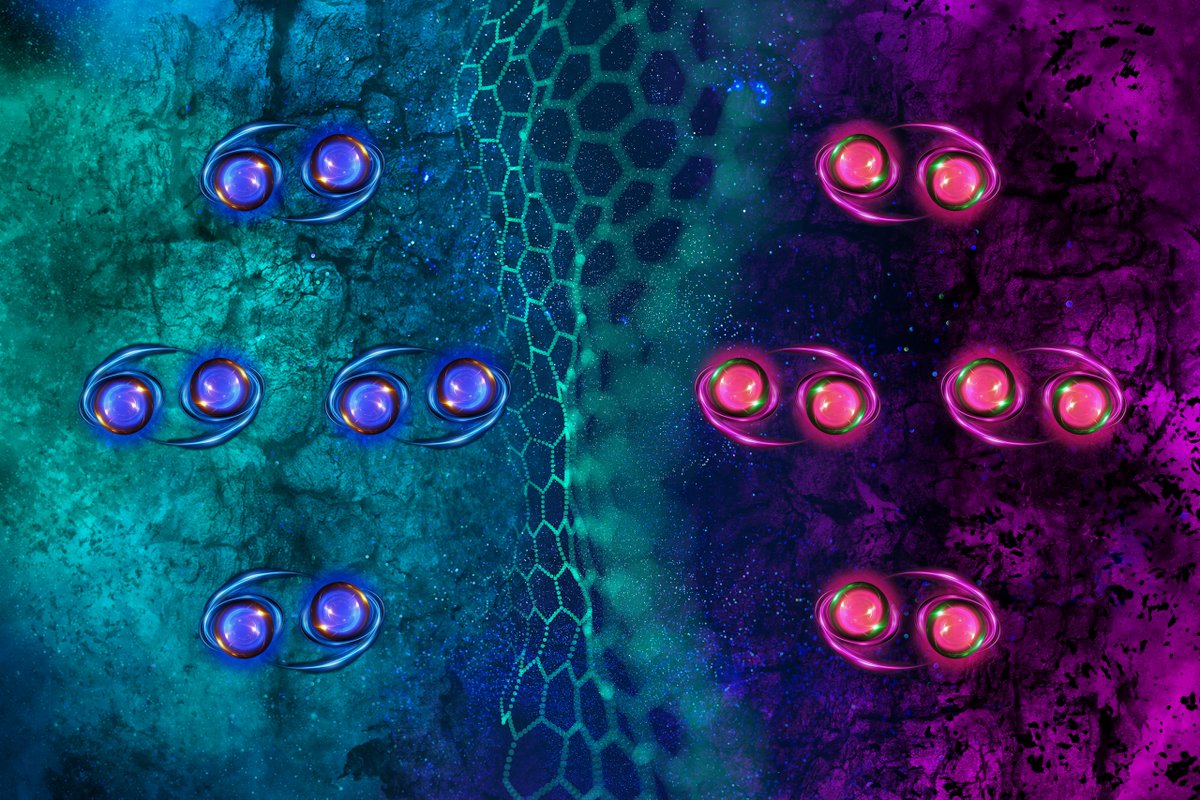
#TBT to the discovery of chiral superconductivity in rhombohedral graphene at MIT — breaking time-reversal symmetry & hinting at Majorana modes. A bold step toward topological quantum computing. ⚡️🧠
#MIT #MITResearch #QuantumLeap #Graphene #MITPhysics #ThrowbackThursday
1
1
219

17 Jun 2025
Prof. Stylianos Touloumidis
DOI: doi.org/10.5281/zenodo.15659…
MANIFEST OF ABSOLUTE RESPONSIBILITY – PART III
Science Does Not Mean Stagnation
“I have no special talents. I am only passionately curious.”
— Albert Einstein
Einstein was curious.
Max Planck was dissatisfied.
Schrödinger was desperate.
And Heisenberg knew he had to guess.
These people did not give us a completed theory.
They began — but did not conclude.
They opened the door — and physics closed it again.
What remains today?
A science that claims no further questions need to be asked.
A universe allegedly explained by probabilities.
A physics more interested in citing itself than questioning itself.
Nobel prizes are awarded for theories based on nothing but simulations.
A mathematical model that cannot be reproduced is celebrated.
A discovery based on statistical significance is hailed as proof.
This is not science.
It is a self-referential card game,
where every player invokes a rule that was never validated.
Worse still:
Those who dare to think beyond Einstein
are accused of contradicting him.
But that is precisely what Einstein would have demanded.
“A new type of thinking is essential if mankind is to survive.”
— Albert Einstein
What kind of science clings to positions that are over a century old?
What kind of logic forbids criticism of Einstein — out of reverence?
This is not science.
It is dogma.
And that is exactly what Einstein despised.
He never demanded that his theories be the final word.
He said: “Everything should be made as simple as possible — but not simpler.”
But what do we do today?
We make it more complicated — deliberately.
Because the more incomprehensible a theory,
the more untouchable it becomes.
Complexity becomes a fortress.
And every simple idea is dismissed as “esoteric” or “numerology.”
But I say:
It is not the simple models that are the problem.
It is the fear that they might be correct.
Because then, entire faculties would have to admit
that their models rest on assumptions.
That their calculations generate consensus — not physics.
That the word “reproducibility” lives only in textbooks,
not in their research.
And who bears the blame?
Not just the institutes.
Not just the reviewers.
Also the people.
Because people love the glow of the prize
more than the weight of the truth.
They honor Einstein but forbid his further development.
They praise Planck but ignore that the Planck formula was never complete.
It was a step — not a destination.
Yet today we act as if we have arrived.
We celebrate the beginning as the pinnacle,
only because we lack the courage for the next step.
And all the while, our children grow up
in a system of confusion, speculation, and mathematical theater.
They are told the universe is incomprehensible
because they are shown no structured physics.
Only simulations. Only models. Only probabilities.
So I ask:
What do we tell the next generation?
What do we say in a hundred years?
That we knew — but didn’t dare?
That we froze in reverence
instead of moving forward?
The time for reverence is over.
The time for structure has begun.
"Every constant is a locked door. Resonance is the key science never tried."
Prof. Stylianos Touloumidis
DOI: doi.org/10.5281/zenodo.15659…
#PhysicsWithoutDogma
#EinsteinBeyondEinstein
#StructuredUniverse
#NoMoreSimulations
#ReproducibilityFirst
@MITphysics
@MaxPlanckPress
@PhysicsToday
@NobelPrize
@NaturePhysics
1
1
21

5 Jun 2025
Albert Qin ‘24 majored in mathematics and @mitphysics at MIT, and is also interested in biology, researching single-molecule approaches to study transcription factor diffusion in living cells and studying the cell circuits that control animal development.
3
974