
Jun 12
🤔 "It's just a theory."
In everyday conversation, that phrase usually means "it's just a guess."
But in science, a theory is one of the strongest forms of knowledge we have.
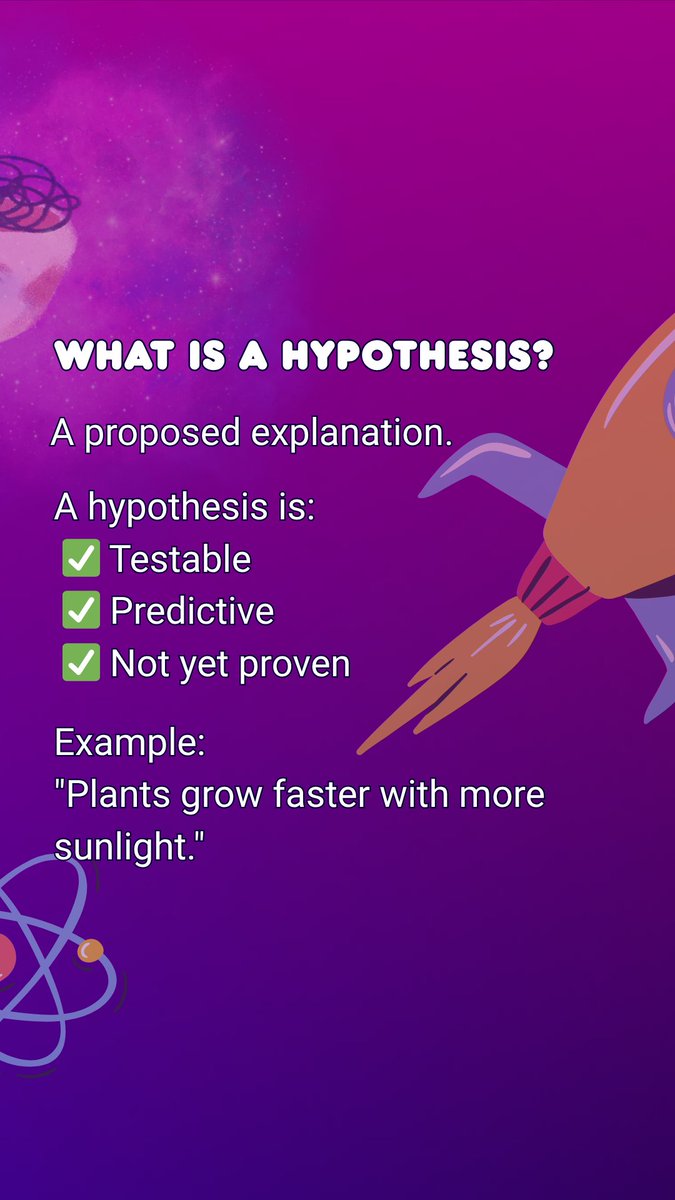
A hypothesis is a testable idea or prediction.
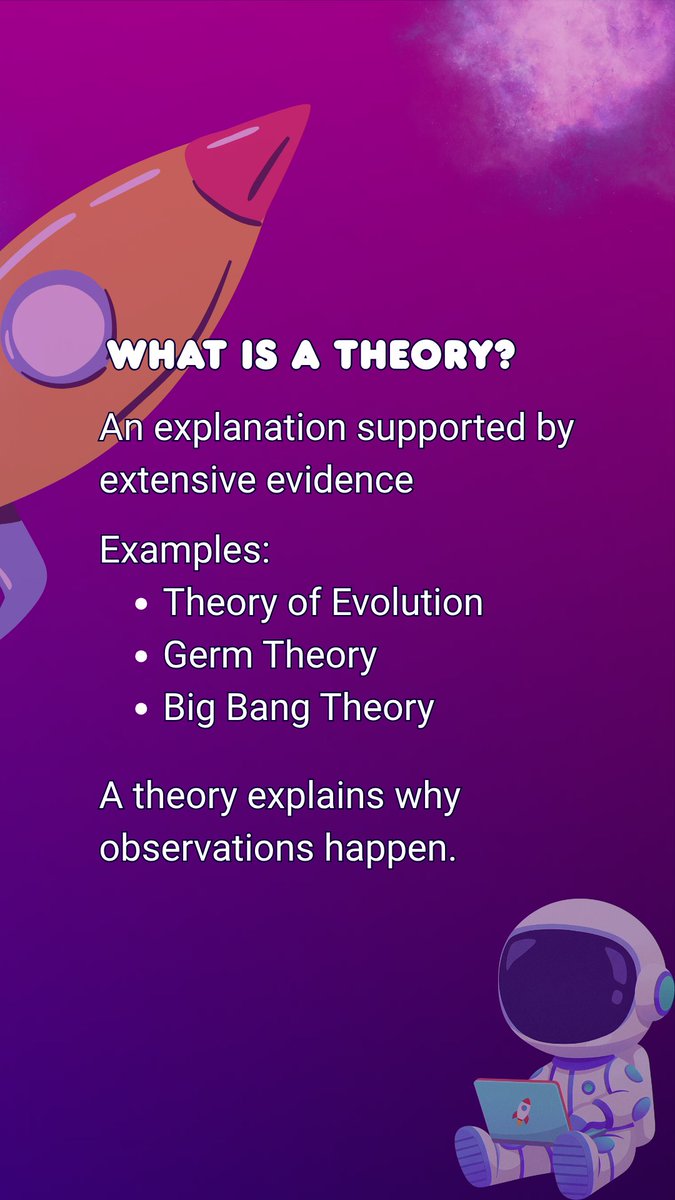
A scientific theory is an explanation that has survived repeated testing, observations, and scrutiny from the scientific community.
For example:
🔬 Germ Theory explains how diseases spread.
🦕 Evolution explains how species change over time.
🌌 The Big Bang Theory explains the evolution of the universe.
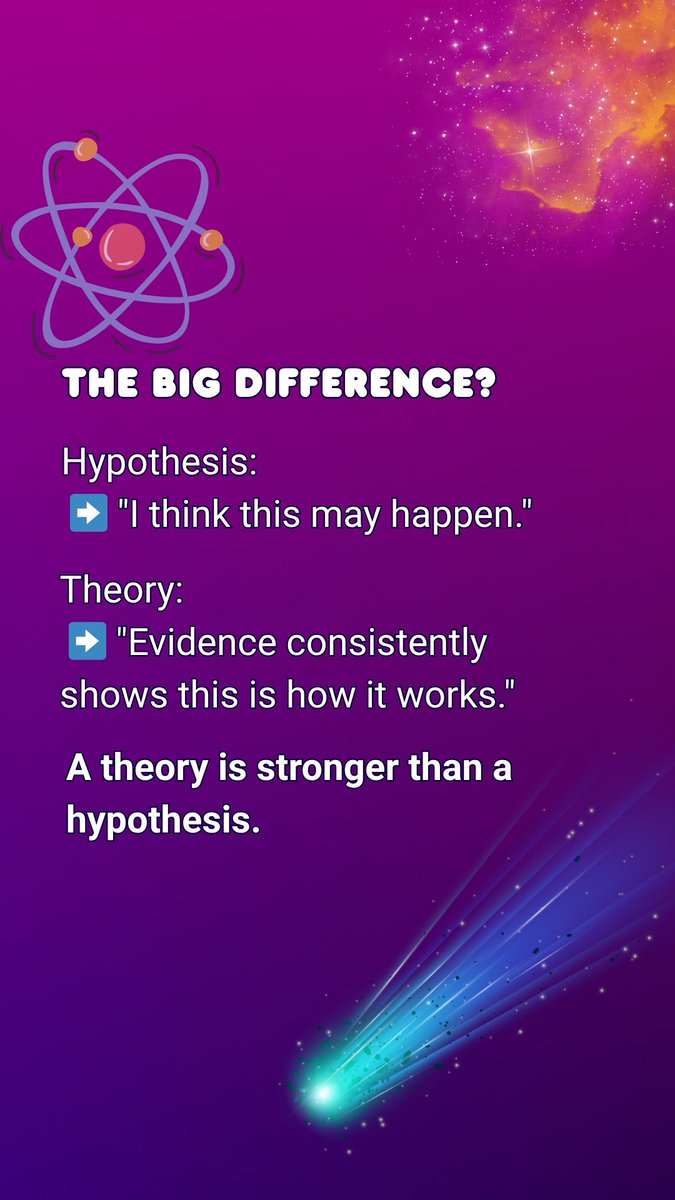
Theories aren't guesses.
They're evidence-backed explanations that help us understand reality.
Science advances by testing ideas—not by assuming they're true.
💬 Before today, did you think a theory was just a guess?
What's another science term people often misunderstand?
#ScienceExplained #ScientificMethod #ScienceFacts #STEMEducation #AstronomyFacts #CriticalThinking #LearnScience #DidYouKnow #ScienceCommunication #UniverseExplained #SpaceScience #Education #Astrobitica #ScienceContent #CuriousMinds
3

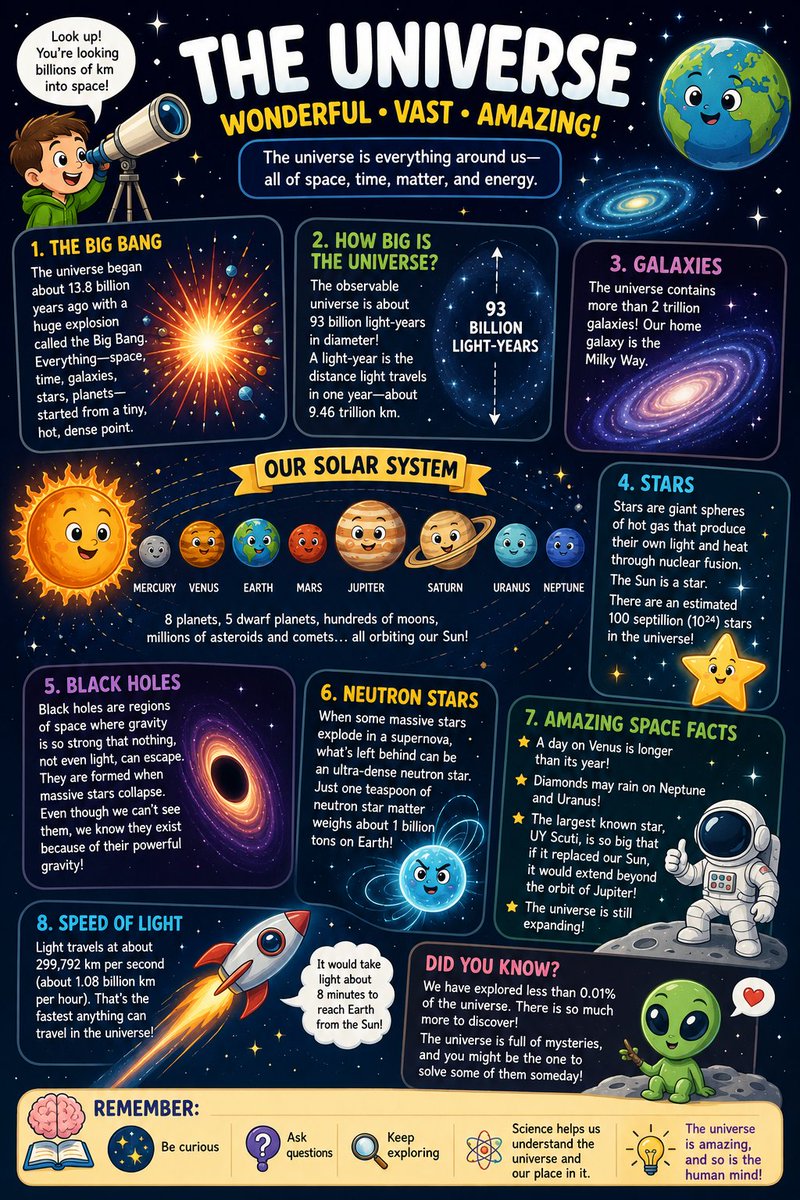
🌌✨ THE UNIVERSE: WONDERFUL • VAST • AMAZING! ✨🌌
Did you know? 🤔
🌠 The Universe began about **13.8 billion years ago** with the Big Bang.
🌌 Scientists estimate there are **over 2 trillion galaxies** in the observable universe.
⭐ The Sun is just one of an estimated **10²⁴ stars** in the cosmos.
🕳️ Black holes can trap even light with their immense gravity.
💎 It may actually rain diamonds on Uranus and Neptune!
🚀 Light travels at an incredible **299,792 km/s**.
🔭 We have explored less than **0.01%** of the Universe—countless discoveries still await!
The more we learn about space, the more we realize how extraordinary our Universe truly is. Every star, galaxy, and planet tells a story of science, exploration, and curiosity. 🌍❤️
🔬 Science is not just about answers—it's about asking better questions.
📸 Which space fact amazed you the most? Let us know in the comments! 👇
@NASA @ESA @NASAHubble @NASAWebb @ESO @ISRO @IASC @UNESCO @ScienceMagazine @NaturePortfolio @NationalGeographic @SkyandTelescope
#Universe #Space #Astronomy #Astrophysics #Cosmos #Science #STEM #SpaceFacts #Galaxy #MilkyWay #BlackHole #Stars #Planets #SolarSystem #BigBang #JamesWebb #JWST #NASA #ESA #ISRO #SpaceExploration #ScienceCommunication #ScienceEducation #Physics #Cosmology #ScientificFacts #ScienceForEveryone #STEMEducation #LearnScience #DidYouKnow #UniverseFacts #AstronomyLovers #SpaceLovers #SkyWatching #NightSky #ScienceOutreach #Education #Innovation #FutureScientists #DistrictCommunityScienceCentre #GUJCOST
9
12
237
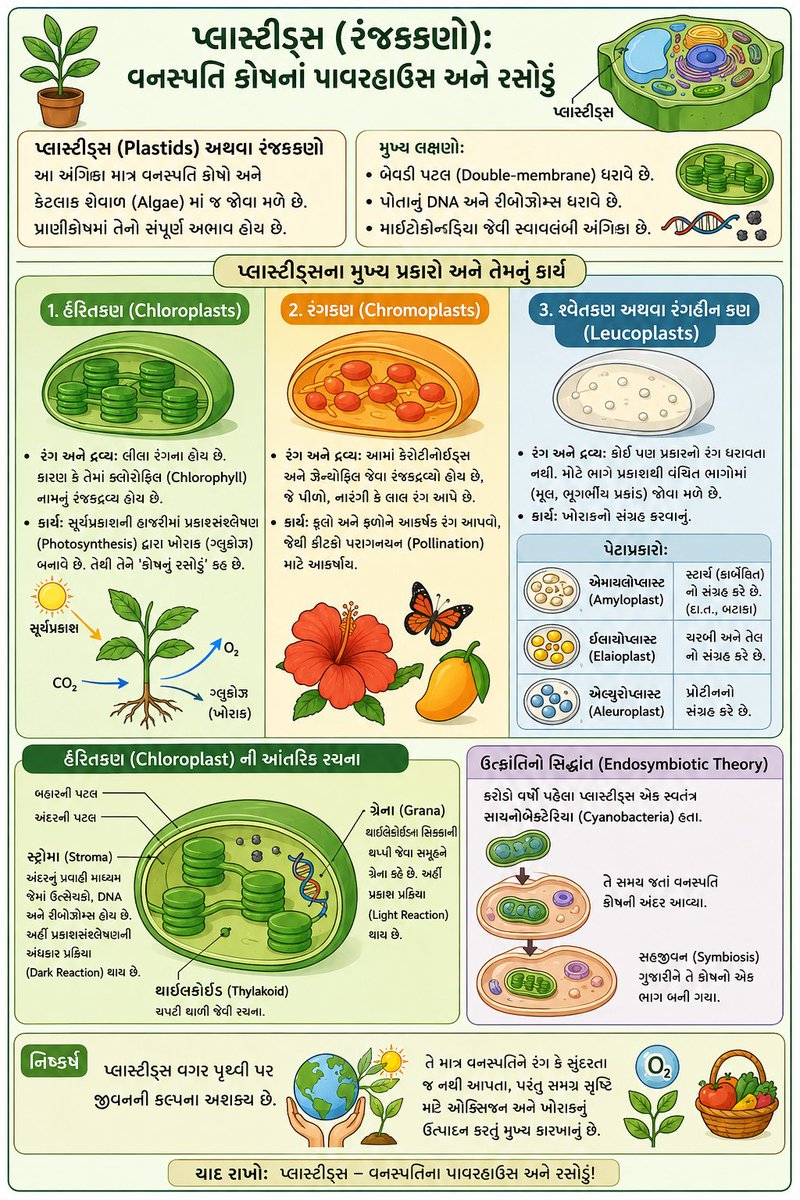
🌿🔬 પ્લાસ્ટીડ્સ (રંજકકણો): વનસ્પતિ કોષનાં પાવરહાઉસ અને રસોડું! 🔬🌿
શું તમે જાણો છો? 🤔
પૃથ્વી પરના લગભગ તમામ જીવસૃષ્ટિના અસ્તિત્વ પાછળ વનસ્પતિઓમાં રહેલા પ્લાસ્ટીડ્સ (Plastids) નો ખૂબ મોટો ફાળો છે!
✅ માત્ર વનસ્પતિ કોષો અને શેવાળ (Algae) માં જ જોવા મળે છે.
✅ પોતાનું DNA અને Ribosomes ધરાવે છે.
✅ ખોરાક અને ઓક્સિજનનું ઉત્પાદન કરે છે.
✅ ફૂલો અને ફળોને આકર્ષક રંગ આપે છે.
✅ સ્ટાર્ચ, ચરબી અને પ્રોટીનનો સંગ્રહ કરે છે.
🌱 હરિતકણ (Chloroplasts)
☀️ સૂર્યપ્રકાશની મદદથી Photosynthesis દ્વારા ગ્લુકોઝ બનાવે છે.
🌍 પૃથ્વીના ઓક્સિજન ચક્રનું મુખ્ય કેન્દ્ર!
🍊 રંગકણ (Chromoplasts)
🌺 ફૂલોને અને 🍅🍋 ફળોને લાલ, પીળા અને નારંગી રંગ આપે છે.
🐝 પરાગનયન માટે જીવજંતુઓને આકર્ષે છે.
🥔 શ્વેતકણ (Leucoplasts)
📦 સ્ટાર્ચ, ચરબી અને પ્રોટીનનો સંગ્રહ કરે છે.
🌱 મૂળ અને ભૂગર્ભીય ભાગોમાં વધુ જોવા મળે છે.
🧬 વૈજ્ઞાનિકો માને છે કે પ્લાસ્ટીડ્સ કરોડો વર્ષ પહેલાં સ્વતંત્ર Cyanobacteria હતા, જે પછી વનસ્પતિ કોષો સાથે સહજીવનમાં જોડાઈ ગયા! (Endosymbiotic Theory)
🌎 પ્લાસ્ટીડ્સ વગર પૃથ્વી પર જીવનની કલ્પના અશક્ય છે!
📸 ઇન્ફોગ્રાફિક જુઓ, શેર કરો અને વિજ્ઞાનને જનજન સુધી પહોંચાડો!
@GUJCOSTOfficial @IndiaDST @VigyanPrasar @CSIR_IND @moesgoi @PIB_India @IndiaScience
#Plastids #Chloroplast #Chromoplast #Leucoplast #Photosynthesis
#PlantScience #CellBiology #BiologyFacts #ScienceEducation
#STEM #LifeScience #Botany #Microbiology #ScienceFacts
#GujaratiScience #ગુજરાતીવિજ્ઞાન #વિજ્ઞાન #શિક્ષણ
#ScienceCommunication #ScienceForAll #Nature #Oxygen
#PlantCell #Biotechnology #Research #Innovation
#DistrictCommunityScienceCentre #CSCNavsari #GUJCOST
#ScienceAwareness #LearnScience #ScientificKnowledge
🌿🔬📚
4
5
64
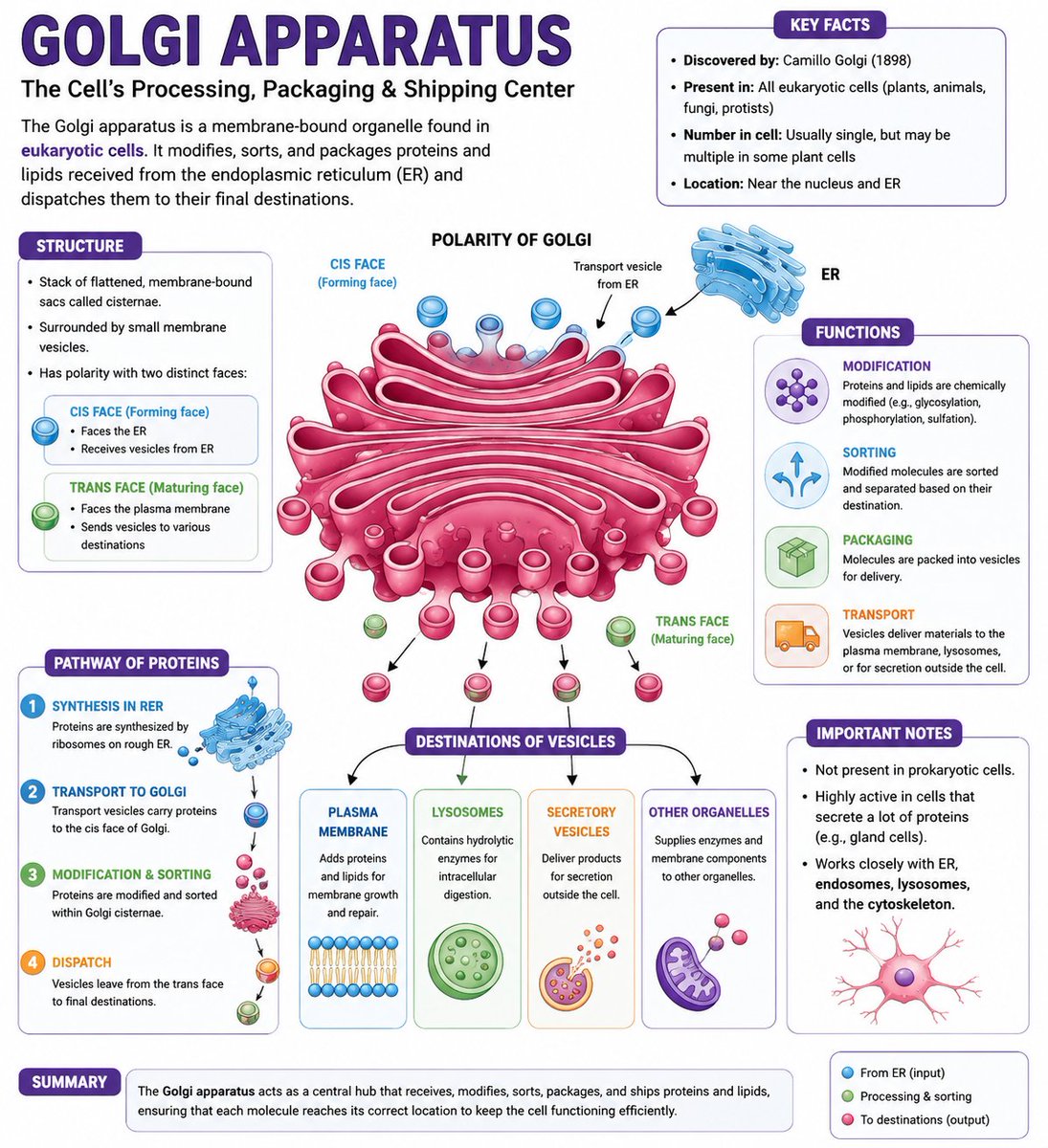
🔬🧬 Meet the Cell's Logistics Hub: The Golgi Apparatus!
Every second, millions of proteins and lipids are processed, modified, sorted, packaged, and shipped inside your cells—and the Golgi Apparatus is at the center of it all.
📦 Think of it as the cell's processing, packaging, and distribution center.
🔍 Key Scientific Facts:
✅ Present in almost all eukaryotic cells (animals, plants, fungi, and protists)
✅ Consists of stacks of flattened membrane sacs called cisternae
✅ Receives proteins and lipids from the Endoplasmic Reticulum (ER)
✅ Chemically modifies molecules through processes such as:
• Glycosylation
• Phosphorylation
• Sulfation
✅ Sorts and packages cellular cargo into vesicles
✅ Directs materials to:
📍 Plasma membrane
📍 Lysosomes
📍 Secretory vesicles
📍 Other organelles
🧠 Why is it important?
Without the Golgi Apparatus, cells could not properly transport proteins, secrete hormones, build membranes, or maintain cellular organization.
🔬 The Golgi works closely with:
• Endoplasmic Reticulum (ER)
• Lysosomes
• Endosomes
• Cytoskeleton
⚡ Fun Fact:
The Golgi Apparatus was discovered by Italian scientist Camillo Golgi and remains one of the most important organelles in modern cell biology.
🌍 Understanding the Golgi helps scientists study:
🧬 Genetics
💊 Drug delivery
🦠 Diseases
🧠 Neuroscience
🔬 Cell biology
⚕️ Biotechnology
Science is not just about what we can see—it's also about understanding the incredible microscopic factories working inside every living cell.
#GolgiApparatus #CellBiology #Biology #MolecularBiology #CellScience #LifeScience #STEM #ScienceEducation #Biotechnology #Biochemistry #Genetics #Microbiology #Neuroscience #MedicalScience #Healthcare #ScientificIllustration #Infographic #ScienceCommunication #STEMEducation #Research #ScienceFacts #CellStructure #ProteinSynthesis #MolecularScience #FutureScientists #Education #LearnScience #Biotech #ScienceForEveryone #BiologicalSciences
@Nature @ScienceMagazine @CellPressNews @TheLancet @NEJM @NIH @wellcometrust @UNESCO @WHO @HHMINEWS @ASCBiology @BiophysicalSoc @BiochemSoc @EMBO @NatureReviews @SpringerNature @ElsevierConnect @WileyGlobal @PLOS @eLife @NIHResearch @NASA @ISRO @IndiaDST @DBTIndia @CSIR_IND @GUJCOST
5
22
519

🦗 Have you ever wondered how some insects can walk on water without sinking?
The secret is Surface Tension
🌐 chemistrynotesinfo.com/2026/…
#SurfaceTension #ScienceFacts #Chemistry #LearnScience #ChemistryNotesInfo

45
Jun 7
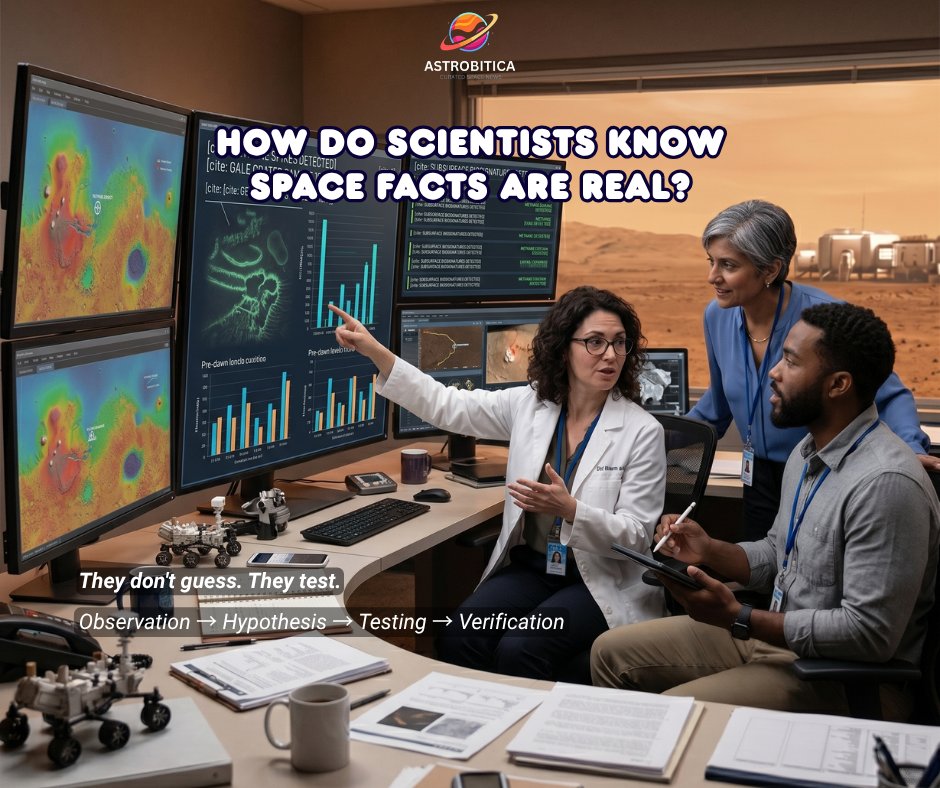
How do scientists know what stars are made of?
How do they discover planets around distant suns?
How can they study galaxies millions of light-years away?
𝐓𝐡𝐞 𝐚𝐧𝐬𝐰𝐞𝐫 𝐢𝐬 𝐭𝐡𝐞 𝐒𝐜𝐢𝐞𝐧𝐭𝐢𝐟𝐢𝐜 𝐌𝐞𝐭𝐡𝐨𝐝.
Scientists gather observations using telescopes, satellites, spacecraft, and detectors. They form hypotheses, test them against evidence, and compare results with independent observations.
If the evidence consistently supports the same conclusion, confidence in that explanation grows.
That's why science isn't based on belief or assumptions.
It's built on evidence that can be tested, challenged, and verified.
Every confirmed space discovery—from exoplanets to black holes—has survived this process.
The universe leaves clues.
Science is how we read them.
💬𝐖𝐡𝐚𝐭'𝐬 𝐚 𝐬𝐩𝐚𝐜𝐞 𝐟𝐚𝐜𝐭 𝐭𝐡𝐚𝐭 𝐬𝐞𝐞𝐦𝐬 𝐮𝐧𝐛𝐞𝐥𝐢𝐞𝐯𝐚𝐛𝐥𝐞 𝐛𝐮𝐭 𝐢𝐬 𝐚𝐜𝐭𝐮𝐚𝐥𝐥𝐲 𝐛𝐚𝐜𝐤𝐞𝐝 𝐛𝐲 𝐞𝐯𝐢𝐝𝐞𝐧𝐜𝐞?
#ScientificMethod #ScienceExplained #AstronomyFacts #SpaceScience #STEMEducation #UniverseExplained #CosmicPerspective #ScienceFacts #Astronomy #SpaceExploration #LearnScience #DidYouKnow #Astrobitica #SpaceContent #ScienceCommunication
6
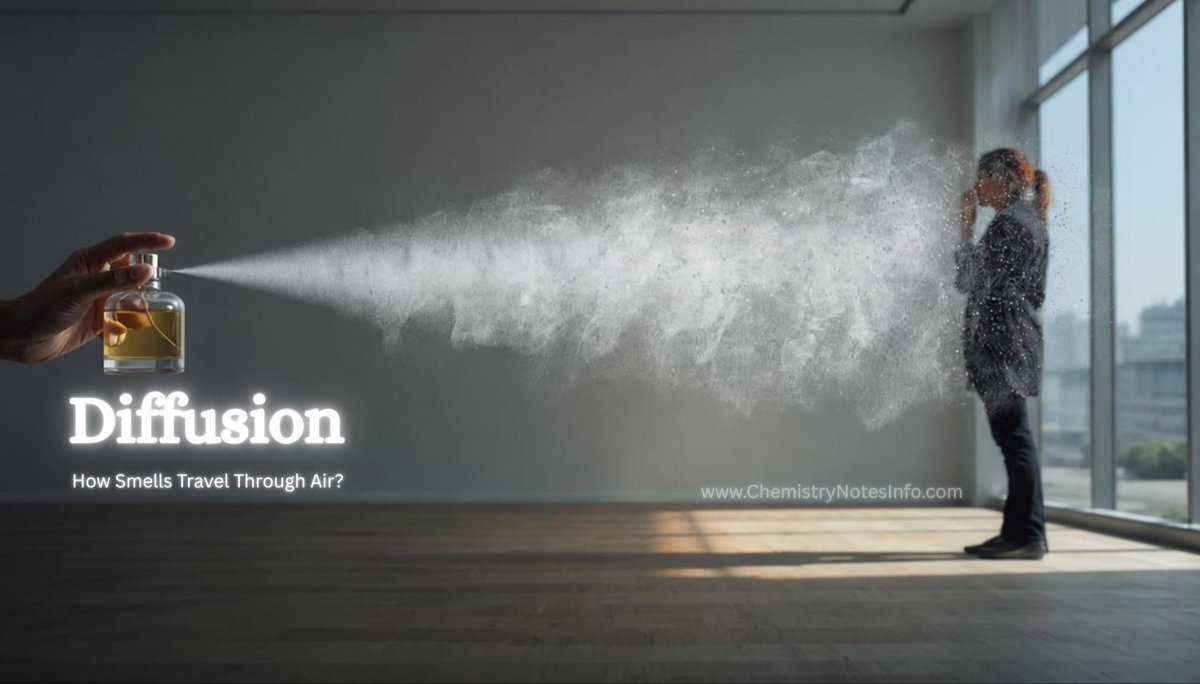
💨 Have you ever wondered why the smell of perfume spreads across an entire room within seconds? 🤔
This happens because of Diffusion —
chemistrynotesinfo.com/2026/…
#Diffusion #ScienceFacts #Chemistry #LearnScience #ChemistryNotesInfo #Science #curiosity #learning #study
1
31
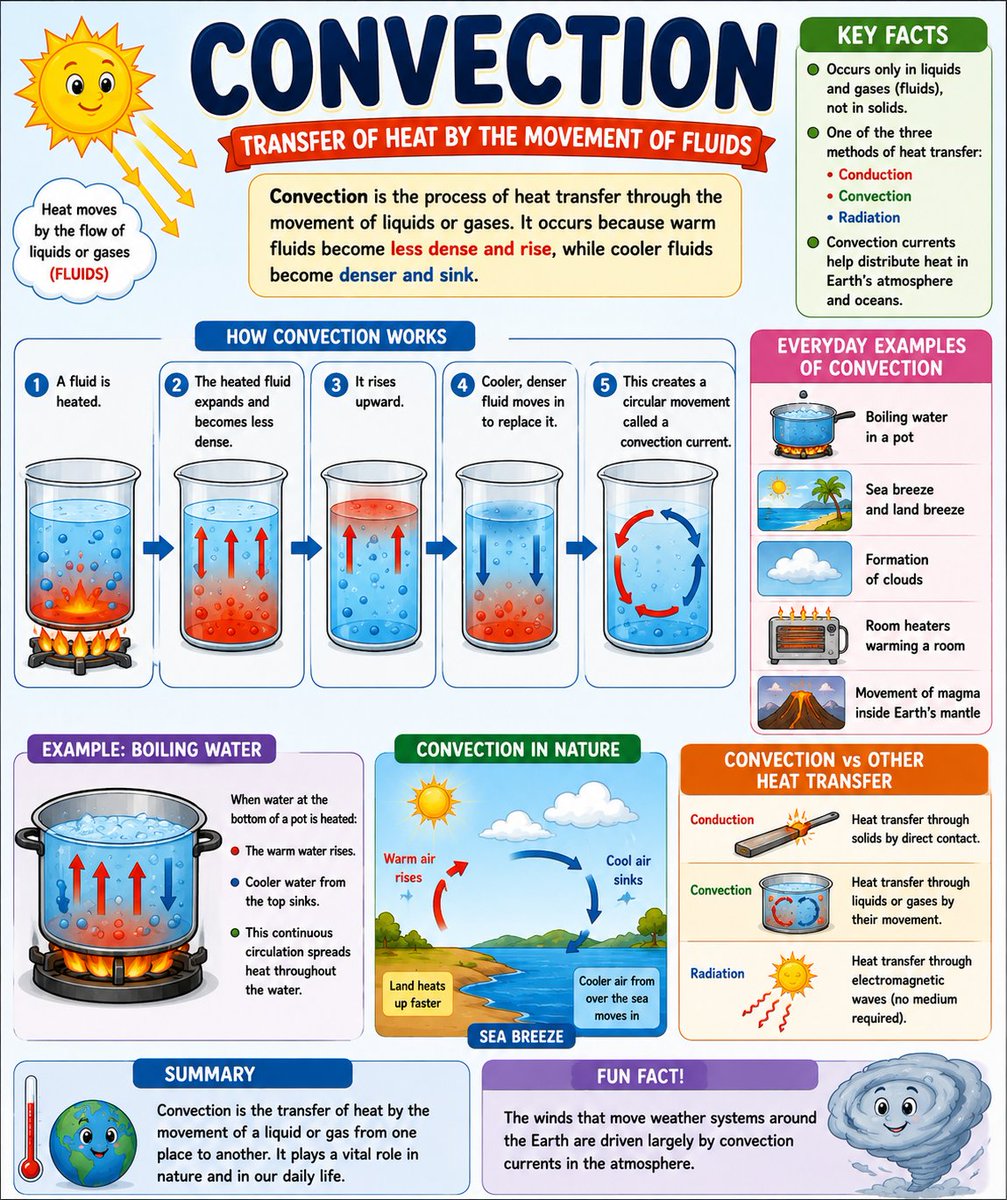
🌡️🌬️ CONVECTION – The Heat Transfer That Moves Our World! 🌍🔥
Have you ever wondered why hot air rises, sea breezes form, or water circulates while boiling? The answer is CONVECTION!
🔬 Convection is the transfer of heat through the movement of liquids and gases (fluids).
⚡ How does it work?
1️⃣ A fluid is heated.
2️⃣ It expands and becomes less dense.
3️⃣ The warm fluid rises.
4️⃣ Cooler, denser fluid sinks.
5️⃣ This creates a continuous circulation called a Convection Current.
🌎 Everyday Examples:
🍲 Boiling water in a pot
🌊 Sea and land breezes
☁️ Cloud formation
🔥 Room heaters warming a room
🌋 Movement of magma inside Earth's mantle
🌪️ Weather systems and wind patterns
📚 Did You Know?
Convection currents in Earth's atmosphere help drive weather patterns and distribute heat around the planet!
🔥 Three Methods of Heat Transfer:
🧱 Conduction – Heat transfer by direct contact
🌬️ Convection – Heat transfer by movement of fluids
☀️ Radiation – Heat transfer by electromagnetic waves
💡 Fun Fact:
Without convection, many natural processes such as winds, ocean currents, and even plate tectonics would be very different!
🌟 Science is everywhere—from the boiling kettle in your kitchen to the movement of air across continents!
#Convection #HeatTransfer #Physics #Science #STEM #STEMEducation #ScienceEducation #PhysicsFacts #ScienceFacts #LearnScience #EducationalPoster #Thermodynamics #Energy #Heat #Temperature #Conduction #Radiation #Weather #Meteorology #EarthScience #ClimateScience #OceanCurrents #Atmosphere #Engineering #EngineeringScience #PhysicalScience #ScienceCommunication #ScienceForAll #STEMLearning #PhysicsTeacher #ScienceTeacher #Education #DistrictScienceCentre #GUJCOST #IndiaScience
@PhysicsWorld @APSphysics @AIP_HQ @CERN @NASAScience @NASAClimate @NOAA @WMO @NaturePortfolio @ScienceMagazine @SciAm @newscientist @UNESCO @UN @theNASEM @NSF @RoyalSociety @InstituteofPhysics @IEEEorg @ASMEorg @MIT @Stanford @Harvard @Caltech @WorldScienceDay @Britannica @NatGeo @KhanAcademy @NobelPrize
🌍🔬 "The same convection currents that boil water in your kitchen also help shape Earth's weather and oceans!"
9
39
931
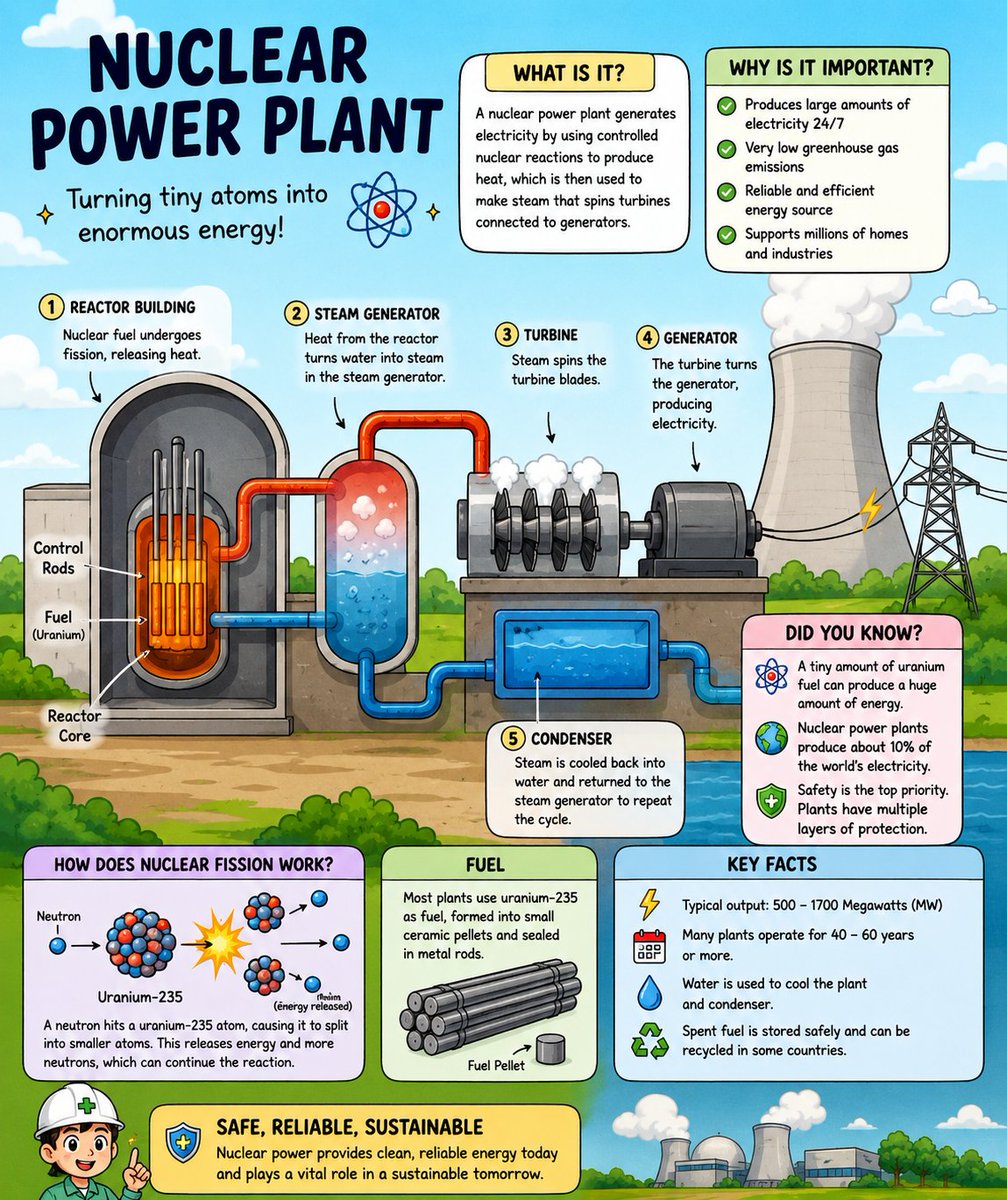
⚛️🔋 NUCLEAR POWER PLANTS: Turning Tiny Atoms into Massive Energy! 🔋⚛️
Did you know? A small amount of uranium fuel can generate enormous amounts of electricity through a process called nuclear fission! 🌟
🔹 Produces large amounts of electricity 24/7
🔹 Very low greenhouse gas emissions
🔹 Reliable baseload power source
🔹 Helps meet growing energy demands
🔹 Supports industries, hospitals, homes, and research facilities
⚡ How it works:
1️⃣ Uranium atoms split in a controlled reaction.
2️⃣ Heat is released.
3️⃣ Water turns into steam.
4️⃣ Steam spins turbines.
5️⃣ Generators produce electricity.
🌍 Nuclear energy currently supplies about 10% of the world's electricity and plays an important role in reducing carbon emissions.
🔬 Science Engineering Innovation = Sustainable Energy Future
What do you think will be the future of clean energy: ☀️ Solar, 🌬️ Wind, ⚛️ Nuclear, or a combination of all three?
#NuclearPower #NuclearEnergy #STEM #Science #Physics #Engineering #Technology #Energy #CleanEnergy #Electricity #PowerPlant #NuclearFission #Uranium #RenewableEnergy #FutureEnergy #EnergySecurity #ClimateAction #ScienceEducation #LearnScience #ScienceFacts #PhysicsFacts #EngineeringMarvels #Innovation #Sustainability #GreenEnergy #Education #ScienceCommunication #STEMEducation #CartoonScience #DistrictScienceCentre
@IAEAorg @WorldNuclearOrg @ANS_org @ENERGY @UNESCO @UN @NuclearEnergyAgency @CERN @NASAScience @IEEEorg @ASMEorg @theNASEM @ScienceMagazine @NaturePortfolio @physicsworld @SciAm @newscientist
26
37
503
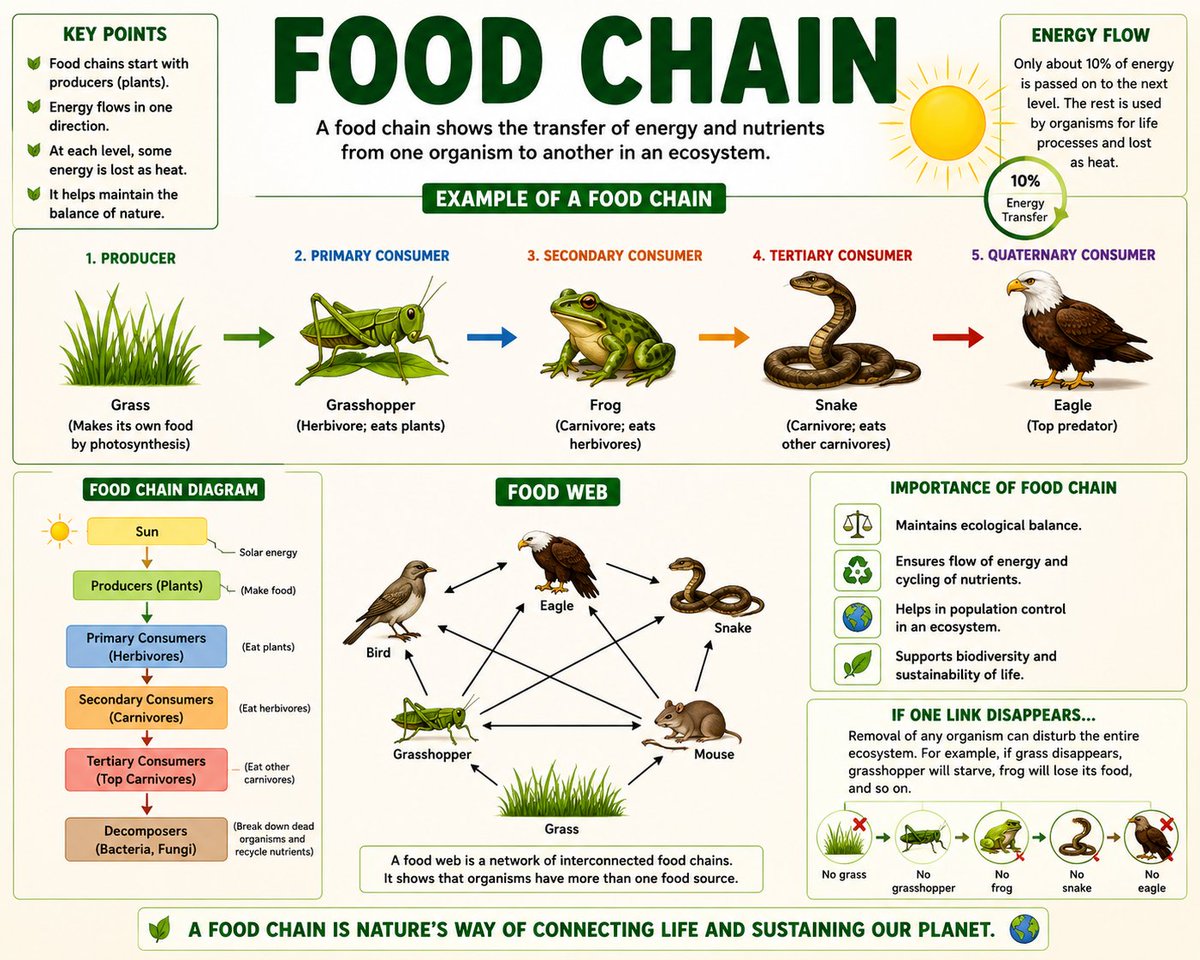
🌱🧠 FOOD CHAIN – THE CYCLE OF LIFE IN ECOSYSTEMS 🌍✨
Discover how energy flows through nature in a simple yet powerful way! 🔁
From 🌞 Sun → 🌿 Producers → 🦗 Consumers → 🐸 🐍 🦅 Top Predators → 🍄 Decomposers
every organism plays a vital role in maintaining ecological balance. ⚖️
📌 KEY SCIENTIFIC CONCEPTS:
✔️ Producers make food through photosynthesis 🌿
✔️ Energy flows in one direction 🔋
✔️ Only ~10% energy transfers to next level ⚡
✔️ Decomposers recycle nutrients back to soil 🍂
✔️ Food webs show multiple feeding relationships 🕸️
🌎 WHY IT MATTERS:
✔️ Maintains ecosystem balance
✔️ Supports biodiversity 🐝🦋🐦
✔️ Ensures survival of all living organisms
✔️ Helps in nutrient cycling ♻️
💡 A food chain shows how every living thing is connected in nature!
#FoodChain #Ecosystem #ScienceEducation #Biology #STEM #EnvironmentalScience #NatureLovers #SaveEarth #Ecology #FoodWeb #LearnScience #StudySmart #Education #SchoolLearning #BiologyPoster #SciencePoster #GreenPlanet #EarthDayEveryDay #KnowledgeIsPower #Sustainability #ClimateEducation #Biodiversity #Students #Teachers #LearningEveryday
@students @teachers @educators @biologylovers @scienceenthusiasts @schools @ecoactivists @environmentalists @learnercommunity @academicworld @naturelovers
5
6
126
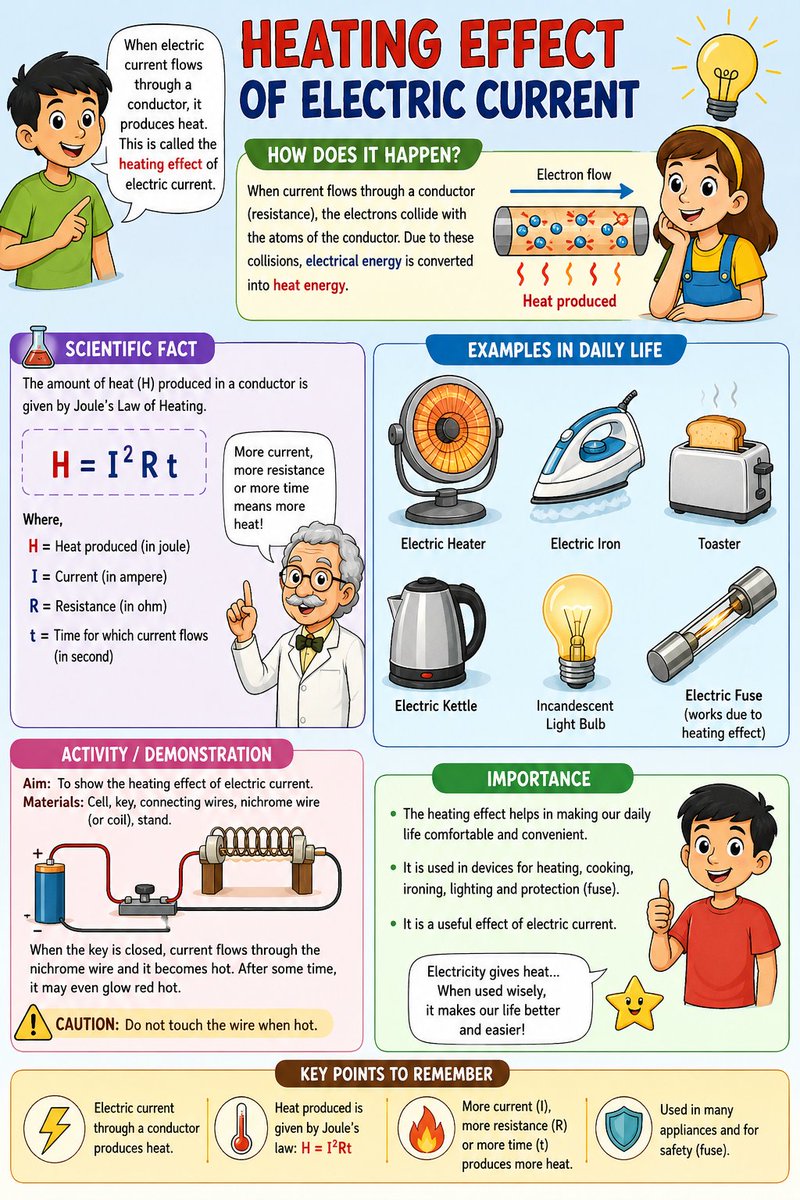
🔥⚡ HEATING EFFECT OF ELECTRIC CURRENT ⚡🔥
Electric current is not just flow of charge — it also produces HEAT when it passes through a conductor! This is called the Heating Effect of Electric Current.
💡 When current flows through a resistance, electrical energy converts into heat energy
📌 Based on Joule’s Law: H = I²Rt
⚡ More current, more resistance, or more time = more heat produced
🏠 Real-life applications:
• Electric heater
• Electric iron
• Toaster
• Electric kettle
• Fuse (safety device)
🔬 Science Fact: This principle is widely used in household appliances and electrical safety systems!
#Physics #Science #Electricity #HeatingEffect #JoulesLaw #Education #STEM #ScienceProject #SchoolLearning #EdTech #SciencePoster #LearnScience #ElectricCurrent #KnowledgeIsPower #StudyHard #StudentLife #ScienceExperiment
@science @physics @education @students @teachers @edtech @school @learning @stem @engineering @sciencefacts @studygram @physicsworld @sciencecommunity @incredibleindia
2
27
605
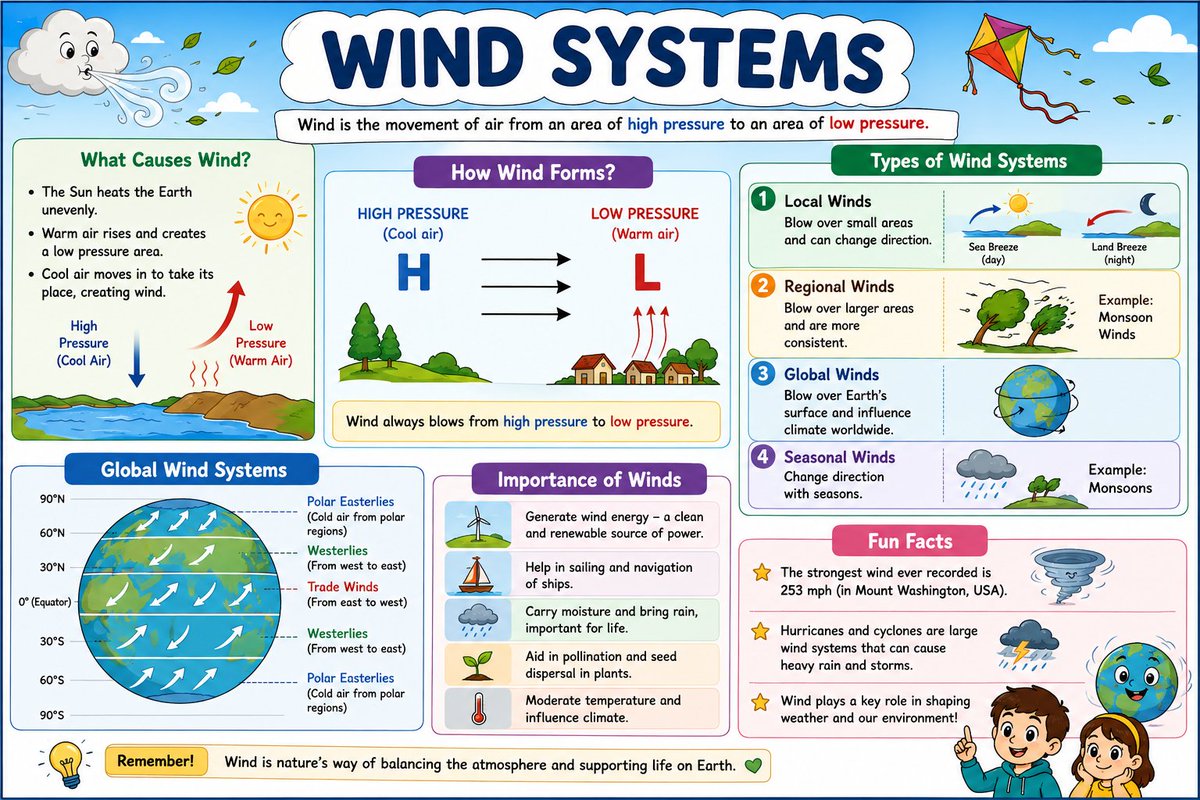
🌍💨 WIND SYSTEMS: The Invisible Force Shaping Our Planet! 💨🌍
Have you ever wondered why the wind blows? 🤔
Wind is the movement of air from high-pressure areas to low-pressure areas, helping regulate Earth's climate, distribute heat, bring rainfall, and even generate clean energy! ⚡🌦️🌱
🌬️ Learn about:
✅ How wind forms
✅ Local Winds (Sea Breeze & Land Breeze)
✅ Regional Winds (Monsoons)
✅ Global Wind Systems (Trade Winds, Westerlies & Polar Easterlies)
✅ Importance of Wind in Climate and Daily Life
✅ Amazing Wind Facts
🔬 Wind is not just moving air—it is a powerful force that influences weather, ecosystems, agriculture, transportation, and renewable energy across the globe.
📚 Perfect for students, teachers, science enthusiasts, competitive exam aspirants, and curious minds!
👉 Save this infographic for future reference.
👉 Share it with your students and friends.
👉 Follow for more exciting science content.
💬 Question: Which wind system has the biggest impact on your region's weather? Tell us in the comments!
#WindSystems #Wind #Atmosphere #EarthScience #Geography #Meteorology #ClimateScience #Weather #Climate #Monsoon #TradeWinds #Westerlies #PolarEasterlies #ScienceEducation #STEM #STEMEducation #ScienceFacts #ScienceCommunication #LearnScience #GeographyTeacher #ScienceTeacher #SchoolScience #EnvironmentalScience #RenewableEnergy #WindEnergy #Sustainability #ClimateAwareness #WeatherFacts #Education #KnowledgeSharing #ScienceForAll #StudentLife #TeacherLife #CompetitiveExams #UPSC #GSET #NETExam #CommunityScienceCentre #GUJCOST #ScienceLearning
@GUJCOSTOfficial @IndiaDST @EduMinOfIndia @NCERT_India @AICTE_INDIA @ISROIn @UNESCO @UNICEF @WorldMeteorologicalOrganization @NASAClimate @NOAA @STEMLearning @ScienceMuseum @NationalGeographic @UNEnvironment @EarthDayNetwork
2
2
117
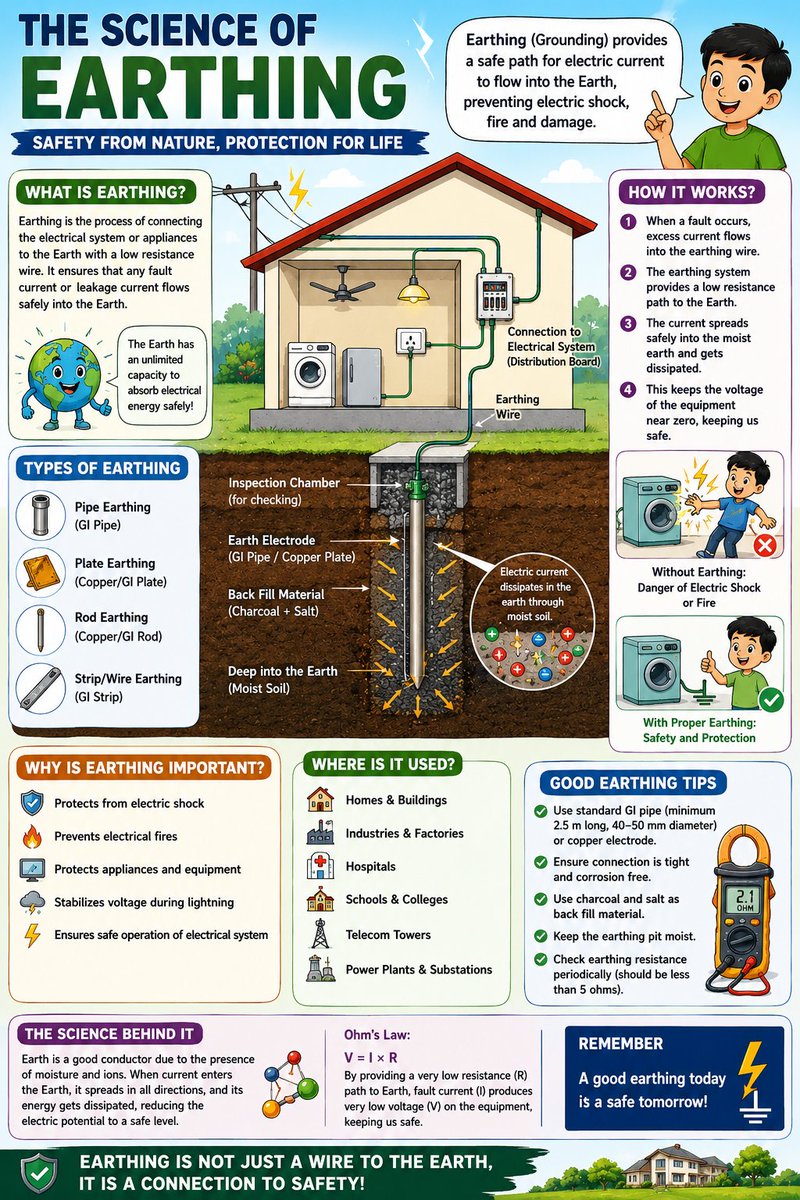
⚡🏠 THE SCIENCE OF EARTHING (GROUNDING) 🏠⚡
Have you ever wondered what protects us from electric shocks when using appliances at home? 🤔
The answer is EARTHING (GROUNDING) — one of the most important safety systems in electrical engineering!
🔬 How does it work?
✅ Provides a low-resistance path for fault current
✅ Safely transfers excess electricity into the Earth 🌍
✅ Prevents electric shocks ⚠️
✅ Protects appliances and equipment 🔌
✅ Reduces fire hazards 🔥
✅ Helps safeguard buildings during lightning strikes ⛈️
⚡ Science Behind It:
The Earth acts as a massive conductor and charge reservoir. When a fault occurs, electrical current follows the path of least resistance through the earthing system and dissipates safely into the ground.
🏠 Where is Earthing Used?
🔹 Homes & Apartments
🔹 Schools & Colleges
🔹 Hospitals
🔹 Factories & Industries
🔹 Telecom Towers
🔹 Power Stations & Substations
🔹 Data Centers & Laboratories
💡 Fun Fact:
A properly designed earthing system can save lives, protect expensive equipment, and prevent devastating electrical fires!
🔧 Science Engineering Safety = Reliable Electrical Systems
🌍 Earthing is not just a wire in the ground—it's a connection to safety!
@UNESCO @UNDP @UNEnvironment @WHO @UNICEF @NASA @NatGeo @SciAm @newscientist @IFLScience @physicsworld @IEEEorg @ASMEorg @theIET @EngineeringNews @IndiaDST @CSIR_IND @AICTE_INDIA @GUJCOST @VigyanPrasar
#Earthing #Grounding #ElectricalEngineering #Engineering #Electricity #ElectricalSafety #Science #STEM #Physics #OhmsLaw #EngineeringFacts #ScienceEducation #STEMEducation #ElectricalTechnology #HomeSafety #LightningProtection #ElectricalSystem #EnergySafety #Innovation #Technology #LearnScience #ScienceCommunication #FutureEngineers #EngineeringStudents #Infrastructure #SmartHomes #IndustrialSafety #DistrictCommunityScienceCentre #Navsari #Gujarat #India #ScienceForAll #ElectricShock #PowerSystems #RenewableEnergy #SafetyFirst
15
59
921
💧⚙️ HOW DOES A SUBMERSIBLE WATER PUMP WORK? ⚙️💧
Ever wondered how water is lifted from deep underground wells and borewells? 🤔
A Submersible Water Pump is a remarkable example of how Science Engineering Mechanics work together to deliver water efficiently!
🔹 Operates completely underwater 🌊
🔹 Uses centrifugal force to move water upward 🔄
🔹 Sealed motor prevents water damage 🛡️
🔹 High efficiency with low maintenance ⚡
🔹 Essential for agriculture, industries, homes, and water supply systems 🚜🏭🏠
🧪 The Science:
Rotating impellers increase water velocity, converting kinetic energy into pressure energy, pushing water upward through the delivery pipe.
⚙️ The Mechanics:
✅ Electric Motor
✅ Impellers
✅ Bearings
✅ Check Valve
✅ Waterproof Housing
Without pumps, modern agriculture, drinking water systems, and industries would be impossible!
💡 Science lifts ideas. Engineering makes them work. Technology brings them to life.
🌍 Water is life, and pumps help deliver it every day!
@UNESCO @UNWater @WHO @UNDP @UNEnvironment @NASA @ASMEorg @IEEEorg @WorldBank @NatGeo @newscientist @SciAm @IFLScience @physicsworld @EngineeringNews @GUJCOST @VigyanPrasar @IndiaDST @CSIR_IND @AICTE_INDIA
#SubmersiblePump #WaterPump #Engineering #MechanicalEngineering #Science #STEM #Technology #Physics #FluidMechanics #Hydraulics #WaterEngineering #Innovation #EngineeringLife #CivilEngineering #ElectricalEngineering #Agriculture #Irrigation #Groundwater #Borewell #WaterSupply #RenewableTechnology #ScienceCommunication #ScienceEducation #EngineeringFacts #STEMEducation #LearnScience #FutureEngineers #WaterConservation #DistrictCommunityScienceCentre #Navsari #Gujarat #India

18
58
1,224

Jun 2
Learn the basics of crystalline solids and understand why copper is an excellent conductor of electricity and heat.
.
.
#shorts #CrystallineSolids #Copper #Physics #Chemistry #Engineering #ScienceShorts #LearnScience #ElectricalEngineering #EducationalVideos
1
8
68
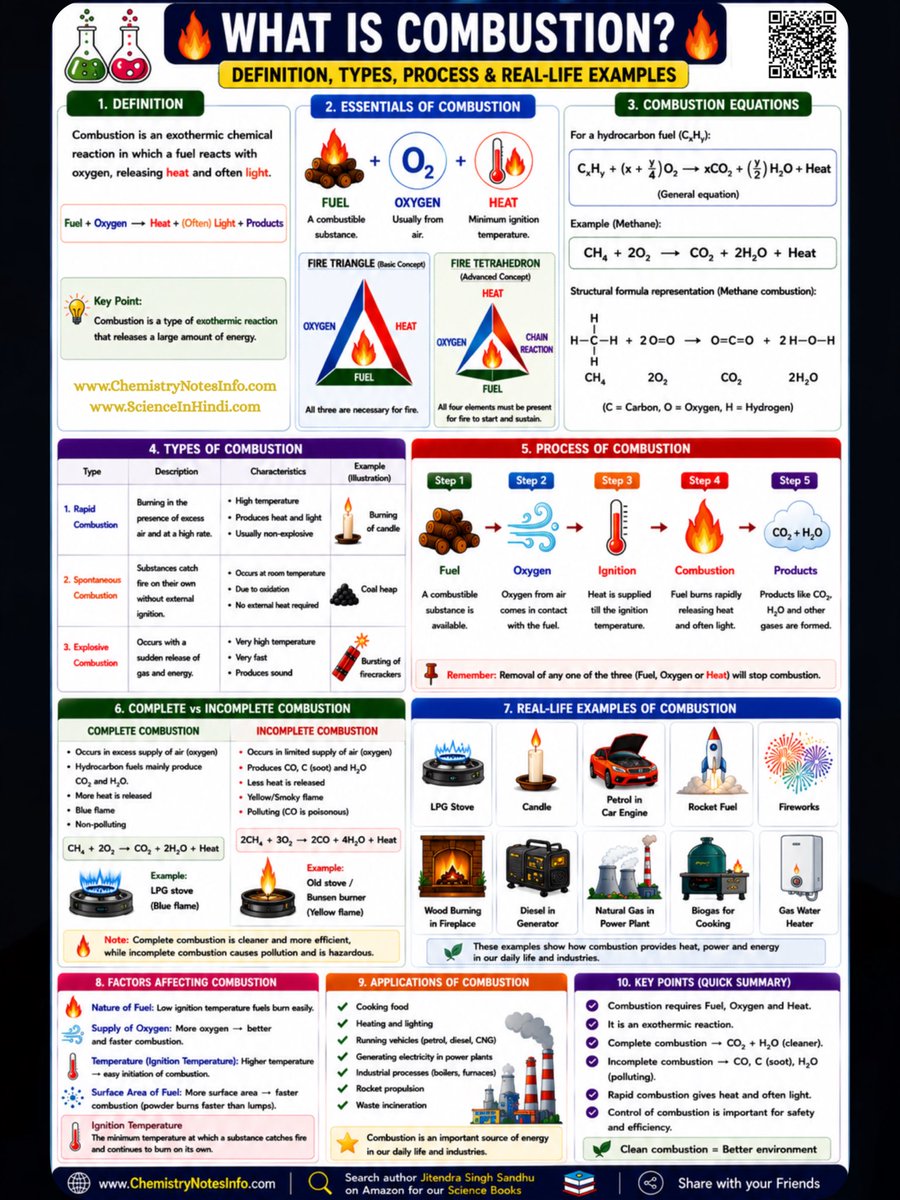
🔥 What keeps a fire burning? Why does a candle glow?
The answer is COMBUSTION — one of the most important chemical processes that powers our modern world! ⚗️⚡
🌐 chemistrynotesinfo.com/2025/…
#Chemistry #Combustion #ScienceEducation #ChemistryNotesInfo #LearnScience
1
2
63
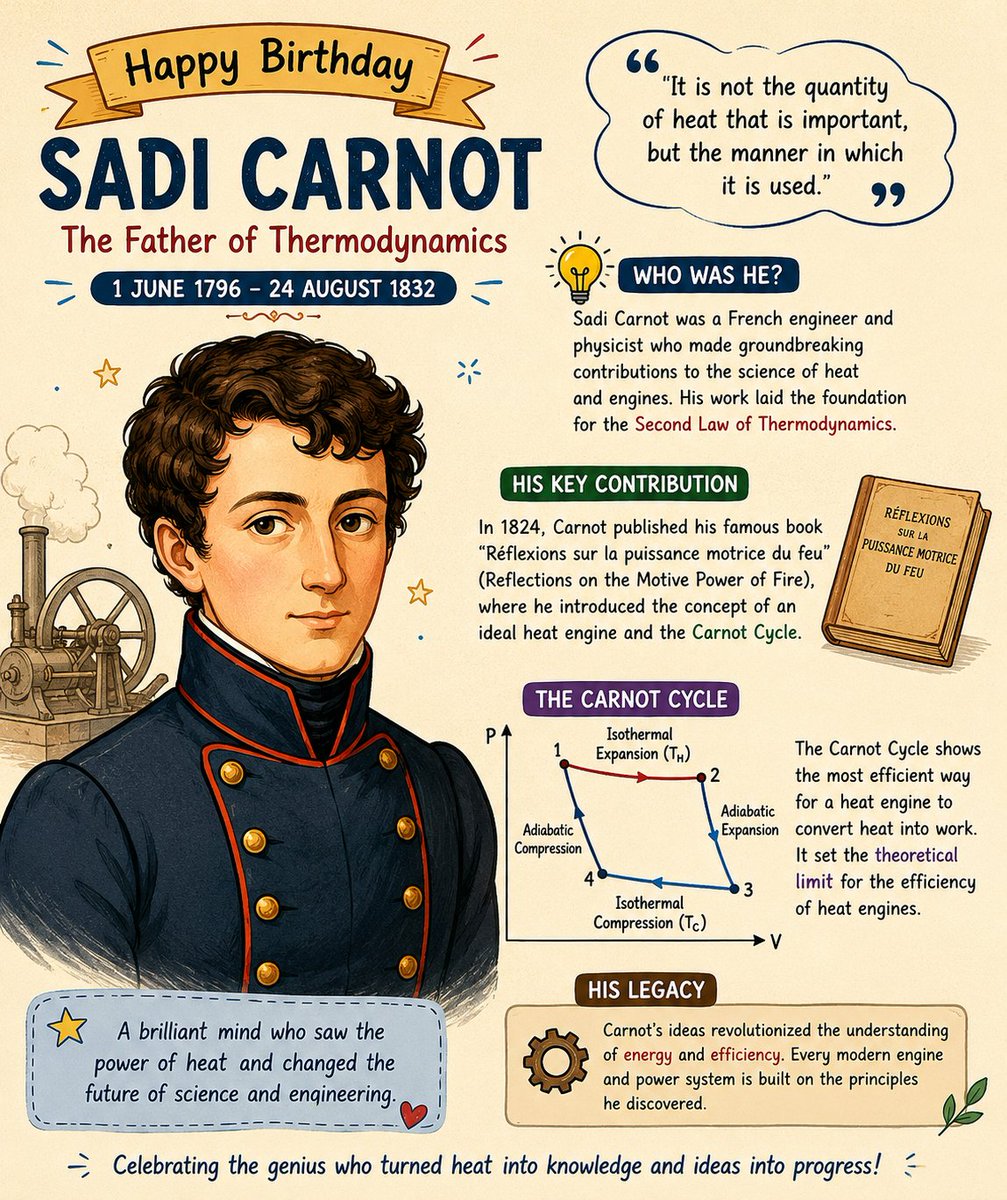
🎉 Happy Birthday to Sadi Carnot (1 June 1796) – the brilliant scientist known as the "Father of Thermodynamics"! 🔥⚙️
His groundbreaking work on heat engines and the Carnot Cycle laid the foundation for modern thermodynamics, power generation, and energy efficiency. Every power plant, engine, and refrigeration system owes something to his revolutionary ideas.
🌍 From steam engines to modern technology, Carnot's legacy continues to drive innovation and scientific progress.
🔬 Science Fact: The Carnot Cycle defines the maximum possible efficiency of any heat engine, setting a fundamental limit that engineers still use today!
#SadiCarnot #Thermodynamics #ScienceHistory #STEM #Physics #Engineering #HeatEngine #Energy #ScienceEducation #Innovation #Scientist #OnThisDay #ScienceCommunication #ScientificLegacy #ScienceForAll #LearnScience #PhysicsFacts #EngineeringMarvels #FutureScientists #Technology
@NASA @ESA @CERN @UNESCO @SciTechDaily @NewScientist @Nature @ScienceMagazine @PhysicsWorld @TheRoyalSociety
33
37
325
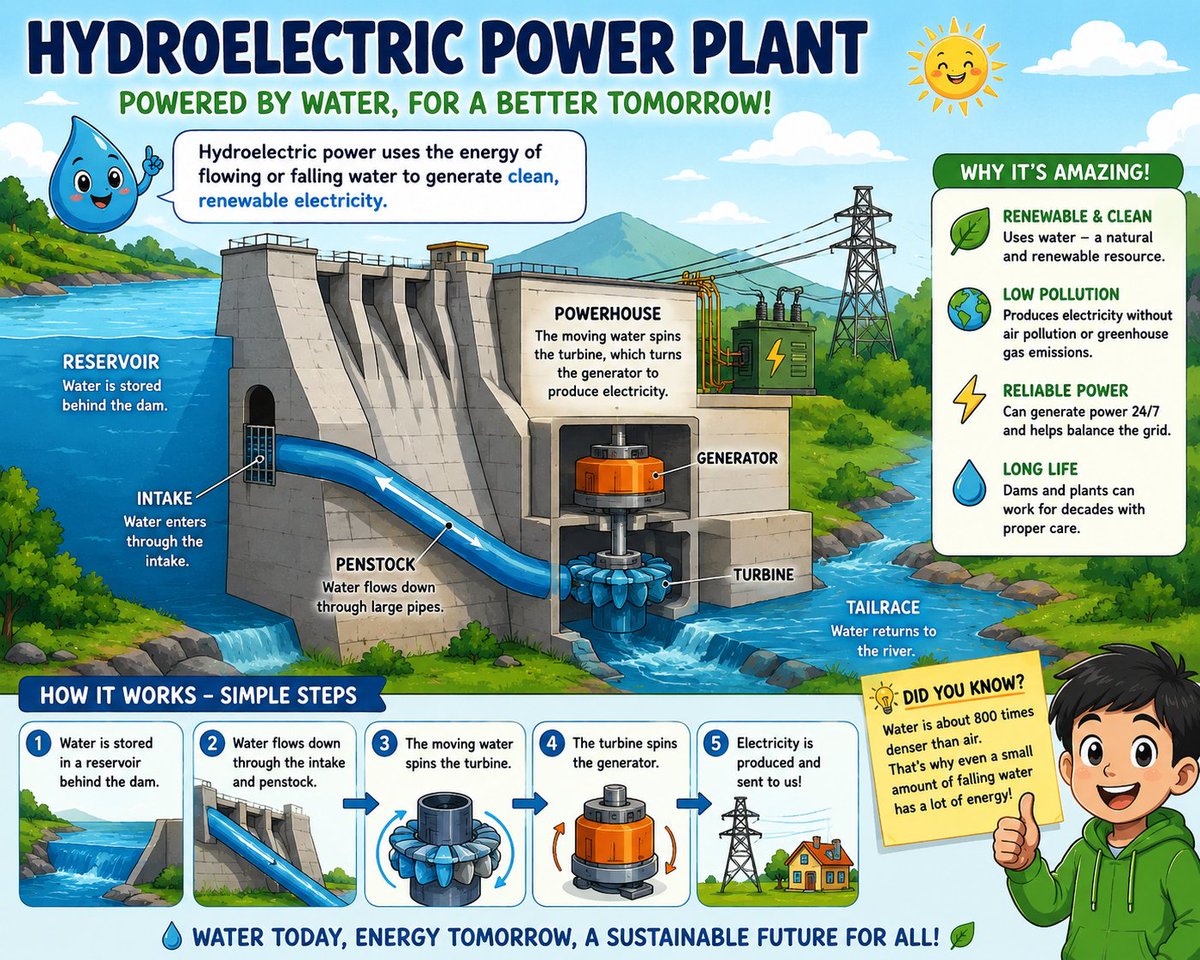
💧⚡ HYDROELECTRIC POWER: TURNING WATER INTO ELECTRICITY! ⚡💧
Did you know that falling water can power entire cities? 🌍🏙️
A hydroelectric power plant works by storing water behind a dam. When water flows through large pipes, it spins a turbine connected to a generator, producing clean electricity! 🔄⚙️⚡
✅ Renewable Energy
✅ Low Carbon Emissions
✅ Reliable Power Supply
✅ Long Plant Lifespan
✅ Supports Sustainable Development
🌊 Water → Turbine → Generator → Electricity ⚡
Hydropower is one of humanity's greatest engineering achievements, providing clean energy to millions while reducing dependence on fossil fuels. 🌱🌎
What other renewable energy technologies would you like to learn about? 🤔
@NASA @UN @UNESCO @IEA @WorldBank @NationalGeographic @ScienceChannel @Discovery @BBCScience @Nature @ScienceMagazine @MIT @Stanford @Harvard
#HydroelectricPower #Hydropower #RenewableEnergy #CleanEnergy #GreenEnergy #Electricity #PowerPlant #Engineering #Science #Technology #STEM #Physics #Generator #Turbine #Dam #WaterPower #Sustainability #ClimateAction #FutureEnergy #EnergyTransition #ScienceCommunication #ScienceEducation #LearnScience #Innovation #Environment #EcoFriendly #CleanFuture #STEMEducation #Energy #EarthScience #PhysicsLovers #EngineeringLife #RenewableResources #ScienceFacts #EducationalContent #GreenTechnology #SustainableDevelopment #ElectricPower #Hydrology #FutureOfEnergy #SaveThePlanet #CleanTech #EnergyEngineering #ScienceForEveryone #Knowledge #DidYouKnow #ExploreScience #InspiringScience #Water #Hydroelectricity
39
41
344
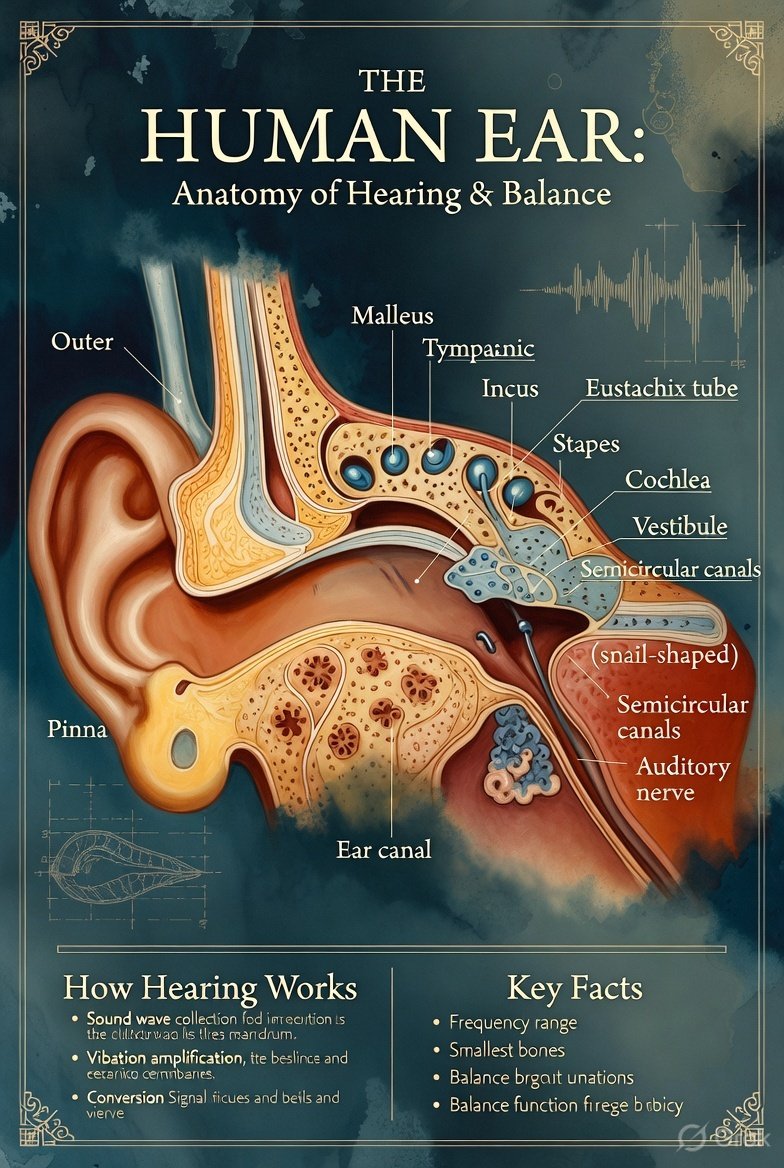
The Human Ear: Masterpiece of Nature’s Engineering 🎨
Discover the incredible anatomy of one of our most fascinating organs with this stunning scientific art poster!
From the elegant curves of the Pinna that capture sound waves, to the tiny ossicles (the smallest bones in your body), the spiral Cochlea, and the delicate Semicircular Canals that keep us balanced — every detail is beautifully illustrated in a classical painting style combined with precise scientific accuracy.
✨ Perfect for:
Science lovers & students
Medical & biology classrooms
Doctors, audiologists & ENT specialists
Anyone fascinated by how we hear and stay balanced
How Hearing Works:Sound waves → Pinna → Ear Canal → Eardrum → Ossicles → Cochlea → Auditory Nerve → Brain All happening in a fraction of a second!
Did You Know?
Your ear can detect frequencies from 20 Hz to 20,000 Hz
The three tiniest bones in your body are inside your middle ear
Your inner ear is also your balance control center
A perfect blend of Art Science for your wall, study room, clinic, or classroom!
Would you hang this in your space? Drop a ❤️ if you love science art!
#HumanEar #EarAnatomy #ScienceArt #Biology #Anatomy #MedicalIllustration #STEM #SciencePoster #Hearing #Neuroscience #ENT #BiologyLovers #ScienceEducation #EducationalArt #LearnScience #MedStudent #FutureDoctor #ScienceIsBeautiful #ArtMeetsScience #ClassroomDecor #MedicalArt
@Science @NatGeo @KhanAcademy @WHO @TED @BBCNews @SciAm @DiscoverMag @BiologyMag @MedicalStudents @NeuroscienceNews @VisualScience
8
10
159
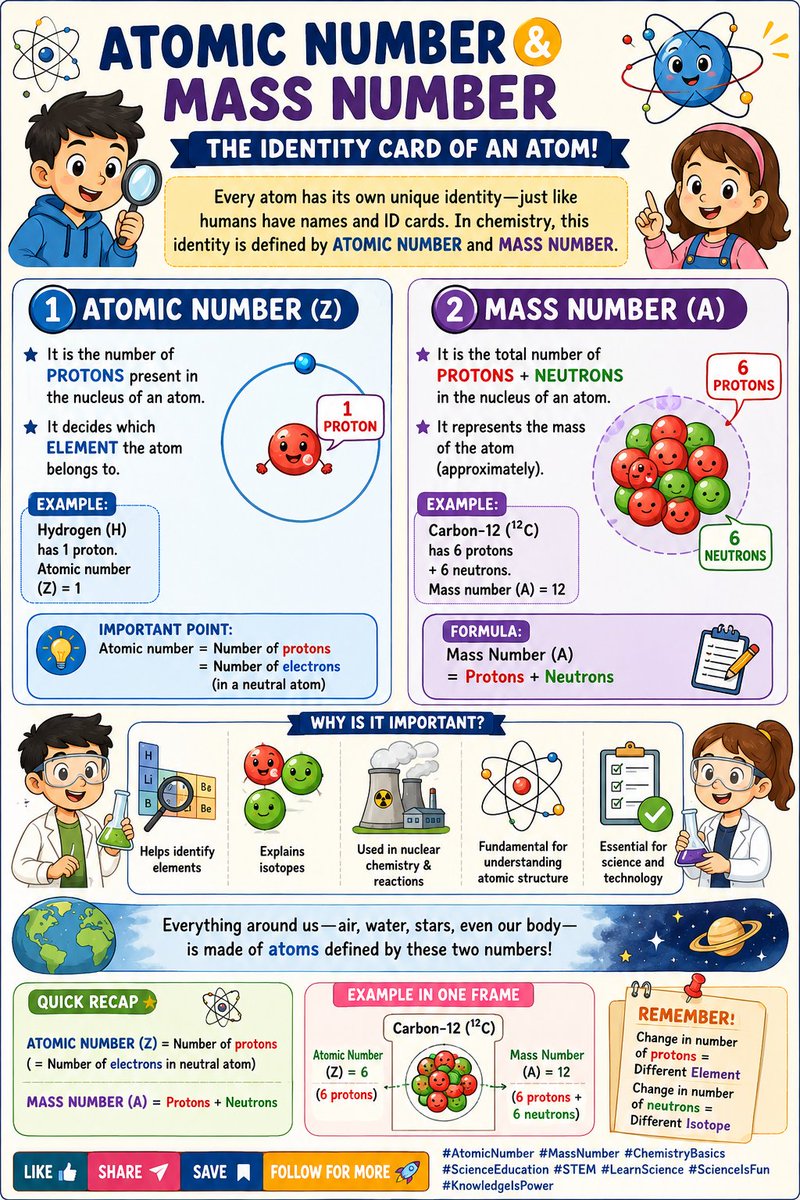
🧪⚛️ Atomic Number & Mass Number: The Identity Card of an Atom ⚛️🧪
Every atom in the universe has its own unique identity — just like humans have names and ID cards. In chemistry, this identity is defined by Atomic Number and Mass Number.
🔹 Atomic Number (Z)
➡️ It is the number of protons present in the nucleus of an atom.
➡️ It decides which element the atom belongs to.
➡️ Example: Hydrogen = 1 proton → Atomic number = 1
✨ Important point:
Atomic number = number of protons = number of electrons (in a neutral atom)
🔹 Mass Number (A)
➡️ It is the total number of protons neutrons in the nucleus.
➡️ It represents the mass of the atom (approximately).
➡️ Example: Carbon-12 → 6 protons 6 neutrons = Mass number 12
✨ Formula:
Mass Number (A) = Protons Neutrons
⚛️ Why is it important?
✔ Helps identify elements
✔ Explains isotopes
✔ Used in nuclear chemistry & reactions
✔ Fundamental for understanding atomic structure
🌍 Everything around us — air, water, stars, even our body — is made of atoms defined by these two numbers!
#AtomicNumber #MassNumber #ChemistryBasics #ScienceEducation #PhysicsAndChemistry #AtomicStructure #ScienceFacts #LearnScience #STEMEducation #ScienceIsFun #EduContent #KnowledgeIsPower #GujaratScience #SciencePost #STEMLearning
@students @teachers @scienceenthusiasts @educationworld @sciencecommunity @researchers @learners @curiousminds @futurescientists @chemistrylovers @physicslovers @academia @educationforall
12
14
182